TL;DR:
- Historical sword accuracy encompasses technique fidelity, weapon authenticity, and measurable strike precision, reflecting a multidimensional approach to realism. Evaluations differ based on sources, replica quality, and performance, making a single standard impossible; practitioners must consider these facets collectively for true understanding. Scientific analysis offers insights into wear patterns and manufacturing but cannot definitively confirm specific techniques, emphasizing the importance of combining evidence with practical experimentation.
Most people picture medieval sword fights as either balletic movie choreography or brutish hacking. Neither picture is accurate, and that gap is exactly what makes the question of what is historical sword accuracy so interesting. The phrase covers a lot of ground, from how faithfully a technique matches a 14th-century fight manual to how precisely a trained fencer can land a thrust on a measured target. This guide unpacks every layer of that question, drawing on surviving historical treatises, modern archaeology, and sport science, so whether you train or collect, you leave with a sharper understanding than you arrived with.
Table of Contents
- Key takeaways
- What is historical sword accuracy and why it defies a simple answer
- Reading the manuals: HEMA and the interpretation challenge
- Scientific methods and what they actually tell us
- Myths that distort your understanding
- Applying accuracy knowledge in real training and collecting
- My take: stop chasing one answer
- Explore historically accurate replicas at Propswords
- FAQ
Key takeaways
| Point | Details |
|---|---|
| Accuracy is multidimensional | Historical sword accuracy spans technique fidelity, weapon authenticity, and measurable strike precision, not just one standard. |
| Primary sources are incomplete | Medieval fight manuals like those of Liechtenauer and Fiore require inference, creating legitimate variation between schools. |
| Science measures, not confirms | Wear analysis and imaging verify blade use and quality but cannot fully confirm which specific techniques were executed. |
| Reenactment is not HEMA | Reenactment prioritizes spectacle and safety; HEMA prioritizes reconstructing real combat mechanics from historical texts. |
| Replicas matter for training | Choosing a replica with accurate geometry and balance directly affects how useful it is for studying historical sword techniques. |
What is historical sword accuracy and why it defies a simple answer
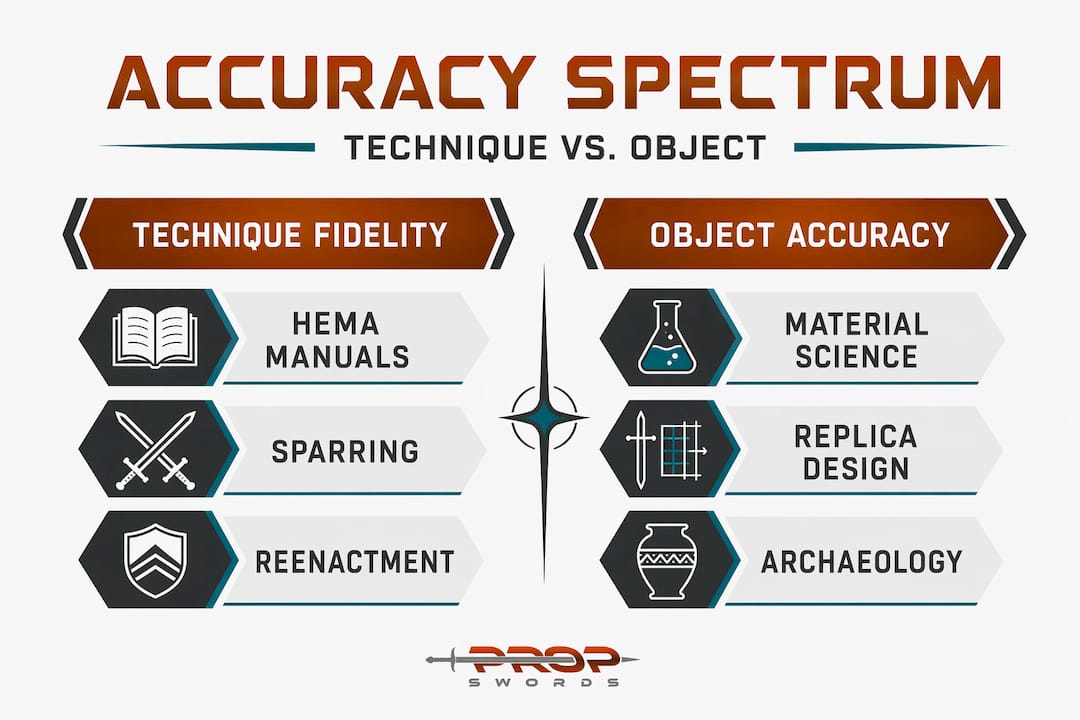
The industry term practitioners use is historical fidelity, which refers to how closely a technique, weapon, or reconstruction matches documented historical evidence. When people ask how accurate were swords and their associated techniques, they are usually conflating at least three separate questions. First, how well does a modern practitioner’s technique match what a historical fighter actually did? Second, how close is a given weapon replica to the original in materials and geometry? Third, how precisely can a trained swordsman place a strike on an intended target?
Each question demands a different method of evaluation, and none has a single clean answer. A longsword replica can be metallurgically identical to a 15th-century original, yet the person holding it might move in ways no medieval fighter would recognize. Conversely, a practitioner with deep knowledge of a historical manual might be working with a modern training sword that differs from the original in weight distribution. Historical sword accuracy is the intersection of all three, and understanding where each question ends and another begins is the first step toward answering any of them honestly.
Reading the manuals: HEMA and the interpretation challenge
Historical European Martial Arts, known as HEMA, is the clearest framework practitioners have for chasing technique-level accuracy. It relies on surviving fight manuals called fechtbücher, or fighting books, produced between roughly 1300 and 1600. The most studied are the teachings attributed to Johannes Liechtenauer and the Italian master Fiore dei Liberi. These texts describe guards, cuts, footwork, and grappling, but they do so in verse, allegory, and compressed notation that was designed for students who already had a foundation in the art.
Historical accuracy in sword practice varies by interpretation because the manuals leave significant gaps. A single illustration might show a guard position without specifying foot placement, weight distribution, or the exact angle of the blade. Different schools of HEMA practitioners fill those gaps through a combination of textual analysis, physical experimentation, and cross-referencing with other period sources. The result is a spectrum of interpretations, all claiming historical grounding, yet differing on details that would matter enormously in actual combat.
Here is what separates serious HEMA practice from theatrical reenactment:
- HEMA training uses protective gear and sparring drills to test techniques against resistance, so interpretations are pressure-checked rather than only theorized.
- Reenactors typically use dulled, lighter weapons and avoid targeting dangerous areas, which means their fight displays are choreographed for spectacle and safety rather than technique validation.
- HEMA groups publish their interpretations, critique each other’s work, and update conclusions when new manuscripts or translations surface.
- Reenactment groups may draw from HEMA research but subordinate technical accuracy to narrative and entertainment goals.
Pro Tip: If you are evaluating a HEMA school’s claim to historical accuracy, ask which specific manuscript they base their curriculum on and how they handle passages where the text is ambiguous. Vague answers suggest theatrical influence.
Scientific methods and what they actually tell us
Archaeology and materials science have added an objective layer to the accuracy question that no amount of textual interpretation can replicate. The most revealing approach is metalwork wear analysis, which examines patterns of scratching, notching, and polish loss on surviving blades. A 2025 Danish study demonstrated that wear pattern analysis on swords can identify distinct local fencing styles coexisting within a single culture, some blades showing wear consistent with thrusting-dominant technique and others showing slash-dominant patterns. This tells us that even within one region and era, swordsmanship was not monolithic.
That finding has a direct implication for how we define accuracy. There may not be one “correct” medieval German longsword technique. There may have been several, practiced side by side.
| Method | What it reveals | What it cannot confirm |
|---|---|---|
| Wear pattern analysis | Dominant strike types, local style variation | Exact footwork, tempo, or grip changes |
| Neutron imaging and CT | Blade composition, quenching quality, authenticity | Whether specific techniques were used with that blade |
| Electronic fencing targets | Strike precision and thrust accuracy in training | How training results compare to historical norms |
| Manuscript iconography | Guard positions, weapon types, opponent relationships | Dynamic movement between positions |
On the measurement side, a 2025 study showed that electronic-mechanical fencing targets produced significant improvement in thrust accuracy among juvenile fencers, giving coaches an objective metric for swordsmanship skill assessment. This kind of measuring sword accuracy tool is genuinely useful for tracking training progress, though it evaluates modern performance rather than historical fidelity directly.
Material science has its own important but limited role. Research published in 2025 on Japanese sword studies using neutron Bragg-edge imaging revealed crystallite size variations and quenching areas that authenticate a blade’s manufacturing process. Those findings confirm craftsmanship quality, but as the researchers note, material authenticity does not translate to confirmation of how the sword was actually wielded in combat.
“Measurable proxies such as wear pattern analysis and strike tracking can support, but do not fully establish, historical sword accuracy.” — Danish Journal of Archaeology, 2025
Myths that distort your understanding
Popular media has planted several misconceptions so deeply that even experienced enthusiasts carry them without realizing it. Clearing them up is not pedantry. It changes how you train, what you buy, and what you call accurate.
-
Medieval swords were heavy and slow. Studies consistently show medieval swords were light and manageable, with most single-handed arming swords weighing between 1.1 and 1.5 kilograms. A properly balanced longsword is nimble enough to be recovered and redirected faster than most people expect. The “heavy lump of metal” image comes from poorly reproduced stage props, not historical weapons.
-
Dual wielding was a standard combat style. Research shows dual wielding was rare and mostly limited to specific contexts, including certain Roman gladiatorial combats. In historical European martial arts, carrying a secondary weapon in the off-hand typically meant a buckler, dagger, or cloak, not a second sword.
-
Movie choreography reflects historical sword fighting techniques. Film fights are designed for camera angles and emotional readability. Attacks are telegraphed, defenses are exaggerated, and exchanges are prolonged for drama. A historically accurate exchange is often over in seconds, which is why the entertainment industry consistently abandons it.
-
Reenactment equals historical accuracy. Safety protocols in reenactment shape performance heavily. Reenactors modify their technique by avoiding lethal targets, pulling force, and choreographing sequences, all of which are necessary for safe performance but pull the result away from combat reality.
Pro Tip: When watching a film or stage fight for historical reference, focus on grip changes, half-swording, and murder stroke moments. Those details are harder to fake and sometimes survive even in popular media.
Applying accuracy knowledge in real training and collecting
Understanding the theory is worth little if it does not change what you do. For martial arts practitioners and collectors alike, historical weapon precision has concrete applications.
For training, your choice of sword matters more than most beginners realize. A blade with accurate geometry and period-correct weight distribution trains your mechanics correctly. A heavy, poorly balanced replica builds muscle memory that would have gotten a historical fighter killed. When selecting a training sword, cross-reference the historical sword reproduction guide to understand which manufacturing details affect handling and which are purely cosmetic.
The balance between historical fidelity and modern safety is real, and HEMA handles it honestly. Protective gear and controlled training environments mean that even the most rigorous practitioner is not fully replicating medieval combat. That is the right trade-off. The goal is to approximate historical technique closely enough that the skill you develop is genuinely informed by historical sources, not to recreate the lethality.
For collectors, accuracy has a different meaning. A display sword accurate to a 15th-century Oakeshott Type XVII original should match the original in blade profile, cross-section, fuller dimensions, and guard geometry. Use an expert collector’s checklist to evaluate replicas before purchasing. Many replicas look visually correct but deviate significantly in taper, distal geometry, and point of balance, the details that define how a sword moves in the hand.
The sword accuracy comparison between a functional trainer and a display replica also matters for anyone who trains and collects simultaneously. A sword built for display may have a blade that is too thick or too flexible to give realistic feedback in drilling.
My take: stop chasing one answer
I have spent years working at the intersection of historical research and sword collecting, and the most common mistake I see is the search for a single authoritative standard of accuracy. Someone reads one interpretation of Liechtenauer, treats it as the definitive version, and dismisses everything else. That approach misreads what the sources actually offer.
What I have learned is that historical sword accuracy is best understood as a spectrum with documented evidence at one end and informed reconstruction at the other. The most honest practitioners I have encountered are clear about where on that spectrum their work sits. They say “our interpretation of this guard is based on this manuscript passage and tested against this type of sparring” rather than “this is how it was done.”
My practical advice: prioritize sources. If a school or a vendor claims historical accuracy, ask what they are citing. A well-documented interpretation tested in sparring is worth ten undocumented ones, even if the undocumented version looks more dramatic on video. And if you are building a collection, accuracy in geometry and balance will serve you better long-term than accuracy in surface finish or aesthetic detail. The former shapes how you understand the weapon. The latter shapes how it photographs.
The research is evolving too. The 2025 wear analysis findings from Denmark changed how I think about regional variation in fencing styles. New manuscript discoveries and improved imaging technology will keep shifting the picture. Stay curious, hold conclusions loosely, and never stop reading primary sources.
— Muhammad
Explore historically accurate replicas at Propswords
If this article has changed how you think about what makes a sword accurate, the next step is putting that knowledge into your hands literally. At Propswords, the replica selection is built with collectors and practitioners in mind, not just display cases.

Whether you want a training sword with period-correct geometry or a display piece faithful to a specific historical type, the best replica swords of 2026 list gives you a vetted starting point with notes on balance, construction, and historical reference. For cosplayers and practitioners who need a replica that performs safely in motion, the safe replica preparation guide covers exactly what to check before you train. Free shipping within the USA makes it easy to start building a collection grounded in genuine historical accuracy.
FAQ
What does historical sword accuracy actually mean?
Historical sword accuracy refers to how closely a technique, weapon, or training method matches documented historical evidence, including surviving fight manuals, archaeological wear patterns, and period-correct weapon geometry. It is not a single standard but a combination of technique fidelity, weapon authenticity, and measurable strike precision.
Is HEMA more historically accurate than reenactment?
HEMA focuses on reconstructing real fighting techniques from primary sources and tests interpretations through sparring, making it more accurate in technique terms. Reenactment prioritizes storytelling and safety, which means techniques are often modified or choreographed rather than reconstructed from historical manuals.
Can science prove which sword techniques are historically accurate?
Science supports but cannot fully confirm historical accuracy. Wear pattern analysis reveals dominant strike types and local style variation, while materials imaging authenticates blade construction. Neither can confirm the exact footwork, timing, or tactical decision-making that defined historical sword fighting techniques.
Were medieval swords really as heavy as they look in movies?
No. Most single-handed medieval swords weighed between 1.1 and 1.5 kilograms, making them significantly lighter and more maneuverable than popular media suggests. The heavy, slow sword image comes largely from poorly made stage props rather than surviving historical weapons.
How do I choose a replica sword that reflects historical accuracy?
Look for replicas that match historical references in blade profile, taper, cross-section, and point of balance rather than just surface appearance. Cross-referencing an authentication guide for collectors helps identify which details actually affect handling and which are purely cosmetic.
Recommended