Recent Post

7 Iconic Sword Replicas Collectors and Cosplayers Love

How to Authenticate Replica Swords for Collectors

Role of Swords in Anime: Impact on Storytelling

Mastering the Art of Daggers: A Buyer's Guide

The Ultimate Guide to Bowie Knives for Outdoor Enthusiasts and Collectors

Everything You Need to Know About Damascus Knives
Leave a comment
How to Authenticate Replica Swords for Collectors
Finding a fantasy sword that truly matches your passion goes far beyond flashy designs and pop culture labels. For American collectors and cosplayers, the quest for authentic anime and fantasy-themed replicas demands a sharp eye for historical craftsmanship and genuine details. Understanding materials, signatures, and expert validation helps you avoid common pitfalls and build a collection rooted in accuracy and value. Get the proven strategies you need to confidently authenticate your next sword purchase.
Table of Contents
- Step 1: Assess Materials And Craftsmanship
- Step 2: Compare To Official References
- Step 3: Verify Maker Marks And Certificates
- Step 4: Inspect For Authentic Details
- Step 5: Confirm Authenticity With Experts
Quick Summary
| Key Point | Explanation |
|---|---|
| 1. Assess Materials and Craftsmanship | Examine blade construction to identify quality, focusing on materials and traditional techniques. |
| 2. Compare to Historical References | Validate authenticity by matching the sword’s features with established historical standards. |
| 3. Verify Maker Marks and Certificates | Document and validate markings and certificates for provenance to ensure authenticity. |
| 4. Inspect for Authentic Details | Look for unique craftsmanship details that distinguish authentic replicas from mass-produced ones. |
| 5. Confirm Authenticity with Experts | Engage with specialists for authoritative validation and deeper insights into the sword’s history. |
Step 1: Assess Materials and Craftsmanship
Authentic replica sword collectors know that understanding the materials and craftsmanship is critical to identifying a true masterpiece. When examining a potential sword, you’ll want to investigate several key characteristics that reveal its quality and historical accuracy.
Start by closely inspecting the blade’s construction. Historical swordsmithing techniques reveal crucial details about a sword’s authenticity. Look for these critical elements:
- Blade Material: Check for high-quality steel or appropriate historical alloys
- Forging Quality: Examine surface texture and signs of traditional metalworking
- Edge Characteristics: Assess sharpness, symmetry, and refinement
- Metal Layers: Investigate potential folding techniques used in traditional bladesmithing
The physical composition tells a rich story. A genuine replica will demonstrate careful attention to historical metalworking processes. Authentic swords typically showcase precise craftsmanship, with smooth transitions between blade sections and consistent metal grain patterns. Pay special attention to how the blade responds to light - quality replicas will have a subtle, even reflection that indicates careful forging.
Professional collectors know that true craftsmanship lies in the details invisible to casual observers.
Surface texture and metal composition provide significant insights into the sword’s manufacturing process. Examine the blade from multiple angles, looking for signs of traditional sword making techniques like controlled heating, precise hammering, and intentional metal layering.
Pro tip: Bring a small jeweler’s magnifying glass to your sword inspection to reveal microscopic details that separate authentic replicas from cheap imitations.
Step 2: Compare to Official References
Now that you’ve assessed your sword’s materials and craftsmanship, the next critical step is comparing it against official historical references. Collectors need a systematic approach to validate the authenticity and historical accuracy of their replica sword.
Sword identification guides provide crucial benchmarks for comparing replica details. Focus on these key comparative elements:
- Historical Period: Match design features with specific historical eras
- Blade Proportions: Compare blade length, width, and curvature against standard references
- Hilt Configuration: Examine handle design and ornamentation typical of specific cultures
- Metal Characteristics: Analyze metallurgical details against traditional manufacturing techniques
Careful comparison requires deep research. Professional collectors invest significant time studying medieval sword classifications to understand nuanced differences between authentic historical pieces and modern reproductions. Look beyond surface appearances and dig into technical details that reveal true craftsmanship.
The devil is in the details when distinguishing genuine replicas from mass-produced imitations.
Accumulate a personal reference library of historical sword documentation. Academic publications, museum catalogs, and specialized collector guides become invaluable tools in your authentication process. Cross-referencing multiple sources helps build confidence in your assessment.

Pro tip: Join online collector forums and sword history communities to access specialized reference materials and expert insights that aren’t publicly available.
Step 3: Verify Maker Marks and Certificates
Authenticity isn’t just about physical appearance - it’s also about documented provenance. In this crucial step, you’ll learn how to meticulously examine and validate the maker marks and certificates that can transform a simple replica into a certified collectible piece.
Antique sword identification guides provide essential strategies for verifying a sword’s legitimacy. Focus on these critical verification elements:
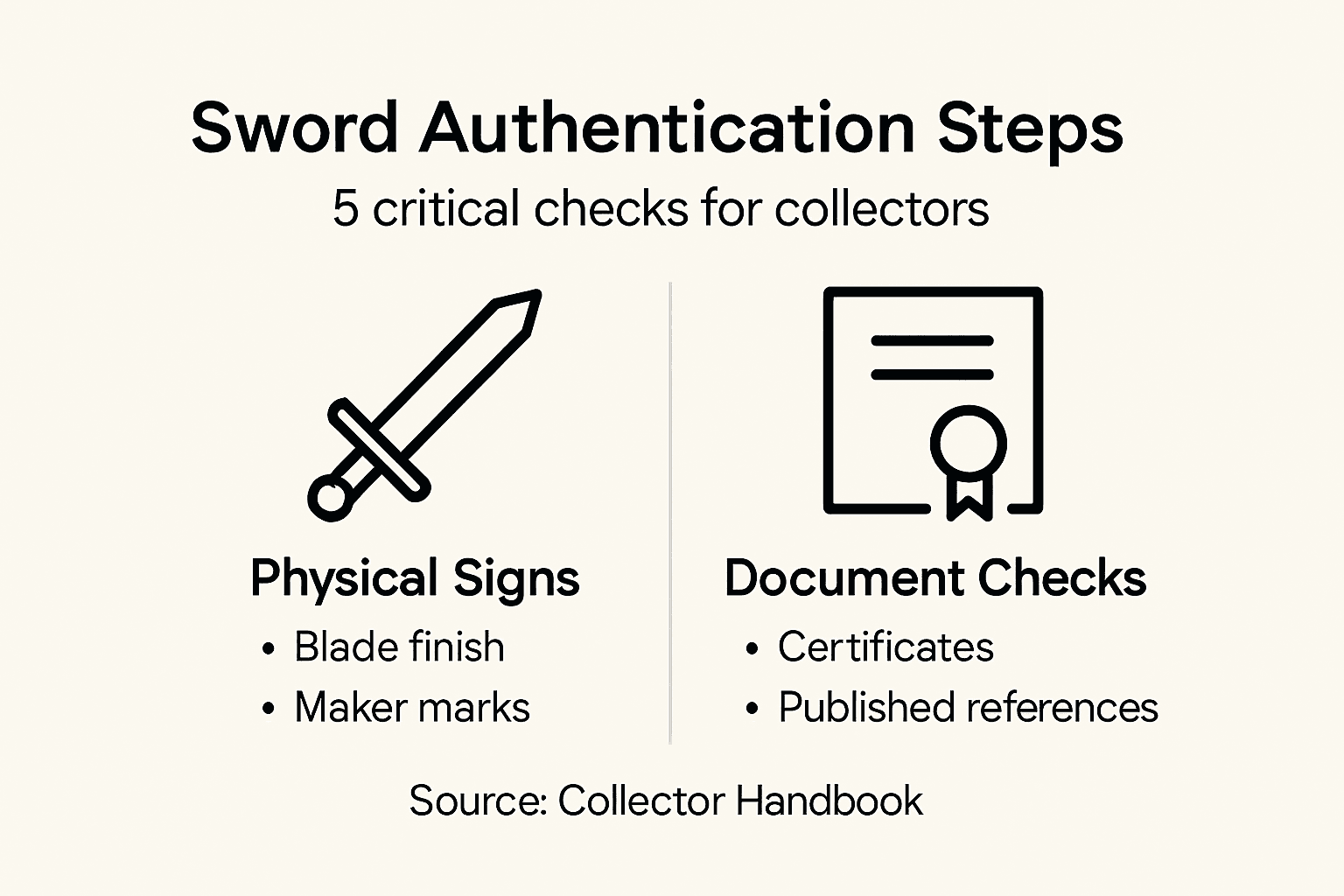
- Maker’s Marks: Look for distinctive stamps or engravings unique to specific manufacturers
- Certificate Details: Examine official documentation for completeness and authenticity
- Provenance Documentation: Trace the sword’s historical ownership and production lineage
- Signature Verification: Compare maker signatures against known reference samples
Thoroughness is key in authentication. Professional collectors understand that maker marks tell a complex story. Specialized mark databases offer incredible resources for cross-referencing and validating these intricate identifiers. Each mark represents a potential clue to your sword’s true origin and craftsmanship.
Not all maker marks are created equal - some whisper secrets, while others shout their legitimacy.
Develop a systematic approach to documentation verification. Collect high-resolution photographs of maker marks, compare them against multiple reference sources, and don’t hesitate to consult expert appraisers when uncertainty strikes. Authenticity is a nuanced art that rewards patient, methodical investigation.
Pro tip: Create a dedicated digital folder for storing high-quality images and scans of your sword’s marks and certificates to build a comprehensive authentication portfolio.
Step 4: Inspect for Authentic Details
Authentic sword replicas reveal their true character through meticulous examination of intricate details that mass-produced imitations often miss. In this step, you’ll develop a detective’s eye for the subtle nuances that distinguish genuine collectible pieces from ordinary reproductions.
Sword identification techniques demand a comprehensive visual investigation. Focus on these critical authentic details:
- Blade Etching: Examine precision and depth of historical markings
- Patina Development: Look for natural aging characteristics consistent with period
- Metalwork Quality: Assess intricate details in handle construction and blade finishing
- Historical Wear Patterns: Analyze natural signs of use and aging
Professional collectors understand that authenticity lives in the microscopic details. Historical arms documentation reveals that genuine replicas possess a complex language of craftsmanship that cheap imitations cannot replicate. Each imperfection tells a story of careful historical reconstruction.
Authenticity whispers its secrets to those patient enough to listen closely.
Develop a systematic approach to detail inspection. Use high-powered magnification, compare historical references, and train your eye to recognize the subtle differences between mass-produced replicas and meticulously crafted collector pieces. Remember that true authenticity is an art form that requires both knowledge and intuition.
Pro tip: Invest in a professional jeweler’s loupe with at least 10x magnification to reveal the microscopic details that separate exceptional replicas from ordinary imitations.
Step 5: Confirm Authenticity with Experts
Even the most experienced collectors reach a point where professional expertise becomes essential. This final step transforms your personal investigation into a definitive authentication process by engaging with recognized specialists who can provide authoritative validation.
Arms collector networks offer critical resources for expert authentication. Consider these strategic approaches to professional verification:
- Expert Selection: Identify certified arms historians and sword authentication specialists
- Documentation Preparation: Gather all collected research, photographs, and initial assessments
- Consultation Methods: Explore in-person evaluations, digital submissions, and specialized review services
- Professional Testing: Request metallurgical analysis and provenance research
Professional collectors understand that expert confirmation is the gold standard of authentication. Detailed appraisal techniques involve comprehensive assessments that go far beyond visual inspection, including archival research and specialized historical context evaluation.
True authentication is a dialogue between your research and an expert’s deep knowledge.
Develop a strategic approach to expert consultation. Research specialists with demonstrated expertise in your specific sword’s historical period, cultural origin, or manufacturing style. Prepare comprehensive documentation, be open to additional research recommendations, and understand that professional validation might reveal unexpected insights about your replica.
Pro tip: Budget for professional authentication as an investment - a $200-$500 expert evaluation can potentially validate a sword worth thousands or save you from purchasing a fraudulent replica.
Key benefits of a systematic sword authentication process:
| Step | Main Benefit | Added Value |
|---|---|---|
| Materials Assessment | Spots poor-quality imitations | Ensures durability |
| Reference Comparison | Confirms historical accuracy | Enhances collection |
| Mark & Certificate Checks | Verifies manufacturing origin | Supports resale value |
| Detail Inspection | Identifies subtle craftsmanship | Reveals artistry |
| Expert Confirmation | Provides authoritative validation | Builds investment trust |
Here’s how traditional and modern replica authentication methods compare:
| Method | Traditional Approach | Modern Replica Authentication |
|---|---|---|
| Material Analysis | Visual/grain pattern checks | High-magnification, alloy tests |
| Reference Comparison | Physical catalogs, museums | Online databases, expert forums |
| Mark Verification | Signature books, archives | High-res imaging, digital records |
| Expert Validation | In-person appraisals | Digital consultations, remote labs |
Elevate Your Collection with Verified Authentic Replica Swords
Authenticating replica swords requires sharp attention to materials, maker marks, and expert confirmation, as outlined in the comprehensive guide on identifying genuine collectibles. If you are passionate about owning swords that truly reflect craftsmanship and historical accuracy, let your next acquisition be both stunning and trustworthy. At Propswords, we understand the challenges collectors face with imitations and uncertain provenance. That is why we offer a curated selection of high-quality replica swords inspired by anime, movies, Vikings, and history — each crafted to meet exacting standards that resonate with serious enthusiasts.
Discover swords with authentic detail, designed to meet the expectations of discerning collectors and cosplayers alike. Take advantage of our free shipping within the USA and exclusive discounts now to secure your next prized replica. Visit Propswords today and explore replicas where craftsmanship and passion come alive. Start building your collection with confidence and elevate your appreciation for genuine artistry.
Frequently Asked Questions
How can I assess the materials and craftsmanship of a replica sword?
To assess the materials and craftsmanship of a replica sword, closely inspect the blade’s construction, including the blade material, forging quality, and edge characteristics. Look for high-quality steel and evidence of traditional metalworking techniques. Examine these elements using a jeweler’s magnifying glass for detailed analysis.
What should I compare a replica sword against to verify its authenticity?
Compare a replica sword against official historical references, such as sword identification guides. Pay close attention to the historical period, blade proportions, and hilt configuration, and ensure they align with documented standards from the relevant era.
How do I verify maker marks and certificates for a replica sword?
To verify maker marks and certificates, carefully examine the sword for distinctive stamps or engravings, and check the completeness and authenticity of accompanying documentation. Collect high-resolution photos of any maker marks and compare them against established databases to confirm their legitimacy.
What specific details should I inspect to determine a sword’s authenticity?
Inspect the blade etching, natural patina development, and the quality of metalwork in the handle and blade. Look for signs of wear consistent with historical use, as these details can help distinguish authentic replicas from mass-produced imitations.
When should I consult an expert for sword authentication?
Consult an expert when you’re unsure about your assessment or if you want definitive validation. Prepare a comprehensive portfolio of your research, photographs, and initial assessments before seeking a professional’s opinion to ensure a thorough evaluation.
What are the benefits of following a systematic process for sword authentication?
A systematic process for sword authentication helps identify poor-quality imitations, confirms historical accuracy, and verifies the sword’s manufacturing origin. This thorough approach also enhances your collection’s overall value and builds your investment trust.