TL;DR:
- Viking swords are valued for their balance, flexible construction, and double-edged design, which remain relevant today. High-quality replicas replicate these features, offering authentic handling, striking appearance, and collector appeal for display, cosplay, or reenactment. Proper selection and care based on steel type, construction, and intended use ensure safety, durability, and long-term enjoyment of these historic-inspired weapons.
Viking swords were prized for three reasons that still matter today: exceptional balance, composite construction that combined flexibility with edge-holding, and a double-edged geometry that worked from either side without reorienting your grip. A well-made replica captures all three. For display, cosplay, or light reenactment, those same engineering choices translate into a sword that handles naturally, photographs beautifully, and holds its value as a collector piece.
The core advantages at a glance:
- Balance and weight: Historical examples typically weighed 2–4 lbs, with many closer to 2.3 lbs — light enough for one-handed use alongside a shield, comfortable for long costume wear
- Pattern-welded construction: Soft-iron cores wrapped in harder steel edges gave blades flexibility without brittleness; replicas with Damascus-style finishes echo this visually and add display appeal
- Double-edged design: Both edges were sharp, so strikes landed cleanly from either side — no grip adjustment needed, which matters in choreography and stage combat
- Cultural status: Swords were expensive heirlooms in Viking society; decorated replicas carry that same prestige signal for collectors
TL;DR: A Viking-style replica is an excellent choice for display, cosplay, or reenactment when you prioritize authentic handling feel, visual drama, and long-term collector value.
Table of Contents
- What made Viking swords so effective in battle?
- How historical advantages translate to modern replicas
- What should you check before buying a Viking replica?
- Authenticity versus practicality: which matters more for you?
- How to care for and store a replica Viking sword
- How did Viking swords compare to axes and spears?
- What fighting styles did Viking swords favor?
- Why the Viking sword’s design excelled in cutting and thrusting
- Key Takeaways
- A perspective on what actually matters when buying a replica
- Propswords has Viking replicas matched to your purpose
- Useful sources
- FAQ
What made Viking swords so effective in battle?
The engineering behind a Viking sword was not accidental. Smiths in the 8th–11th centuries worked with composite construction because no single material did everything well. The solution was pattern welding: twisting and welding multiple iron types into a core, then adding hardened steel strips along the cutting edges. The result was a blade that flexed under stress rather than snapping, while still holding a sharp edge through extended use.
The fuller, that broad shallow groove running down the center of the blade, is often misnamed a “blood groove.” Its actual job: remove mass without sacrificing stiffness. Less weight toward the tip shifts the balance point closer to the hilt, making the sword feel nimble rather than front-heavy. The pommel on the opposite end acts as a counterweight, completing the balance equation.
Measured specs: what historical swords actually looked like
| Feature | Typical Range | Well-Preserved Example |
|---|---|---|
| Overall length | 89–100 cm | 89 cm |
| Blade length | 70–90 cm | 77 cm |
| Blade width | 4–5 cm | ~5 cm |
| Total weight | 2–4 lbs (typically 2–2.3 lbs) | 2.3 lbs |
| Balance point | Near the hilt | Extraordinary in-hand feel |
Compared to later medieval longswords, which often ran heavier and required two hands, Viking swords were built for speed and one-handed use. The shield held the other hand. That constraint shaped everything: shorter grip, lighter blade, balance tuned for quick cuts rather than powerful two-handed blows.
How historical advantages translate to modern replicas
The balance characteristics that made Viking swords deadly in a shield wall make replicas genuinely pleasant to handle. A well-balanced replica sits naturally in one hand, which matters when you’re wearing a full costume for six hours at a convention. Replicas that reproduce the fuller correctly keep weight down and reduce wrist fatigue during photo shoots or choreographed sequences.
Damascus-style finishes on modern replicas deliver the visual complexity of pattern welding without requiring the same labor-intensive forge process. For display buyers, the layered steel appearance reads as authenticity, and collectors who understand the history appreciate the reference even when the underlying metallurgy differs from a genuine Ulfberht-era blade.
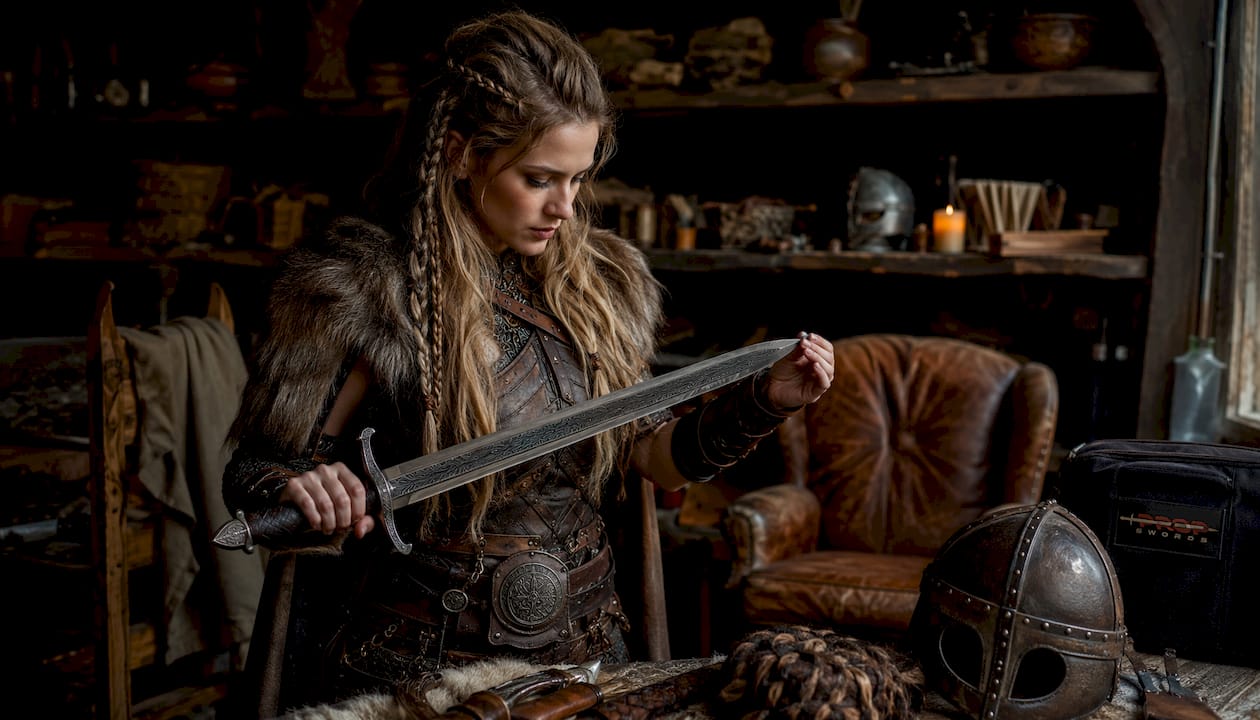
The double-edged geometry pays off in cosplay specifically. Because both edges are functional (or appear functional on a blunted replica), you can swing from either side without telegraphing a grip flip. Stage combat choreographers and photographers both notice the difference.
Pro Tip: Before buying, hold the replica at the grip and let it rest horizontally. The balance point should sit within a few inches of the crossguard, not halfway down the blade. A front-heavy replica will tire your wrist fast and photograph with a drooping tip.
What should you check before buying a Viking replica?
A buying checklist keeps you from spending $200 on something that looks right in photos and handles wrong in person.
- Blade material: Stainless steel (420 or 440 grade) resists rust and suits display; high-carbon steel (1075, 1095) holds a better edge and suits reenactment but needs oiling; Damascus-style steel offers the best visual impact for collectors
- Tang type: Full tang (steel running the full length of the grip) is structurally superior; rat-tail tangs are acceptable for display-only pieces but will not survive repeated handling
- Hilt and pommel: Check that the pommel is securely peened or threaded; a loose pommel is a safety issue and a sign of poor assembly
- Scabbard quality: Leather-wrapped wood scabbards are historically accurate; avoid storing carbon or Damascus blades in leather long-term without oiling, as leather retains moisture
- Weight and balance: Request the actual weight in pounds and the balance point measurement; a reputable seller will provide both
Price expectations for U.S. buyers
| Grade | Typical Price Range | Best For |
|---|---|---|
| Display-grade (stainless) | $200 | Wall mounting, gifts, casual cosplay |
| Cosplay-grade (carbon/stainless) | $200–$350 | Convention use, choreography, reenactment |
| Collector-grade (Damascus/full tang) | $300–$700 | Long-term collecting, investment pieces |
For U.S. buyers: sword ownership is legal in most states, but carrying a sword in public is regulated differently by state and municipality. Always transport replicas in a scabbard or case, check local ordinances before traveling with one, and confirm event weapon policies with organizers before bringing any replica to a convention or reenactment.
Authenticity versus practicality: which matters more for you?
The answer depends entirely on what you plan to do with the sword. For replica accuracy and collecting, historical authenticity in materials and proportions matters most. A collector who wants a piece that mirrors a museum example should prioritize full-tang construction, period-accurate hilt geometry, and documented steel types.
Cosplayers and reenactors face different trade-offs. A blunted edge is safer at public events and often required by event rules. Lighter stainless steel ships more easily and clears airport security without the complications that come with a sharpened carbon blade. A reinforced tang survives repeated handling that a display-only piece would not.
The practical decision tree: if your sword lives on a wall or in a display case, invest in Damascus finish and hilt detail. If it travels to events, prioritize a blunted edge, full tang, and a hard-shell case for transport.
How to care for and store a replica Viking sword
Maintenance by steel type:
- Carbon steel: Wipe the blade dry after every handling session; apply a thin coat of camellia or mineral oil; store in a dry environment away from leather scabbards for extended periods
- Damascus steel: Same oil routine as carbon; inspect the layered surface for rust spots after any humidity exposure
- Stainless steel: Wipe clean and dry; less prone to rust but still benefits from occasional light oiling at the crossguard and pommel joints
Storage:
- Maintain indoor humidity between 40–50% to prevent both rust (too humid) and wood/handle cracking (too dry)
- Store horizontally on padded blade supports or vertically in a display stand with the blade protected
- Never store a carbon or Damascus blade in a leather scabbard long-term without oiling; leather retains moisture and accelerates corrosion
Safety checklist for events and display:
- Transport in a scabbard or hard case at all times
- Check event weapon policies before arrival; many conventions require peace-bonding or blunted edges
- Inspect the pommel and crossguard for looseness before each use
- Keep the sword out of reach of children when displayed
How did Viking swords compare to axes and spears?
The Viking sword held specific advantages over the axe and spear in close combat. An axe delivered powerful blows but committed the wielder to a single cutting arc; recovering from a missed swing left a fighter exposed. The sword’s lighter weight and balanced geometry allowed faster recovery and direction changes.
Spears had superior reach and were the most common Viking weapon, but they struggled in tight formations where a long shaft became a liability. The sword excelled precisely in those close-quarters situations, and its double-edged blade meant a fighter could cut on the draw stroke as well as the push stroke, something a spear could not replicate.
For collectors comparing Viking weapons, the Floki Viking bearded axe represents the axe tradition well, but the sword remained the prestige weapon because it demanded more skill and rewarded that skill with versatility no axe or spear could match.
What fighting styles did Viking swords favor?
Viking sword technique centered on shield-wall combat and one-on-one dueling. The shield did most of the defensive work, freeing the sword arm for quick, controlled cuts rather than wide power swings. Fighters aimed for exposed limbs and gaps in armor rather than trying to hack through protection.
The sword’s balance point near the hilt made tip control precise. Thrusts were viable, particularly against opponents in mail, where a well-placed point found gaps more reliably than a slashing edge. Cuts targeted the legs, sword arm, and neck, areas a round shield left exposed.
Why the Viking sword’s design excelled in cutting and thrusting
The slight blade taper on most Viking swords served two functions. It shifted the balance point toward the hilt, improving handling, and it concentrated mass at the point of contact during a cut, increasing impact. The double edge meant a fighter could cut on the return stroke without repositioning, effectively doubling the offensive options per movement.
For thrusting, the tapered tip and relatively stiff blade (stiffened by the fuller’s geometry) delivered enough force to penetrate mail links at close range. The sword was not purely a slashing weapon; it was genuinely versatile across cutting and thrusting scenarios, which is why it remained the prestige weapon of the Viking age rather than being replaced by a more specialized tool.
Key Takeaways
Viking swords earned their reputation through balance, composite construction, and double-edged versatility, and quality replicas translate all three into real handling and display benefits.
| Point | Details |
|---|---|
| Weight and balance | Historical examples weighed as little as 2.3 lbs; replicas should match that balance point near the hilt. |
| Construction matters | Pattern welding and hardened steel edges gave flexibility plus cutting ability; Damascus finishes echo this for display buyers. |
| Double-edged advantage | Both edges usable without grip adjustment, benefiting cosplay choreography and stage combat. |
| Buying checklist | Verify full tang, blade material, pommel security, and actual weight before purchasing. |
| Propswords recommendation | For display-grade to collector-grade Viking replicas with Damascus options and free U.S. shipping, Propswords is a strong starting point. |
A perspective on what actually matters when buying a replica
The conversation around Viking swords tends to get pulled toward mythology: the ULFBERHT mystique, the idea that every historical blade was a masterpiece. The archaeological record tells a more complicated story. Surviving swords range from extraordinary to barely functional, and the same is true of replicas today.
What separates a replica worth owning from one that disappoints is not the marketing language on the product page. It is the balance point, the pommel fit, and whether the seller can tell you the actual weight and steel grade. Those three things predict the experience better than any brand story.
For collectors, hilt decoration and pommel authenticity are where value concentrates, because those features were historically the most visible markers of status. A replica that invests detail in the crossguard and pommel geometry will hold collector interest longer than one with a flashy blade and a generic hilt.
The Viking sword design origins page on the Propswords blog goes deeper on these design decisions if you want the historical context behind specific hilt types.
Propswords has Viking replicas matched to your purpose
Whether you are mounting a sword on a wall, carrying it to a convention, or building a serious collection, the right replica depends on matching the grade to the use.

Propswords carries display-grade stainless options, full-tang carbon steel pieces for reenactors, and handmade Damascus Viking swords for collectors who want the layered finish and documented steel quality. Free shipping within the USA applies across the catalog. Before ordering, confirm the listed weight and overall length match your expectations, and check the return policy for dimensional accuracy. Browse the best replica swords page to compare current options by grade and purpose.
Useful sources
- Hurstwic: Viking Swords — primary source for measurements, construction, and combat context
- National Museum of Denmark: Viking Age Swords — cultural context, status, and construction
- vikingsword.com: Technical features — fuller function and blade geometry
- SwordsInfo: Viking swords explained — materials and maintenance by steel type
- The Viking Herald: Ulfberht and status swords — provenance, ULFBERHT archaeology, and collector implications
- The Art Institute of Chicago: The Art of the Viking Sword — museum-level visual and historical reference
- Propswords blog: Viking sword design, origins, and legacy — on-site collector and buyer guidance
- Propswords blog: Authentic examples of Viking swords — replica accuracy and museum parallels
For deeper reading on pattern welding and ULFBERHT metallurgy, the Hurstwic article and the National Museum of Denmark pages are the most reliable starting points. For maintenance routines by steel type, the SwordsInfo guide covers the practical steps clearly.
FAQ
What are the main advantages of Viking swords?
Viking swords combined light weight (typically 2–4 lbs), a balance point near the hilt, and a double-edged blade that cut from either side without grip adjustment, making them fast, versatile, and effective in one-handed combat.
What steel is best for a Viking replica sword?
Damascus or high-carbon steel suits collectors and reenactors who want authentic handling and edge quality; stainless steel is the lower-maintenance choice for display-only pieces.
Are Viking replica swords legal to own in the United States?
Owning a replica sword is legal in most U.S. states, but public carry is regulated by state and local ordinances. Always transport replicas in a scabbard or case and confirm event weapon policies before bringing one to a convention or reenactment.
How heavy should a Viking replica sword be?
A historically proportioned Viking replica should weigh between 2–4 lbs, with many authentic blades and quality replicas close to 2.3 lbs. Heavier replicas with poor balance points feel front-heavy and tire the wrist quickly, which is a sign of lower build quality.
Where can I buy a quality Viking replica sword in the United States?
Propswords offers a range of Viking-style replicas from display-grade stainless to handmade Damascus options, with free shipping within the USA and a documented return policy for dimensional accuracy.
Recommended