TL;DR:
- Bring only convention-approved replicas and get your prop peace-bonded immediately upon arrival to avoid confiscation.
- Materials like EVA foam and Worbla pass most weapons checks, while metal blades are typically banned or restricted.
Bring only convention-approved replicas, read the event’s weapons policy before you pack, and get your prop peace-bonded the moment you walk through the door. Those three steps cover the vast majority of confiscations, ejections, and legal headaches that cosplayers run into every year.
TL;DR:
- Check the official weapons policy for your specific convention before you build or buy anything.
- Use EVA foam, Worbla, or flexible plastics. Metal blades are banned at most events unless permanently sheathed and even then often prohibited outright.
- Keep props concealed in transit and get them peace-bonded at the venue’s weapons check station on arrival.
- State and local laws govern public carry of replica swords. Keep the prop in a bag until you are inside the venue.
Pro Tip: On public transit, carry your sword in a long, transparent plastic tube or clear garment bag. Bystanders can see immediately that it is a prop, which dramatically reduces the chance of a 911 call before you even reach the convention center.
Table of Contents
- What should you check before leaving for a convention?
- Which materials actually pass a convention weapons check?
- How do you hold and carry a sword safely at a convention?
- How do you transport a cosplay sword safely?
- What does a weapons inspection actually check, and how do you pass?
- What should you pack in a convention repair kit?
- What are the legal basics for owning and carrying replica swords in the U.S.?
- What mistakes most often get props confiscated or cause accidents?
- Why purpose-built replicas can be the safer convention choice
- Key Takeaways
- The part of cosplay sword safety most guides skip
- Ready to find a convention-safe replica sword?
- Useful sources and further reading
- FAQ
What should you check before leaving for a convention?
A five-minute inspection at home saves hours of stress at the weapons check line.
Confirm the policy first. Pull up the convention’s official website and find the weapons or props policy page. Events like FanX Salt Lake Comic Convention publish detailed rules listing approved materials, prohibited items, and where the weapons check station is located. Screenshot it. Policies change between years.
Inspect the prop itself:
- Run your fingers along every edge. No exposed metal, no sharp tip, no burrs on resin or hard plastic.
- Flex the blade gently. If it does not give at all, it may fail the flex test at weapons check.
- Tug the pommel, guard, and any decorative fittings. Loose parts become projectiles in a crowd.
- Check the sheath or scabbard. Torn or cracked sheaths that expose the blade tip will get flagged.
- Confirm the overall length fits within the event’s size limits (many cap blades at 48 inches).
Pack this before you leave:
- Hard-sided transport case or a padded sword bag
- Zip ties and a spare peace-bond tag (in case the original comes loose)
- Compact repair kit (see the repair section below for the full list)
- Photo ID and any vendor receipt or documentation for the prop
- Printed or downloaded copy of the convention weapons policy
If you are traveling with minors, assign one adult to supervise the prop at all times. Never leave a sword prop unattended in a hotel room accessible to children without locking it in a case.
Pro Tip: Take a photo of the prop fully assembled before you leave home. If security questions the build, you can show them the original condition and demonstrate that nothing was modified en route.
Which materials actually pass a convention weapons check?
EVA foam is the gold standard for convention-safe prop weapons. It is lightweight, flexible, and poses minimal injury risk even in an accidental collision. Most events accept it without hesitation. The challenge is that foam alone can look cheap, which is where finish techniques and structural cores come in.
Common convention-approved materials include EVA foam, Worbla, flexible PVC, rigid resin, carbon-fiber rods (core only), wood, and metal. Metal is usually prohibited or heavily restricted, while wood is often subject to zip-tying or other control measures. Crowd safety and flexibility vary across these materials, with EVA foam generally preferred for safety.
A few practical rules regardless of material:
- Blunt every tip. Round foam tips with sandpaper; cap resin tips with a rubber or foam dome.
- No exposed metal edges. Metal accents are allowed at some events as decoration, but metal cannot be the primary construction material per FanX and similar policies.
- Secure every fitting. Pommels, guards, and crosspieces must be glued or pinned so they cannot detach.
- Wrap rigid cores. A carbon-fiber or PVC rod running through a foam blade is fine; the same rod exposed at the tip is a puncture risk.
Pro Tip: To get a metallic look without using metal, apply two coats of silver or chrome acrylic paint over EVA foam, then seal with a matte varnish. From three feet away, it reads as steel. Up close, the slight flex gives it away as safe — which is exactly what you want security to see.
How do you hold and carry a sword safely at a convention?
Convention security treats aggressive handling as an immediate safety hazard, even with foam props. Brandishing and mock-combat in corridors are the most common reasons for confiscation or removal from an event. The rule is simple: if your sword is moving fast and other people are nearby, you are doing it wrong.
Do:
- Carry the sword vertically at your side, tip pointing down, when walking through crowds.
- Keep the blade in its sheath or scabbard whenever you are not posing for a photo.
- Ask for verbal consent before drawing the prop for a photo, especially with strangers.
- Maintain at least arm’s length plus blade length of clear space before any posed swing or draw.
Don’t:
- Brandish, swing, or thrust in hallways, dealer rooms, or any crowded space.
- Draw the sword without warning near people who have not agreed to the photo.
- Rest the sword horizontally across your shoulder in tight corridors — the tip sweeps a wide arc when you turn.
- Leave the prop propped against a wall or on a table unattended.
For photoshoots specifically:
- Agree on the pose with the photographer before drawing.
- Check behind and beside you for bystanders before any wide stance or extended arm pose.
- Use a vertical carry (tip up or tip down) for brief repositioning between shots.
- Signal clearly when you are sheathing the prop so the photographer and nearby attendees know the action is done.
Pro Tip: Tell photographers upfront: “I’ll draw on your count of three.” That one-second warning gives everyone nearby time to step back, and it makes your photos look more deliberate anyway.
How do you transport a cosplay sword safely?
Getting the prop from your car to the convention floor without incident takes a bit of planning, especially if you are flying or using public transit.
By car: Keep the sword in a padded case in the trunk, not visible on the back seat. If you are stopped, a clearly cased prop is far less alarming than a loose blade. Hotel storage follows the same logic: lock the case, or use the in-room safe for smaller props.
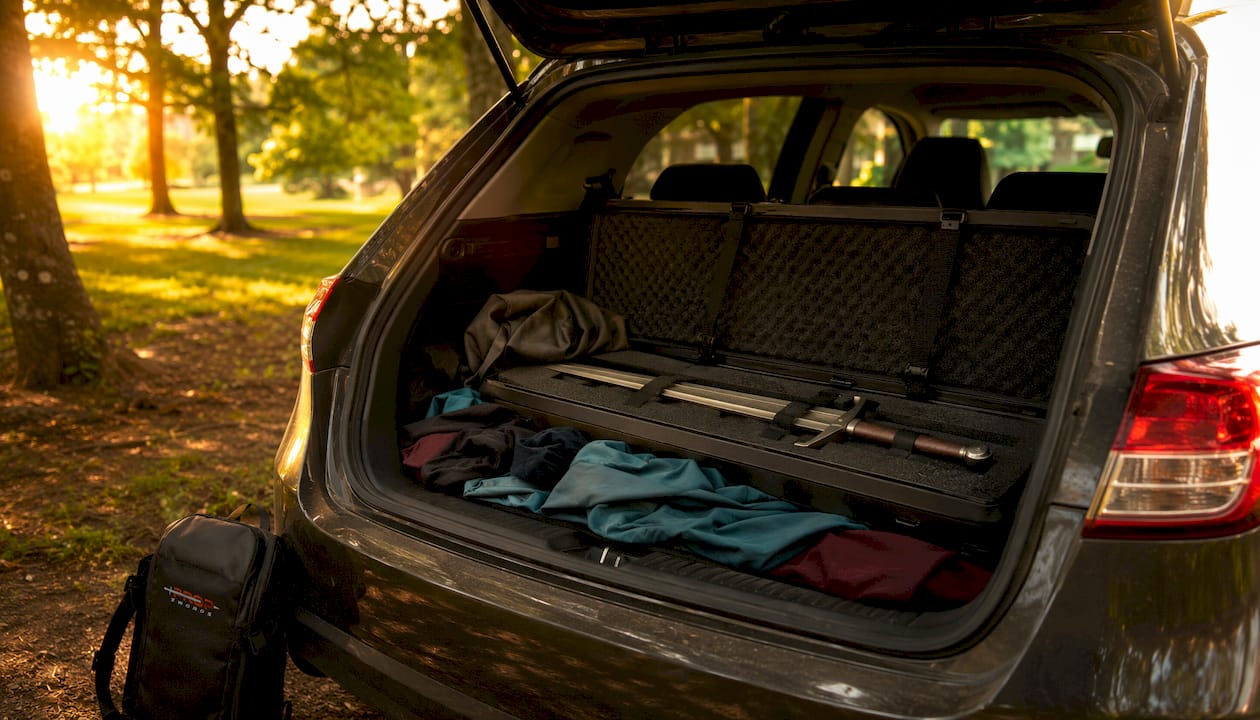
On public transit: Keep the prop fully concealed in a bag or case. A transparent container is better than an opaque one because bystanders can see it is not a functional weapon. Opaque shrouds can cause misunderstandings with law enforcement and fellow passengers, even when the prop is completely harmless.
By air: Cosplay swords go in checked baggage, not carry-on. The TSA prohibits replica swords in the cabin regardless of material. Pack the prop in a hard-sided case with padding on all sides, and declare it at check-in if the airline’s policy requires it. For very long props (over 62 inches total when cased), shipping the prop ahead via a carrier like UPS or FedEx is often cheaper and less stressful than oversized baggage fees.
Pro Tip: Attach a printed card to the outside of your transport case that reads “Costume prop — non-functional replica sword.” It costs nothing and gives TSA agents and hotel staff immediate context before they open the case.
What does a weapons inspection actually check, and how do you pass?
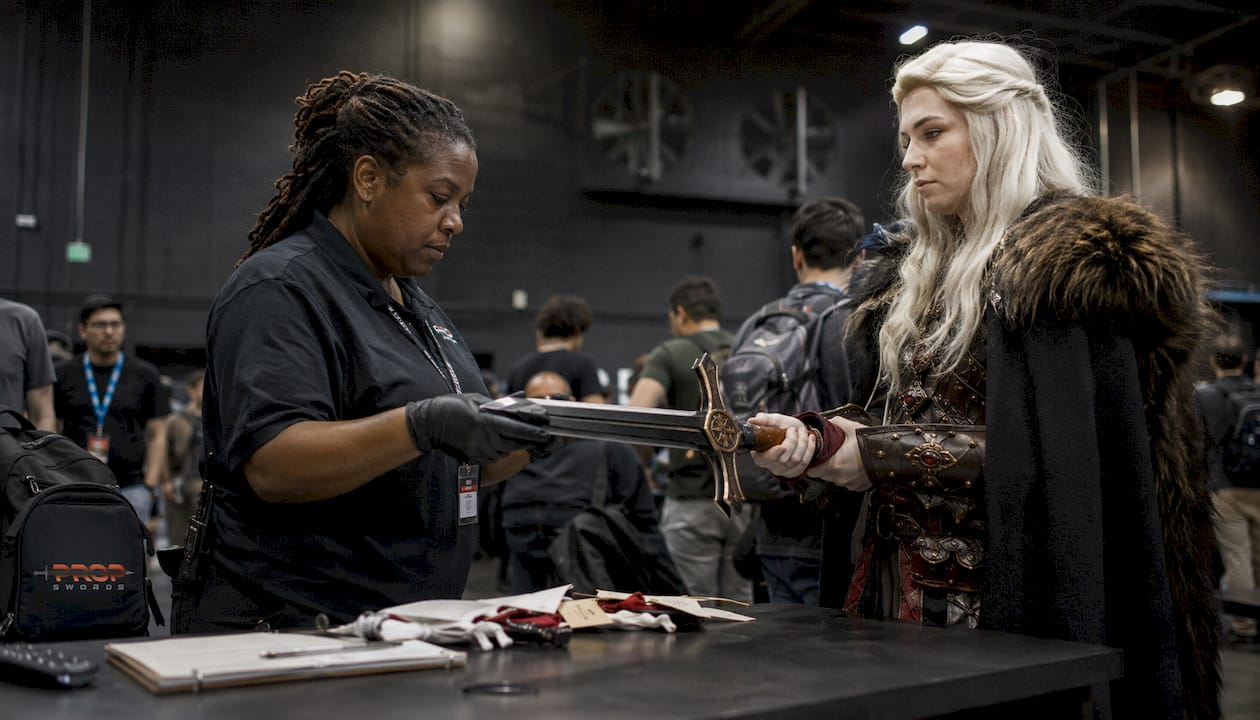
Convention peace-bonding is a standard process at most U.S. events. Staff inspect props and apply a visible marker, usually a zip tie or colored tag, that proves the prop was checked and cannot be drawn easily. If a prop is not obviously fake from a distance, security will treat it as a potential hazard until proven otherwise.
Typical inspection steps:
- Present the prop unsheathed and visible at the weapons check station.
- Staff will flex the blade to test rigidity. Foam and Worbla pass easily; rigid resin may require a blunt-tip check.
- They will check the tip for sharpness and the edges for exposed metal or burrs.
- Fittings (pommel, guard) get a tug test for security.
- If the prop passes, staff apply a peace-bond marker, often a zip tie through the guard or a sticker on the sheath.
- Wooden swords are typically zip-tied to the sheath so they cannot be drawn at all.
Bring to inspection:
- The prop fully assembled, not in pieces
- Any documentation showing it is a replica (vendor receipt, product page screenshot)
- Your repair kit, in case staff ask for a minor adjustment on the spot
Immediate red flags that will get your prop rejected:
- Exposed metal blade or metal primary construction
- Sharp tip (even on foam, a hard resin cap with a point will fail)
- Any projectile mechanism (spring-loaded, pressurized)
- Realistic weight and finish with no visible non-functionality
If you lose your peace-bond tag mid-event, return to the weapons check station immediately. Do not try to continue without it. A minimal weapons check kit with spare zip ties and a tag lets you reattach a marker quickly if it comes loose, preventing repeated full inspections.
What should you pack in a convention repair kit?
Props take a beating over a multi-day event. A compact kit kept in your bag handles the most common failures without creating new hazards.
Repair kit contents:
- Hot glue sticks and a mini glue gun (or pre-applied glue pads)
- Super glue (gel formula for porous surfaces)
- Zip ties in two sizes
- Duct tape (black and silver)
- Spare EVA foam scraps matching your blade color
- Small file or fine sandpaper (220 grit) for smoothing cracked edges
- Spare screws and a small screwdriver for metal fittings
- Acrylic paint in your blade’s base color for touch-ups
Quick fixes for common problems:
- Detached pommel: Clean the break, apply super glue, hold for 60 seconds, reinforce with a wrap of duct tape until fully cured.
- Loose guard: Tighten with a screw if threaded, or pack the joint with a foam shim and hot glue.
- Cracked foam blade: Fill the crack with hot glue, smooth with a damp finger, let cure, then touch up with acrylic paint.
Safety warnings for repairs: Never re-sharpen a tip that has worn down to a point. Never add metal reinforcement to a cracked section — it creates an exposed edge that will fail inspection and can injure someone. Temporary fixes that make a prop structurally rigid where it was previously flexible can actually make it more dangerous, not less.
What are the legal basics for owning and carrying replica swords in the U.S.?
Owning a replica sword for display or cosplay is generally legal in the United States, but public carry is a different matter entirely. State and local laws vary widely, and carrying a replica sword in public can trigger brandishing charges depending on how it is perceived and handled.
Key points:
- Owning a replica sword at home is legal in most U.S. states.
- Carrying one in public, even to a convention, is governed by state and local statutes. Some states treat imitation weapons the same as functional ones under certain conditions.
- Brandishing a replica sword in a way that causes alarm is a criminal offense in most jurisdictions, regardless of whether the blade is real.
- Airport and airline rules are federal: replica swords are prohibited in carry-on baggage by the TSA.
Before you travel:
- Check your state’s statutes on imitation or replica weapons.
- Call the local police non-emergency line and ask specifically about transporting a cosplay prop to a convention.
- Confirm the convention venue’s city or county rules, not just the event policy.
Pro Tip: Keep the prop in a closed, opaque or transparent case until you are physically inside the convention venue. A sword in a bag is a prop in transit; a sword in your hand on a public sidewalk is a potential incident.
This guide is general information, not legal advice. Confirm current laws with your state’s statutes or a qualified attorney for your specific situation.
What mistakes most often get props confiscated or cause accidents?
Most confiscations follow a predictable pattern. Knowing the red flags in advance is the easiest way to avoid them.
Red flags that trigger immediate action:
- Opaque transport bags that conceal the prop’s shape entirely
- Exposed metal edges or a realistic metal finish with no visible non-functionality
- Props that are heavy enough to feel functional when staff handle them
- Carrying a drawn blade through crowds without a sheath
- Mock-combat or sparring in hallways, even with foam props
Behaviors that get attendees ejected:
- Swinging or thrusting in any populated area
- Drawing the sword near people who did not consent to the photo
- Leaving the prop unattended, especially near children
- Ignoring a staff request to sheath or bag the prop
Borderline situations and how to handle them:
- Oversized props: A sword longer than the event’s size limit will be turned away at weapons check. Measure before you build. If you are borderline, contact the convention’s prop team in advance for a ruling.
- Late-night photoshoots outside the venue: Public carry rules apply the moment you step outside. Sheath the prop and bag it before you leave the building, even for a quick outdoor shoot.
Pro Tip: If a staff member approaches you about your prop, stop moving immediately, lower the prop to your side, and speak calmly. Reaching for the prop or continuing to walk while being addressed escalates the situation fast.
Why purpose-built replicas can be the safer convention choice
Building a prop from scratch gives you creative control, but it also puts the entire safety burden on your construction skills. Purpose-built replicas from a reputable seller come with consistent weight distribution, pre-blunted edges, and materials that are already matched to common convention standards.
When evaluating any pre-built replica for convention use, check the seller page for:
- Materials list: EVA foam, Worbla, or flexible plastics listed explicitly. Avoid listings that say “metal blade” without specifying it is decorative-only and permanently sheathed.
- Weight: Lighter is almost always safer and more comfortable for a full day of wear.
- Sheath condition: A well-fitted sheath that covers the tip completely is a peace-bonding prerequisite at most events.
- Return policy: A seller who stands behind the product will accept returns if the prop does not meet your event’s requirements.
- Safety notes: Look for any mention of blunt edges, non-functional design, or convention-readiness in the product description.
Propswords carries convention-ready replica swords built for display and cosplay use, with product descriptions that specify materials and construction. Their cosplay sword selection guide walks through exactly what to look for when matching a replica to your character and your event’s rules.
Pro Tip: Ask the seller directly whether the prop has passed any convention weapons checks before. Sellers who work with the cosplay community will often know which events their props have cleared.
Key Takeaways
Safe cosplay sword handling comes down to three things: choosing the right materials, following your convention’s specific rules, and keeping the prop controlled at all times in public.
| Point | Details |
|---|---|
| Check the policy first | Read your convention’s official weapons policy before building or buying; rules vary by event. |
| Use convention-safe materials | EVA foam, Worbla, and flexible plastics pass most weapons checks; metal blades are generally prohibited. |
| Peace-bond on arrival | Get your prop inspected and tagged at the weapons check station as soon as you enter the venue. |
| Keep props concealed in transit | Use a closed case or transparent bag in public; state laws govern public carry of replica swords. |
| Propswords for pre-built replicas | Propswords offers cosplay-ready replicas with documented materials and blunt-edge construction suited for convention use. |
The part of cosplay sword safety most guides skip
The conversation around cosplay sword safety almost always focuses on materials and convention rules, which are genuinely important. But the bigger risk I see overlooked is behavioral, not structural. A perfectly built EVA foam sword in the hands of someone who swings it in a crowded hallway is more dangerous than a rigid resin prop carried responsibly in a sheath.
Convention security operates on a worst-case lens. Staff are not materials experts. They are watching how you handle the prop, not analyzing its Shore hardness. A cosplayer who carries their sword vertically, sheathes it immediately after photos, and responds calmly to staff questions will almost never have a problem, even with a prop that is borderline on materials. A cosplayer who waves a foam sword around while walking through a packed dealer room will get stopped, regardless of how safe the foam actually is.
The practical takeaway: treat your cosplay sword the way a stage combat professional treats a training weapon. It is always in your control, always pointed in a safe direction, and never drawn without a clear reason and clear space. That discipline matters more than any single material choice.
Ready to find a convention-safe replica sword?
Propswords specializes in replica swords built for cosplay and display, with anime, movie, and historical designs that hold up visually without the safety risks of functional blades. Every listing includes material details and construction notes so you know exactly what you are bringing to weapons check.
Free shipping within the USA, a clear return policy, and a catalog that covers everything from iconic anime blades to Viking-inspired replicas. Before you order, confirm your specific convention’s weapons policy so you pick the right build for your event.
Browse the best replica swords for 2026 or explore the full cosplay weaponry guide to find the right prop for your next convention.
Useful sources and further reading
The sources below informed this guide. Check official convention pages directly for the most current rules, as weapons policies update between event years.
- FanX Salt Lake Comic Convention — Weapons Policy: Detailed approved materials list, inspection process, and consequences for non-compliance.
- New York Comic Con — Safety Guidance: Covers brandishing rules and security expectations at one of the largest U.S. conventions.
- GalaxyCon — Event Guidance: Explains how security evaluates props and why visual non-functionality matters.
- CosplayIdeas — Safe Display of Weapons and Props: Practical construction and peace-bonding guidance.
- AKTI (American Knife and Tool Institute): Resource for U.S. knife and blade laws by state.
- HEMAA — Training Safely: Safe sword-handling principles from the Historical European Martial Arts Alliance.
- Propswords — Role of Swords in Conventions: Publisher’s guide to convention prop selection and compliance.
- Propswords — Replica Sword Display Guide: Safe home storage and display practices for collectors.
For state-specific public carry laws, contact your local police non-emergency line or check your state legislature’s official statutes website directly.
FAQ
Is it legal to own a replica sword in the U.S.?
Owning a replica sword for display or cosplay is legal in most U.S. states, but public carry is regulated by state and local law and can trigger brandishing charges depending on circumstances.
Can I bring a cosplay sword on a plane?
Replica swords must go in checked baggage; the TSA prohibits them in carry-on luggage regardless of material. For very long props, shipping ahead via a parcel carrier is often the simpler option.
How do you travel with cosplay swords safely?
Pack the prop in a padded, hard-sided case, keep it in checked baggage for flights, and use a transparent container on public transit to reduce alarm from bystanders and law enforcement.
Can I legally carry a replica sword in public?
Public carry of a replica sword is governed by state and local statutes, not federal law. In many jurisdictions, carrying one in a way that causes alarm constitutes brandishing, even if the blade is not functional. Keep the prop cased until you are inside the venue.
What is peace-bonding and do all conventions require it?
Peace-bonding is a security process where staff inspect a prop and attach a visible marker, usually a zip tie or tag, confirming it cannot be drawn easily. Most major U.S. conventions require it for any sword-type prop.
Recommended