TL;DR:
- The katana and broadsword are designed to overcome different armor types and battlefield environments.
- Each weapon’s shape and metallurgy reflect its specific purpose, with the katana optimized for speed and slicing, and the broadsword for thrusting and multi-range combat.
The difference between katana and broadsword is rooted in two entirely separate engineering philosophies, each built to solve a specific battlefield problem. The katana is a single-edged, curved Japanese sword optimized for fast draw-cuts against laced composite armor. The broadsword is a straight, double-edged European weapon built to thrust into the narrow gaps of steel plate armor. Both weapons weigh roughly 1 to 1.5 kilograms and were wielded two-handed, yet their blade shapes, metallurgy, and combat roles could not be more different. Understanding those differences transforms how you appreciate either sword, whether you collect replicas or train with them.
What is the core difference between katana and broadsword design?
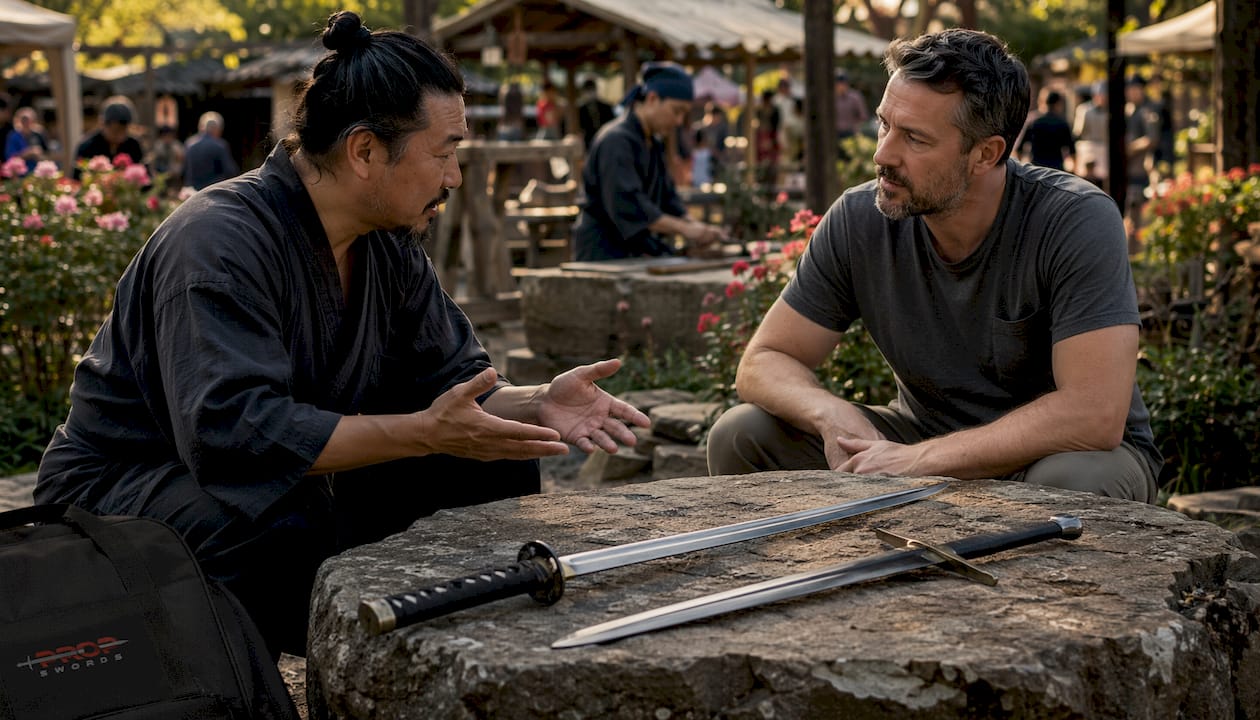
The katana and broadsword each solved a different armor problem, and that single fact explains almost every physical difference between them. Japanese warriors faced opponents wearing laced composite armor, which was layered and flexible. A slicing cut along the seams was far more effective than a direct stab. The broadsword’s European opponents wore rigid steel plate, where a slash would simply skid off. Thrusting into joints and gaps was the only reliable option.
Geography shaped both designs in ways that go beyond armor. Japan’s humid, mountainous islands favored close-range, fast engagements where drawing speed was decisive. European open battlefields rewarded a weapon that could do many things: thrust, strike, bind, and grapple. The katana answered one question brilliantly. The broadsword answered five questions adequately. Neither answer was wrong.
Pro Tip: When comparing these swords, always ask “what armor was this designed to defeat?” That question unlocks every design choice, from blade curve to guard shape.
How geography and armor shaped each blade
The katana’s curve is not decorative. Laced Japanese composite armor had seams and gaps that a curved, slicing blade could exploit with a single fluid draw. The mountainous terrain of Japan also meant combat often happened in tight spaces, where a fast, close-range cut mattered more than a long, committed thrust.
European plate armor presented the opposite problem. Steel plates covered nearly every surface, leaving only small gaps at the joints. The broadsword’s straight, double-edged blade was built to punch into those gaps with a controlled thrust. On open European battlefields, soldiers also fought in formations, which demanded a weapon that could work at multiple ranges without requiring the fighter to step back and reset.
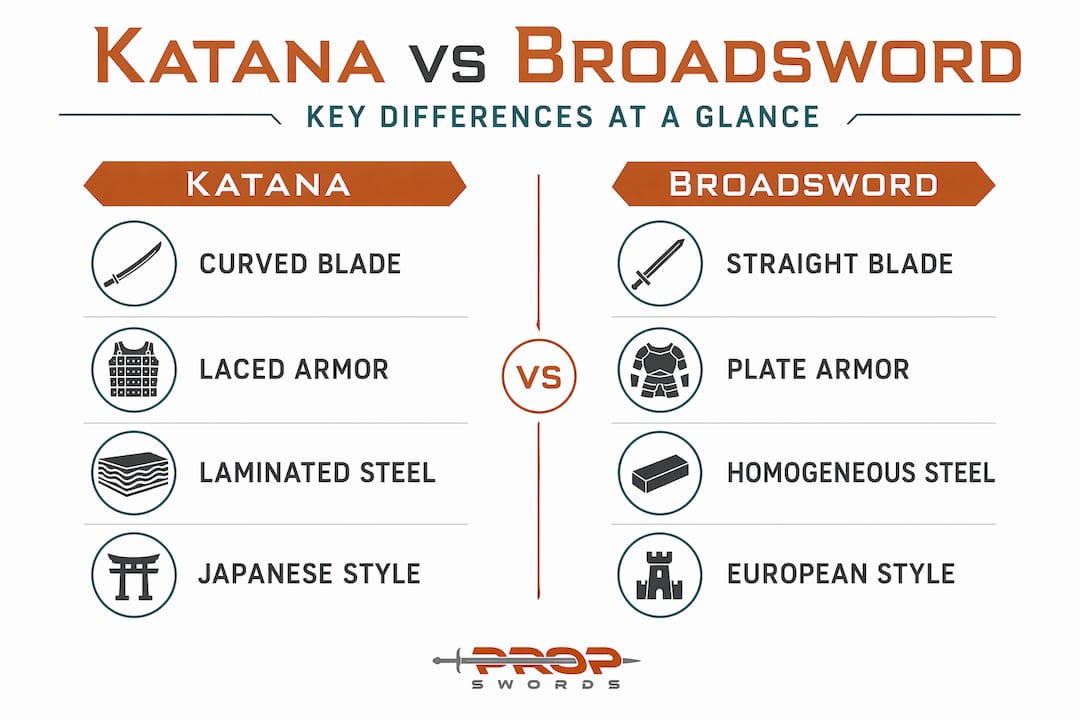
Climate influenced metallurgy too. Japan’s limited iron ore led swordsmiths to develop tamahagane, a high-carbon steel made by smelting iron sand in a clay furnace called a tatara. European smiths had access to more consistent iron deposits, which allowed them to work with homogeneous steel at intermediate hardness. Each material tradition produced a blade perfectly matched to its local demands.
What makes katana and broadsword metallurgy different?
The katana’s construction is one of the most sophisticated blade-making methods ever developed. Japanese smiths used differential hardening, coating the spine of the blade with clay before quenching it in water. The clay-coated spine cooled slowly, staying relatively soft and tough. The exposed edge cooled fast, becoming extremely hard. The contraction difference between these two zones is what physically bends the blade into its characteristic curve.
The result is a laminated structure with a hard kawagane outer layer and a tough shingane core. This mirrors what modern engineers call composite material design, combining two materials to get properties neither could achieve alone. The katana’s edge can hold an acute cutting angle without the whole blade becoming brittle.
The broadsword took a different path. European smiths forged blades from homogeneous steel at intermediate hardness, balancing toughness and flexibility across the entire blade. This made the sword more resistant to the lateral stresses of blade-binding and grappling, which were common in European combat. A fully hardened blade would snap under those forces.
Key structural differences between the two swords include:
- Blade edge: Katana uses a single, acutely ground edge; broadsword uses two symmetrical edges for thrusting and cutting from either side.
- Guard design: The katana’s tsuba is a circular disk that protects the hand and acts as a balance weight. The broadsword’s cruciform guard functions as a mechanical lever for blade-binding and grappling.
- Grip: The katana’s long, wrapped tsuka allows a two-handed grip with rotational wrist movement. The broadsword’s grip is shorter and straighter, suited to thrusting mechanics.
- Point geometry: The katana’s tip is clipped and angled for draw-cuts. The broadsword’s point is tapered for penetration.
How did combat styles differ for each sword?
The katana’s fighting system, codified in schools like Kenjutsu and later Iaido, centers on the draw-cut. Speed of the draw was a decisive advantage in Japanese dueling culture. The curved blade accelerates through the draw because the cutting edge travels a longer arc than a straight blade would. This makes the katana’s draw-cut faster and more fluid than any straight-blade equivalent.
European longsword combat, documented in historical fencing manuals from masters like Fiore dei Liberi and Johannes Liechtenauer, was a multi-range system. The broadsword enabled:
- Thrusting into plate armor gaps at full extension.
- Half-swording, where the fighter grips the blade with a gauntleted hand to use the sword as a short spear for close-range thrusting.
- Pommel strikes to the face or helmet when the opponent was too close for a full swing.
- Blade-binding and grappling, using the cruciform guard as a lever to control the opponent’s weapon.
These techniques appear in European fencing manuals that were codified specifically to deal with plate armor. The broadsword was not a simpler weapon. It was a more complex one, designed for a more complex battlefield.
Terrain mattered too. Japanese mountain passes and castle corridors rewarded the katana’s speed and compact cutting arc. European open fields rewarded the broadsword’s reach, thrusting power, and ability to transition between ranges mid-fight.
What cultural meanings do the katana and broadsword carry?
Both swords became symbols that far outlasted their battlefield roles, and both accumulated meanings that their original makers never intended.
The katana became the soul of the samurai under bushido philosophy. It was treated as a spiritual object, given a name, and passed through generations as a family heirloom. The aesthetic of the blade, including its hamon (the visible temper line along the edge), was considered as important as its cutting ability. This spiritual status, however, sometimes overshadows a real limitation: the katana’s thrusting ability is significantly weaker than a European longsword’s, because the curved geometry reduces penetrating force.
The broadsword’s cruciform guard started as a purely mechanical feature for hand protection and blade-binding. Over centuries, Christian symbolism attached itself to that cross shape, and the sword became a symbol of the knight’s sacred mission. Crusader knights prayed over their swords as if they were crosses. The engineering function came first. The spiritual meaning came later.
“Viewing katana and broadsword purely as opponents misses that each was engineered to overcome different armor and battlefield demands. They were never designed for direct competition. Comparing them without that context is like comparing a scalpel to a chisel and asking which is better.”
This insight reframes the entire katana vs broadsword debate. The question is not which sword wins. The question is which sword was built for which world.
Practical considerations for collectors and martial artists
For modern enthusiasts, the physical differences between these swords translate directly into how you handle, train with, and maintain them.
| Feature | Katana | Broadsword |
|---|---|---|
| Grip style | Two-handed, rotational wrist movement | Two-handed, linear thrusting grip |
| Training focus | Draw speed, cutting arc, footwork | Range transitions, thrusting, blade control |
| Blade care | Oil regularly to prevent rust on high-carbon steel | Wipe dry after use; less prone to rust with homogeneous steel |
| Replica weight | Approximately 1 to 1.5 kg | Approximately 1 to 1.5 kg |
| Display consideration | Horizontal mount on a stand shows the curve | Vertical wall mount shows the cross-guard profile |
Replica craftsmanship matters more than most collectors realize. A well-made katana replica will show a visible hamon line, a wrapped tsuka, and a properly fitted tsuba. A quality broadsword replica will have a tapered point, a balanced cruciform guard, and a grip sized for two hands. You can compare replica sword types and weights to understand what authentic proportions look like before you buy.
Proper blade care varies by construction. High-carbon steel katana blades need light oiling every few months to prevent oxidation. Broadsword replicas made from stainless or homogeneous steel are more forgiving but still need to be wiped dry after handling, since skin oils cause spotting over time.
Pro Tip: Store katana replicas horizontally with the edge facing up. This follows traditional Japanese practice and prevents stress on the habaki, the metal collar that holds the blade in the scabbard.
Key Takeaways
The katana and broadsword are not rivals. They are two engineering solutions to two completely different problems, shaped by armor, climate, terrain, and culture.
| Point | Details |
|---|---|
| Design philosophy | Each sword was built to defeat a specific armor type, not to compete with the other. |
| Metallurgy | The katana uses differential hardening for a composite structure; the broadsword uses homogeneous steel for flexibility. |
| Combat role | The katana excels at fast draw-cuts; the broadsword handles thrusting, grappling, and multi-range fighting. |
| Cultural weight | Both swords gained spiritual meaning after their engineering function was established. |
| Collector relevance | Replica quality, blade care, and handling differ meaningfully between the two sword types. |
Why the “which is better” question misses the point
I’ve handled both sword types in training contexts, and the single most common mistake I see is treating this as a competition. People want a winner. They want to know which sword would beat the other in a fight. That framing throws away everything interesting about both weapons.
What actually changed my perspective was holding a well-made broadsword replica and working through half-swording drills. The moment you grip the blade with your off hand and use the sword as a short thrusting spear, you realize this weapon was built for a completely different problem than the katana ever faced. The katana’s draw-cut is breathtaking in its speed and economy of motion. But against a fully armored knight, that cut would do almost nothing.
The katana’s spiritual status, built up through bushido and centuries of Japanese culture, sometimes makes enthusiasts defensive about its limitations. The broadsword gets dismissed as crude by comparison. Neither reaction is fair to the history. Each sword represents the peak of what its culture could engineer with the materials and opponents it had. Respecting that context makes you a better collector and a more thoughtful martial artist. If you want to go deeper on how these two traditions compare in practice, the combat style breakdown at Propswords is worth your time.
— Muhammad
Propswords’ replica collection for katana and broadsword enthusiasts
Collectors and practitioners who want to hold these differences in their hands need replicas built to authentic proportions.
Propswords carries a curated selection of katana and broadsword replicas designed to reflect the real weight, balance, and visual detail of historical originals. Each piece is built for display or safe handling practice, not just shelf appeal. The best replica swords for 2026 include options across both traditions, with accurate guard profiles, proper grip lengths, and blade geometries that match what you’ve read about here. Free shipping within the USA is included, and the Propswords blog covers katana replica buying guidance for anyone starting their collection.
FAQ
What is the main difference between a katana and a broadsword?
The katana is a curved, single-edged Japanese sword built for fast slicing cuts against laced composite armor. The broadsword is a straight, double-edged European weapon designed for thrusting into plate armor gaps and multi-range combat.
Did the katana and broadsword weigh the same?
Both swords weighed approximately 1 to 1.5 kilograms and were typically wielded two-handed. Their similar weight makes the difference in blade shape and combat function even more striking.
Why is the katana curved?
The katana’s curve is a direct result of differential hardening during forging. The clay-coated spine cools slower than the exposed edge during quenching, and the contraction difference physically bends the blade into its characteristic arc.
Could a katana defeat a broadsword in combat?
The question assumes a direct competition that history never staged. The katana was optimized for Japanese armor and terrain; the broadsword for European plate armor and open battlefields. Against a fully armored European knight, the katana’s slicing cuts would be far less effective than the broadsword’s thrusting techniques.
What should collectors look for in a quality replica?
A quality katana replica shows a visible hamon temper line, a wrapped tsuka grip, and a fitted tsuba guard. A quality broadsword replica has a tapered thrusting point, a balanced cruciform guard, and a grip proportioned for two hands.
Recommended