TL;DR:
- The sword hilt includes the guard, grip, and pommel, each critical for control, balance, and protection. Its shape, material, and construction reveal its historical period, regional origin, and intended fighting style. Proper understanding of these components enhances evaluation, display, and handling of both authentic and replica swords.
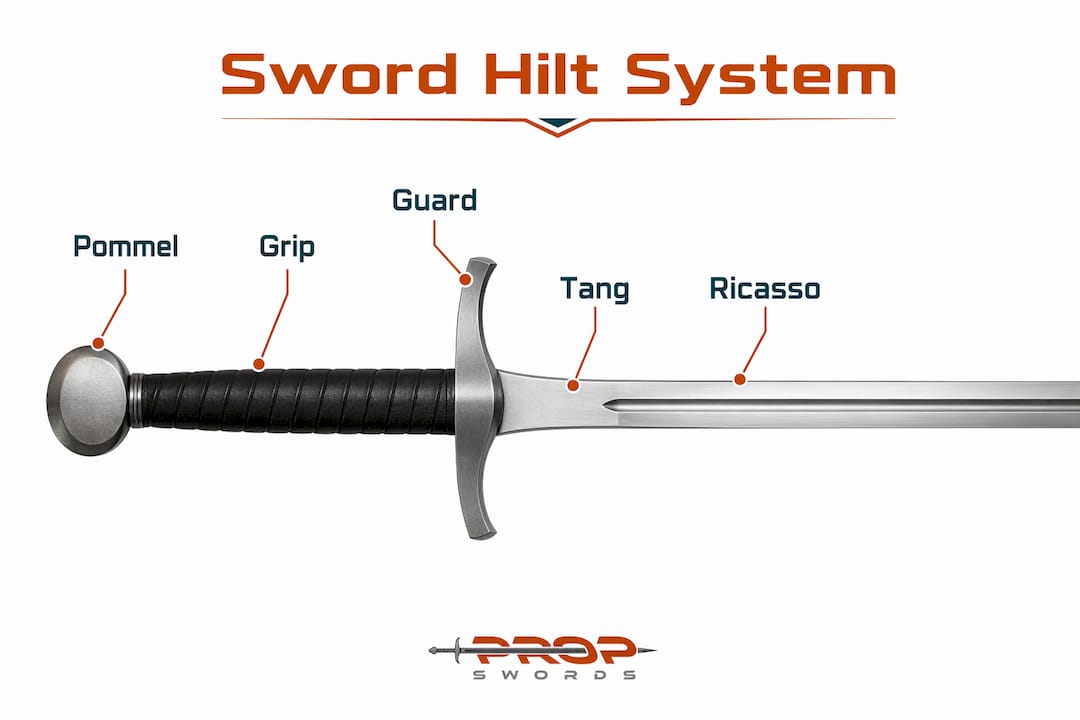
The sword hilt is the complete handle assembly of a sword, comprising three core components: the guard, the grip, and the pommel. Together, these three parts determine how a sword feels in the hand, how well it protects the user, and how the blade’s weight is balanced. Get the hilt wrong and even a perfectly forged blade becomes difficult to control. Get it right and the weapon becomes an extension of the arm.
The hilt’s primary roles are control, protection, and balance. The guard shields the hand from an opponent’s blade sliding down the edge. The grip is where the hand actually contacts the weapon, and its shape, material, and texture directly affect technique. The pommel acts as a counterweight, shifting the point of balance toward the hand and making the sword feel lighter and more responsive than its raw weight suggests.
Main parts at a glance:
- Guard (also called quillons or crossguard): the barrier between grip and blade
- Grip: the handle section the hand wraps around
- Pommel: the weighted cap at the butt end of the grip
- Ricasso: an unsharpened section of blade just above the guard, present on some swords
- Tang: the blade extension that runs through the grip and into the pommel
- Sword knot (or sword strap): a loop attached to the grip for wrist security
Table of Contents
- What are the main parts of a sword hilt?
- What do different pommel shapes actually do?
- How grip construction affects handling and durability
- How does guard design balance protection and mobility?
- Why the tang is the most structurally critical part of a hilt
- How hilt styles evolved across regions and centuries
- What medieval ergonomics research reveals about grip shape
- How to identify and date a hilt as a collector
- Key Takeaways
- Why replicas deserve more respect than they usually get
- Propswords has the replica hilt styles you’re looking for
- FAQ
- Authoritative sources and further reading
What are the main parts of a sword hilt?
Every sword hilt is a system, not just a handle. Each component has a specific mechanical job, and understanding them makes it much easier to read museum labels, evaluate replicas, or follow historical fencing manuals.
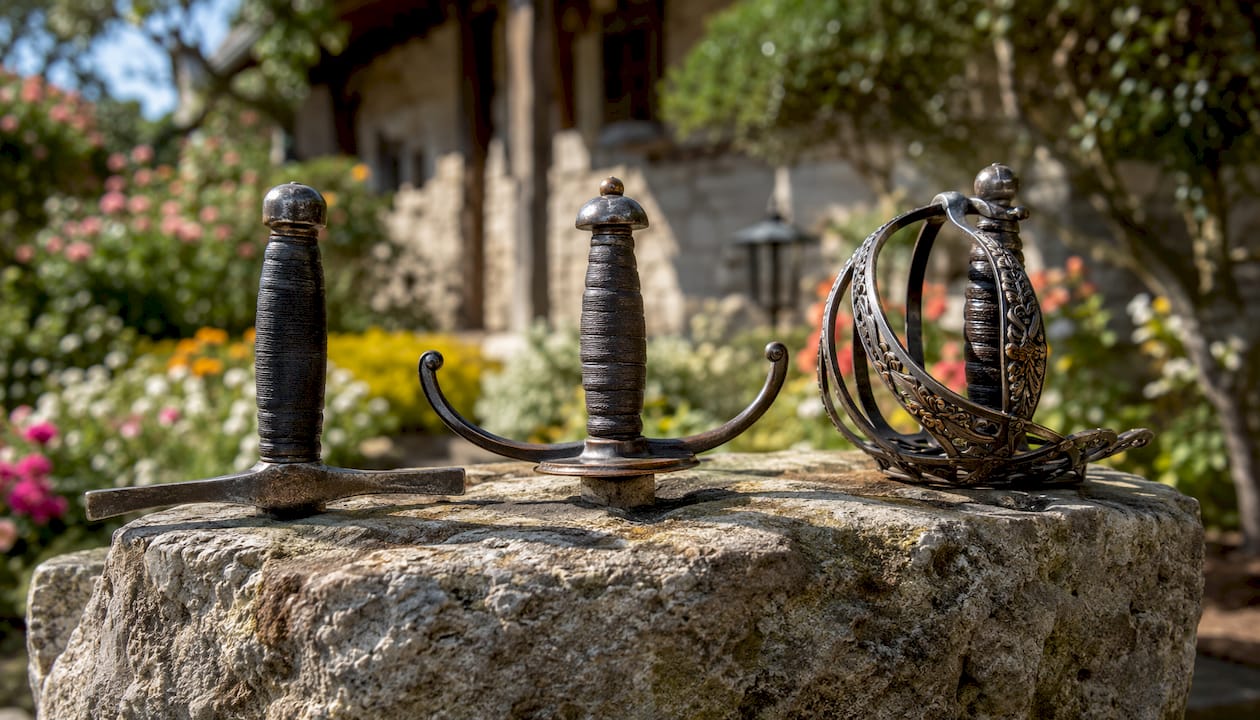
The guard separates the grip from the blade and stops an opponent’s weapon from sliding into the hand. On medieval swords, this is typically a straight crossguard with two projecting arms called quillons. Later designs added rings, side rings, and knuckle-bows to extend that protection. A knuckle-bow is a curved bar running from the guard to the pommel, protecting the back of the fingers.
The grip is the hand-contact zone. It sits between the guard and the pommel, and its length determines whether the sword is a one-handed, hand-and-a-half (bastard), or two-handed weapon. Grips are almost never solid metal; they are typically a wooden core shaped to the tang, then covered in leather, wire, or shagreen.
The pommel caps the grip and performs two jobs simultaneously: it locks the grip assembly onto the tang, and it acts as a counterweight. A heavier pommel pulls the balance point toward the hand, which reduces the perceived effort of swinging and recovering the blade.
The ricasso is an unsharpened section of blade immediately above the guard. On two-handed swords, it allowed the user to choke up on the blade for close-quarters leverage, effectively giving the weapon a second grip position. The presence and length of a ricasso is a useful dating and function clue, as noted in hilt anatomy references.
The tang is the steel spine of the blade that extends through the grip and into or through the pommel. It is the structural backbone of the entire assembly. A weak or poorly fitted tang is the most common cause of hilt failure.
The sword knot (sometimes called a sword strap or portepée) is a loop of cord or leather attached near the pommel or guard. It wraps around the wrist to prevent the sword from being dropped in combat or ceremony.
“The hilt is the handle of a knife, dagger, sword, or bayonet and normally consists of the guard, grip, and pommel; the guard can include a crossguard or quillons.”
Wikipedia, Hilt
Quick glossary
| Term | Definition |
|---|---|
| Guard | The hand-protecting barrier between grip and blade |
| Quillons | The two projecting arms of a crossguard |
| Knuckle-bow | A curved bar protecting the back of the fingers |
| Grip | The hand-contact section between guard and pommel |
| Pommel | The weighted cap at the butt end of the grip |
| Ricasso | An unsharpened blade section above the guard for choking up |
| Tang | The blade extension running through the grip into the pommel |
| Sword knot | A wrist loop attached to the grip or pommel |
What do different pommel shapes actually do?
Pommel shape is one of the most reliable dating and regional-identification tools available to collectors. It also has direct functional consequences that go well beyond decoration.
The pommel’s first job is counterbalancing the blade. A longer or heavier blade needs a heavier pommel to pull the balance point back toward the hand. Swords designed for fast, one-handed use tend to have compact, dense pommels. Two-handed swords often use elongated or lobed pommels that spread the counterweight mass without adding excessive bulk at the butt.
Common pommel types:
- Wheel/disc pommel: A flat, circular form common on 13th–14th-century European swords. Provides good counterweight in a compact profile.
- Scent-stopper pommel: A cylindrical form with a rounded end, named for its resemblance to a perfume-bottle stopper. Common on 18th-century smallswords.
- Brazil-nut pommel: An oval, slightly pointed form associated with Viking-age and early medieval swords.
- Fishtail/crescent pommel: A flared, bifurcated shape seen on some late medieval and Renaissance weapons.
- Lobated/multi-lobed pommel: Multiple rounded projections; common on Viking swords, where the lobes also served as a striking surface.
- Knop pommel: A small, rounded button form, often found on daggers and short swords.
- Oblate pommel: A flattened sphere, common on later medieval swords where a lower profile was preferred.
Beyond counterweighting, the pommel serves as an offensive tool. The technique known as Mordhau in German fencing manuals involves gripping the blade and striking with the pommel as a bludgeon, particularly effective against armored opponents. A heavy, projecting pommel makes this viable. The Art Institute of Chicago’s arming sword collection illustrates how pommel profiles shifted across centuries as tactics evolved.
Pommel design is never purely aesthetic. The shape encodes tactical doctrine: a heavy wheel pommel on a 13th-century sword signals a fighting style that relied on cuts and half-swording, while a delicate scent-stopper on an 18th-century smallsword tells you the fight had moved entirely to the thrust.
Pro Tip: When evaluating a replica, hold it at the grip and let it rest horizontally. The balance point should sit roughly 3–5 inches forward of the guard on a single-handed sword. If the blade feels like it’s pulling your arm forward, the pommel is likely too light for the blade length.
How grip construction affects handling and durability
The grip is where sword design gets personal. Two swords with identical blades and guards can feel completely different based on grip cross-section, length, and surface texture. Makers throughout history understood this, and the variety of construction methods they used reflects both material availability and deliberate ergonomic choices.
One-piece vs. multi-piece grips
The simplest grips are carved from a single piece of wood, slotted to fit over the tang. These are structurally sound but limit how tightly the grip can be shaped around a narrow tang. Academic research on 9th–12th-century wooden grips documents one-, two-, and four-piece constructions. Two-piece grips (two halves glued around the tang) allow the maker to shape the interior channel precisely, producing a tighter fit. Four-piece grips go further, enabling narrow profiles and better vibration control because the wood grain can be oriented to absorb shock.
Materials
| Material | Properties | Typical Use |
|---|---|---|
| Yew / alder wood | Lightweight, workable, good shock absorption | Core of most European medieval grips |
| Bone / antler | Dense, durable, naturally textured | Viking and early medieval hilts |
| Shagreen (ray/shark skin) | Extremely grippy, moisture-resistant, durable | Japanese katana tsuka, some European smallswords |
| Leather | Comfortable, conforms to hand, moderate durability | Wrapped over wood cores, common across all eras |
| Wire (iron, copper, silver) | Excellent grip, adds weight, very durable | Wrapped over leather or cord on rapiers and basket-hilts |
| Modern synthetics (Micarta, G-10) | Consistent, moisture-proof, very durable | Contemporary replicas and custom builds |
How grips are fastened
Grips attach to the tang by one of three main methods: adhesive (hide glue or modern epoxy), mechanical fastening (rivets or pins through the grip scales), or wrapping (cord or wire wound tightly over the grip body, which compresses it against the tang). Most historical grips used a combination. The wrapping method is particularly effective because it simultaneously secures the grip and creates the textured surface that improves purchase.
Wire wrapping and shagreen coverings served a dual purpose: they improved grip durability and created a repeating tactile pattern that helped the user feel front-back orientation without looking at the weapon.
“Multi-piece grip construction allowed makers to assemble the grip after the pommel was already attached to the tang — a practical assembly sequence that also made tight wire-wrapped profiles possible.”
Projekt Forlǫg, wooden grip construction study
Pro Tip: Cross-section shape matters more than most buyers realize. An oval cross-section naturally indexes the edge alignment to the hand, while a circular cross-section requires the user to consciously orient the blade. If you’re buying a replica for display or light handling, oval is almost always the better choice for a historically accurate feel.
How does guard design balance protection and mobility?
The guard is the most visually variable part of any hilt, and the variation is not arbitrary. Every guard design represents a trade-off between how much of the hand it covers and how much it restricts movement, weight, and hand positioning.
Guard families and their trade-offs
| Guard type | Protection level | Mobility/weight | Typical era and weapon |
|---|---|---|---|
| Straight crossguard (quillons) | Moderate | High / light | 10th–15th century arming swords |
| Ring guard | Moderate-high | High / light | 15th–16th century transitional swords |
| Swept hilt | High | Moderate / medium | 16th–17th century rapiers |
| Basket hilt | Very high | Lower / heavier | 17th–18th century broadswords, sabers |
| Cup hilt | Very high | Moderate / medium | 17th century Spanish and Italian rapiers |
| Minimal / no guard | Low | Very high / very light | Two-handed swords, some Asian swords |
The straight crossguard dominated European swordsmanship for centuries because it paired well with a shield. When the shield disappeared from civilian and military use in the 16th century, the hand became exposed, and guard complexity exploded in response. Swept hilts added side rings and curved bars to catch and deflect thrusting blades. Basket hilts enclosed the entire hand in a cage of steel bars. Cup hilts replaced the open guard with a solid hemispherical bowl.
Two-handed swords are the notable exception. Their guards stayed relatively simple because the weapon’s length and the use of both hands made elaborate finger protection impractical. Some two-handed swords added parrying hooks (short projections above the guard) rather than expanding the guard itself.
Pro Tip: When examining a swept or basket hilt, check the interior clearance. A well-made guard should allow the hand to move slightly without binding, but not so loosely that the bars contact the knuckles during a thrust. Tight interior clearance is a sign of a poorly fitted replica.
Why the tang is the most structurally critical part of a hilt
Collectors and buyers focus on the visible parts of a hilt, but the tang is what holds everything together. A beautiful guard and grip mean nothing if the tang fails.
Tang types and their mechanical differences
Full tang: The blade steel extends the full length and width of the grip, with grip scales attached to either side. This is the strongest configuration and the most common in modern production knives. It is less common in historical swords, where weight and grip shaping were priorities.
Partial (rat-tail) tang: A narrow extension that runs through the grip but does not fill it. Lighter than a full tang, but more prone to failure under lateral stress. Common in lower-cost replicas.
Peened tang: The tang passes through the pommel and its tip is hammered (peened) over to lock the assembly. This is the dominant method in historical European swords. Peening is mechanically secure and requires no adhesive, but disassembly is difficult. Peened tangs mechanically secure the blade by deforming the tang’s tip under the pommel, which both secures and makes disassembly difficult.
Threaded tang: The tang is threaded and the pommel screws on. This makes disassembly easy for maintenance or repair, but the threads can loosen over time, especially under impact. Common in modern production swords.
Pinned tang: A cross-pin through the grip and tang locks the assembly. Historically used on some daggers and short swords; easy to disassemble for repair.
Pro Tip: Grasp the grip firmly and try to twist the pommel. Any rotational movement indicates a loose assembly. Then hold the blade and try to flex the grip laterally. A properly peened or assembled hilt should feel completely rigid. Even minor wobble is a reason to stop using the sword for any kind of handling.
Signs of a failing attachment to watch for:
- Visible gap between the guard and the blade shoulder
- Pommel that rotates independently of the grip
- Cracked or split grip scales, especially near the guard or pommel
- Audible rattle when the sword is shaken
- Corrosion visible at the guard-blade junction (indicates moisture intrusion)
How hilt styles evolved across regions and centuries
Hilt design is a record of tactics, materials, and culture. The same basic problem (how to hold a blade safely and effectively) produced radically different solutions depending on geography and era.
European evolution
Early medieval European swords (roughly 8th–10th century) used simple crossguards and lobed pommels, well-suited to shield-based combat. As armor improved through the 12th–14th centuries, swords lengthened and pommels grew heavier to maintain balance. The Art Institute of Chicago’s two-handed sword from the late 16th century illustrates how guard complexity scaled with weapon size and the demands of bodyguard duty.
By the 16th century, the rapier emerged as the dominant civilian weapon in Spain and Italy, driving the development of swept and cup hilts. The National Park Service’s documentation of a smallsword hilt fragment (late 17th–18th century) shows how guard forms continued to simplify as thrusting technique matured and the sword became a social accessory as much as a weapon.
Japanese hilts
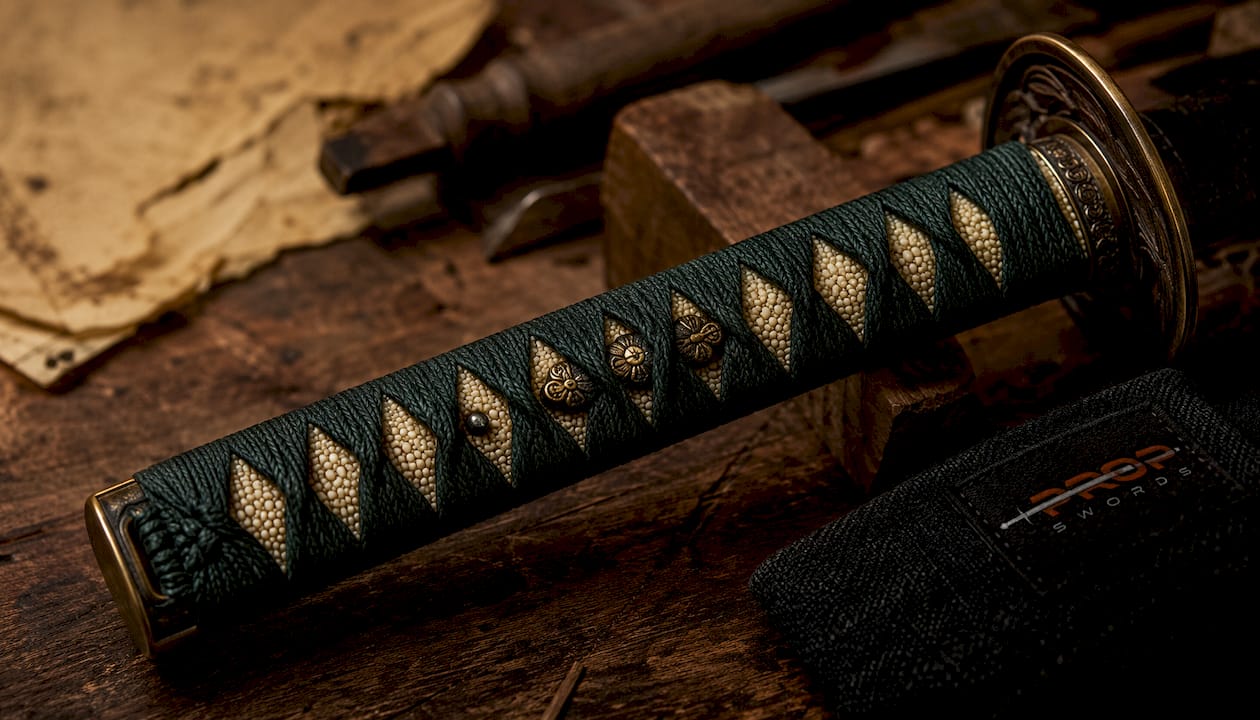
The Japanese katana uses a fundamentally different hilt system. The tsuka (handle) is a wooden core wrapped in ray skin (same) and then bound with silk or cotton cord (ito) in a diamond pattern. This wrapping creates both grip texture and a visual front-back indicator. The tsuba (guard) is typically a flat disc or shaped plate, prioritizing draw speed over hand enclosure. Menuki (ornamental grip ornaments) are placed under the wrapping at specific positions to improve grip purchase and index the hand.
Middle Eastern and South Asian hilts
Persian, Ottoman, and Indian swords often feature pistol-grip pommels that curve toward the palm, locking the hand in position without a crossguard. The tulwar and shamshir use this approach, relying on the curved pommel rather than a guard to prevent the hand from slipping forward during a cut. Decoration on these hilts tends to be more elaborate, with inlaid gold, ivory grips, and jeweled pommels signaling status.
Key timeline:
| Period | Development |
|---|---|
| 8th–10th century | Simple crossguard, lobed pommel, shield-paired combat |
| 12th–14th century | Heavier pommels, longer grips, half-swording techniques |
| 15th–16th century | Ring guards, ricasso sections, transition from shield use |
| 16th–17th century | Swept hilts, cup hilts, rapier fencing systems |
| 17th–18th century | Basket hilts, smallsword guards, decorative elaboration |
| — | Military sabers, standardized production, modern replicas |
What medieval ergonomics research reveals about grip shape
The most underappreciated aspect of hilt design is intentional asymmetry. Most people assume historical grips were roughly cylindrical, but practitioner research and museum examination suggest otherwise.
Medieval ergonomics research by historical fencing practitioners documents a consistent pattern: the finger side of the grip (the side facing the edge) is often slightly bellied or convex, while the thumb side is flatter. This asymmetry does two things. It seats the fingers naturally against the grip without requiring a conscious squeeze, and it makes the edge orientation immediately readable by touch. The hand knows where the blade is pointing without the eye needing to check.
Pommel asymmetry compounds this effect. When the pommel is slightly offset toward the thumb side, it reinforces the natural wrist angle for a cutting grip. Grip asymmetry and pommel profile asymmetry historically improved control, with intentional offsets used to favor right- or left-handed handling.
This has direct implications for replica buyers. A grip that feels “neutral” in the hand is often less accurate historically than one that feels slightly asymmetric. The asymmetry is the feature, not a flaw.
Pro Tip: When testing a grip, close your eyes and pick up the sword. Without looking, note whether you can feel which way the edge is oriented. A well-designed grip should tell you. If you have to open your eyes to check, the cross-section is too symmetrical for historical accuracy.
How to identify and date a hilt as a collector
Dating a hilt does not require a museum degree. A systematic inspection of a few key features will get you to a reasonable era and region hypothesis in most cases.
Hands-on identification checklist
- Pommel profile: Identify the basic shape (wheel, disc, lobated, scent-stopper, etc.) and cross-reference with known typologies. Oakeshott’s pommel typology (Types A through Z) is the standard reference for European swords.
- Guard complexity: A straight crossguard points to pre-16th century. Rings and swept bars suggest 15th–17th century. A basket or cup hilt narrows the window to 17th century onward.
- Grip construction: One-piece grips are simpler and earlier. Multi-piece and wire-wrapped grips appear more frequently from the 14th century onward. Shagreen wrapping on a European sword suggests 17th–18th century.
- Tang and peening: Examine the pommel base. A visible peened tang tip (a small mushroomed nub of steel) indicates historical construction or a faithful reproduction. A threaded pommel that screws on is a modern production feature.
- Ricasso presence: Any ricasso longer than a few centimeters strongly suggests a two-handed or hand-and-a-half sword from the 15th–17th century.
- Patina and corrosion: Genuine age produces consistent, layered patina. Pitting under the patina, not on top of it, suggests authentic age. Bright machine marks under thin artificial patina indicate a modern piece.
- Construction method: Hand-filed surfaces, slight asymmetries in the guard, and visible hammer marks on the pommel are consistent with pre-industrial manufacture. Perfect symmetry and machined surfaces point to modern production.
Pro Tip: For appraisal or sale, photograph the pommel from directly above, the guard from both sides, and the tang junction from below the guard. These four angles capture the most diagnostic details. Store vintage hilts wrapped in acid-free tissue, away from humidity, and never apply oil directly to organic grip materials like leather or bone without consulting a conservator.
Quick dating rules of thumb:
- Straight crossguard only + wheel or disc pommel = likely 12th–14th century European
- Ring guard + transitional pommel = 15th–16th century
- Swept or basket hilt = 16th–18th century
- Scent-stopper pommel + minimal guard = 18th century smallsword
- Pistol-grip pommel, no crossguard = Middle Eastern or South Asian origin
For a detailed collector evaluation checklist, Propswords has published a practical guide covering condition, provenance, and construction criteria.
Key Takeaways
A sword hilt’s guard, grip, and pommel work as an integrated system: change one element and the balance, protection, and ergonomics of the entire weapon shift.
| Point | Details |
|---|---|
| Three-part system | Every hilt consists of guard, grip, and pommel, each with a distinct mechanical role. |
| Pommel as counterweight | Pommel shape and mass shift the balance point toward the hand, reducing perceived blade weight. |
| Guard complexity tracks tactics | Simple crossguards suit shield-paired combat; basket and cup hilts emerged when shields disappeared. |
| Grip asymmetry is intentional | Bellied finger side and flat thumb side index edge orientation by touch, a deliberate ergonomic feature. |
| Propswords offers historically informed replicas across multiple hilt styles, from medieval crossguards to movie-inspired designs, with free US shipping. |
Why replicas deserve more respect than they usually get
The conventional wisdom in collecting circles is that originals are always preferable to replicas, and that replicas are a consolation prize for people who can’t afford the real thing. That framing misses the point entirely.
Originals are irreplaceable research objects. They carry patina, wear patterns, and construction details that no reproduction can fully replicate. If you have the resources and the provenance is clean, an original is worth pursuing. But originals also come with serious obligations: proper storage, insurance, careful handling, and the ethical weight of stewarding something that belongs, in a real sense, to history.
Replicas serve a completely different purpose. A high-quality replica lets you hold the weapon at the correct weight and balance, feel the grip asymmetry, and understand why the guard was shaped the way it was. That is educational value that a photograph or museum case cannot provide. For cosplay, display, and hands-on study, a well-made replica is not a lesser object. It is the right tool for the job.
The ethical considerations for originals are real: verify provenance before purchasing, be skeptical of pieces without documentation, and be aware that some historical weapons are subject to export restrictions or cultural property laws. When in doubt, consult a specialist before buying. For most collectors, a well-researched replica delivers more usable value than a poorly documented original.
Propswords has the replica hilt styles you’re looking for
If this guide has sharpened your eye for hilt construction, Propswords is the natural next stop. The catalog covers medieval crossguard swords, movie-inspired replicas with metal hilts, and historically themed pieces built with stainless steel blades and leather sheaths — the kind of construction detail this article has been describing.

The William Wallace replica is a good example: a double-edged stainless steel blade with a metal hilt and leather sheath, built for display and handling. For buyers who want a curated starting point, the top replica swords for 2026 ranking covers four well-regarded options across different hilt styles and price points. Propswords ships free within the US, so the barrier to getting a piece in hand is lower than most specialty retailers. Browse the full catalog and find the hilt style that matches what you’ve been reading about.
FAQ
What is the hilt of a sword?
The hilt is the complete handle assembly of a sword, consisting of the guard, grip, and pommel. It provides control, hand protection, and blade balance.
What are the main parts of a sword called?
A sword divides into two sections: the blade and the hilt. The hilt contains the guard (or crossguard), the grip, and the pommel; the blade includes the fuller, edge, and tip.
What is the difference between a scabbard and a hilt?
The hilt is the handle of the sword, used to hold and control the weapon. The scabbard is a separate sheath that protects the blade and makes the sword safe to carry when not in use.
What does “sword hilt” mean?
“Hilt” refers specifically to the handle portion of a bladed weapon. The term covers the entire grip assembly, including guard and pommel, distinguishing it from the blade itself.
How do I identify what era a sword hilt is from?
Check the guard complexity and pommel shape. Straight crossguards with wheel pommels suggest 12th–14th century European origin; swept or basket hilts narrow the date to the 16th–18th century; scent-stopper pommels with minimal guards point to 18th-century smallswords.
Authoritative sources and further reading
The sources below back the claims in this guide and offer reliable starting points for deeper research.
Primary and academic sources:
- Hilt, Wikipedia: Comprehensive overview of hilt terminology, components, and regional variants.
- Sword Hilt, U.S. National Park Service: Conservation case study of a late 17th–18th century smallsword hilt fragment; useful for dating methodology.
- Construction of wooden sword grips of 9th–12th century, Projekt Forlǫg: Academic study of multi-piece grip construction and wrapping techniques in early medieval swords.
- Medieval Ergonomics: Fine-tuning A Sword Grip, Dimicator: Practitioner analysis of grip asymmetry, thumb placement, and pommel offset in historical swords.
- Arming Sword, Art Institute of Chicago: Museum record of a medieval arming sword with hilt details and dating context.
- Two-Handed Sword, Art Institute of Chicago: Late 16th-century bodyguard sword illustrating guard and pommel evolution at scale.
- The Parts of a Sword, Red Label Abrasives: Practical anatomy overview covering hilt vs. scabbard and balance roles.
Propswords buying resources:
- Historical sword replicas: compare 4 types: Weight and size comparison across replica categories.
- How to buy collectible swords: a 2026 buyer’s guide: Practical checklist for evaluating construction and provenance.
- Historical replica buying guide for collectors: Step-by-step purchase guidance with hilt-focused considerations.
Recommended