TL;DR:
- Sword authenticity is determined by materials, forging methods, cultural lineage, and official recognition, not age or sharpness alone. Certified blades can be unsigned and still hold significant value, while forged signatures often indicate fraud, making verification crucial. Well-crafted replicas serve collectors for display and cosplay when their origins are transparently understood.
Most people assume a sword is authentic if it looks old or feels sharp. That instinct leads to expensive mistakes. What is sword authenticity, really? It comes down to materials, forging method, historical lineage, and official recognition. A blade can be centuries old and still fail authentication. A replica can be crafted to extraordinary standards and serve a completely legitimate collector purpose. Understanding where that line falls, and what it actually means, shapes every smart decision you make as a collector or enthusiast.
Table of Contents
- Key takeaways
- What is sword authenticity, defined by materials and craft
- Certifications and what they actually guarantee
- How to identify authentic versus replica swords
- Mumei blades and the valuation complexities collectors miss
- Practical steps for verifying authenticity and avoiding fraud
- My honest take on sword authenticity and where collectors go wrong
- Explore quality replicas and authentication resources at Propswords
- FAQ
Key takeaways
| Point | Details |
|---|---|
| Authenticity is multifaceted | Materials, hand-forging method, cultural lineage, and certification all define a sword’s genuine status. |
| Certifications have limits | NBTHK papers describe condition at appraisal time and do not reflect changes made to the blade after that date. |
| Signatures can mislead | 60 to 70 percent of signed blades on the open market carry forged signatures, which can destroy resale value. |
| Mumei blades hold real value | Unsigned authentic blades with proper certification often outperform poorly verified signed swords in collector markets. |
| Replicas serve a clear purpose | Quality replicas offer collectors display and cosplay value when their nature is clearly understood and not misrepresented. |
What is sword authenticity, defined by materials and craft
Sword authenticity is not a single yes-or-no answer. It is a layered evaluation of origin, construction, and recognition. Authenticity involves origin, traditional forging with tamahagane steel, and official recognition certificates, not merely age or sharpness. That distinction matters because it shifts the question from “how old is it?” to “how was it made, by whom, and has that been verified?”
The role of traditional materials
Tamahagane, produced by smelting satetsu iron sand in a clay furnace called a tatara, is the foundation of an authentic Japanese sword. This steel contains variable carbon content throughout, which a skilled smith exploits during forging. Replicas typically use stainless steel or high-carbon steel, both of which are processed industrially rather than hand-worked through the same centuries-old method. The difference is not cosmetic. It is structural, technical, and traceable.
Forging method and the hamon
The forging process for an authentic blade includes folding, differential clay tempering, and a water quench. That quench creates the hamon, the visible temper line running along the blade. A sword’s hamon is the unique result of careful clay tempering and differential hardening, which replicas cannot authentically reproduce. Replica hamon patterns are typically created through acid etching or laser engraving, producing a visually similar but structurally different line. Under magnification, a genuine hamon shows nie (crystalline structures in the steel) and nioi (a misty transition zone) that no artificial process can replicate.
Pro Tip: If you are examining a blade and the hamon looks perfectly uniform along its entire length, that is a strong indicator of acid etching rather than authentic differential hardening.
The sword as a cultural artifact adds another dimension. Authentic blades from established schools carry maker traditions, regional styles, and sometimes documented ownership histories. That cultural context is part of what certification bodies evaluate.
Certifications and what they actually guarantee
The NBTHK (Nihon Bijutsu Token Hozon Kyokai), Japan’s most respected sword preservation society, operates a multi-tier certification system. The entry level is Hozon, followed by Tokubetsu Hozon, Juyo Token, and Tokubetsu Juyo Token. Each level reflects increasing rarity and historical significance. Only 20% of blades submitted to NBTHK pass the entry-level Hozon authentication. That figure alone tells you how rigorous the standard is.
Certification papers provide written confirmation of the blade’s maker attribution, period, school, and condition at the time of appraisal. Here is what collectors must understand about those papers:
- Certificates describe condition at a specific moment. NBTHK papers describe blade condition at appraisal and do not update with changes after polishing, repairs, or damage. A blade that has been re-polished since certification may no longer match the described measurements.
- Physical matching is mandatory. NBTHK certification papers must physically match the sword, and no photocopies are accepted. You verify the blade metrics listed against the actual sword in your hands.
- Shinsa panels carry the authority. Authentication decisions come from expert panels, not individual appraisers. This group structure reduces the risk of a single expert being deceived by a forgery.
- Forged signatures (gimei) are widespread. A genuine mei is hand-chiseled into the nakago; forged or machine-made signatures are key indicators of fraud, often detectable by file mark mismatches on the tang.
Certification is the strongest evidence of authenticity available to collectors, but it is a snapshot, not a permanent guarantee. The blade’s condition and any post-certification alterations must always be independently verified.
How to identify authentic versus replica swords
For collectors and enthusiasts navigating the market, the practical question is how to spot the difference between a genuine historical sword and a high-quality replica. The evaluation covers several layers.
| Feature | Authentic sword | Quality replica |
|---|---|---|
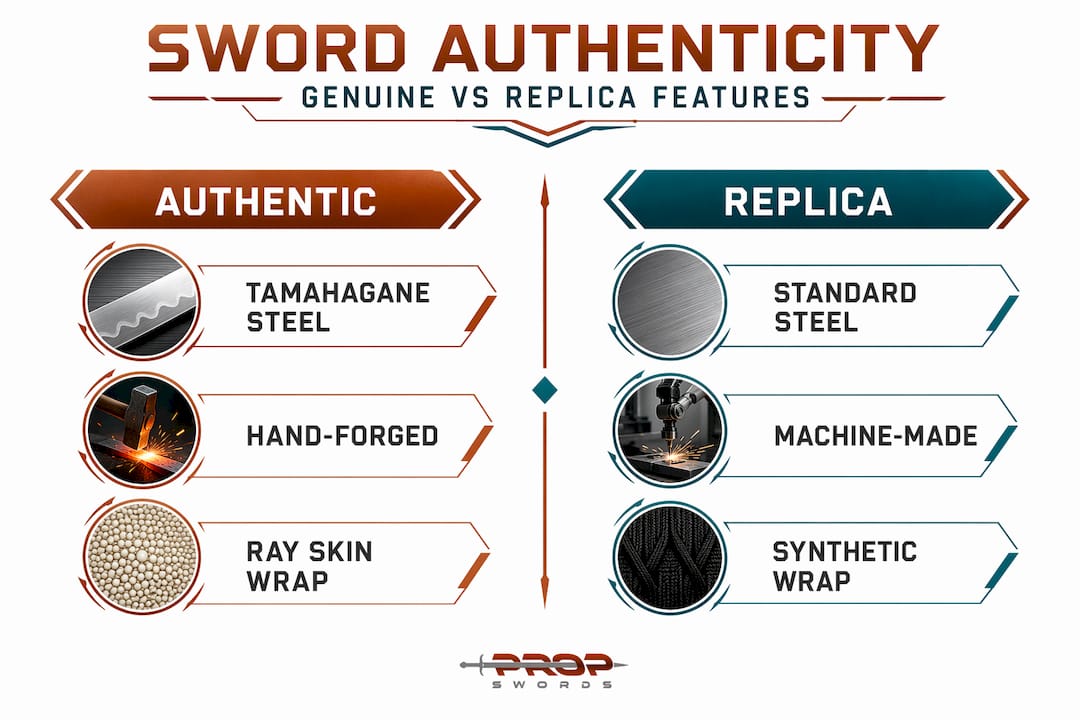
| Steel type | Tamahagane or period-equivalent | Stainless or carbon steel, industrially processed |
| Hamon | Natural, formed through clay tempering | Acid etched or laser engraved |
| Handle (tsuka) | Genuine ray skin, silk wrapping | Synthetic alternatives, machine-stitched |
| Balance | Optimized through hand-forging | Approximated, often heavier at tip |
| Documentation | NBTHK or equivalent papers, original to blade | None, or manufacturer certificate only |
| Nakago (tang) | Aged, file-marked, may bear hand-chiseled mei | Machine finished, often unsigned |
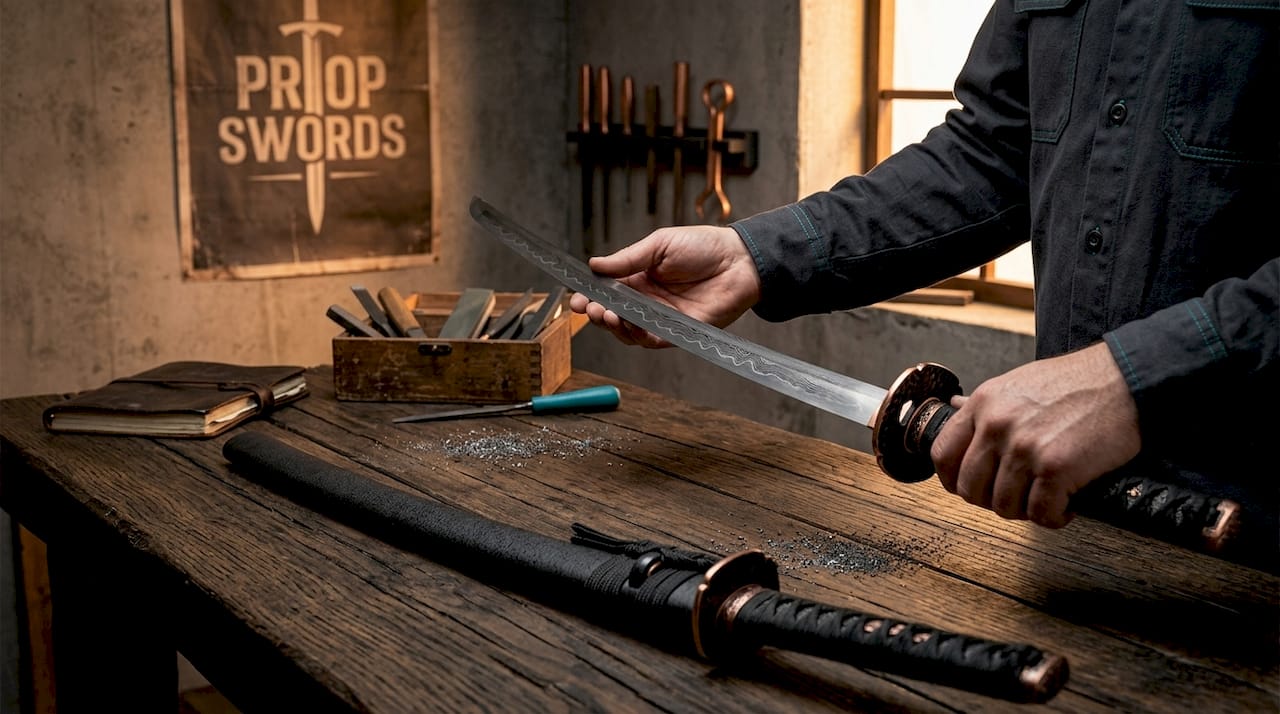
Authentic katana handles feature genuine ray skin and silk wrapping, while replicas tend to use synthetic substitutes. Running your hand along the tsuka, the grip, of a genuine blade feels categorically different from a synthetic wrap. The ray skin, called same, has a granular texture that is distinct and consistent with historical records.
Balance is another telling indicator. Replicas do not replicate the balance and responsiveness of authentic swords, which affects function despite visual similarity. An authentic katana is balanced at a specific point relative to the guard, making it feel alive in the hand. A replica, even a well-made one, tends to feel front-heavy or statically weighted.
Pro Tip: Always request the original certification papers with the blade, not a photocopy. Cross-reference the listed nagasa (blade length) and sori (curvature) against the actual sword using a soft measuring tape. Any discrepancy warrants a closer look.
Common red flags when evaluating a purchase include blades with laminated stickers in place of actual papers, certificates where the blade description is typed rather than formally written, and sellers who refuse physical inspection before payment.
For collectors interested in understanding these identification techniques in more depth, exploring resources on replica sword authentication can sharpen your eye before you spend serious money.
Mumei blades and the valuation complexities collectors miss
One of the most misunderstood corners of sword collecting involves blades that bear no signature at all. These are called mumei, meaning unsigned. Many collectors immediately downgrade mumei blades in their minds, assuming unsigned means lower quality or unknown origin. That assumption costs them real opportunities.
Some authentic swords do not bear signatures due to historical tang shortening. The process, called suriage, involved shortening the nakago to fit a new mounting. When smiths did this, the original signature was often cut away entirely. The blade itself retained its original quality, but the visible proof of maker identity was gone.
Key realities about mumei blades that serious collectors understand:
- A mumei blade from a recognized period and school can carry significant monetary and historical value.
- NBTHK certification can still attribute a mumei blade to a maker, school, or period based on construction characteristics alone.
- Mumei blades with NBTHK certification can command strong market values, sometimes exceeding gimei blades because there is no forgery risk attached.
- Many collectors overvalue signed swords without certification, ignoring mumei blades with proper verification that often hold better value.
The counterintuitive truth is that a mumei blade with clean certification can be a safer acquisition than a signed blade without verified papers.
Practical steps for verifying authenticity and avoiding fraud
Applying authentication knowledge to real purchase decisions requires a structured approach. Here is how to work through it.
- Request original documentation first. Before inspecting the blade, ask for any certification papers. If the seller only has photocopies, that is a non-starter. Original NBTHK papers are irreplaceable.
- Cross-reference blade metrics. Measure the nagasa, sori, and motohaba (base width) against what the certificate states. Even a small discrepancy suggests either the wrong papers or post-certification alteration.
- Inspect the nakago closely. Check file marks, patina, and any mei for signs of machine finishing or modern tooling. Patina on an authentic tang should be consistent with age, not artificially applied rust.
- Consult a trusted dealer or appraiser. For significant purchases, an independent shinsa review or a trusted nihonto dealer’s opinion adds a critical verification layer.
- Understand the NBTHK submission process. NBTHK authentication takes 2 to 4 months per blade, with limited submission windows each year. Authentication requires certified agents for overseas collectors, adding both time and cost to the process.
- Evaluate replicas on their own terms. A high-quality replica from a reputable source has a clear place in display collecting and cosplay. The issue is only when a replica is misrepresented as authentic.
Pro Tip: When evaluating a sword’s material quality and construction, compare the stated steel type against the appearance of the nakago. Authentic period blades show specific aging patterns and file-mark styles that are consistent with their attributed school.
For display and appreciation purposes, learning to identify quality replica swords through material comparison and craftsmanship details gives you a practical skill applicable across both authentic and replica markets.
My honest take on sword authenticity and where collectors go wrong
I’ve watched collectors make the same costly errors repeatedly, and most of them trace back to one misconception: that a visible signature equals authenticity. In my experience, the signed blade on the table is often the one to approach with the most skepticism. 60 to 70 percent of signed blades on the open market carry forged signatures, and some of those forgeries are genuinely difficult to detect without expert review.
What I’ve found is that the most underrated collector strategy is pursuing mumei blades with solid certification. You avoid the gimei risk entirely, and you often pay less because the general market still undervalues unsigned blades. The knowledge gap works in your favor if you’ve done the work.
On replicas: I think the framing around them gets unnecessarily polarized. A well-crafted replica that accurately represents its source material is not a lesser object. It is a different object. The problem is fraud, not the replica category itself. When Propswords curates replicas with accurate construction detail and clear provenance, that serves collectors who want the visual and tactile experience without the authentication burden of historical acquisition.
The practical wisdom I’d pass on is this: build your knowledge before you build your collection. An expert criteria checklist for historical assessment is worth more than any single purchase because it compounds. Every sword you evaluate correctly teaches you something the next one cannot.
— Muhammad
Explore quality replicas and authentication resources at Propswords
Whether you’re refining your eye for authentic swords or building a display collection with high-quality replicas, Propswords provides curated options that combine realistic craftsmanship with clear, honest provenance. Every piece in the catalog is selected for detail, material quality, and visual accuracy, so you know exactly what you are getting.
Browse the best replica swords of 2026 for a selection that spans anime, historical, and cinematic categories, each with the kind of construction detail collectors actually care about. If cosplay is your focus, the safe and realistic replicas guide offers specific guidance on preparation, handling, and presentation. Propswords ships free within the USA, making it straightforward to add a piece that earns its place in any collection.
FAQ
What does sword authenticity actually mean?
Sword authenticity refers to verification that a blade was made using traditional materials, historical forging methods, and documented maker lineage, confirmed through expert examination or official certification. Age alone does not make a sword authentic.
How do I verify sword authenticity before buying?
Request original certification papers such as NBTHK Hozon or higher, cross-reference the blade metrics against what the certificate states, inspect the nakago for age-consistent patina and hand-chiseled signatures, and consult a reputable dealer or appraiser for independent confirmation.
What is a mumei blade and is it worth buying?
A mumei blade is an unsigned authentic sword, often unsigned because the tang was shortened historically, removing the original signature. Mumei blades with NBTHK certification can hold strong collector value and carry no risk of forged signature fraud.
Can a replica sword be considered authentic?
A replica is not authentic in the historical sense, but a quality replica can be authentic to its source material in terms of design accuracy and craftsmanship. The distinction matters for collecting purposes: replicas should never be misrepresented as historical originals.
How long does NBTHK sword authentication take?
The NBTHK shinsa process typically takes 2 to 4 months per blade, with only a few submission windows available per year. Overseas collectors must work through certified licensed agents, which adds time and cost to the process.
Recommended