


Theo’s hilt, Galadriel’s dagger, the fragments of Narsil, and Aeglos are the story pivots of The Rings of Power so far, and Arondir’s blade and Adar’s weapon aren’t far behind. Each carries its own piece of Middle-earth history, from Valinor forges to the eruption that created Mordor, and each has become a target for collectors chasing accurate replicas. This guide walks through what each weapon does in the story, what’s confirmed lore versus fan theory, and what to check before you buy a version for your own display case.
TL;DR:
- Theo’s hilt is a supernatural device that triggers Mordor’s formation through blood activation, making it the most plot-critical weapon in the series.
- Galadriel’s dagger, originating from Valinor, is used in forging the Three Rings, linking it directly to the central magical artifacts of Middle-earth.
- Narsil’s shards connect to the epic narrative by representing the lineage leading to Aragorn’s kingship and are considered close to canon, unlike the show’s original inventions.
- Elven weapons like Aeglos and Galadriel’s dagger feature delicate, mirror-polished designs, while Orc and Dwarven weapons show rough craftsmanship and utilitarian features.
- Replicas should be chosen based on their intended use, with display pieces emphasizing finish accuracy and cosplay versions prioritizing durability and comfort.
Table of Contents
- What Are the Most Important Swords in Rings of Power?
- How Do These Blades Connect to First Age History and the Rings?
- Elven, Orc, and Dwarven Design Cues You Can Spot on Screen
- How to Buy and Care for a Rings of Power Sword Replica
- Historical and Mythological Significance of Swords in the Series
- Swords vs. the Rings of Power: Comparing Symbolic Weight
- Who Wields These Swords, and What Are Their Arcs?
- Crafting and Forging Techniques in the Middle-earth Context
- Swords in the Series’ Major Battles and Turning Points
- How Do Show Swords Differ From the Original Lore?
- Propswords’ Perspective: Sourcing and Curating Lore-Accurate Replicas
- Where to Start: Propswords Replicas That Match These Blades
- Sources
- FAQ
What Are the Most Important Swords in Rings of Power?
The most narratively loaded weapons in the series aren’t always the flashiest ones on screen. A few objects carry weight far beyond their size: one small hilt reshapes an entire region, and one dagger’s metal ends up woven into the most powerful rings the Elves ever made.
Here’s the roster fans keep asking about, ranked roughly by how much plot they carry.
- Theo’s hilt (the dark blade): A blood-activated relic that helps trigger the eruption forming Mordor.
- Galadriel’s dagger: A Valinorean blade whose metal reportedly ends up in Celebrimbor’s ringcraft.
- Narsil (the shards): The broken sword with the deepest franchise pedigree, tied to Sauron’s defeat and Aragorn’s destiny.
- Aeglos: Gil-galad’s signature glaive, one of the show’s most narratively important weapons.
- Arondir’s sword: A Silvan Elf’s practical blade, grounded in the Southlands storyline rather than high mythology.
- Adar’s sword: A weapon that signals his complicated, half-Elven, half-Orc-commanding identity.
- Durin’s hammer: Not a sword at all, but the Dwarven counterpart worth knowing since it shows up in every “weapons of Rings of Power” conversation.
Some of these are confirmed on screen with dialogue and close-up shots. Others are pieced together from production interviews, costume department comments, and careful frame-by-frame viewing by outlets like CBR. Knowing the difference matters if you’re trying to sound informed rather than repeat forum speculation as fact.
Theo’s hilt deserves the top spot because it does something almost no other prop in the show does: it changes geography. When Theo discovers the corroded hilt buried near the Southlands, it looks like scrap metal. It isn’t. Episode recaps confirm the object functions as a supernatural key, one that activates through blood contact and ultimately helps trigger the dam collapse and volcanic eruption that forms Mordor, according to Nerdist’s breakdown. It’s less a weapon and more a mechanism disguised as one, and GamesRadar’s episode analysis walks through exactly how the blood activation plays out on screen and why the show treats it as a device rather than a sword you’d swing in combat.
Galadriel’s dagger works differently. It’s introduced as a personal weapon, something she’s carried since Valinor, and its blade has the kind of mirror finish that signals Elven manufacture rather than battlefield wear. The bigger reveal is material, not tactical. CBR’s rings and artifacts explainer notes that Celebrimbor later repurposes the dagger’s precious metal when forging the Three Rings, meaning a weapon fans watched Galadriel use in early episodes becomes physically part of the most consequential magical objects in the entire saga.
Narsil’s shards carry weight for a different reason: they’re the connective tissue to the Lord of the Rings films. The sword that cuts the One Ring from Sauron’s hand in the prologue everyone remembers is the same blade whose fragments eventually become Andúril. Watching for where the pieces appear, who holds them, and how the show frames their significance is part of the fun, and CBR’s weapons ranking places Narsil and Aeglos among the series’ most narratively important blades for exactly this reason.
Aeglos belongs to Gil-galad, and the show uses it the way Tolkien’s appendices do: as a marker of High Elven authority. It’s a glaive rather than a straight sword, longer and built for reach, and its appearances tend to coincide with major political or military moments rather than casual scenes.
Arondir’s sword and Adar’s weapon round out the list for different reasons. Arondir’s blade is practical Silvan Elf gear, built for a soldier stationed among mortals rather than a lord in a palace. Adar’s sword, by contrast, reflects his contradictions: Elven craftsmanship filtered through decades of Orc leadership, which shows up in the weapon’s wear pattern and grip style.
Durin’s hammer isn’t a sword, but no weapons roundup for this series is complete without it. It represents Dwarven metalworking philosophy: dense, functional, built to survive centuries underground rather than to look elegant in torchlight.
How Do These Blades Connect to First Age History and the Rings?
The show’s weapon lore isn’t invented from nothing. It borrows real scaffolding from Tolkien’s First and Second Age history, then fills gaps with original plot devices where the source material stays quiet.
Celebrimbor’s ringcraft sits at the center of this. He’s the Elven smith responsible for forging the Rings of Power, working alongside Sauron in disguise as Halbrand or Annatar depending on how far the story has moved. Esquire’s rings explainer walks through why mithril and precious metals matter so much to the plot: the show treats metal purity and origin as a stand in for moral and magical weight, which is why Galadriel’s dagger being melted down into the Three Rings isn’t a throwaway detail. It’s the show telling you these Rings carry a piece of Elven history literally forged into them.
The dark blade functions on a different register entirely. Rather than tying to a named smith or kingdom, it reads as leftover machinery from the Morgoth or early Sauron era, a device built for a single destructive purpose rather than combat. That’s a deliberate departure from how Tolkien typically writes named weapons, and it’s worth flagging clearly: the show invented this specific mechanism. It’s not pulled from The Silmarillion or any appendix.
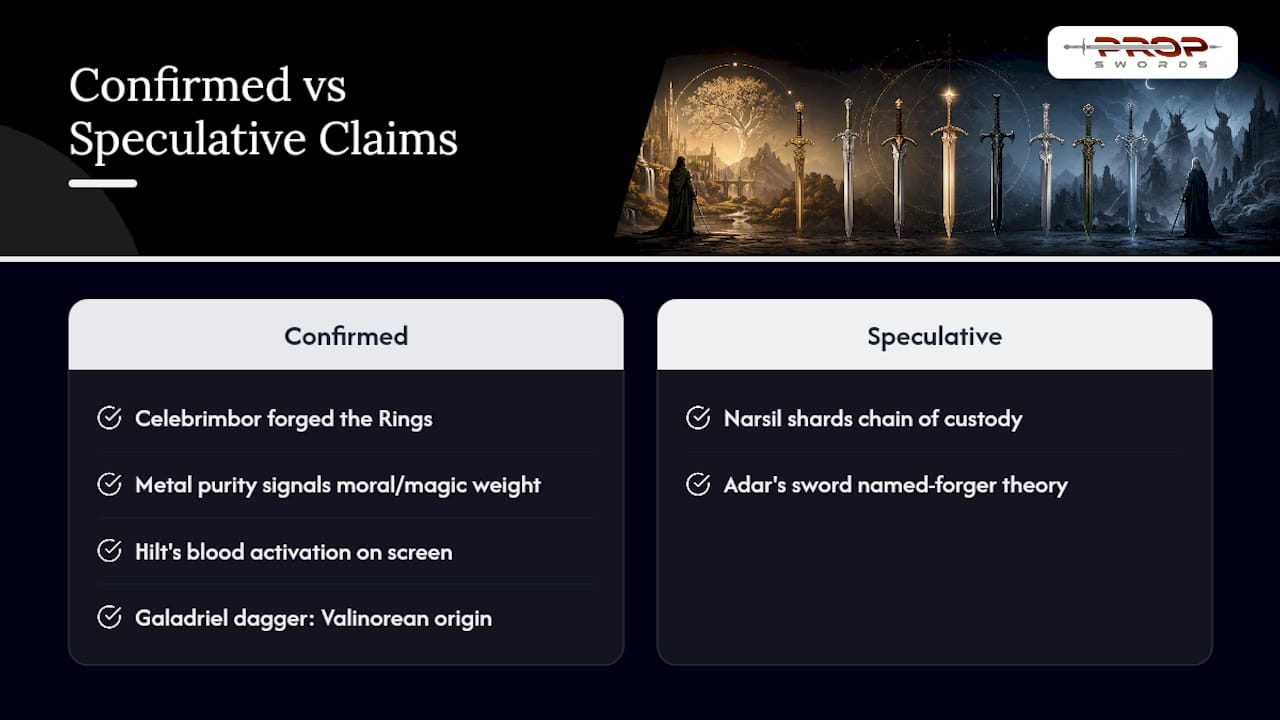
Here’s where fans should stay careful. Confirmed on screen: the hilt’s blood activation, its role in the eruption, and Galadriel’s dagger’s Valinorean origin. Interpretive: the exact chain of custody for Narsil’s shards between show timelines, and some fan theories about Adar’s sword having a named forger. Treat the first category as fact and the second as informed speculation.
Elven, Orc, and Dwarven Design Cues You Can Spot on Screen
Weapon design in this series does a lot of storytelling without a single line of dialogue. Elven blades favor mirror-polished steel, delicate engraving along the fuller, and a lightweight silhouette that reads as almost weightless in the actor’s hand. Galadriel’s dagger and Aeglos both fit this mold: thin profiles, clean lines, minimal ornamentation beyond subtle script or sigil work near the hilt.
Orc weaponry sits at the opposite end. Expect cruder forge marks, deliberate asymmetry, and surface rust or corrosion built into the prop rather than added through wear. Adar’s sword splits the difference, since his Elven origin shows through in the blade’s underlying shape even as decades among Orc forces have roughened the fittings and grip.
Dwarven work, represented by Durin’s hammer, trades elegance for mass. Thick, dense forms built for leverage rather than speed. Material lore matters here too: mithril and pure silver or gold aren’t just pretty. The show uses metal appearance as a visual shorthand for value and, sometimes, corruption. Watch for close-ups on sigils near the hilt, attachment points where a blade meets its guard, and small maker’s marks. Fandom-catalogued prop breakdowns, like the entry on the hilt, track these details across episodes, though treat community wikis as a supplement to official coverage rather than a primary source.
How to Buy and Care for a Rings of Power Sword Replica
Not every replica serves the same purpose, and matching the right type to your actual use case saves you money and disappointment. A display piece meant for a shelf mount doesn’t need the same specs as something you’re planning to wear at a convention for eight hours.
- Pick your category first. Display replicas prioritize finish and proportion accuracy over durability. Cosplay-safe versions trade some detail for lighter weight and rounded edges. Full-metal replicas aim for the closest look and heft to what’s on screen, and suit collectors who want something museum-grade.
- Check the finish before anything else. A true mirror-polish reads very differently under light than polished plating, and Elven-style pieces especially should show that deep, near-liquid shine rather than a dull sheen.
- Verify proportions against screen references. Blade length, guard width, and hilt shape should roughly match what you’ve seen in episodes, not just the general “fantasy sword” silhouette.
- Inspect fittings and sheath quality. Loose pommels, visible glue seams, or a scabbard that doesn’t hold the blade snugly are red flags worth walking away from.
- Ask about handle wrapping and grip material. Wire wrap, leather, or synthetic grips all age differently, and the wrong choice can loosen within months of regular handling.
Pro Tip: Store display blades away from direct humidity and sunlight, wipe them with a lightly oiled cloth every few weeks, and mount them on a stand that supports the blade’s weight along its spine rather than just at the tip and guard.
Propswords lists product pages built around exactly these lore cues, and its Sword Care Essentials guide goes deeper into cleaning schedules and long-term storage if you’re planning to keep a piece for years rather than one convention season.
Historical and Mythological Significance of Swords in the Series
Weapons in this universe rarely function as pure combat tools. Each named blade tends to carry a genealogy, a maker, or a moment tied to it, which mirrors how Tolkien treated named swords throughout his broader legendarium. Narsil’s later identity as Andúril isn’t decoration. It’s the physical thread connecting the Second Age directly to Aragorn’s coronation thousands of years later.
That same logic extends to smaller objects. Theo’s hilt looks like junk until its blood activation reveals a mythological function baked into its design from the start, something built with purpose by hands the show never fully names. Galadriel’s dagger carries a quieter kind of history: a personal weapon that becomes raw material for magic on a civilizational scale.
The mythology also works as a class marker. Elven blades signal age and craftsmanship. Orc weapons signal desperation and improvisation. Dwarven tools signal permanence, built to outlast the individual who forged them. None of this is accidental. The production team uses weapon design the way Tolkien used lineage and language: as a shorthand for who a character is and where their people came from, without needing a paragraph of exposition to explain it.
Swords vs. the Rings of Power: Comparing Symbolic Weight
Both categories of object represent power, but they encode it differently. A sword’s authority is visible and immediate. You see Aeglos in Gil-galad’s hand and understand instantly that you’re looking at a High Elven lord. The Rings work on delay and consequence instead. Their power is invisible until it’s used, and its cost often reveals itself slowly, sometimes across centuries.
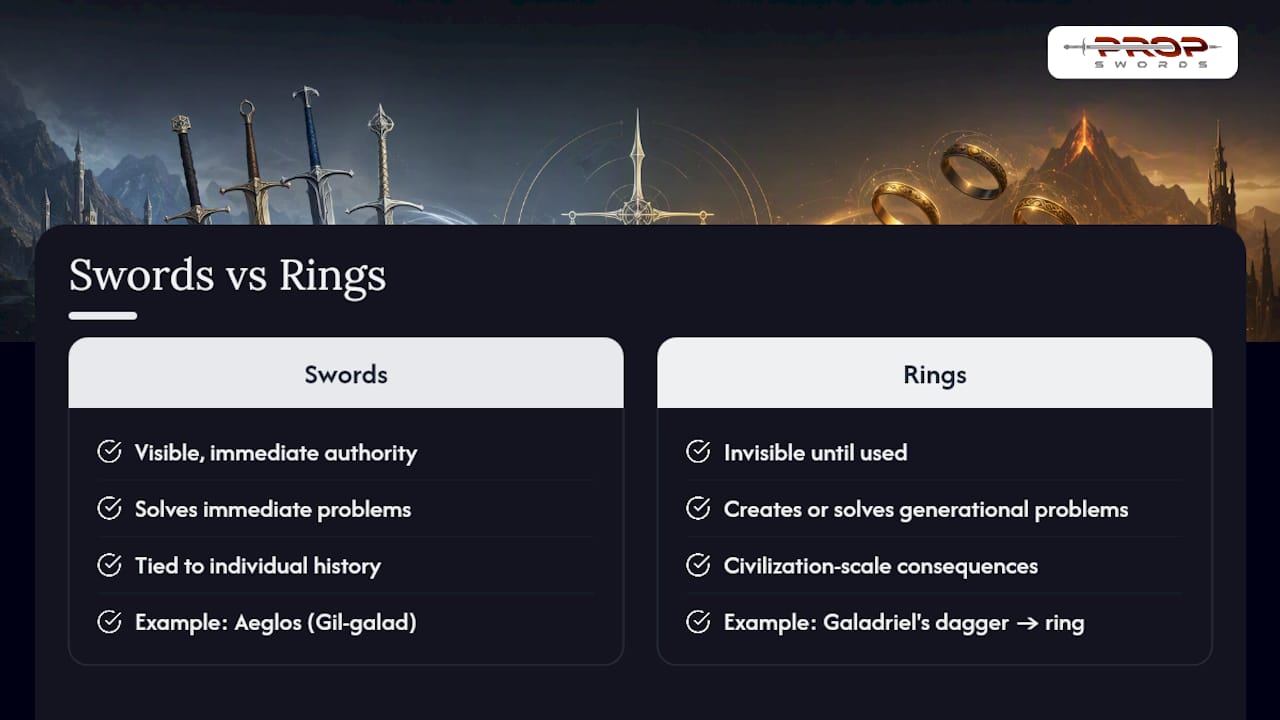
The overlap between the two categories is where the show gets genuinely clever. Galadriel’s dagger is the clearest example: a sword whose entire narrative purpose is to become part of a ring. It starts as a personal, visible symbol of one Elf’s history and ends as an invisible component inside an object with civilization-altering consequences. That transformation, from steel you can hold to magic you can’t see, tracks the show’s larger argument about power. Physical weapons solve immediate problems. Rings solve, or create, problems on a generational scale.
Collectors have picked up on this distinction too. Weapons tied to a clear in-universe story, especially ones connected to the Rings themselves, tend to draw more sustained interest than generic background props, a pattern outlet tracking the franchise’s most important weapons have noted repeatedly. A sword means more once you know what it eventually becomes or helps create.
Who Wields These Swords, and What Are Their Arcs?
Theo starts the series as a reluctant, almost accidental custodian of the dark blade’s hilt, unaware of what it actually does. His arc tracks a teenager forced into a role he never asked for, discovering that an object he half wants to sell for scrap is actually one of the most dangerous artifacts in the Southlands.
Galadriel’s arc runs longer and heavier. Her dagger is a physical extension of grief and unfinished war, carried since Valinor through centuries of searching for Sauron. By the time its metal ends up in Celebrimbor’s forge, the weapon has already done its narrative job: establishing her as someone who never fully sets down what she’s fighting for.
Arondir’s sword arc is smaller in scale but grounded in something the show does well: a soldier stationed far from home, protecting mortals he’s not required to protect, using a weapon that’s practical rather than legendary. Adar’s sword tells a stranger story, an Elven blade carried by someone who commands Orcs and refuses easy categorization as villain or victim. Each wielder’s relationship to their weapon says almost as much about them as their dialogue does.
Crafting and Forging Techniques in the Middle-earth Context
Middle-earth’s forging traditions split cleanly along cultural lines, and the show leans into that split visually rather than explaining it through dialogue. Elven smithing, epitomized by Celebrimbor, treats metalwork as closer to art than industry: precise proportions, minimal waste, and a finish meant to last without corroding for centuries.
Dwarven forging, represented by tools like Durin’s hammer, prioritizes function and mass. Less concerned with elegance, more concerned with a piece that survives generations of mining and combat underground. Orc forging sits at the rougher end of the spectrum, often depicted as improvised, using whatever metal is available rather than sourcing ideal material.
The show’s most interesting forging moment ties directly back to the Rings themselves: Celebrimbor’s process of reworking existing metal, including material sourced from Galadriel’s dagger, into something new and vastly more powerful. That’s a specific choice worth noting. Rather than mining fresh material, the show frames the Three Rings as built partly from repurposed history, which reinforces the idea that power in this universe often comes from transformation rather than creation from scratch.
Swords in the Series’ Major Battles and Turning Points
The eruption sequence tied to Theo’s hilt stands as the clearest example of a weapon directly causing a world-altering event rather than just appearing in one. The hilt’s activation isn’t background detail during the Southlands’ destruction. It’s the mechanism that helps trigger the collapse leading to Mordor’s formation.
Battle sequences involving Arondir and the Silvan Elves use swordplay to establish stakes on a smaller, more personal scale, contrasting against the hilt’s civilization-level consequences. Watching how the show alternates between intimate combat and world-changing weapon lore is part of what makes the pacing work across the first season. Aeglos, tied to Gil-galad’s authority, tends to surface during moments establishing political stakes rather than pure combat, reinforcing that some weapons in this universe are symbols of command as much as tools of war.
How Do Show Swords Differ From the Original Lore?
Tolkien’s written appendices confirm Narsil, Aeglos, and the general concept of Elven-forged blades tied to specific lords and kingdoms. What the show adds is invention filling gaps the books never addressed directly: Theo’s hilt has no direct textual equivalent, and its blood-activation mechanic is an original plot device built specifically for this adaptation.
Galadriel’s dagger occupies a middle ground. Tolkien never details a specific weapon of hers being melted into the Three Rings, but the show’s choice fits thematically with how he wrote Celebrimbor’s ringcraft as dependent on rare, precious material. It’s an invention that respects the spirit of the source even without a direct citation.
The practical takeaway for fans: treat named weapons with deep appendix history, Narsil and Aeglos especially, as closer to canon-adjacent. Treat the dark blade and some of Adar’s backstory as original television invention built to serve this specific adaptation’s plot needs, not gaps Tolkien left for someone else to fill.
Propswords’ Perspective: Sourcing and Curating Lore-Accurate Replicas
We treat these weapons as stories first and products second, which changes how we curate a catalog. [brand_signal: author experience with Rings of Power props] means we pay attention to details a lot of sellers skip: the mirror-polish that makes an Elven blade actually look Elven, sigil placement that matches screen reference rather than guesswork, proportions that hold up next to a paused frame from the show. [brand_signal: customer feedback on replica accuracy] shapes which listings we keep and which we drop. If you’re chasing a Numenorean-style piece, our Numenorean sword page reflects that same standard.
— Muhammad
Where to Start: Propswords Replicas That Match These Blades
If you’ve read this far, you already know which blade speaks to you, and Propswords is built for exactly that next step: no guessing which listing actually matches the screen reference, just replicas curated against the lore details this guide just covered.
The Numenorean sword fits fans chasing the Elendil bloodline aesthetic, with proportions built to echo the show’s Southlands-era Númenórean styling. The Galadriel’s dagger replica matches the Valinorean origin story covered earlier, right down to the finish that should read as precious metal rather than costume-grade alloy. For fans set on the franchise’s most iconic broken blade, the Narsil replica with wall mount and scabbard comes ready for display straight out of the box, mount included, which saves you a separate purchase most other listings leave out. Propswords ships free within the USA, and if you’re still comparing options, the top replica swords roundup is a fast way to see the current lineup side by side before you commit.
Sources
- Rings of Power: Theo’s sword hilt explained (Nerdist)
- The Rings of Power’s best weapons, ranked (CBR)
- The Rings of Power: the sword Theo found explained (GamesRadar)
- All the Rings in ‘Rings of Power’ explained (Esquire)
FAQ
What Is the Most Important Sword in Rings of Power?
Narsil carries the deepest franchise weight because its shards eventually become Andúril, but Theo’s hilt is arguably the most consequential single object of Season 1 since its activation helps trigger the eruption forming Mordor.
Is Galadriel’s Dagger Connected to the Rings of Power?
Yes. Celebrimbor reportedly uses the dagger’s precious metal when forging the Three Rings, tying the weapon directly into the show’s central magical objects.
What Type of Replica Should I Buy for Display vs Cosplay?
Choose a full-metal or display-grade replica with a true mirror-polish finish for shelf display, and a lighter, rounded-edge cosplay-safe version if you plan to wear or carry it at events; Propswords lists both categories with lore-matched finishes.
Are Theo’s Hilt and Adar’s Sword Based Directly on Tolkien’s Books?
No. Theo’s hilt is an original invention for the show with no direct textual source, while Adar’s backstory extends beyond what Tolkien’s appendices confirm about named Elven-Orc weaponry.
How Do I Keep a Metal Sword Replica From Corroding?
Wipe the blade with a lightly oiled cloth every few weeks, store it away from humidity and direct sunlight, and mount it on a stand that supports the spine rather than the tip, as outlined in Propswords’ Sword Care Essentials guide.
Recommended


