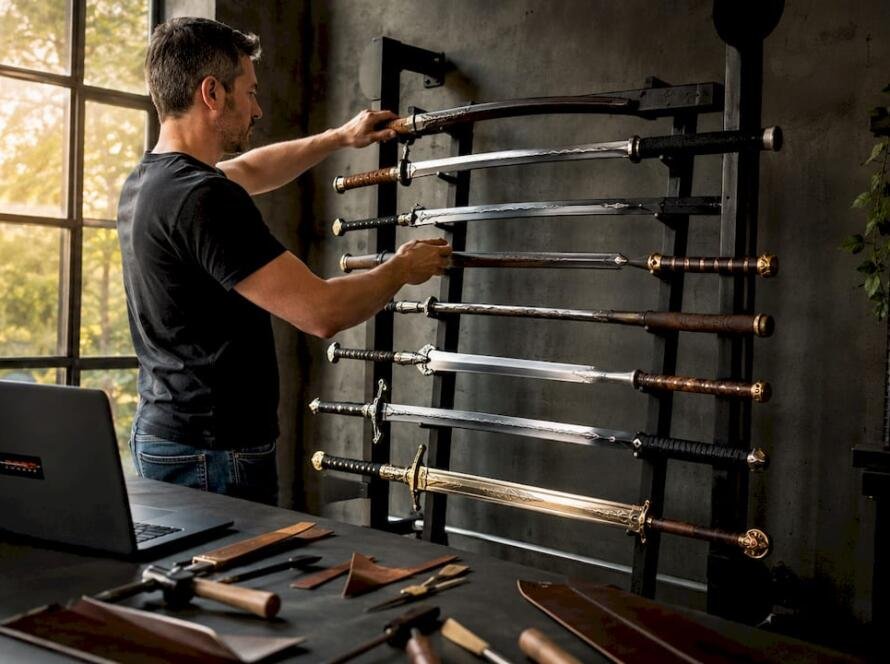
For most collections, the right setup is simple: horizontal dual-cradle mounts for katanas and grouped displays, vertical plaques or pegs for European blades or tight wall space, and a glazed shadowbox for anything irreplaceable. The one rule that overrides all of it: anchor into wall studs, or use toggle anchors rated well beyond the combined weight of the blade and mount hardware.
A typical katana runs 1.1 to 1.5 kg (2.4 to 3.3 lb), and a heavier decorative broadsword can hit 2 to 3 kg. That’s not much weight for a stud-anchored screw, but it’s more than enough to rip out of drywall on a hollow-wall anchor rated for picture frames.
Before you buy anything, keep two things in mind:
- Padded contact points (felt, microsuede, or leather) protect the finish; bare metal-on-metal cradles will scratch a blade over time.
- Check the listed weight capacity on any mount, not just its appearance. A gorgeous forged-black wall mount is useless if it’s rated for a letter opener.
Key Takeaways
The safest and best-looking sword displays come from matching mount type to blade weight and anchoring hardware into studs or rated toggles, not from any single decorative trick.
| Point | Details |
|---|---|
| Match mount to blade type | Horizontal cradles suit katanas; vertical plaques suit rapiers and tight spaces. |
| Anchor into studs | Use lag screws into studs or toggles rated 25 to 45 lb or more for hollow walls. |
| Protect the finish | Felt, microsuede, or leather padding prevents scratches; avoid moisture-trapping foam. |
| Keep consistent spacing | Space single-handed mounts 90 to 120 mm apart on one horizontal datum line. |
| Buy display-ready when possible | Propswords offers replicas marketed as display-ready with compatible mount options. |
Table of Contents
- Sword Wall Mount Ideas by Mount Type and Material
- How Do You Hang a Sword on the Wall Safely?
- What Spacing and Lighting Make a Sword Display Look Intentional?
- Safety Spacing, Kids and Pets, and Ongoing Maintenance
- Curated Sword Wall Mount Ideas by Category
- Custom Mount Options and Sourcing Your Own Materials
- An Honest Take on What Actually Matters Here
- Sources
- FAQ
Sword Wall Mount Ideas by Mount Type and Material
Not every blade wants the same mount. A katana displayed horizontally shows off the hamon, the wavy tempering line along the edge, in a way a vertical mount hides. European rapiers and broadswords, by contrast, tend to read better vertically, where their length becomes the visual statement. Swords Info’s collector guide makes this distinction a starting point for most home displays, and it holds up in practice.
Here’s how the main mount styles break down:
- Horizontal dual-support mounts use two pegs or cradles, one near the guard, one near the tip. Best for katanas, wakizashis, and anything you want displayed with the blade profile visible.
- Vertical single-support mounts (plaques, pegs, or a single hook) hold the sword tip-down or tip-up against the wall. Best for narrow spaces, hallways, and rapiers or sabers where length matters more than blade curvature.
- Hardwood cleat systems distribute weight across a mounted board rather than a single point. Best for heavier or antique pieces where you want load spread across multiple studs.
- Angled showcases and floating acrylic shelves create a “hovering” effect. Best for modern rooms and lighter display blades, not battle-ready steel.
- Shadowboxes with glazing seal the piece behind glass or UV acrylic. Best for irreplaceable or humidity-sensitive items you want protected from dust and handling.
Material choice matters as much as mount style. Padded contact surfaces like felt, microsuede, and leather prevent finish abrasion, but avoid foam padding in humid rooms since it can trap moisture and off-gas against the steel. In kitchens, basements, or coastal climates, stainless steel fasteners are worth the extra cost over standard zinc-plated hardware.
For the visible hardware itself, powder-coated steel and blackened metal finishes pair well with darker, industrial rooms, while hardwood mounts and brass hangers suit a more traditional study or den.
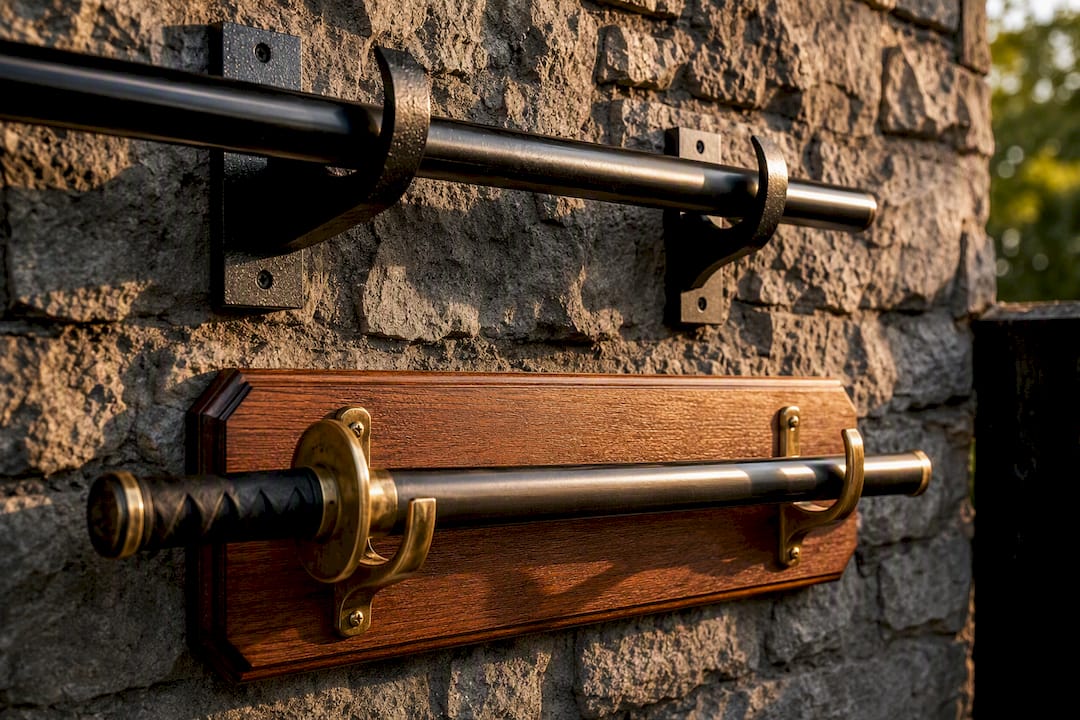
Pro Tip: If you’re mixing metals (a chrome hanger next to a brass-accented sword), test the pairing on a shelf first. What looks fine in a product photo can clash badly once it’s on your actual wall color.
How Do You Hang a Sword on the Wall Safely?
Getting a sword mount right is less about tools and more about sequence. Skip a step, and you either end up with a crooked display or, worse, a mount pulling out of the wall six months later.
- Measure and plan. Find your stud locations with a stud finder, then map the display height. A center-of-blade guideline around eye level, typically between 55 and 59 inches from the floor, puts most swords comfortably for viewing.
- Mock the layout. Tape the mount’s outline on the wall or use painter’s tape to trace the sword’s silhouette before drilling anything.
- Choose your anchor. For studs, use lag screws rated for the mount’s hardware. For hollow drywall sections, use 1/4-20 machine screws with toggle anchors rated 25 to 45 lb or higher, well past the sword’s actual weight.
- Drill pilot holes. Use roughly 3 mm (1/8 in) pilot holes for hardwood mounts to avoid splitting, and 2 mm (5/64 in) for softwood. Countersink screws so the mount sits flush.
- Mount and level. Drive the fasteners, check the mount with a level, and adjust before fully tightening.
- Add retention. A lower catch block, leather strap, or hidden magnet keeps the blade from sliding if the wall gets bumped.
- Test before you trust it. Apply gentle downward and outward pressure on the mounted sword. If anything shifts, stop and re-anchor before hanging the actual blade permanently.
Tools worth having on hand: stud finder, drill with the right bits, a level, a tape measure, the correct anchors for your wall type, and microfiber gloves so you’re not leaving fingerprints on freshly cleaned steel. Propswords’ own safety-focused display checklist walks through a similar sequence if you want a second reference before you start drilling.
What Spacing and Lighting Make a Sword Display Look Intentional?
Spacing is where most home displays go wrong. Crowd blades too close and the wall looks cluttered; space them too far apart and the collection loses cohesion. For single-handed swords mounted side by side, aim for 90 to 120 mm between mounts. Wider guards or crossguards need 120 to 150 mm to avoid visual crowding.
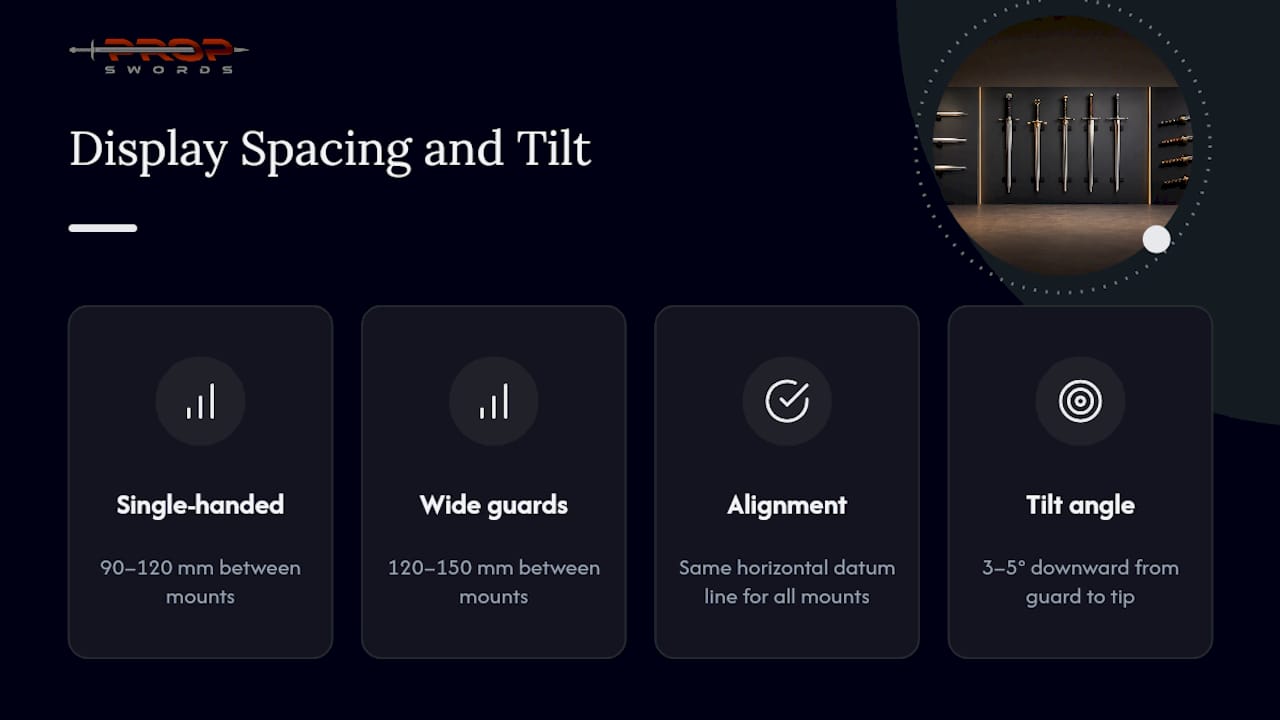
Keep every sword on the same horizontal datum line, even if the blades themselves differ in length. That single consistent reference point is what separates a “gallery wall” look from a scattered one. Historical Fencer’s collector guide recommends grouping pieces by era or theme rather than mixing styles indiscriminately, since a Viking blade next to an anime katana next to a rapier reads as random unless there’s a clear organizing idea behind it.
A slight downward tilt from guard to tip, roughly 3 to 5 degrees, makes a mounted sword look deliberate rather than crooked. It’s a small detail, but it’s the difference between “displayed” and “propped up.”
For lighting, warm white in the 2700 to 3000K range with a CRI of 90 or higher renders steel and wood tones accurately. Diffuse wall washers or concealed LED strips beat point spotlights, which tend to create glare hotspots on polished blades. Behind the display, semi-matte neutral or deep-toned backdrops keep the focus on blade geometry instead of a busy wallpaper pattern. Propswords’ lighting guide for fantasy collectors covers fixture placement in more detail if you’re building out a themed room.
Safety Spacing, Kids and Pets, and Ongoing Maintenance
Even a securely mounted sword needs breathing room. Keep blade tips at least 600 mm from any door swing and roughly 350 mm above any reachable surface like a couch back or a dresser. In homes with kids or pets, that clearance matters less than the mount itself: consider a locking case or a secondary retention strap rather than relying on gravity and a single cradle.
Environment affects the blade as much as the wall. Avoid mounting in bathrooms or kitchens, where humidity accelerates corrosion. Where moisture is unavoidable, stainless steel fasteners hold up far better than standard hardware, and it’s worth checking felt or microsuede padding periodically since it can trap condensation against the steel.
For cleaning, a lint-free cloth and a light coat of mineral oil keeps carbon steel from developing surface rust. Skip abrasive cleaners entirely; they’ll dull a finish faster than any amount of display time will.
- Check fastener tightness every 3 to 6 months.
- Inspect padding for wear or trapped moisture.
- Confirm anchors haven’t loosened from wall vibration (foot traffic, nearby doors, HVAC systems).
Pro Tip: If you live somewhere humid, a small silica gel packet tucked behind a shadowbox backing does more for corrosion prevention than most people expect.
Curated Sword Wall Mount Ideas by Category
Some mounts are built for volume; others are built for one showpiece. Here’s a shortlist across the main categories, with what to verify before buying.
- Universal padded pegs (Mythrojan-style hangers) suit lightweight display katanas and rapiers. Check peg diameter against your blade’s tsuba or guard, and confirm the padding material.
- Vertical sword and sleeve kits, like the Standard Vertical Sword & Sleeve Wall Mount, work well in narrow hallways and for scabbarded display. That listing includes angled posts, a leather retention strap, and protective bumpers as standard features, worth using as a benchmark when comparing kits.
- Hardwood cleat systems with custom pegs suit heavier or antique blades where load distribution across studs matters more than a slim profile.
- Acrylic floating shelves or clear mounts fit modern interiors that want a “hovering” display effect rather than visible hardware.
- Glazed shadowboxes protect valuable or humidity-sensitive pieces behind sealed, UV-rated acrylic.
| Mount Type | Material / Finish | Weight Capacity Fit | Installation Complexity | Typical Price Range |
|---|---|---|---|---|
| Universal padded peg hangers | Metal or wood, felt-lined | Light to medium blades (katanas, rapiers) | Low | Budget |
| Vertical sword and sleeve kit | Wood with leather strap | Light to medium, scabbarded swords | Low to moderate | Mid-range |
| Hardwood cleat system | Solid hardwood, custom pegs | Medium to heavy blades | Moderate to high | Mid-range to premium |
| Acrylic floating shelf/mount | Clear acrylic | Light display pieces | Low to moderate | Mid-range |
| Glazed shadowbox | Wood frame, UV acrylic glazing | Any, with protection priority | Moderate to high | Premium |
What to Check Before You Buy a Sword Mount
Confirm the listed weight capacity, and favor hardware that either mounts into studs directly or ships with rated heavy-duty toggles. Measure your sword’s guard and scabbard width against the mount’s peg spacing; a mismatch is the most common return reason. Check the contact material (felt or microsuede beats bare metal) and finish durability, whether that’s powder coat or hardwax oil, and read the return policy before committing to anything decorative and non-returnable.
Why Some Replicas Come Display-Ready
Propswords specializes in replica swords built with display in mind, and a number of pieces in the catalog are marketed as display-ready or ship with compatible wall mounts included. If you’re shopping for a piece specifically to hang, Propswords’ display guide and curated display collections make it easier to match a blade to a mount before you buy either one separately.
Custom Mount Options and Sourcing Your Own Materials
Off-the-shelf mounts cover most needs, but a custom build makes sense when you’re working with an oversized blade, an unusual guard shape, or a specific finish that nothing on the shelf matches. A local woodworker or metal fabricator can build a cleat system sized exactly to your sword’s guard width and blade curve, which matters more than it sounds for anything with an asymmetric hilt.
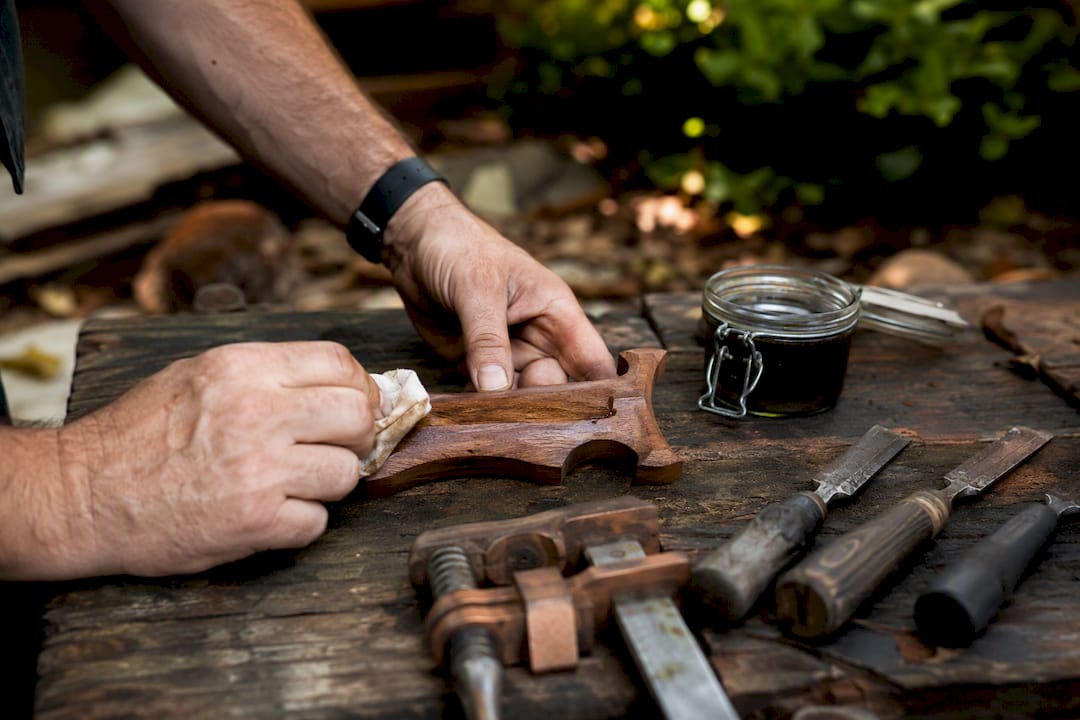
For hardwood cleats, oak, walnut, and maple are common choices because they hold screws well and finish cleanly with hardwax oil or a matte polyurethane. If you’re sourcing your own hardware rather than buying a kit, look for stainless steel or blackened steel brackets rather than standard zinc plating, particularly if the display room sees any humidity swings.
Felt and microsuede padding can be bought by the yard from most fabric or upholstery suppliers, which is often cheaper than buying pre-padded commercial mounts if you’re outfitting several pieces at once. Just make sure whatever adhesive you use to attach padding is fully cured before it contacts the blade; some contact cements off-gas for days.
If you’re mounting a particularly heavy or valuable Damascus steel piece, it’s worth having a fabricator weld a steel backing plate that spans two studs rather than relying on a single point of contact. It costs more upfront, but it eliminates the sag that shows up on wood-only cleats over a year or two of hanging weight.
An Honest Take on What Actually Matters Here
Most sword display advice fixates on aesthetics, angle, spacing, backdrop color, while treating the mounting hardware as an afterthought. That’s backward. A stunning horizontal arrangement with a 4-degree tilt and perfect lighting means nothing if the anchor pulls out of drywall in eight months. Get the hardware right first, then worry about whether your katana looks better next to a rapier or a wakizashi.
The other place conventional advice falls short: it treats every sword the same. A 1.2 kg display katana and a 3 kg forged broadsword have no business using the same peg hardware, yet plenty of generic mount listings don’t specify weight ratings at all. Ask for that number before you buy, not after something bends.
If you’re starting from zero, prioritize in this order: stud location, weight-rated hardware, padding, and only then the visual layout. Everything else, tilt angle, backdrop color, lighting temperature, is polish on a foundation that either holds or doesn’t.
Display-Ready Replicas for Your Next Sword Wall Setup
Propswords built its catalog around swords meant to be seen, not just owned, which means a number of pieces are designed with display in mind from the start rather than as an afterthought to a functional blade.
If you’d rather skip sourcing a separate mount entirely, browse the top replica swords for 2026 or the display-worthy movie sword collection, where pieces are curated specifically for wall presentation. Every order ships free within the USA, and customer support can answer fit questions about mounting hardware compatibility before you buy. If you already know which blade you want, checking mount compatibility first saves a return later.
Sources
- Best Ways To Display A Sword At Home | Safe, Stylish & Collector-Approved Ideas
- Standard Vertical Sword & Sleeve Wall Mount – 2" Gap (Made in The USA)
FAQ
How do I hang my sword on the wall?
Locate wall studs, mount horizontal or vertical padded hardware with lag screws (or rated toggle anchors for hollow walls), and test retention with gentle pressure before considering the job done.
What is a good bracket to hang a sword?
Padded metal or wood hangers, like universal Mythrojan-style hangers or a vertical sword and sleeve kit, work well as long as the bracket lists a weight capacity that matches your blade.
What is the best way to display a sword?
Horizontal dual-support mounts show off blade curvature and are popular for katanas, while vertical single-support mounts suit longer European swords and narrow spaces; shadowboxes protect valuable or humidity-sensitive pieces.
How do I display a katana on a wall?
Mount it horizontally with two padded supports, one near the guard and one near the tip, since this orientation is the traditional way to showcase the hamon along the blade’s edge.
Do Propswords replicas come with wall mounts included?
Some Propswords replicas are marketed as display-ready and include compatible wall mount hardware, which is worth checking on the product page before you source a mount separately.
Recommended