TL;DR:
- Practitioners must prioritize layered safety through correct equipment, controlled environments, and clear protocols before relying on PPE. Mastery involves understanding historical principles like measure, guard strategy, and economy of motion, which are rooted in authentic tradition. Recognizing common errors and respecting cultural context enhances both safety and proficiency in historic sword handling.
Historic sword handling is the disciplined practice of wielding historical blades with correct technique, structured safety protocols, and cultural awareness rooted in traditions like HEMA (Historical European Martial Arts). Whether you train with a longsword, a Viking seax, or a medieval arming sword, mastering this practice demands far more than physical strength. It requires understanding the HEMA safety hierarchy, selecting appropriate equipment, and internalizing the tactical principles documented in historical treatises. This guide delivers the technical depth and cultural context you need to practice authentically and safely.
What equipment and environment are essential for safe historic sword handling?
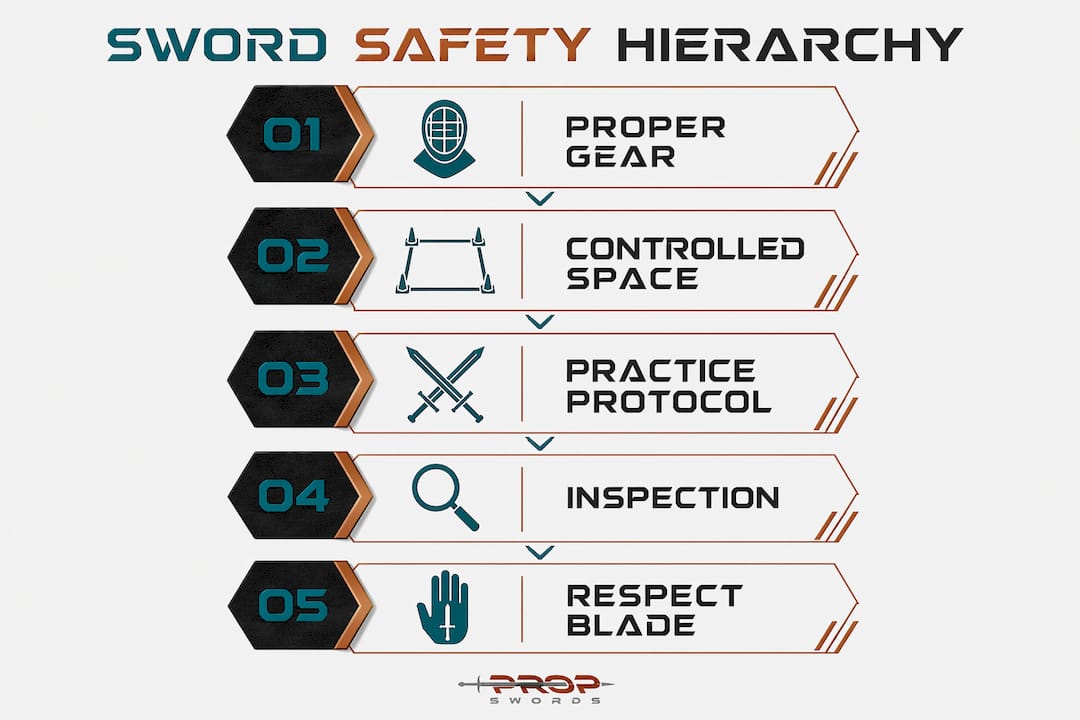
Safety in historic swordsmanship is layered, starting with safer equipment, then a controlled environment, then protocols, and finally personal protective equipment as the last line of defense. This hierarchy matters because no amount of padding compensates for a blade that is too rigid, too sharp, or poorly fitted. Get the equipment right before anything else.
Choosing the right training sword
Functional training swords must have blunted edges, flexible blades rated for contact, and secure fittings where the guard and pommel cannot loosen under impact. Steel feders, synthetic wasters from manufacturers like Black Fencer or Purpleheart Armory, and wooden shinai-style trainers each serve different training phases. A historically accurate replica typically weighs between 1.1 and 1.8 kg depending on type, and that weight distribution directly affects how you learn measure and cutting mechanics. Choosing a sword that is too heavy for your current strength level builds compensatory habits that take months to unlearn.
Personal protective equipment
Minimum PPE for any contact drill includes a fencing mask rated to at least 350 Newtons, padded gloves, a gorget for throat protection, and forearm guards. For full sparring, add a rigid chest plate, knee protection, and elbow cops. The mask is non-negotiable even in slow-work drills because accidental tip contact to an unprotected face causes serious injury at any speed.
Setting up a safe practice space
Safe sword handling requires a clearance radius equal to your arm span plus the full length of your sword in every direction. That translates to roughly 2.5 to 3 meters of clear space per practitioner. The floor must be non-slip. Controlled lighting prevents misjudging distance, and no bystanders should stand within the clearance radius during any live drill.
Pro Tip: Before every session, walk the perimeter of your practice space and physically touch each wall or boundary marker. This resets your spatial awareness and prevents the gradual drift that causes practitioners to crowd each other over a long training session.
| Sword type | Best use | Key safety feature |
|---|---|---|
| Steel feder | Full contact sparring | Flexible blade, blunted tip |
| Synthetic waster | Beginner drills | Lightweight, no edge risk |
| Wooden waster | Slow-work and form practice | Low injury risk, cheap |
| Display replica | Collection and study only | Not rated for contact |
How do you correctly handle and manipulate a historic sword step by step?
Correct handling begins before you ever draw the blade. The sequence below reflects standard HEMA club protocols and applies whether you are drilling solo or preparing to spar with a partner.
- Inspect the sword. Check that the pommel nut is tight, the guard is secure, and the blade has no cracks or burrs that could catch unexpectedly.
- Announce your draw. Verbally signal “drawing” before unsheathing in any group setting. This alerts everyone nearby to step clear.
- Draw with intention. Pull the blade straight from the scabbard without rotating the tip toward bystanders. Keep the point angled downward until you reach your starting guard.
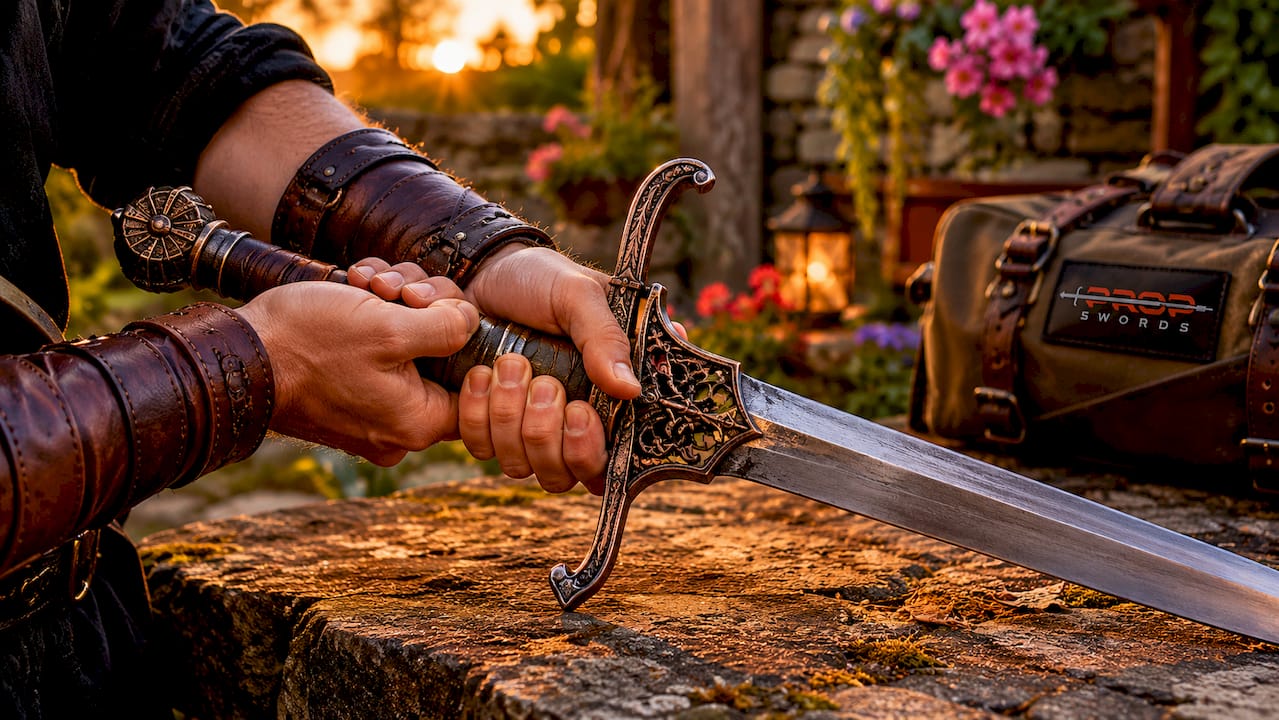
- Establish your grip. The correct grip is firm but relaxed, with fingers closed and the thumb aligned along the side of the grip rather than wrapped over the top. A white-knuckled grip causes fatigue within minutes and reduces your ability to feel blade contact.
- Carry in a safe position. When moving between drill stations, carry the sword in a vertical position at your side or in a recognized carry guard, never horizontally across your body.
- Conduct a mutual safety check. Before any sparring or partner drill, both practitioners verify each other’s PPE, confirm the session protocol, and agree on a stop word.
- Resheathe deliberately. After drilling, announce “sheathing,” guide the blade tip into the scabbard mouth with your off hand, and slide it home without rushing.
Pro Tip: Run a five-point inspection before every session: blade integrity, grip tightness, guard security, scabbard condition, and PPE fit. Experienced practitioners treat this as a ritual, not a checklist. The habit alone prevents the majority of equipment-related incidents.
The death grip is the single most common technical error among beginners. Gripping too tightly locks the wrist, kills sensitivity to blade contact, and telegraphs your movements to an experienced opponent. Gripping too loosely risks dropping the sword entirely. Practice the correct tension by holding the sword at your side and consciously releasing pressure until the blade just begins to feel unstable, then tighten slightly from there.
What are the fundamental sword fighting principles used in historical fencing?
Historical fencing is built on a small number of principles that appear across German, Italian, and Viking traditions. Understanding these principles separates a practitioner who can execute techniques from one who can apply them under pressure.
Measure and distance control
The tactical concept of measure in sword fighting refers to managing the distance between you and your opponent so that you can strike while remaining outside their effective range. Master-level practitioners constantly manipulate measure, collapsing the opponent’s reaction time by entering suddenly and withdrawing before a counter can land. Measure is not a static position. It is an active, continuous calculation that changes with every step.
Guards and their strategic purpose
Guards are not passive resting positions. The Lady’s Guard, documented by Fiore dei Liberi in his early 15th-century treatise Flos Duellatorum, hides the swordsman’s intent by keeping the blade low and angled away, making it impossible for the opponent to read whether a cut or thrust is coming. The Window Guard, by contrast, presents the blade high and forward, inviting an attack to a specific line so the defender can intercept and bind. Each guard is a question posed to the opponent, and the opponent’s answer determines your next action.
Cutting mechanics and economy of motion
Viking sword fighting prioritized economy of motion and hip-driven cuts rather than wide, arm-heavy swings. The basic cutting stroke is driven by the shoulder and hip together, with weight transferred forward through the cut and immediately reset for defense. Wide swings look powerful but leave the cutter exposed for the half-second it takes to recover. Historical sources consistently reward the practitioner who does less, not more.
“The sword is not the weapon. The mind that wields it is.” This principle, implicit throughout Johannes Liechtenauer’s Zettel and Fiore’s treatises, reflects the psychological dimension of historical fencing. Hiding intent and manipulating perception are as tactically important as any physical technique.
Blade binding, also called winden in the German tradition, involves maintaining contact with the opponent’s blade after a parry and using that contact to feel their next intention before they act on it. Off-hand techniques and buckler use add another layer, allowing the practitioner to control the opponent’s blade while delivering a thrust or strike with the sword hand.
What are the most common mistakes in historic sword handling and how can you avoid them?
Most injuries and accidents in historical sword practice trace back to a short list of repeatable errors. Recognizing them in your own training is the fastest way to eliminate risk.
- Drawing without checking surroundings. Always announce your draw and visually clear the space before unsheathing. A sword drawn into an unsuspecting bystander causes serious injury even at slow speed.
- Carrying a drawn sword horizontally. Horizontal carry sweeps the blade through the space occupied by people at waist and face height. Vertical carry at the side is the correct default.
- Skipping the equipment inspection. Common mistakes include skipping equipment inspection before sessions, which allows loose fittings and blade damage to go undetected until they cause an incident.
- Using display swords for sparring. Display swords have different steel properties and are not rated for contact. Using them in sparring risks blade fracture, which can send fragments toward both practitioners.
- Sparring without supervision or agreed protocols. Unsupervised sparring between practitioners who have not agreed on intensity, stop signals, and target zones is the leading cause of preventable injuries in HEMA clubs.
Pro Tip: Treat every sword as loaded, to borrow a firearms safety concept. Assume the blade is sharp and the space around you is occupied, even when you know it is not. This mental habit prevents the complacency that causes most accidents.
When transporting swords publicly, they must be secured in cases or sheaths, and event regulations require blunt or prop weapons depending on location. Carrying an uncased sword in public, even a blunt trainer, creates legal exposure and public alarm that reflects poorly on the entire HEMA community.
How does cultural and historical context enhance your sword handling practice?
Technical skill without historical context produces a practitioner who can execute movements but cannot understand why those movements exist. The why is where genuine mastery begins.
Fiore dei Liberi’s Flos Duellatorum (1409) and Johannes Liechtenauer’s Zettel (late 14th century) are the two most studied primary sources in HEMA. Fiore’s system organizes combat through a hierarchy of masters and scholars, each representing a principle rather than a fixed technique. Liechtenauer’s German tradition encodes its teachings in cryptic verse specifically to prevent casual readers from understanding the system without a qualified instructor. Both approaches reflect a culture that treated swordsmanship as a serious intellectual discipline, not a collection of memorized moves.
Viking sword culture, documented through sagas and supported by archaeological finds like the Ulfberht swords, reveals a fighting tradition built around the shield wall and one-on-one judicial combat. Understanding that context explains why Viking swordsmanship emphasized economy of motion over elaborate technique. A fighter in a shield wall has almost no room to swing wide. Every cut had to be short, direct, and immediately recoverable.
Studying these sources through organizations like the HEMA Alliance or the Meyer Freifechter Guild connects your physical practice to a living scholarly community. Reading a historical manual and then drilling its techniques the same day creates a feedback loop that accelerates understanding far beyond what physical repetition alone can achieve. Propswords offers a guide to historical sword reproduction that explains how replica features map to historical originals, which is a useful companion to primary source study.
Key takeaways
Mastering historic sword handling requires layered safety, correct technique, and grounding in the historical traditions that gave these weapons their purpose.
| Point | Details |
|---|---|
| Safety hierarchy first | Start with appropriate equipment, then environment, then protocols, then PPE. |
| Grip determines control | A firm but relaxed grip with the thumb aligned prevents fatigue and improves sensitivity. |
| Measure is the core skill | Controlling distance to strike while staying safe is the defining skill of historical fencing. |
| Context accelerates learning | Studying Fiore dei Liberi or Liechtenauer alongside physical drills builds faster understanding. |
| Display swords are not training swords | Using uncertified blades for contact practice creates serious injury and equipment risk. |
Why I think most practitioners underestimate the safety hierarchy
After years of working with historical weapons and studying how HEMA clubs operate, the pattern I see most often is practitioners who invest heavily in PPE but skip the foundational steps. They buy excellent masks and gloves, then drill in cramped spaces with swords that have loose pommels. The gear gives them confidence that the environment does not justify.
The HEMA safety hierarchy exists because PPE is the last resort, not the first defense. A controlled environment with proper equipment and clear protocols prevents the situation where PPE has to do its job. I have watched experienced practitioners get hurt not because their mask failed but because someone drew without announcing or carried a blade horizontally through a crowded room.
The historical sources reinforce this. Fiore and Liechtenauer both emphasize awareness and intention over physical force. The practitioner who controls the space, controls the timing, and controls their own grip is safer than the one wearing the most expensive armor. Invest in your protocols and your environment first. The gear follows.
Connecting with a structured HEMA club that uses reenactment event protocols as a baseline is the single fastest way to build these habits correctly from the start.
— Muhammad
Build your practice with the right replica swords

Choosing the right sword for study and display is as important as choosing the right training blade. Propswords carries a curated selection of historically accurate replicas spanning Viking, medieval, and fantasy traditions, each detailed for collectors and enthusiasts who take authenticity seriously. Whether you are sourcing a display piece to study guard positions and blade geometry or adding to a collection that reflects your training focus, the best replica swords for 2026 at Propswords are selected with both accuracy and quality in mind. Free shipping within the USA applies to all orders, and the catalog covers the full range from arming swords to longswords.
FAQ
What is the minimum safe space for sword practice?
Safe sword handling requires a clearance radius equal to your arm span plus the full length of your sword in every direction, on non-slip flooring with no bystanders inside that radius.
Can I use a display sword for sparring drills?
No. Display swords have different steel properties and are not rated for contact use. Sparring with a display sword risks blade fracture and serious injury to both practitioners.
What is “measure” in historical sword fighting?
Measure is the tactical management of distance between two fighters. Controlling measure allows a practitioner to strike while remaining outside the opponent’s effective range, and it is considered the central skill of historical fencing.
Which historical manuals should beginners study first?
Fiore dei Liberi’s Flos Duellatorum (1409) is widely recommended for beginners because its visual structure makes techniques easier to interpret. Liechtenauer’s Zettel is the foundational German text but requires guided instruction to decode correctly.
How do I transport a sword safely in public?
Swords transported publicly must be secured in a case or sheath at all times, and event regulations typically require blunt or prop weapons depending on local laws and venue rules.
Recommended