Light, food-grade mineral oil or its clove-scented cousin, choji, is the best sword oil for nearly every collection. Neither is fancy, and that’s the point. A thin, unbroken film applied consistently beats any premium bottle used sporadically. Skip WD-40 and cooking oil for long-term storage. They cause more problems than they solve.
TL;DR:
- Regular application of a thin, food-grade mineral oil film is essential for preventing rust, especially if the sword is handled frequently or stored in humid environments.
- Choji oil offers traditional Japanese scent and ritual value but provides no additional rust protection beyond plain mineral oil, which is more cost-effective.
- Camellia oil produces a lighter, less sticky coating suited for blades that are handled weekly, although it is more expensive than mineral oil.
- Avoid using crude cooking oils, vegetable oils, or petroleum-based lubricants like WD-40, as they oxidize, become acidic, or trap moisture, leading to corrosion.
- Consistent reapplication according to climate and usage, alongside proper storage and minimal handling, is more important for blade preservation than the specific oil brand or type used.
Table of Contents
- What Is the Best Oil for Swords, Type by Type?
- How Do These Oils Actually Compare?
- How Do You Clean and Oil a Sword Correctly?
- How Often Should You Oil a Sword?
- Which Oils Should You Never Put on a Sword?
- How Should You Store and Handle a Sword Long Term?
- Why Trust This Sword Care Advice?
- What Happens to a Blade Over Years of Oil Choice?
- What Oils Did Swordsmiths Use Historically?
- What Safety Precautions Matter When Handling Sword Oils?
- Where Can You Learn More About Sword Care?
- The Overlooked Truth About Sword Oil
- Sources
- FAQ
What Is the Best Oil for Swords, Type by Type?
Every recommended oil below does the same core job: block oxygen and moisture from reaching bare steel. Which one fits your blade depends on how often you handle it, what it’s made of, and whether tradition matters to you.
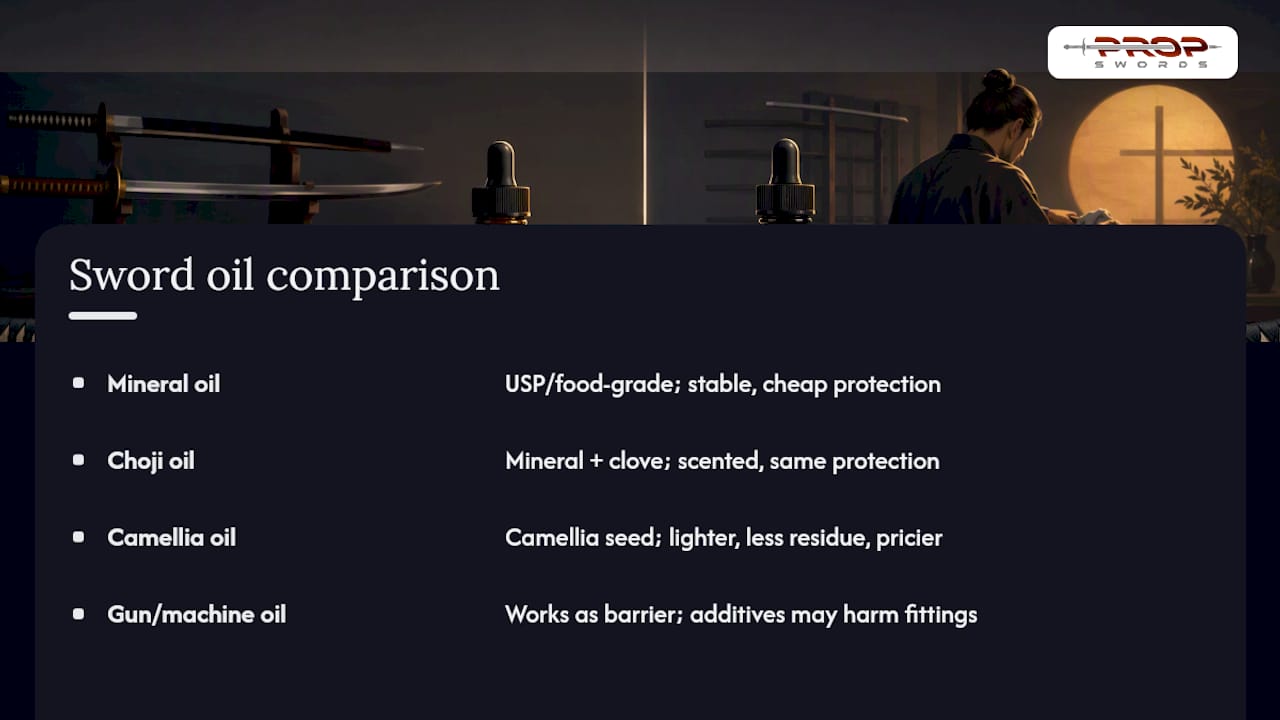
- Mineral oil (food-grade): The default choice for everyday care and long-term storage. Odorless, chemically stable, and cheap enough to reapply as often as needed.
- Choji oil: Mineral oil with a splash of clove oil, favored by katana collectors for its scent and its tie to traditional Japanese sword care.
- Camellia oil: A plant-derived alternative popular with people who handle their blades often, since it feels less greasy and doesn’t leave heavy residue on the hands.
- Gun oil or light machine oil: A reasonable substitute if you already have a bottle on hand, though you need to check the label for additives before trusting it on an antique.
- Sewing machine oil: Thin, widely available, and a fine stand-in when you’re out of anything else, though it lacks the anti-corrosion additives found in dedicated gun oils.
None of these is dramatically better than the others at the chemistry level. What separates a well-preserved blade from a rusted one is how often the oil gets renewed, a point that comes up again and again in community-focused sword care guidance.
How Do These Oils Actually Compare?
Mineral oil is refined petroleum with the reactive compounds stripped out, which is why it doesn’t oxidize or turn acidic the way organic oils do over time. Look for USP-grade or food-grade mineral oil, sold in pharmacies and grocery stores as a laxative or wood-conditioning product. It’s the same substance either way, and it’s the base ingredient in most dedicated sword oils sold to collectors, a detail confirmed by vendor guidance for katana owners. You don’t need to hunt down a specialty brand to get a chemically sound product.
Choji oil is that same mineral oil with a small amount of clove oil mixed in, traditionally a small but non-specified quantity of clove per liter of mineral oil. The clove adds a warm, spicy scent and connects the ritual to centuries of Japanese sword maintenance, but it isn’t doing any extra rust-fighting work. As one breakdown of sword oil options puts it, the clove component is cosmetic and traditional rather than functional. If you want the ritual, buy a small bottle of choji-yu from a Japanese sword supplier. If you just want protection, plain mineral oil does the same job for less money.
Camellia oil comes from the seeds of Camellia japonica and has been used on Japanese blades for generations, prized for a lighter feel than mineral oil and less tendency to gum up over months of storage. Collectors who handle their swords weekly, whether for practice cutting or regular display rotation, often prefer it because it doesn’t leave the sticky residue that heavier oils can develop. It costs more per ounce than mineral oil, so it makes more sense for a prized piece you touch often than for a rack of a dozen display blades.
Gun oil and general machine oil work fine in a pinch, since most are built around the same anti-corrosion principle as sword oil: keep a barrier between metal and air. The catch is additives. Some gun oils include solvents or tackifiers designed for firearm mechanisms that can react badly with lacquered wood fittings, painted tsuba, or aged brass hardware common on antique and replica pieces alike. Test a small area first, and avoid anything marketed as a heavy-duty degreaser rather than a lubricant.
Pro Tip: Check the ingredient list before applying any oil to a blade with decorative fittings. If it lists silicone, PTFE, or strong solvents, use it on modern stainless tools only, never near lacquer or antique brass.
How Do You Clean and Oil a Sword Correctly?
Getting this right takes about five minutes once you’ve done it a couple of times. Gather your supplies first: a soft microfiber cloth, cotton gloves, isopropyl alcohol for degreasing, and a dropper or small spray bottle for the oil itself.
- Wipe off old oil and debris. Use a dry microfiber cloth first, then a second cloth lightly dampened with isopropyl alcohol to strip old oil and any fingerprints, which contain salt and acid that accelerate rust.
- Dry the blade completely. Any moisture left behind gets sealed in under the new oil coat, which defeats the entire purpose.
- Apply a few drops of oil to a clean cloth, not directly to the blade. This keeps the coating even and stops oil from pooling near the guard or fittings.
- Wipe the oil along the blade in long strokes from spine to edge, following the same direction each time to avoid streaking.
- Wipe off the excess with a dry cloth. You want a film so thin it’s barely visible, not a visible wet coat.
Lacquered saya, painted tsuba, and stuck fittings all deserve extra caution. Spot-test any new oil on an inconspicuous area first, and never let oil pool against wood or leather parts, since some finishes soften with prolonged contact.
Pro Tip: Run a clean, dry cloth over the blade after oiling. If it comes away with a visible oily streak, you’ve applied too much. A properly oiled blade should feel faintly slick, not wet.
How Often Should You Oil a Sword?
Cadence depends entirely on how the blade lives. A display piece in a climate-controlled room needs a fresh coat monthly. A sword you actually handle, whether for iaido practice or regular demonstrations, needs oiling after every session or at least weekly. Blades in long-term storage should get inspected at minimum twice a year, a baseline echoed across collector forums and hobbyist communities.
Climate changes everything. Coastal environments and anywhere with high ambient humidity call for weekly to monthly reapplication regardless of how often you touch the blade, since airborne salt and moisture attack steel even in a closed cabinet. Basements and attics with big seasonal temperature swings cause condensation on cold steel, which is another reason to check more often during transitional months like spring and fall.
Between full oiling sessions, do a thirty-second visual check: look for dullness, a hazy film, or the faintest orange tint near the edge. Press a clean cloth against the blade and check for any discoloration. If your storage box uses silica packs, glance at the indicator color, since a saturated pack means the humidity around your blade has crept up and it’s time to accelerate your schedule.
Which Oils Should You Never Put on a Sword?
Reaching for whatever’s already in the garage is how good blades get ruined. A few products show up constantly in beginner routines, and every one of them causes long-term problems.
- WD-40 is a water-displacing solvent, not a preservative. It evaporates within days and leaves almost no protective residue behind, useful for an emergency dry-out after a sword gets wet, but useless as an ongoing rust barrier.
- Cooking and vegetable oils oxidize when exposed to air, turning rancid and acidic over weeks. That acidity actively corrodes steel instead of protecting it.
- Petroleum jelly and heavy grease trap moisture underneath a thick layer and attract dust and grit, which grinds against the blade surface over time.
If WD-40 is genuinely all you have after a blade gets soaked, use it to displace water immediately, then follow up within a day or two with a proper coat of mineral oil once the surface is fully dry. Treat it as first aid, never as the long-term plan, a distinction backed by oil comparison guides for blade care.
How Should You Store and Handle a Sword Long Term?
Leather sheaths look great and ruin high-carbon steel blades over months of storage. Leather holds moisture against the metal, and that trapped humidity is exactly what causes pitting rust you can’t buff out. Swap to a cloth-wrapped storage sleeve or a synthetic-lined display stand for anything you’re not actively displaying in a sheath short-term, a point collector guides consistently emphasize.
Keep ambient humidity between 30% and 50% wherever the blade lives, using silica gel packs inside any closed case or cabinet. A secure, climate-conscious storage solution does double duty here, protecting against both theft and the humidity swings that come with an uninsulated garage or closet. Rotate wall-mounted display pieces away from direct sunlight, since UV exposure degrades handle wraps and fades lacquer over years.
When transporting a sword, wrap the blade in a lightly oiled cloth and secure any loose fittings with tape or a strap before it goes in a case. Never stack heavy items on top of a sheathed blade. Even a modest weight can bend a thin blade or crack a wooden saya.
Why Trust This Sword Care Advice?
Propswords has spent years building out collector-focused guides that go beyond the basics, including a full maintenance guide for replica swords and a sword care essentials checklist covering everyday upkeep for stainless and carbon steel pieces alike. As a retailer specializing in anime, movie, and historically inspired replica swords, Propswords works directly with the materials this article covers, from Damascus steel to lacquered saya on themed katana replicas.
This guidance draws on established vendor and collector consensus rather than any single brand’s marketing claims, matching the routine-over-brand philosophy that runs through the best replica sword picks Propswords recommends to buyers.
*[Author credentials and collector testimonials will be added]
What Happens to a Blade Over Years of Oil Choice?
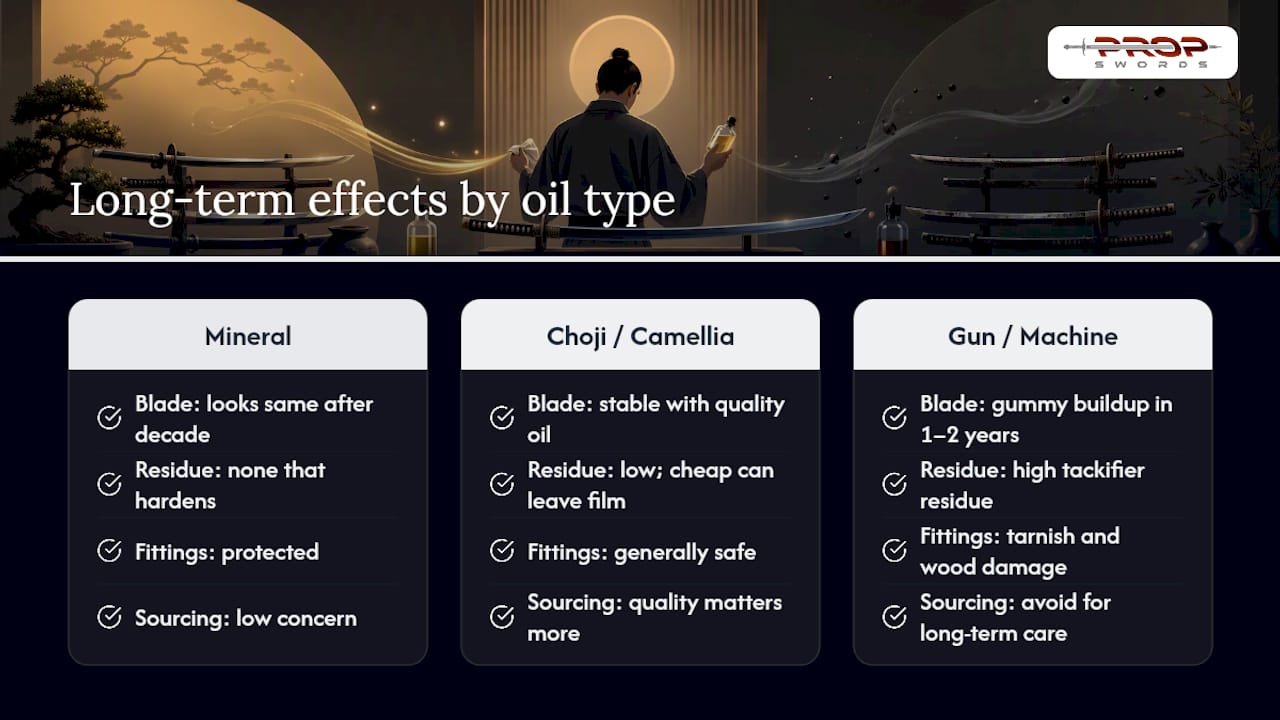
Mineral oil’s biggest long-term advantage is chemical boredom. It doesn’t react with steel, doesn’t degrade into anything acidic, and doesn’t leave a residue that hardens over years of reapplication. A blade maintained on mineral oil for a decade looks the same as one maintained for a year, provided the film gets renewed on schedule.
Choji and camellia oils share that same long-term stability, since both are built on stable base oils with minimal additives. The one caution with camellia oil involves quality. Cheap, heavily processed versions sometimes contain fillers that leave a faint residue after repeated use, so sourcing from a reputable supplier matters more here than with mineral oil.
Gun oils and machine oils are where long-term problems show up most. Repeated use of a gun oil loaded with tackifiers can leave a gummy buildup near the guard and fittings after a year or two, attracting dust that then acts like fine sandpaper every time the blade slides in and out of its sheath. That buildup is far harder to remove than a simple oil film, often requiring solvent cleaning that risks stripping lacquer nearby.
The fittings suffer more than the blade in the long run. Brass tsuba can tarnish under acidic residue from old cooking oil, and wooden saya can absorb moisture that heavy grease trapped against the wood over months. Choosing a stable, low-additive oil protects the whole sword, not just the steel.
What Oils Did Swordsmiths Use Historically?
Long before mineral oil existed as a refined product, sword owners relied on whatever animal or plant fats were on hand. Japanese swordsmiths and samurai households developed choji oil specifically because clove-scented oil masked the smell of the base oils available at the time, while also serving a ceremonial role during sword inspections and maintenance rituals passed down through samurai families.
European armorers leaned on tallow, lard, and various plant oils depending on region and era, often mixed with beeswax for a thicker, more weather-resistant coating suited to blades that traveled with soldiers through rain and mud. These older options worked reasonably well short-term but degraded faster than modern mineral oil, requiring far more frequent reapplication than today’s collectors need.
Camellia oil’s use in Japan predates modern sword collecting by centuries, originally pressed from seeds for cooking and hair care before its rust-inhibiting properties made it a natural fit for blade maintenance. The shift toward refined mineral oil in the twentieth century happened for practical reasons: it’s shelf-stable indefinitely, costs less to produce at scale, and doesn’t turn rancid the way older organic oils eventually did. Modern collectors inherited the choji ritual, but the substance doing the actual protective work changed completely.
What Safety Precautions Matter When Handling Sword Oils?
Most oils used for blade care are low-risk, but a few precautions are worth building into your routine. Mineral oil, choji, and camellia oil are all considered low-toxicity and safe for incidental skin contact, though prolonged, repeated exposure can dry out skin, so gloves are a reasonable habit for anyone oiling multiple blades in one sitting.
Gun oils and machine oils carry more risk. Many contain petroleum distillates or solvents that can irritate skin with repeated contact and produce fumes in poorly ventilated spaces. Work in a room with airflow, and avoid extended bare-hand contact with any oil that lists solvents on its label.
Flammability is the bigger concern across the board. Mineral oil, choji, camellia oil, and gun oil are all combustible to varying degrees, and rags soaked in any of them should never be balled up and left in a closed container. Oil-soaked cloth can undergo a slow oxidation reaction that generates heat, and in rare cases that heat buildup causes spontaneous combustion. Lay used cloths flat to dry outdoors or in a well-ventilated area before disposal, and keep any oil bottle away from open flames or heat sources during storage.
If oil gets in your eyes, flush with water for several minutes. If skin irritation develops after handling gun oil or machine oil, wash with soap and discontinue use of that particular product.
Where Can You Learn More About Sword Care?
- Navigating the Sword Care Maze, a collector-oriented guide on oil selection and storage habits.
- Best Oils For Swords And Blades, a comparison of common oil types and what to avoid.
- Oiling a Katana Blade, a katana-specific breakdown of choji composition.
- Propswords’ own replica sword maintenance guide for a collector-focused checklist.
Ready to put this routine into practice? Browse the top replica swords for 2026 from Propswords, each one built with materials that respond well to the mineral oil and choji routine covered here, whether you’re adding a display centerpiece or your first carbon steel blade.
The Overlooked Truth About Sword Oil
Most sword-care advice online obsesses over which bottle to buy, and that obsession misses the actual lesson buried in decades of collector experience. The chemistry barely varies between mineral oil, choji, and camellia oil. What varies wildly is how consistently people apply any of them.
I’d argue the entire “best oil” question is a distraction from the habit that actually prevents rust: a five-minute check every week or two, adjusted for your climate and how often you handle the blade. Buy the $8 bottle of mineral oil before you buy the $30 specialty blend. Spend the money you save on a good storage case with silica gel instead, since humidity control does more long-term work than any oil formulation.
Where collectors go wrong most often isn’t picking the wrong oil. It’s picking a good oil once, applying it heavily, and then forgetting about the blade for eight months. Rust doesn’t care what brand failed to stop it.
— Muhammad
Sources
- Navigating the Sword Care Maze
- Best Oils For Swords And Blades: Top Choices For Rust-Free Longevity – Swords Info
- Oiling a Katana Blade: Essential Care for Longevity
FAQ
Should You Oil a Sword Regularly?
Yes. Bare carbon steel starts oxidizing from ambient humidity and skin contact within days, and even stainless blades benefit from a light oil film to prevent surface staining over time.
What Is the Best Type of Oil to Use on Knives and Swords?
Light, food-grade mineral oil is the most practical choice for both knives and swords because it’s chemically stable, inexpensive, and won’t turn acidic like cooking oils do. Choji and camellia oil are strong alternatives for collectors who prefer traditional Japanese options.
What Is the Best Oil to Use for Katana Maintenance?
Choji oil, a blend of mineral oil and clove oil, is the traditional choice for katana maintenance, though plain mineral oil provides the same rust protection without the added scent.
Can I Use Gun Oil on My Sword?
Yes, in most cases, but check the label first. Some gun oils contain tackifiers or solvents that can damage lacquered saya or antique brass fittings, so spot-test on an inconspicuous area before applying it to the full blade.
How Often Should I Reapply Oil to a Display Sword?
A sword kept purely for display in a stable indoor environment needs fresh oil about once a month, while blades stored in humid or coastal climates need attention as often as every one to two weeks.
Recommended