


TL;DR:
- Swords at conventions symbolize character identity, narrative, and craftsmanship, extending beyond mere aesthetics.
- Weapon safety and material regulations prioritize attendee protection, with foam and PVC being the most accepted materials.
Walk into any major convention and the swords are impossible to miss. Cloud’s Buster Sword looming over a crowd. A glowing lightsaber catching the hall lights. A meticulously crafted Demon Slayer nichirin blade posed for photos. The role of swords in conventions runs deeper than aesthetics — they carry fandom identity, character narrative, and serious craftsmanship. But here is what surprises most first-timers: not all replica swords are allowed through the door, and the rules vary enough to get your prized prop confiscated before you hit the main floor.
Table of Contents
- Convention rules and safety standards for swords
- Cultural and cosplay significance of swords at conventions
- Comparison of cosplay sword materials and construction
- Preparing and presenting swords safely at conventions
- Rethinking convention swords: authenticity vs. accessibility
- Finding the best replica swords for your convention and collection
- Frequently asked questions
Key Takeaways
| Point | Details |
|---|---|
| Convention sword rules | Swords must follow strict size, material, and safety guidelines at conventions to be allowed. |
| Material choice | EVA foam with supportive cores balances realism and safety better than metal for cosplay swords. |
| Cultural role | Swords carry deep symbolic weight and enhance cosplay storytelling and fan engagement. |
| Preparation essentials | Proper assembly, inspection tagging, and safe handling at conventions prevent prop confiscation. |
| Balancing authenticity | Prioritizing comfort and compliance often beats chasing ultimate realism with heavy or banned materials. |
Convention rules and safety standards for swords
The role of swords in conventions depends heavily on what your sword is actually made of. Metal blades are the single most common reason props get turned away at the door. Conventions have clear reasons for this: a sharp or even blunt metal edge in a crowded hall creates genuine risk, and event organizers carry liability for what happens on their floor.
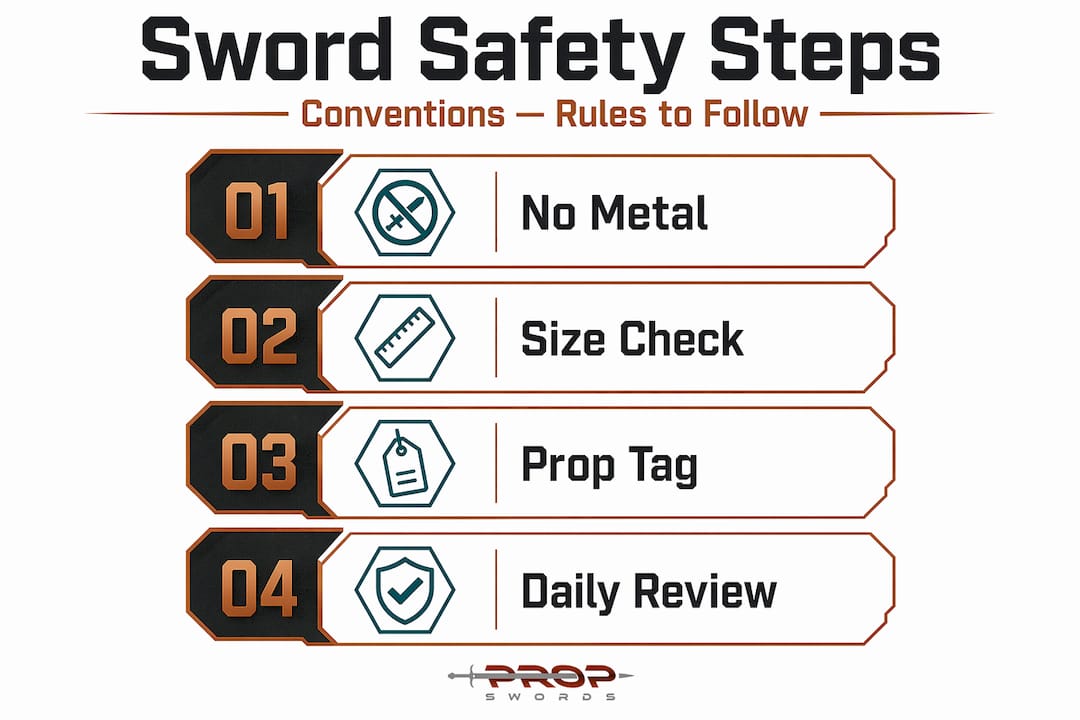
C2E2 2026 bans metal blades and places strict limits on prop length and materials for swords. Most conventions follow a similar framework: foam and PVC are the preferred materials, props must typically stay under 150 to 180 centimeters, and all edges must be rounded or sealed. These are not arbitrary rules. They reflect years of incident reports and feedback from convention staff managing tens of thousands of attendees at once.
Fan Fest 2026 requires daily inspection and tagging of all sword props. That tag is your green light for the day. Lose it, forget to get it, or show up with a prop that fails inspection and you will spend the first hour of your morning at the security desk instead of the show floor.
Albany Comic Con 2026 prohibits live steel but does allow wooden and certain approved metal props after review. This is relatively permissive compared to others. Williamsburg Comicon 2026 bans even blunt metal swords that could cause injury, allowing only foam replicas. That is the stricter end of the spectrum, and it reflects where the industry is moving.
Here is a quick comparison of what common conventions allow:
| Convention | Metal blades | Foam/PVC | Wood | Length limit | Daily tagging |
|---|---|---|---|---|---|
| C2E2 2026 | Banned | Allowed | Check rules | 150 cm | Required |
| Fan Fest 2026 | Banned | Allowed | Allowed | 180 cm | Required |
| Albany Comic Con 2026 | Banned | Allowed | Approved only | Varies | Recommended |
| Williamsburg Comicon 2026 | Banned | Allowed | Restricted | Not specified | Required |
Key things every cosplayer should know before packing a sword prop:
- Foam and PVC are universally safe choices across almost every major convention.
- Length matters more than you think. A sword that looks normal on a character sheet can easily hit 160 cm in real life.
- Rounded tips are not optional. Even a foam blade with a sharp foam point can fail inspection.
- Bringing documentation helps. A photo of the character alongside your prop shows inspectors context and speeds up the process.
Pro Tip: Read the full prop policy for each convention you attend, not just a summary. Policies change year to year, and what was allowed at the same event in 2024 may be restricted in 2026.
For more on getting your prop ready correctly, the cosplay sword preparation steps guide covers the full build and safety checklist. If you are still picking your sword, start with how to choose replica swords before committing to a build.
Cultural and cosplay significance of swords at conventions
Sword symbolism at conventions goes far beyond a prop you carry around. For most cosplayers and collectors, a sword is the centerpiece of their character. It communicates story, faction, power, and identity in a single glance. Sephiroth without the Masamune is just a man in a coat. Ichigo without Zangetsu loses the whole point.
The importance of swords in events like anime cons and fantasy conventions is tied directly to how these weapons function in the source material. In anime and fantasy, swords are rarely just weapons. They reflect a character’s arc, their origin, their moral code. Collectors who invest in detailed replicas understand this. A well-crafted replica enhances your costume not just visually but emotionally, because it signals to other fans that you understand the character at that level.
Historical swords in storytelling have always carried weight. Think of Excalibur as proof of kingship, or the katana in samurai culture representing both skill and honor. Modern anime and fantasy inherit this tradition. When someone carries a replica of Demon Slayer’s Tanjiro blade or a Viking-style longsword, they are participating in that same symbolic language.
“The sword is not just a weapon in these stories. It is the character’s voice, their wound, their purpose. A good replica carries all of that.”
The impact of swords on cosplay culture is also practical. A standout sword generates more photo requests than almost any other costume element. It creates natural interaction points with other fans, sparks conversations about favorite characters, and elevates group shoots to something that genuinely looks like it belongs in a magazine spread.
UK cosplayers switching to T6 aircraft-grade aluminum combat sabers for events like MCM London shows how seriously the community takes realism and balance in dueling demonstrations. These materials stay convention legal while offering the weight distribution that makes choreographed fights look and feel authentic.
Swords in fantasy conventions also serve a community function. Sword fighting demonstrations draw crowds, create spectacle, and give skilled cosplayers a stage to show what months of practice looks like. The role of swords in cosplay is, at its core, about storytelling through physical presence.
Comparison of cosplay sword materials and construction
Choosing the right material is where most cosplayers either get it right or spend half the convention regretting their build. Here is what actually matters when comparing options:
| Material | Weight | Safety | Convention acceptance | Realism | Cost |
|---|---|---|---|---|---|
| EVA foam only | Very light | Highest | Universal | Moderate | Low |
| EVA foam + PVC core | Light to moderate | High | Universal | Good | Low to moderate |
| EVA foam + wood core | Moderate | Medium | Varies | Very good | Moderate |
| Resin cast | Moderate to heavy | Medium | Often accepted | Excellent | High |
| Non-edged metal | Heavy | Lower | Restricted | Best | High |
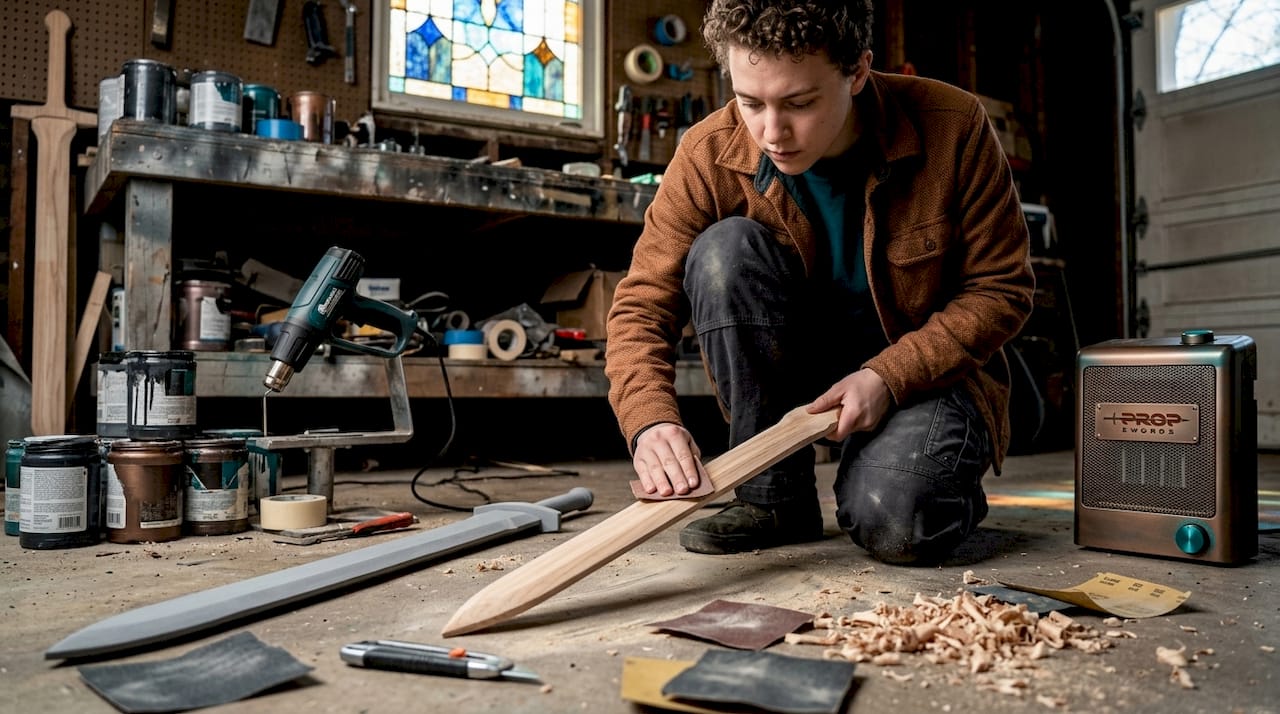
EVA foam with PVC or wood core is the most widely accepted and safest option for convention use. The EVA foam layer handles the safety requirement. The core adds rigidity so your sword does not flop around during a photoshoot or droop after four hours of carrying it.
Here is a practical build sequence that works for most convention sword props:
- Start with the core. Cut your PVC pipe or wooden dowel to slightly shorter than the blade length. Sand any exposed ends smooth.
- Build out the blade shape with EVA foam. Use contact cement to layer sheets, then carve and sand the blade profile with a rotary tool or fine sandpaper.
- Round and seal all edges and the tip. A heat gun helps smooth foam edges; Plasti-Dip or flexible sealant locks the surface.
- Add detail layers. Thin sheets of craft foam work well for guard details, fuller lines, and decorative elements.
- Paint in layers. A gray base coat followed by dry brushing with silver gives a realistic metal look without any actual metal.
- Check against your convention’s length limit before finishing.
Pro Tip: The paint job matters more than most builders realize. A flat gray foam sword with no finishing looks like a school project. The same sword with a proper metallic basecoat, dry-brushed highlights, and a matte sealer coat looks convincing in photos even under close inspection.
For guidance on picking the right starting point, how to choose cosplay swords walks through the decision factors clearly. If you want a more structured approach, the step-by-step guide to choosing a cosplay sword is worth bookmarking before your next build.
Preparing and presenting swords safely at conventions
Knowing the rules is only half the equation. Applying them without stress on the day of the convention is where preparation actually pays off. Here is a checklist that works:
- Measure your sword. Get the total length including hilt and tip. Write it down. Compare it against the specific convention’s published limit, not a general estimate.
- Inspect every edge and point. Run your fingers along the blade and tip. If anything catches, fix it before you leave home.
- Practice disassembly. Oversized swords over 150 cm must come apart without tools for entry at events like C2E2. Practice the full process until it takes under two minutes.
- Arrive early for weapons check. Getting your daily tag early means you avoid the late-morning line and have your visible compliance proof before the show floor gets crowded.
- Keep the sword sheathed when moving through crowds. An unsheathed prop at chest height in a tight corridor is exactly the situation conventions write their safety rules about.
- Avoid swinging or pointing your sword playfully in crowded spaces, and use coat check or gear storage for large props when you are not actively posing for photos.
- Use a protective carry bag. This matters both for the prop’s safety and for avoiding alarm in public spaces between your hotel and the convention entrance.
A few quick reminders that often get overlooked:
- Visible tagging is non-negotiable at events that require it. A tag tucked inside a bag does not count.
- Keep your prop documentation handy. Photos of the original character and a note about materials speed up inspection.
- Have a backup plan. If a prop fails inspection unexpectedly, know whether your hotel can store it or whether there is a left-luggage option nearby.
For a full sword cosplay prep workflow built specifically around conventions, that resource maps out the timeline from build completion through event day. The cosplay sword prep guide covers the finishing and safety steps in detail.
Rethinking convention swords: authenticity vs. accessibility
Here is an uncomfortable truth the cosplay community rarely says out loud: the most accurate metal sword is often the worst convention prop. Not because it looks bad. Because it gets confiscated at the door, weighs enough to wreck your shoulder by noon, and puts you in a defensive position with every security volunteer you pass.
The real cost of chasing metal-level realism in convention settings is not just potential confiscation. It is the mental overhead. You spend the day worrying instead of enjoying, explaining your prop instead of posing with it, and managing fatigue instead of participating in the community you came to find.
The cosplayers who consistently get the best photos, the most interactions, and the most enjoyment at conventions are not the ones with the heaviest or most technically accurate builds. They are the ones who built something that looks credible at a glance, passes inspection without drama, and is comfortable enough to carry for eight hours. That is not a compromise. That is good craft.
Accessibility shifts the culture in a positive direction too. When convention-legal builds are normalized and celebrated, more people can participate without needing the budget, tools, or experience for a metal commission piece. A teenager with EVA foam, a decent paint job, and a character they love deserves the same floor space as a veteran prop builder. Sword-related activities at events become richer when the barrier to entry is a skill, not a material.
The role of swords in cosplay has always been about what the weapon represents, not what it is made of. A perfectly painted foam Zangetsu tells Ichigo’s story just as well as a stainless steel replica. The difference is one of them gets to be in the convention hall where the story actually gets shared.
Finding the best replica swords for your convention and collection
Convention-ready does not mean settling for less. At Propswords, the best replica swords for 2026 are built with convention compliance and visual accuracy in both directions, whether you are a cosplayer who needs a prop that passes weapons check or a collector who wants something display-worthy on the shelf.
Collectors drawn to the cultural depth of iconic blades will find fantasy swords as symbols and collectibles that represent fandom history, not just decoration. Every piece comes with the craftsmanship and detail that makes it worth owning long after the convention ends. Free shipping within the USA makes getting started even easier. And if you are looking for a gift idea that actually lands with a fan, the unique value of gifting a fantasy sword explains exactly why a replica blade is a better gift than another piece of merch. Round out the look with the right apparel — the Anakin lightsaber t-shirt pairs well with a Star Wars themed build.
Frequently asked questions
Can I bring a metal sword to a convention?
Most conventions ban metal swords due to safety concerns, but some allow approved non-edged metal props after inspection and tagging. Metal blades are banned at both C2E2 2026 and Williamsburg Comicon 2026, which reflects the majority position across major events.
What materials are best for cosplay swords at conventions?
EVA foam with PVC or wooden cores are the safest and most widely accepted materials because they are light and flexible. EVA foam with PVC or wood core is the preferred build for convention-legal props that still look realistic in photos.
Are there size limits for swords at conventions?
Yes, most conventions limit sword props to between 150 and 180 centimeters, with larger props required to come apart without tools. Maximum permitted sizes are 150 cm or 180 cm depending on the convention, with oversized props needing tool-free disassembly.
What happens if my sword prop fails inspection at an event?
If a prop fails inspection, it may be confiscated or you may be asked to return it to your hotel or vehicle before re-entering. Props failing inspection at Fan Fest can be confiscated, and non-compliance may lead to ejection without a refund.
How can I make my cosplay sword look realistic while following rules?
Use layered EVA foam combined with detailed painting and finishing to create a convincing metallic look without any banned materials. Layering, finishing, and painting foam creates strong visual realism that holds up even in close-up photos, without the safety risks of metal.
Recommended


