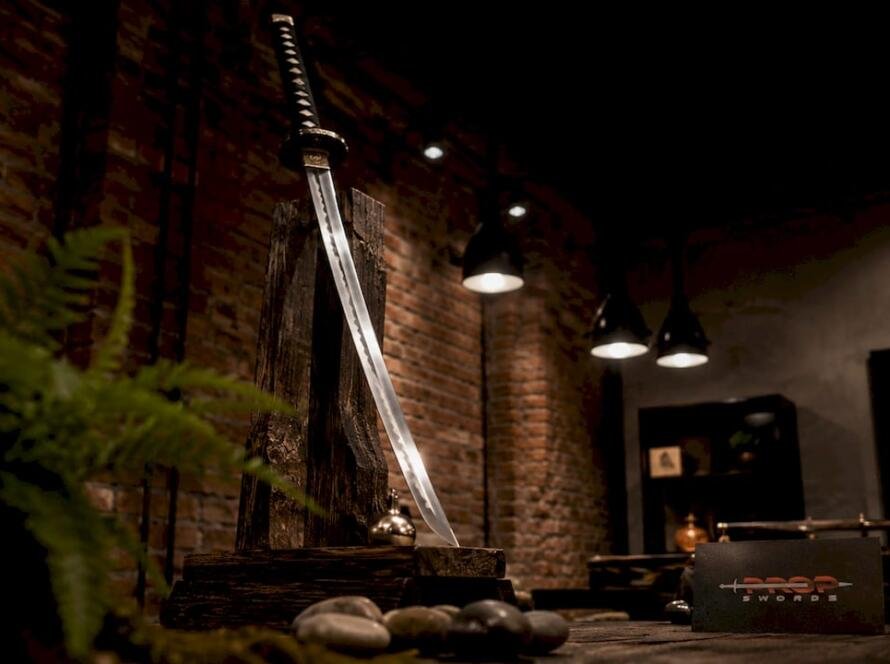
For most buyers, stainless steel is the smarter everyday choice. Damascus is worth the premium when you want edge performance from a quality core alloy, craft you can see, or a piece built to display and collect. The decisive factors are three things that have nothing to do with the pattern: core alloy, heat treatment, and how consistently you’ll maintain the blade.
- Workhorse use: Go stainless. It tolerates humidity, acidic foods, and the occasional missed dry-off without punishing you.
- Precision cutting or collecting: Pattern-welded Damascus on a quality core (VG-10, SG2, or 1095/15N20) rewards the buyer who sharpens carefully and oils regularly.
- Mixed setup: Keep one stainless blade for daily kitchen work and one Damascus piece for display, gifting, or the cuts where edge geometry matters most.
Pro Tip: *Before you read further, decide which category you fall into.
Key Takeaways
Damascus and stainless are not competing materials on the same axis: Damascus is a construction method, stainless is an alloy property, and the best blade for you depends on core alloy, heat treatment, and how much maintenance you’ll actually do.
| Point | Details |
|---|---|
| Damascus is construction, stainless is chemistry | Damascus describes layered forge-welding; stainless means ≥10.5% chromium. They can coexist in the same blade. |
| Heat treatment decides performance | Core alloy and heat treatment quality matter more than whether a blade is pattern-welded or monosteel. |
| Carbon Damascus needs consistent care | Hand-wash, dry immediately, and oil regularly; stainless tolerates occasional neglect far better. |
| Verify before you buy | Ask for named alloys, listed HRC, and billet photos; “Damascus” with no specs is likely acid-etched monosteel. |
| Propswords for both options | Propswords carries Damascus and stainless replica blades with construction details listed, so you can verify before purchase. |
Table of Contents
- What do “Damascus” and “stainless” actually mean?
- How pattern-welded blades are made vs stainless production
- How do Damascus and stainless compare in real performance?
- Quick reference: Damascus vs stainless at a glance
- Why do Damascus patterns command a premium?
- Care routines for Damascus vs stainless blades
- What do you actually pay for at each price point?
- Which blade should you buy for your situation?
- How to verify real Damascus before you buy
- An honest perspective on buying Damascus vs stainless
- Propswords carries both, so you can choose on your terms
- Sources
- FAQ
What do “Damascus” and “stainless” actually mean?
These two terms describe completely different things, and confusing them is the source of most buyer frustration. Damascus refers to a construction method, not a specific alloy. Stainless is an alloy property, not a construction style. They can, and often do, coexist in the same blade.
Damascus (pattern-welded / laminated): Modern makers use “Damascus” to describe blades built by forge-welding two or more steel types together, then folding, drawing out, and twisting the billet to create a layered pattern. Etching in acid reveals the contrast between layers. The term covers:
- True pattern-welded billets (multiple forge-weld passes, visible layer structure through the full blade)
- San-Mai / laminated construction (a hard core steel sandwiched between softer or stainless cladding layers)
- Clad blades where only the outer layers are patterned and the core does the cutting work
That chromium forms a passive oxide layer that resists corrosion. Common knife-grade stainless alloys span a wide performance range:
- 420 / 420HC: Budget end, softer, HRC 52–56, easy to sharpen, modest edge retention
- 440C: Mid-range, HRC 57–60, better edge retention, widely used in production knives
- VG-10: Japanese stainless, HRC 60–62, excellent edge retention, popular as a Damascus core
- AEB-L: Fine-grained Swedish stainless, HRC 60–62, superb toughness-to-hardness ratio
- SG2 / R2: Powdered stainless, HRC 63–65, top-tier edge retention, used in premium laminated blades
The stainless spectrum runs from soft 420-type steels to high-performance powdered alloys like SG2, and that range matters more than the “stainless” label alone. A blade stamped “stainless” could be 420 or SG2 — those are not remotely the same knife.
Common Damascus core and cladding pairings include 1095 / 15N20 (high-carbon workhorse combination), VG-10 core with stainless cladding, and SG2 core with nickel-bearing outer layers. HRC on a well-made Damascus knife typically runs 58–65 depending on the core.
How pattern-welded blades are made vs stainless production
The production gap between these two approaches explains most of the price difference and most of the performance variation you’ll encounter in the market.
Pattern-welded Damascus
- Billet assembly: Two or more steel types (commonly 1095 and 15N20, chosen for their contrasting carbon and nickel content) are stacked and tack-welded.
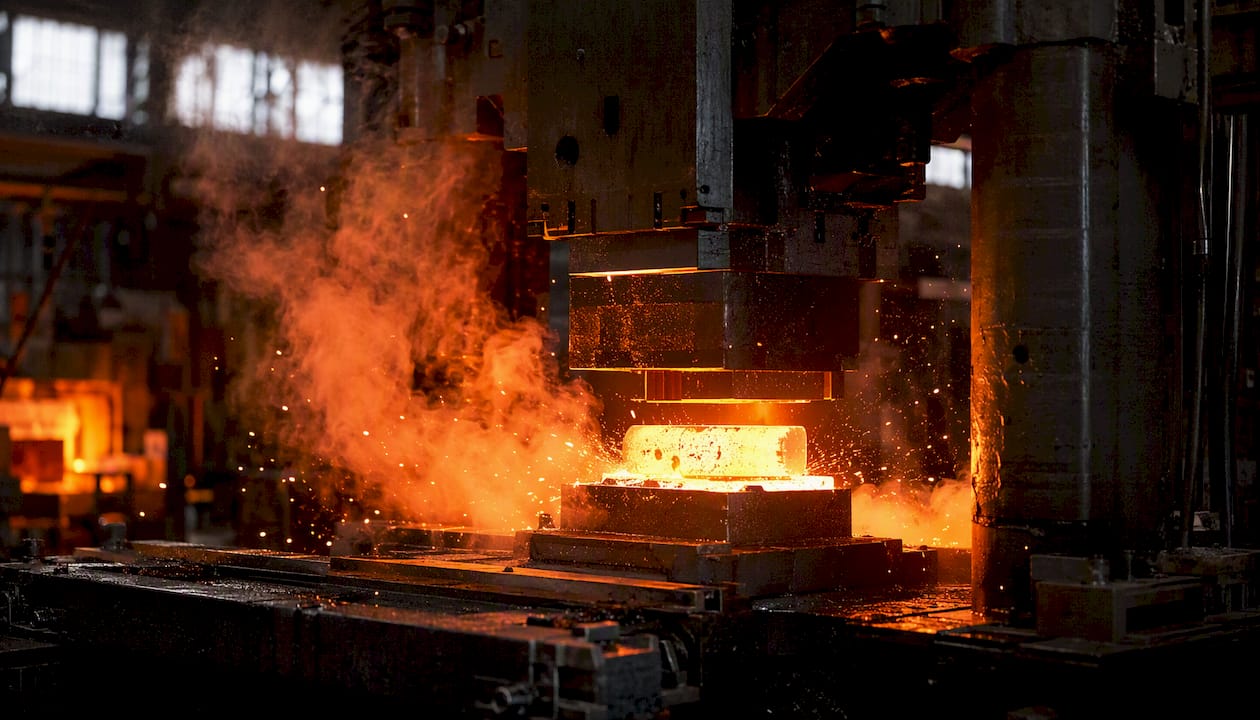
- Forge welding: The stack is heated to welding temperature (roughly 2,300°F) and hammer-welded, either by hand or power hammer, to fuse the layers.
- Drawing and folding: The billet is drawn out, cut, restacked, and forge-welded again. Each pass doubles the layer count. A 7-fold billet produces 128 layers; a 9-fold produces 512.
- Shaping: The patterned billet is forged into a blade profile, ground, and heat-treated.
- Etching: An acid bath (ferric chloride is common) dissolves the high-carbon layers slightly faster than the nickel-bearing ones, revealing the pattern.
Pro Tip: Layer count alone tells you almost nothing about quality. A 512-layer blade made with poor heat treatment will lose to a 64-layer blade with a precise quench and temper. Ask for HRC and heat-treatment details, not just layer numbers.
Modern stainless production
Stainless kitchen and collector blades are typically produced from monosteel bar or sheet stock via stock removal (grinding the blade shape from flat bar) or drop forging (pressing a heated blank into a die). Powder metallurgy alloys like SG2 are produced by atomizing molten steel into fine powder, then sintering it under high pressure, which creates an extremely fine, uniform grain structure. That grain structure is what gives powdered stainless its edge retention advantage.
San-Mai and laminated construction
San-Mai bridges the gap. A hard, high-carbon or powdered-steel core handles the cutting edge, while softer or stainless outer layers protect the spine and cheeks. The result is a blade that can carry a VG-10 or SG2 edge with stainless cladding that resists rust on the flat faces. This laminated approach narrows the maintenance gap while preserving the edge quality buyers want from a harder core.
One important caution: historical folding addressed ore impurity, not strength. Modern steel is clean enough that excessive folding adds no structural benefit and, done poorly, can trap inclusions or create weak interfaces. A maker who leads with “10,000 layers!” as a selling point is marketing, not metallurgy.
How do Damascus and stainless compare in real performance?
Edge retention and corrosion resistance both depend more on core alloy and heat treatment than on whether a blade is pattern-welded or monosteel. A well-treated stainless like SG2 can match or beat a poorly treated Damascus in every measurable category.
| Dimension | Stainless monosteel | San-Mai / laminated | Pattern-welded high-carbon Damascus |
|---|---|---|---|
| Edge retention | Moderate to high (alloy-dependent; SG2 = excellent) | High (core-dependent) | High when core is quality; variable with cheap billets |
| Corrosion resistance | Excellent (passive oxide layer on full blade) | Good to excellent (stainless cladding protects faces) | Low to moderate (carbon layers rust without care) |
| Ease of sharpening | Easy to moderate (softer 420) to challenging (SG2 at HRC 64) | Moderate (core hardness drives grit needs) | Moderate; carbon layers respond well to whetstones |
| Toughness / chip resistance | High at lower HRC; brittle at HRC 64+ | High (soft cladding absorbs shock) | Variable; good with proper temper, brittle if over-hardened |
| Maintenance required | Low; hand-wash, dry, occasional wipe | Low to moderate; same as stainless for cladding | High; hand-wash, dry immediately, oil regularly |
| Aesthetics / pattern | Uniform, clean finish | Visible core line at edge; clean faces | Full layered pattern, unique per blade |
| Price range | $20 and up | $80–$400+ | $80–$600+ for genuine; under $60 = likely cosmetic |
| Best use case | Daily kitchen, outdoor, low-maintenance users | Cooks wanting edge performance with less rust risk | Collectors, precision cooks, display, gifting |
A few highlights worth pulling out:
- Stainless wins on corrosion resistance across the full blade, every time. Even a modest 440C blade handles humidity, acidic foods, and dishwasher splashes that would spot a carbon Damascus.
- Pattern-welded Damascus wins on aesthetics and, when the core is quality, on edge geometry potential. A 1095/15N20 billet at HRC 60 takes a keener edge than most mid-range stainless.
- San-Mai is the practical compromise. The stainless cladding handles the rust risk; the hard core handles the cutting. For most serious home cooks, this is the answer.
- Heat treatment is the great equalizer. Core alloy and heat treatment quality are the decisive performance variables, not the pattern on the blade.
For sharpening, high-HRC blades (above 62) need diamond stones or fine Japanese waterstones (1,000–3,000 grit for reprofiling, 6,000–8,000 for finishing). Lower-HRC stainless responds well to ceramic rods and standard whetstones. Carbon Damascus sharpens readily on waterstones and develops a refined burr quickly.
Quick reference: Damascus vs stainless at a glance
This table gives you the short version. For the reasoning behind each cell, the performance section above has the detail.
| Dimension | Stainless monosteel | San-Mai / laminated | Pattern-welded Damascus |
|---|---|---|---|
| Edge retention | Moderate to high | High | High (core-dependent) |
| Corrosion resistance | Excellent | Good to excellent | Low to moderate |
| Sharpening ease | Easy to moderate | Moderate | Moderate |
| Toughness | High | High | Variable |
| Maintenance | Low | Low to moderate | High |
| Aesthetics | Uniform | Subtle core line | Unique layered pattern |
| Price | $20 and up | $80–$400+ | $80 and up genuine |
| Best for | Daily use, low-maintenance | Serious cooks, outdoors | Collectors, display, gifts |
- Stainless monosteel is the default choice for anyone who won’t commit to a care routine.
- San-Mai is the upgrade path for performance without the rust anxiety.
- Pattern-welded Damascus is the choice when the blade itself is part of what you’re buying.
Why do Damascus patterns command a premium?
The pattern is not decoration bolted onto a functional blade. On a genuine pattern-welded knife, the visual is a direct record of the forge work: every layer, twist, and weld pass is visible in the finished surface. That’s labor you can see. Genuine Damascus production requires multiple forge-weld passes, skilled heat treatment, and hand finishing, and that process is what drives the price above comparable monosteel blades.
The problem is that “Damascus” has become a marketing term. A significant portion of blades sold as Damascus are acid-etched monosteel: a stainless blank chemically treated to mimic a layered pattern. The etching wears off. There are no actual layers. The performance is whatever the underlying monosteel was.
How to tell the difference:
- True pattern-welded: Pattern runs through the blade, visible on the spine and choil, not just the flat faces. Close-up photos of the billet before grinding exist. The maker lists the alloy combination (e.g., “1095/15N20, 128 layers”).
- Cosmetic acid-etch: Pattern is only on the flat faces, fades with use, and the listing says “Damascus finish” or “Damascus pattern” without naming the steel types.
Provenance and maker transparency drive resale value more than layer count. A blade with documented alloys, listed HRC, and photos of the forging process holds its value. One with a vague “Damascus steel” label and no specs does not. For collectors, the Propswords Damascus guide covers construction signals worth checking before any purchase.
Pro Tip: Ask for a photo of the blade’s choil (the unsharpened notch at the base of the edge). On a true pattern-welded blade, the layers are visible there. On an acid-etched monosteel, the choil is uniform.
Care routines for Damascus vs stainless blades
The maintenance gap between these two materials is real, and it’s the single most common reason buyers regret a Damascus purchase. Here’s what each actually requires.
Daily care for stainless blades
- Hand-wash with mild dish soap and warm water.
- Dry immediately with a cloth. Stainless tolerates brief moisture exposure, but standing water near the handle joint causes corrosion over time.
- Store in a knife block, on a magnetic strip, or in a sheath. Avoid loose drawers where edges contact other metal.
- Wipe with a light food-safe mineral oil every few months if stored long-term.
Daily care for Damascus (high-carbon core)
- Hand-wash only. Never dishwasher. The alkaline detergent and heat cycle will strip any protective patina and accelerate rust.
- Dry immediately and thoroughly, including the spine and handle junction.
- Apply a thin coat of food-safe mineral oil or camellia oil after every use if the blade contacts acidic foods (citrus, tomatoes, onions). Acids accelerate carbon layer oxidation fast.
- Inspect the edge and flat faces weekly during regular use. A light patina (gray-brown) is protective; orange rust spots are not.
Deeper maintenance
- Stain removal on stainless: A paste of baking soda and water, applied with a soft cloth along the grain, removes most surface staining without scratching.
- Rust spots on Damascus: Fine (2000-grit) wet-dry sandpaper along the grain, followed by a neutralizing wipe with a diluted baking soda solution, then immediate re-oiling.
- Refreshing the Damascus pattern: Light re-etching in ferric chloride (30–60 seconds, then neutralize in baking soda water) restores contrast on a faded pattern without affecting the blade geometry.
Storage
Keep high-carbon Damascus away from humid environments. A silica gel pack inside a closed display case or storage bag makes a real difference. Magnetic strips are fine for stainless; for Damascus, a wooden block or leather sheath is better because wood and leather wick moisture away from the blade surface. For outdoor and field use, a proper survival kit storage routine that includes blade drying and light oiling before packing applies directly to carbon Damascus knives.
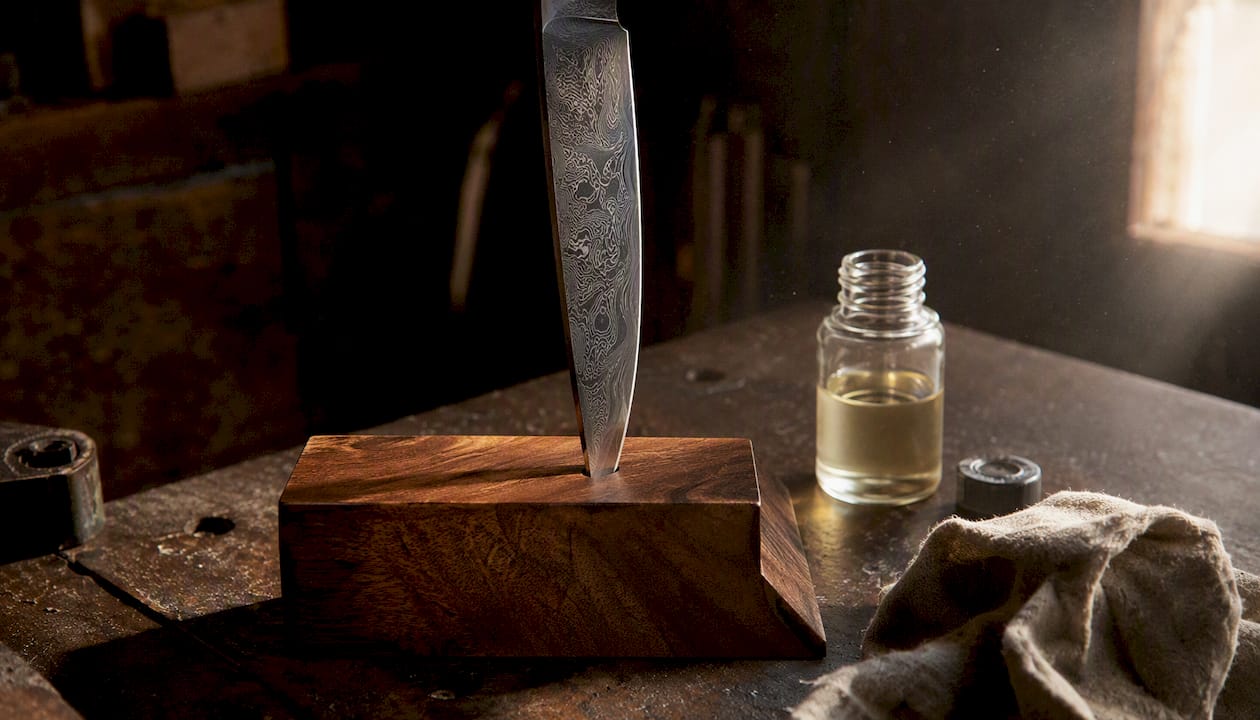
Pro Tip: *After any outdoor or heavy kitchen use, run the blade under warm water, dry it completely with a cloth, and apply one thin wipe of mineral oil before putting it away.
What do you actually pay for at each price point?
Price bands in the Damascus vs stainless market are fairly predictable once you know what drives the cost.
- Under $80: Stainless workhorses dominate here. Expect 420HC or 440C, HRC 54–58, reliable edge, easy maintenance. Any “Damascus” at this price is almost certainly acid-etched monosteel.
- $100–$150: Entry-level real Damascus starts appearing, typically 1095/15N20 billets with 64–128 layers. Quality varies significantly. Mid-range stainless (VG-10 monosteel) also sits here and often outperforms budget Damascus on edge retention.
- $200–$400: Pronounced craft and premium alloys. San-Mai with SG2 or VG-10 cores, hand-finished Damascus with documented heat treatment, and collector-grade pieces with maker provenance. This is where Damascus starts consistently justifying its premium over stainless.
- $400+: Custom and semi-custom work. Hand-forged billets, premium powdered cores, unique patterns, and full documentation. Resale value holds better here because the provenance is verifiable.
What you’re paying for at the top end: labor (a skilled smith can spend 10–20 hours on a single Damascus billet), heat treatment precision (a proper quench-and-temper setup is expensive to run correctly), powdered alloy costs, and hand finishing. Stainless production at scale is far cheaper because stock removal and machine grinding replace most of that labor.
When stainless gives better value: daily kitchen use, outdoor tools, anyone who won’t maintain a carbon blade consistently, and buyers on a budget who need reliable performance over aesthetics.
When Damascus is worth the premium: collectors, display pieces, gifts where the visual impact matters, precision cooks who will maintain the blade, and anyone who wants a blade that’s genuinely one of a kind.
Which blade should you buy for your situation?
Match your use case to the right construction, not the right aesthetic.
- Casual home cook: Stainless monosteel (440C or VG-10). Low maintenance, holds a working edge, survives real kitchen conditions.
- Serious home cook: San-Mai or VG-10 core Damascus. You get the edge performance without committing to a full carbon-steel care routine.
- Outdoor / bushcraft user: Stainless monosteel or San-Mai. Laminated constructions balance edge performance with improved corrosion resistance in field conditions where drying and oiling aren’t always possible.
- Collector / display: Pattern-welded Damascus with documented alloys and maker provenance. The visual and craft value are the point.
- Gift buyer: Damascus wins on presentation. A pattern-welded blade with a leather sheath reads as a considered, high-value gift in a way that monosteel doesn’t.
- Budget buyer: Stainless. A well-made 440C blade at $60 outperforms a $60 “Damascus” that’s acid-etched monosteel every time.
The hybrid solution makes sense for serious enthusiasts: one stainless workhorse for daily use, one Damascus piece for precision work or display. You’re not choosing between them; you’re using each where it’s strongest.
Maintenance commitment is the deciding variable. If you won’t hand-dry and oil consistently, a high-carbon Damascus will frustrate you within weeks. Stainless forgives. Damascus rewards.
How to verify real Damascus before you buy
This checklist applies to any listing, whether you’re buying a kitchen knife, a collector blade, or a display piece.
What a credible listing includes
- Named core alloy: “1095/15N20,” “VG-10 core with stainless cladding,” or “SG2 San-Mai.” Generic “Damascus steel” with no alloy names is a red flag.
- Listed HRC: A maker confident in their heat treatment posts it. No HRC listed usually means it wasn’t tested or it’s not impressive.
- Heat treatment notes: Quench medium (oil, water, interrupted), temper temperature, and number of temper cycles. Not every seller posts this, but premium makers do.
- Billet and forging photos: Real forge work looks like real forge work. You should see the billet before grinding, the forge scale, and the layer structure at the choil.
- Sharpening and finish method: Hand-finished vs machine-ground, grit progression used, and whether the edge was convexed or flat-ground.
Red flags to avoid
- “Damascus” used as a finish description with no steel specs
- Layer counts above 500 with no explanation of the alloy combination (high layer counts in cheap billets often mean the carbon content has been diluted to near-useless levels)
- Price under $80 for a claimed hand-forged Damascus blade
- No maker photos, only stock renders
- Reviews that mention “pattern faded after a few uses” (acid-etched monosteel)
Verification steps
- Ask the seller for a close-up photo of the choil and spine. Pattern should be visible on both.
- Ask directly: “Is this true pattern-welded or acid-etched?” A legitimate seller answers immediately.
- Search for the maker’s build videos or forge documentation. Established smiths have a trail.
- Check whether the pattern is consistent across the blade or only on the flat faces.
On food safety and hygiene: Exposed carbon layers in a poorly finished Damascus blade can harbor bacteria in micro-pits if the surface isn’t properly sealed or maintained. A well-finished blade with tight layer welds and a proper patina or cladding presents no more hygiene risk than any other knife. San-Mai construction, where stainless cladding covers the flat faces, is the cleanest option for food contact surfaces. Always verify that the finish is smooth and the layers are fully welded before using any Damascus blade for food prep.
An honest perspective on buying Damascus vs stainless
The Damascus vs stainless debate gets muddier than it needs to be because the market has two completely different products sharing one name. There’s genuine pattern-welded Damascus, which is a craft object that happens to be a knife. Then there’s acid-etched “Damascus,” which is a stainless knife with a cosmetic treatment. Treating those as the same category is where most buyer confusion starts.
What I find underappreciated: the buyers who get the most out of Damascus are not necessarily the ones who know the most about metallurgy. They’re the ones who’ve decided the blade is worth caring for. That’s a different kind of commitment than knowing your HRC numbers. A collector who oils their blade every week and stores it in a leather sheath will get more from a $150 Damascus piece than a chef who buys a $400 one and leaves it wet on the counter.
Stainless gets undersold in this conversation. A well-made VG-10 monosteel knife at HRC 61 is a genuinely excellent blade. It doesn’t have the visual drama of a layered pattern, but it holds an edge, resists rust, and asks almost nothing from you. For most people in most kitchens, that’s the right answer.
The place where Damascus unambiguously wins is in the collector and display category. A pattern-welded blade with documented provenance is a piece of craft that appreciates in meaning, if not always in dollar value, over time. That’s not a performance argument. It’s a different kind of value, and it’s real.
For replica swords and display pieces specifically, the steel choice matters less for cutting performance and more for appearance, finish durability, and long-term display quality. Stainless holds its finish with minimal upkeep. Damascus develops a living surface that changes with care. Both are legitimate choices for different collector priorities.
Propswords carries both, so you can choose on your terms
Collectors and enthusiasts who’ve read this far know what they’re looking for. Propswords stocks display-quality Damascus and stainless blades across its replica sword and knife collections, with product pages that show construction details, finish type, and steel information so you can apply the verification checklist above before you buy.
The Damascus Fixed Blade Tri Dagger and the Damascus chef’s knife are two examples of pattern-welded pieces with visible construction detail. For stainless options built for display and low-maintenance collecting, the stainless blade guide explains what to expect from each finish. Browse the top replica swords for 2026 to find the piece that fits your collection, and use the checklist in this article to confirm the specs before checkout.
Sources
These are the external sources used to build this article. Check product pages directly for current steel specs and construction details.
- Damascus Steel vs Stainless Steel: Which Knife Steel Wins in 2026 | JW SteelCrafts
- Damascus Steel vs Stainless Steel: Which Is Best? – santokuknives
- Sword steels 101
- Expert Analysis of Damascus Vs Stainless Blades – Deadfall Creations
- Damascus Steak Knife vs Stainless Steel: Which Is Better? | Jayger
FAQ
Is there anything better than Damascus steel for a knife?
For pure corrosion resistance and low maintenance, high-performance stainless alloys like SG2 or AEB-L outperform most Damascus. For a combination of edge performance, aesthetics, and craft value, San-Mai construction with a quality core is the strongest all-around option.
Why can’t we make true Damascus steel anymore?
The original Wootz Damascus (crucible steel from South Asia, used in historical Middle Eastern blades) used ore sources and smelting conditions that aren’t replicated today. Modern pattern-welded Damascus is a related but distinct technique: it produces layered steel through forge-welding rather than crucible casting, and it’s a legitimate craft, just not the same material as historical Wootz.
What are the disadvantages of Damascus steel knives?
High-carbon Damascus requires consistent hand-washing, immediate drying, and regular oiling to prevent rust. It’s more demanding than stainless, more expensive for genuine examples, and the market is flooded with cosmetic acid-etched imitations that deliver none of the performance benefits.
Why is everyone obsessed with Damascus steel?
The pattern is genuinely striking, and on a real pattern-welded blade, it’s a visible record of skilled forge work. The obsession is partly aesthetic and partly the appeal of owning something made by hand with a process that takes real skill. The problem is that “Damascus” now covers everything from hand-forged billets to acid-etched monosteel, so the obsession sometimes outpaces the reality of what’s actually being sold.
Does Damascus steel hold an edge better than stainless?
It depends entirely on the core alloy and heat treatment, not the pattern. A Damascus blade with a well-treated 1095 or SG2 core holds an excellent edge. A Damascus blade with a poorly treated or low-grade core does not. The same logic applies to stainless: a properly heat-treated VG-10 blade holds its edge better than a poorly treated Damascus every time.
Recommended