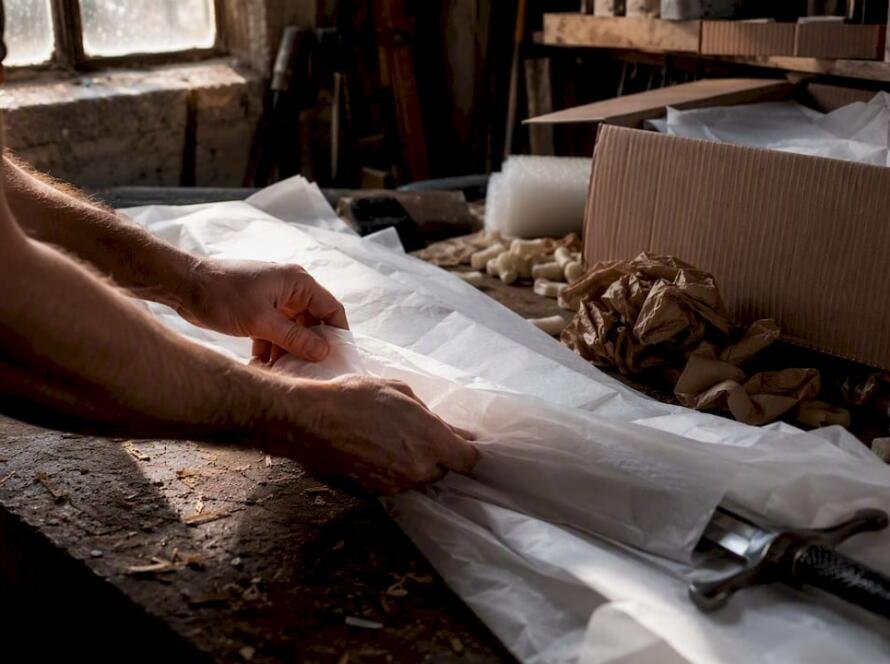
You cannot bring a sword through airport security in your carry-on bag. TSA is explicit: swords are prohibited in carry-on luggage and allowed in checked baggage only when sheathed or securely wrapped. U.S. Customs and Border Protection adds another layer — even if your sword clears the flight, local laws at your destination may restrict possession entirely.
Three things to do right now:
- Sheath or securely wrap the blade before you pack anything else. This protects baggage handlers and reduces the chance of an inspection delay.
- Call your airline to confirm size, weight, and oversize-fee policies. TSA permission does not mean your carrier will accept the item without extra steps or charges.
- Check the laws at your destination. State and local statutes can restrict sword possession regardless of what TSA allows.
One more thing worth knowing before you read further: even a perfectly packed, properly sheathed sword can be refused at the checkpoint. The final call belongs to the TSA officer on duty, not to the rulebook.
Key Takeaways
Swords are banned from carry-on bags under TSA rules and allowed in checked baggage only when sheathed or securely wrapped, with the TSA officer retaining final discretion at every checkpoint.
| Point | Details |
|---|---|
| Carry-on: always no | TSA prohibits swords in carry-on bags with no exceptions. |
| Checked bags: yes, with conditions | Blade must be sheathed or securely wrapped; a hard-sided case is strongly recommended. |
| TSA officer has final say | Even a properly packed sword can be refused if the officer deems it a security risk. |
| Airline rules are separate | Call your carrier before travel to confirm size limits, oversize fees, and advance-notice requirements. |
| Propswords for travel-ready replicas | Propswords sells collector replicas with purchase documentation useful for TSA and CBP declarations. |
Table of Contents
- What TSA and CBP actually say about swords on planes
- How to pack a sword for checked baggage the right way
- Step-by-step packing procedure you can copy
- Why airline policies matter as much as TSA rules
- State and local laws can override TSA clearance
- What to expect at the TSA checkpoint with a checked sword
- Bringing swords into or out of the United States
- When swords get confiscated and what the penalties look like
- A retailer’s perspective on traveling with replica swords
- Propswords has the travel-ready replicas you need
- Sources
- FAQ
What TSA and CBP actually say about swords on planes
The rules break down cleanly across two federal agencies and one federal regulation.
TSA’s sword-specific guidance gives a two-word verdict for carry-on bags: No. For checked baggage: Yes, provided the item is sheathed or securely wrapped. The same logic applies to martial-arts weapons, which TSA treats identically — no carry-on, checked only, officer discretion applies. TSA’s sharp-objects page reinforces this across the board: sharp items in checked bags must be sheathed or wrapped to prevent injury to handlers and inspectors.
49 C.F.R. §1540.111 is the federal regulation underneath all of this. It sets baseline prohibitions on weapons in sterile airport areas and establishes the conditions under which certain items may travel in checked baggage. It does not replace state law or airline policy — it coexists with both.
U.S. Customs and Border Protection takes a different angle. CBP does not broadly prohibit importing swords into the United States, but it flags that local possession and transport laws at the destination may impose their own restrictions. That distinction matters most for international travelers returning home or entering the U.S. with a sword purchased abroad.
TSA’s official position: “The final decision rests with the TSA officer on whether an item is allowed through the checkpoint.” No packing method, documentation, or prior approval guarantees acceptance — the officer at the lane has the authority to refuse any item that appears to pose a security threat.
How to pack a sword for checked baggage the right way
TSA’s phrasing — “sheathed or securely wrapped” — sounds simple, but it has real practical meaning. A sheath must fully enclose the blade with no exposed edge. If your sword has no sheath, wrap the blade tightly in heavy cardboard, then add a layer of bubble wrap, and secure the whole thing with packing tape. The goal is zero exposed metal and zero movement inside the outer case.
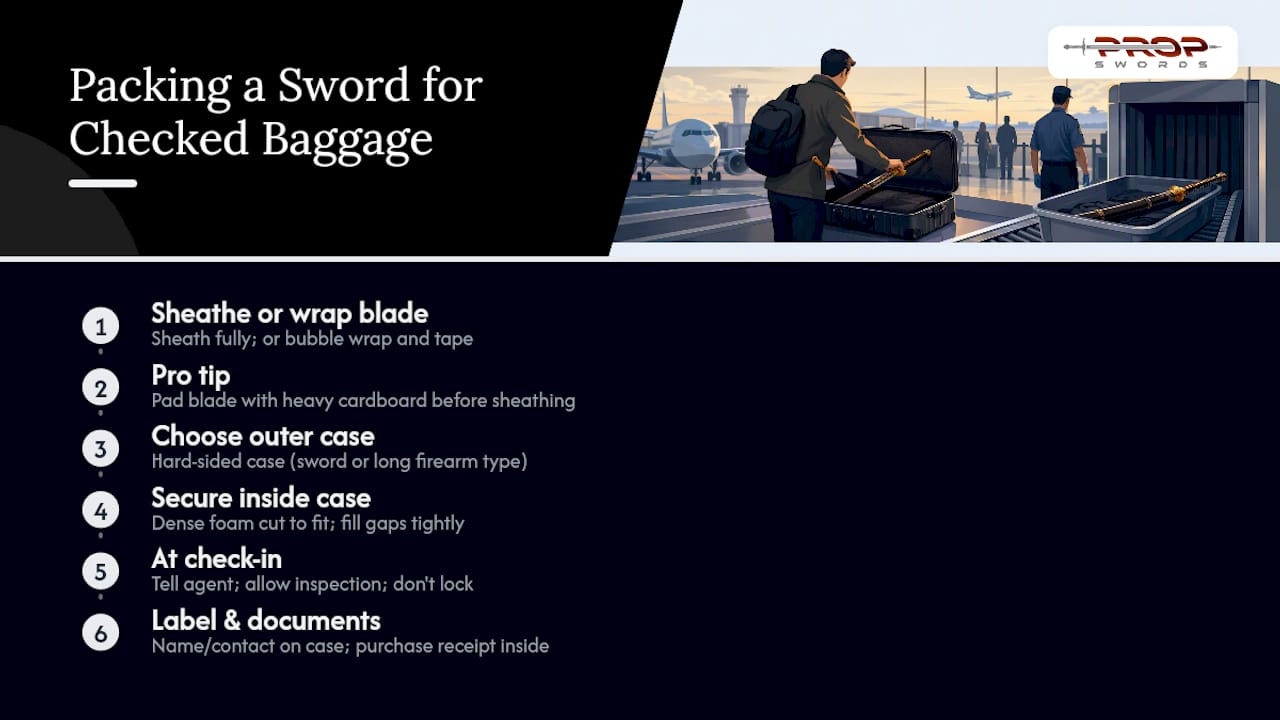
The outer container matters just as much. A hard-sided case, ideally one designed for swords or long firearms, is the standard. Soft bags compress under other luggage and offer no protection against puncture. Inside the hard case, use dense foam cut to fit the sword’s profile, or fill gaps with tightly packed bubble wrap. The blade should not shift when you shake the case.
At check-in, present the item openly and tell the agent what it is. Do not lock the case before the agent has a chance to inspect it if they ask — TSA may need to open checked bags. Once cleared, a TSA-approved lock is fine. Label the outside of the case with your name and contact information, and keep a copy of the purchase receipt inside.
Pro Tip: Wrap the blade in a layer of heavy cardboard before sheathing. This prevents the sheath from shifting during handling and gives inspectors a clear visual signal that the edge is protected — which speeds up any secondary inspection.
Step-by-step packing procedure you can copy
Follow this sequence every time you fly with a sword in checked baggage:
- Disassemble if possible. Remove the handle from the blade if your sword allows it. Shorter components are easier to pack and less likely to trigger oversize fees.
- Clean and dry the blade. Moisture inside a sealed case causes rust. Wipe the blade with a dry cloth before packing. See the Propswords sword care guide for long-term preservation tips.
- Sheath the blade fully. Slide it into the scabbard until the tip is completely covered. If no scabbard exists, wrap in heavy cardboard first, then bubble wrap, secured with tape.
- Place in a hard-sided case. Lay the sheathed sword on a bed of dense foam. Cut foam inserts to match the sword’s profile if your case allows it.
- Fill all gaps. Pack bubble wrap or foam around the blade, handle, and any loose fittings. Nothing should move when you close and shake the case.
- Add documentation inside the case. Place a copy of your purchase receipt and, for ceremonial or antique pieces, any provenance documents.
- Close and present to the airline agent. Do not lock until the agent confirms no inspection is needed. Apply a TSA-approved lock after clearance.
- Declare at check-in. Tell the agent you are checking a sword. This is not legally required for non-firearms in most cases, but it prevents surprise inspections and demonstrates good faith.
This checklist is designed to be screenshotted. Run through it the night before your flight, not at the airport.
Why airline policies matter as much as TSA rules
TSA clearance gets your sword past security. It does not guarantee your airline will accept it as standard checked baggage. These are two separate systems, and the airline’s rules can be more restrictive.
Most airlines cap checked bags at 62 linear inches (length + width + height) and 50 pounds. A sword in a hard case frequently exceeds the length limit, which triggers oversize fees that can run well above the standard checked-bag charge. Some carriers require advance notice for specialty items or weapons, and a small number will route long items to cargo rather than the baggage carousel.
Before you book, or at minimum before you check in, contact your airline directly and ask:
- Does the airline accept swords or bladed items in checked baggage?
- What are the size and weight limits for checked bags, and what is the oversize fee?
- Is advance notice or special handling required?
- Will the item travel in the cabin baggage hold or be routed to cargo?
When you call, describe the item specifically: “a replica sword in a hard-sided case, approximately [X] inches long and [Y] pounds.” Vague descriptions get vague answers. Get the agent’s name and note the date of the call.
State and local laws can override TSA clearance
Federal screening rules and state possession laws operate on completely separate tracks. TSA decides what goes on the plane. State and local governments decide what you can legally possess once you land.
Several states restrict blade length for items carried in public, and some cities have ordinances that go further than state law. California, for example, has restrictions on certain blade types and carrying in public spaces. New York City has historically enforced strict rules on bladed weapons beyond kitchen knives. These laws apply the moment you leave the airport.
CBP’s guidance explicitly flags this: even when importation is permitted, local laws at the destination may restrict possession. The same principle applies to domestic travel.
To check the rules before you fly:
- Search your destination state’s statutes for “bladed weapons,” “swords,” or “edged weapons.”
- Check the municipal code for your destination city, especially if it is a major metro area.
- Contact the destination state’s attorney general’s office or a local attorney if the item has significant value or you have any doubt about legality.
Do not assume that because you bought the sword legally in your home state, it is legal to possess in every state you visit.
What to expect at the TSA checkpoint with a checked sword
By the time your sword reaches the TSA checkpoint, it is already in checked baggage — you are not carrying it through the security lane yourself. The process happens behind the scenes, at the baggage screening area.
Possible outcomes include:
- Standard processing: The bag passes X-ray screening without issue and goes directly to the aircraft.
- Additional screening: The bag is flagged for a secondary X-ray or physical inspection. This is common with dense metal objects and does not indicate a problem.
- Private inspection: A TSA officer opens the case to visually confirm the contents. This is why documentation inside the case matters — a receipt and a clear label speed this up.
- Hold for inspection: In rare cases, the bag may be held while TSA contacts the airline or a supervisor. This can cause a missed connection if you check in late.
- Refusal or confiscation: If the item appears tampered with, is improperly packed, or the officer determines it poses a security risk, it can be refused or confiscated. This is uncommon for properly packed swords but not impossible.
The triggers for additional screening are predictable: loose packing that allows the blade to shift, no visible sheath or wrapping, an unlabeled case, or an item that looks modified. Tight packing and clear labeling reduce all of these risks.
Proactively telling the check-in agent what you are checking is the single most effective thing you can do. It sets expectations, creates a paper trail, and gives the airline the chance to flag any issues before your bag reaches screening.
Bringing swords into or out of the United States
International travel adds CBP to the equation. When you return to the U.S. with a sword purchased abroad, or when you travel internationally with one, two sets of rules apply: U.S. import/export rules and the destination country’s customs and possession laws.
CBP does not broadly prohibit sword importation, but you must declare the item on your customs form. Failure to declare can result in seizure and civil penalties. Keep the original purchase receipt, any certificates of authenticity, and for antique or ceremonial pieces, documentation of age or cultural significance.
For international travel, work through this checklist:
- Confirm the destination country’s customs rules for bladed weapons. Many countries require permits or prohibit certain blade types entirely.
- Check whether the airline’s international baggage rules differ from its domestic rules (they often do).
- Carry all documentation in your carry-on bag, not in the checked case, so it is accessible if customs asks.
- For ceremonial or religious blades, the TSA FAQ recommends notifying the TSA officer for special handling — the same principle applies at international customs.
If you are traveling to countries with strict weapons laws (the UK, Australia, Japan, and several others have significant restrictions on bladed items), consult that country’s customs authority directly before you travel.
When swords get confiscated and what the penalties look like
The consequences for getting this wrong range from inconvenient to serious.
Possible outcomes if you violate TSA or airline rules:
- TSA confiscation at the checkpoint: If a sword appears in carry-on screening, it will be confiscated. You may be able to retrieve it by returning to the check-in counter and checking it, but only if time allows and the airline agrees.
- Airline refusal at check-in: If the airline determines the item violates its policies, it can refuse to accept the bag. You leave the airport with the sword or make other arrangements.
- Civil penalties: 49 C.F.R. §1540.111 establishes the federal framework for weapons carriage violations. Civil penalties can apply for violations of checked-baggage conditions.
- State criminal charges: Possessing a restricted blade in a state that prohibits it is a separate legal matter from TSA rules. Depending on the state and the item, this can range from a misdemeanor to a felony.
If your sword is confiscated by TSA, ask for a receipt immediately. TSA maintains a process for claiming confiscated items, and having documentation of the seizure is the first step toward any appeal or return request. For high-value pieces, consult an attorney before attempting to retrieve the item, especially if state law is involved.
Keep your purchase receipt and any ownership documentation in your carry-on at all times. For collectible swords with significant value, a photograph of the item and its serial number or maker’s mark adds another layer of proof of ownership.
A retailer’s perspective on traveling with replica swords
Most packing problems we see come down to one mistake: treating a sword case like a suitcase. Travelers stuff clothing around the blade, use soft-sided bags, or skip the sheath entirely because the sword “looks decorative.” None of that survives airline handling.
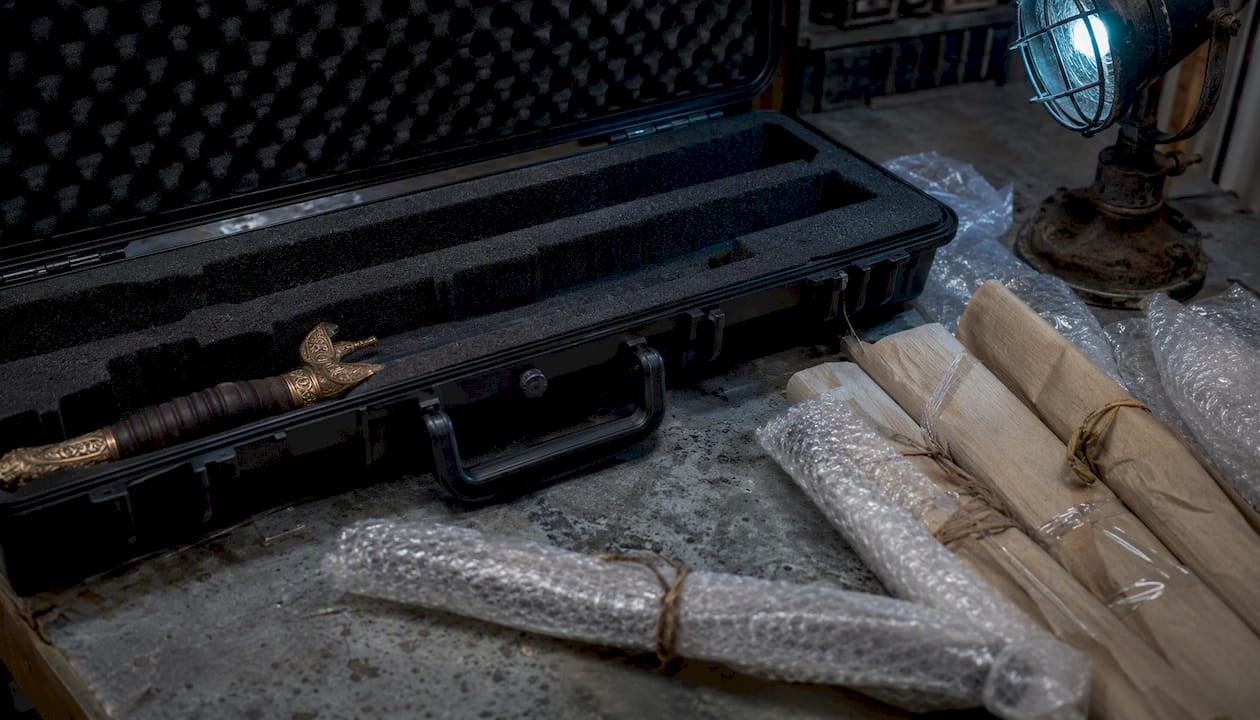
The cases that hold up are hard-sided, foam-lined, and sized to the sword with minimal extra space. A case with two inches of foam on all sides and a blade that cannot shift is what you want. For replica swords with decorative fittings — wrapped handles, ornate guards, detailed scabbards — the fittings are usually the first thing to break in transit. Wrap them separately in bubble wrap before placing the sword in the case.
Weight distribution matters too. A heavy pommel on one end of a long case creates a lever effect when the bag is dropped or tossed. Center the weight by placing the heaviest component (usually the blade) in the middle of the case, not at one end.
One practical note on documentation: keep your purchase receipt in your carry-on, not in the checked case. If the checked bag is delayed or inspected, you still have proof of ownership on your person.
Propswords has the travel-ready replicas you need
Collectors who want a sword that survives the flight and arrives display-ready have a shorter list of options than they think. Propswords carries replica swords built for collectors — anime, movie, Viking, and historical pieces — with free shipping within the USA and the kind of build quality that holds up in a hard case.

Every purchase comes with documentation you can use at check-in and customs: a receipt, product details, and clear provenance for the piece. That paper trail is exactly what TSA and CBP want to see. Browse the current collection at Propswords and find a piece that fits your case, your collection, and your next trip.
Sources
- Swords | Transportation Security Administration – TSA
- Traveling with an personal knife/switchblade/sword into the …
This article is general information, not a substitute for advice from a qualified lawyer. Consult a qualified legal professional about your own circumstances before acting on anything here.
FAQ
Can I bring a sword through TSA in my carry-on?
No. TSA explicitly prohibits swords in carry-on bags. They must be packed in checked baggage, sheathed or securely wrapped, and are subject to TSA officer discretion.
What happens if TSA finds a sword in my carry-on?
The sword will be confiscated at the checkpoint. Depending on timing, you may be able to return to the check-in counter and check it as baggage, but the airline and TSA officer make that call.
Do state laws apply even after TSA clears my sword?
Yes. TSA clearance covers the flight only. Once you land, state and local possession laws govern what you can legally carry or transport, and some states restrict certain blade types or lengths.
Does CBP require me to declare a sword when entering the U.S.?
CBP does not broadly prohibit sword importation, but you must declare the item on your customs form. Failure to declare can result in seizure and civil penalties, so always disclose the item and carry your purchase receipt.
What is the $45 TSA rule?
TSA does not charge travelers a fee for weapons or bladed items. Any fee you pay for a sword in checked baggage comes from the airline’s oversize or specialty-item policy, not from TSA.
Recommended