TL;DR:
- In 2026, sword insurance workflows rely on AI-driven tools for data extraction, risk assessment, and claims processing. Human oversight remains essential to ensure compliance, accuracy, and proper accountability, especially for regulatory audits. Proper documentation, safety practices, and thorough pre-deployment testing improve insurance accuracy and reduce automation errors.
A sword insurance workflow is defined as the end-to-end process of submitting, assessing, and managing insurance coverage for collectible swords using AI-augmented tools that reduce manual effort and preserve accuracy. The industry term for this broader category is collectibles insurance workflow automation, and understanding it matters more in 2026 than ever before. NAIC AI guidelines now require human accountability at every decision point, which means the old manual approach is both too slow and too risky. Whether you manage a single anime replica or a curated historical collection, the sword insurance process in 2026 demands a structured, documented, and partially automated approach from day one.
What tools enable a sword insurance workflow in 2026?
AI-native platforms now handle the full intake-to-renewal cycle for collectibles insurance. Automated systems manage multi-channel intake and triage, cutting what once took three days of manual claim processing down to hours. That speed advantage compounds across a large collection, where dozens of items may need simultaneous appraisal updates.
The most effective tools for a sword insurance process in 2026 fall into three functional categories:
- Intake and data extraction platforms: These tools read non-standard documents, such as auction certificates, provenance letters, and manufacturer spec sheets from Propswords or similar retailers, and convert them into structured underwriting data.
- Risk classification engines: Specialized modules score sword-specific variables including blade material, historical period, condition grade, and storage environment. A carbon-steel Viking replica stored in a humidity-controlled case carries a different risk profile than an unsheathed display piece.
- Policy and claims automation layers: These systems generate policy drafts, calculate premiums, and route first-notice-of-loss filings without requiring an adjuster to touch every record.
Governance is the fourth pillar. Agentic ecosystems orchestrate AI agents across the insurance lifecycle with transparent audit trails, which is exactly what NAIC compliance requires. Without a complete audit log, an automated denial becomes a regulatory liability.
Pro Tip: Before selecting any platform, verify that it produces role-based access logs and time-stamped decision records. Regulators conducting market-conduct exams will ask for both.
| Feature category | What to look for |
|---|---|
| Document ingestion | Handles PDFs, images, and handwritten appraisals |
| Risk classification | Supports collectible-specific fields (provenance, condition, storage) |
| Policy generation | Produces compliant draft language automatically |
| Claims triage | Flags severity level before human review |
| Audit trail | Logs every AI action with timestamp and user attribution |
How do you execute a sword insurance process step by step?
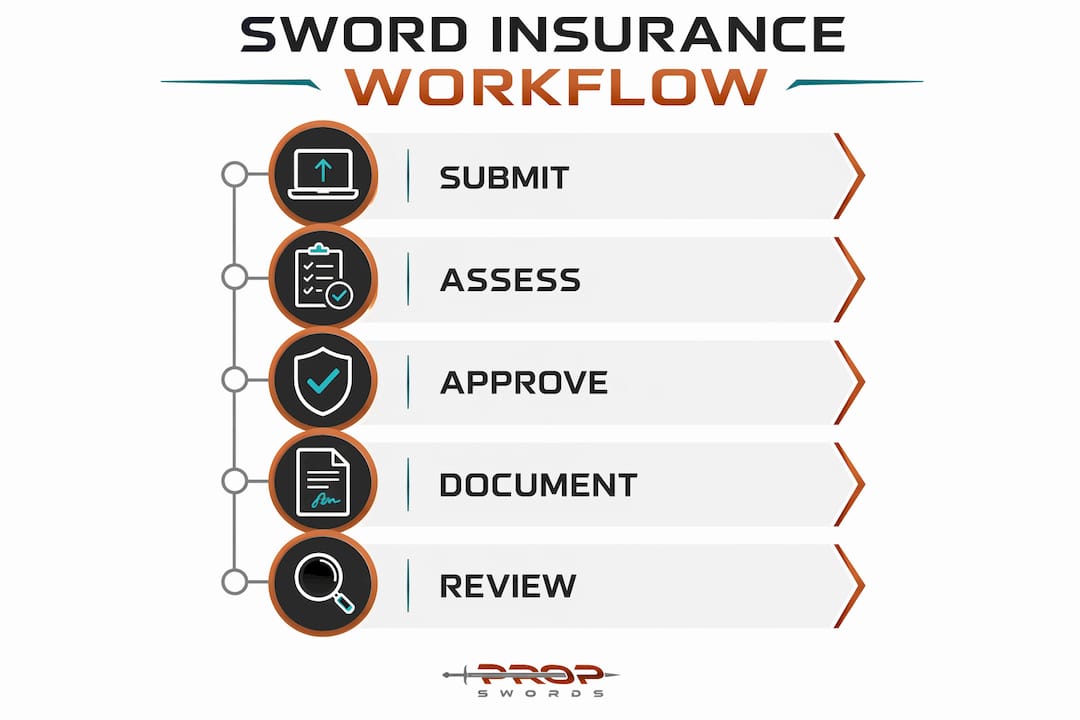
A well-run sword insurance process in 2026 follows five distinct stages. Each stage has a defined AI role and a defined human role. Mixing them up is the most common source of errors.
-
Submission intake. The collector or broker submits documentation: purchase receipts, appraisal reports, photos, and provenance records. AI extracts and validates key fields automatically. AI extracts and organizes submissions, enabling underwriters to focus on risk rather than data entry. A Propswords purchase receipt, for example, contains item name, material, and retail value, all of which feed directly into the risk model.
-
Risk appraisal. The system scores the sword on type (functional vs. decorative replica), provenance (licensed movie prop vs. mass-market replica), condition (mint, display wear, battle-ready), and storage conditions. A licensed replica of a film prop carries higher replacement value and more complex provenance verification than a standard decorative piece.
-
Policy creation. Automation drafts the policy with coverage limits, exclusions, and premium calculations pre-populated. A human underwriter reviews the draft before binding. Human review remains mandatory for underwriting judgments and regulatory compliance. This is not optional under 2026 standards.
-
Claims intake and first-notice-of-loss. When a claim arrives, AI classifies severity immediately. A theft claim on a $4,000 anime replica triggers a different response path than a minor display damage claim on a $200 decorative piece. The system routes each claim to the correct adjuster tier without delay.
-
Exception management. Any record that falls outside normal parameters, such as a sword with disputed provenance or an unusual storage arrangement, gets flagged for senior underwriter review. This human checkpoint prevents the over-automation failures that regulators penalize.
Pro Tip: Build your exception rules before you go live. Defining what triggers human review in advance is far easier than retrofitting those rules after a compliance audit.
How do sword safety principles strengthen insurance workflows?

Sword safety protocols and insurance risk models share the same underlying logic. The HEMA hierarchy of control for safe sword handling runs from hazard elimination at the top, through environment engineering and administrative rules, down to personal protective equipment at the bottom. Insurance underwriters can apply the same hierarchy to risk modeling.
Applying this framework to underwriting looks like this:
- Elimination: Does the collector store the sword in a locked, climate-controlled case? Eliminating access risk reduces theft and damage probability.
- Engineering controls: Are wall mounts, display stands, or locked cabinets in use? Physical safeguards lower the likelihood of accidental damage claims. A complete sword display checklist documents these controls in a format underwriters can review directly.
- Administrative controls: Structured mutual safety checks lower injury risk in group training settings and translate directly into documented handling protocols for insurance purposes. A collector who maintains a written handling log demonstrates lower risk than one who does not.
- Personal protective equipment: For functional swords used in HEMA practice, documented PPE use signals responsible ownership and supports lower premium calculations.
“The hierarchy of control used in sword safety applies directly to insurance risk workflows. Prioritizing hazard elimination through accurate risk data, then engineering controls through automation, before relying on administrative and human processes produces the most reliable outcomes.”
Collectors who document their safety practices before applying for coverage consistently receive more accurate premium quotes. Underwriters reward documented risk reduction because it reduces claim probability. A sword handling guide that details storage and display methods gives an underwriter concrete evidence to work with.
What are the common mistakes in sword insurance workflow automation?
Over-automation is the leading failure mode in insurance workflow automation for collectibles. Automated denial without human review fails regulatory fairness standards and exposes carriers to market-conduct penalties. The NAIC Model Bulletin is explicit: AI-supported decisions require human accountability at the coverage determination stage.
The most frequent mistakes collectors and insurance professionals encounter include:
- Inaccurate data extraction from non-standard documents. Appraisal letters, auction house certificates, and manufacturer descriptions from specialty retailers do not follow standard insurance form layouts. AI trained on generic documents will misread fields or skip them entirely.
- Missing audit trails. Detailed audit logs and role-based access controls are required to meet compliance and market-conduct exam standards. A workflow that processes claims without logging every AI action creates a defense gap.
- Tech integration failures. Sword-specific data fields, such as blade length, hilt material, and historical period, often have no equivalent in standard insurance administration systems. Mapping these fields manually before deployment prevents downstream errors.
- Skipping pre-launch testing. Insurance AI deployments require rigorous pre-launch audits, controlled testing against real data, and continuous monitoring. Deploying against live policies without a test phase is the fastest way to generate incorrect coverage decisions.
- Ignoring 2026 insurance technology trends. The future of insurance workflows moves toward continuous monitoring and adaptive rule updates. A workflow built on static rules from 2024 will drift out of compliance as regulations evolve.
Pro Tip: Run a parallel test for at least 30 days before switching fully to automated processing. Compare AI outputs against manual decisions on the same records to catch systematic errors before they affect real policies.
Key Takeaways
A well-designed sword insurance workflow in 2026 combines AI automation for intake and triage with mandatory human review for coverage decisions, ensuring both speed and regulatory compliance.
| Point | Details |
|---|---|
| Define AI and human roles clearly | Automate intake and data extraction; reserve final coverage calls for licensed professionals. |
| Apply the HEMA hierarchy to underwriting | Use hazard elimination and engineering controls as the first line of risk reduction before administrative checks. |
| Maintain complete audit trails | Log every AI action with timestamps and role attribution to satisfy NAIC compliance requirements. |
| Document sword safety practices | Collectors who provide written handling and storage protocols receive more accurate premium assessments. |
| Test before deploying | Run parallel testing against real records for at least 30 days to identify systematic errors before go-live. |
Why I think most collectors underestimate the workflow side of sword insurance
Most collectors spend significant time selecting the right sword and almost no time preparing the documentation that makes it insurable. I have seen collections worth thousands of dollars sit in coverage limbo because the owner could not produce a clear provenance record or a basic storage description. The sword itself was fine. The workflow around it was not.
The 2026 insurance technology trends point toward AI doing more of the heavy lifting on data processing, but that shift only helps collectors who have their documentation in order first. An AI intake system cannot extract information that does not exist. A handwritten note saying “bought at a convention” will not satisfy an underwriting engine built to read structured appraisal data.
The sword safety workflow principles from HEMA practitioners offer a genuinely useful mental model here. Start with elimination: remove the risk of incomplete data by building a documentation habit before you need coverage. Then apply engineering controls: use a consistent format for recording purchases, storage conditions, and handling history. Administrative controls come last, not first.
The future of insurance workflows for collectibles will reward collectors who treat documentation as part of ownership, not as a bureaucratic afterthought. The technology is ready. The question is whether collectors will meet it halfway.
— Muhammad
Propswords and your collectible sword collection
Building an insurable collection starts with knowing exactly what you own and where it came from.
Propswords carries a curated range of anime, movie, Viking, and historical replica swords, each with clear product descriptions and specifications that feed directly into insurance intake workflows. When your documentation matches your physical collection, the insurance process moves faster and produces more accurate coverage. Browse the best replica swords for 2026 to find pieces that come with the detail and provenance information your underwriter needs. Propswords also offers free shipping within the USA, making it straightforward to build or expand a well-documented collection.
FAQ
What is a sword insurance workflow?
A sword insurance workflow is the structured process of submitting, appraising, and managing insurance coverage for collectible swords, using AI tools for intake and triage and human review for final coverage decisions.
How does AI improve the sword insurance process in 2026?
AI handles document extraction, risk classification, and claims routing automatically, cutting processing time from days to hours while freeing underwriters to focus on complex judgment calls.
What documents do collectors need for sword insurance?
Collectors need purchase receipts, professional appraisals, provenance records, and photos of storage conditions. Structured documentation from retailers like Propswords speeds up the intake process significantly.
How do sword safety practices affect insurance premiums?
Collectors who document storage controls, handling protocols, and physical safeguards demonstrate lower risk to underwriters, which supports more accurate and often lower premium calculations.
What does the NAIC Model Bulletin require for AI-assisted insurance decisions?
The NAIC Model Bulletin requires human accountability and a complete audit trail for every AI-supported coverage decision, meaning automated denials without human review are non-compliant.
Recommended