TL;DR:
- Mythical beliefs about Viking swords often lead collectors to overvalue fakes and misidentify replicas as authentic artifacts. Proper authentication involves metallurgical analysis, typological classification, and documented provenance, with metallurgy being the most definitive indicator. Educating oneself on these factors is essential to avoid costly mistakes and preserve the archaeological integrity of Viking weaponry.
Viking sword collecting myths are false beliefs about authenticity, metallurgy, and historical usage that cause collectors to overpay for fakes, misidentify replicas as originals, or dismiss genuine artifacts. The formal study of these misconceptions falls under Viking sword typology and archaeometallurgy, two disciplines that have transformed how serious collectors approach the market. Swords like the Ulfberht have become lightning rods for myth, attracting both reverence and forgery in equal measure. If you collect ancient swords or plan to, separating legend from documented fact is the difference between a meaningful acquisition and an expensive mistake.
1. The biggest Viking sword collecting myths, debunked
The most damaging myth in Viking sword collecting is that swords were standard warrior gear carried by every Norse fighter. Swords were elite status symbols; the majority of Viking warriors relied on spears and axes, which were cheaper to produce and easier to replace. This means any seller claiming a sword was “a common battlefield weapon of the people” is either misinformed or misleading you. Rarity is the baseline, not the exception.
The second major myth targets the Ulfberht directly. Many collectors assume every sword bearing the +VLFBERHT+ inscription is an authentic masterpiece. Contemporary fakes used misspelled marks like +VLFBERHT+ or +VLFBEHT+, produced by local smiths who copied the brand to deceive buyers. This practice is not a modern invention. Forgery existed in the Viking Age itself, which means historical age alone does not guarantee authenticity.
A third persistent myth holds that Viking swords were crude, heavy, and poorly balanced. Authentic pieces were precision instruments. Real Viking swords feel balanced and alive in the hand, with the point of balance close to the guard. A sword that feels like a crowbar is almost certainly a fake or a low-quality reproduction.
Pro Tip: Before buying any piece described as Viking Age, ask the seller for the typological classification by Jan Petersen or Fedir Androshchuk. A legitimate dealer will know these systems. A fraudulent one will not.
2. How to authenticate a Viking sword: key scientific and typological indicators
Authentication rests on three pillars: metallurgy, typology, and provenance. No single factor is sufficient on its own.
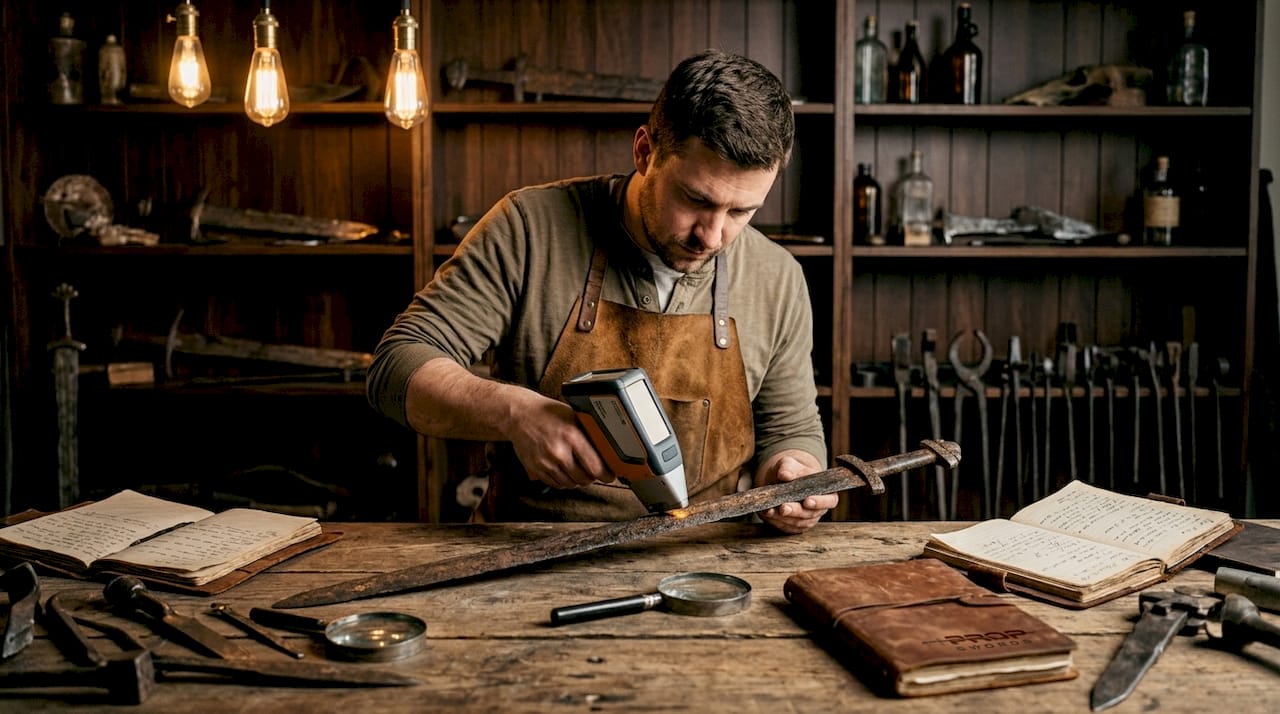
Metallurgical analysis is the most definitive test. Authentic Ulfberht swords used crucible steel with carbon content up to 1.6%, compared to roughly 0.4% in typical swords of the same period. That gap is not a minor technical detail. It represents a completely different manufacturing process, one that required importing steel ingots from Central Asia because temperatures around 1,600°C were unachievable with standard medieval European furnaces. X-ray fluorescence and carbon analysis can confirm these properties in a lab.
Typological classification is the collector’s most practical tool. Hilt architecture, specifically the pommel and guard shape, is the primary dating indicator because blade shapes remained relatively uniform across centuries. The Petersen typology, expanded by Androshchuk, identifies dozens of distinct hilt types that correspond to specific periods and regions. Collectors who learn sword typology can date a piece to within a generation based on hilt geometry alone.
Provenance documentation separates legal acquisitions from illicit ones. Provenance is essential for any serious collector, and professional appraisers reject items from unrecorded excavations outright. A sword without a documented find location has lost its archaeological context permanently, which reduces both its scholarly value and its legal standing in many jurisdictions.
| Authentication method | What it reveals | Limitation |
|---|---|---|
| Carbon and slag analysis | Steel purity, crucible vs. bloomery origin | Requires lab access and sampling |
| Petersen/Androshchuk typology | Period and regional origin via hilt shape | Blade shape alone is unreliable |
| Provenance documentation | Legal status and archaeological context | Absent in many market pieces |
| Patina and corrosion patterns | Age and burial environment | Can be artificially replicated |
| Physical balance test | Handling quality and construction method | Informal; not definitive alone |
3. Common characteristics of modern Viking sword forgeries
Modern forgeries are more sophisticated than most collectors expect, and visual inspection alone will not catch the best ones.
The most common red flag is chemical etching used to simulate pattern-welded or inlaid inscriptions. Modern forgeries use chemical etching rather than the traditional inlay process, and rushed counterfeits often carry a faint acidic smell that genuine ancient pieces do not. If a sword smells like a chemistry lab, treat that as a serious warning sign.
Watch for these additional forgery markers:
- Inscription inconsistencies. Misspelled or inconsistently spaced runes or Latin marks are a classic tell. Authentic Ulfberht inscriptions follow specific letter forms; deviations indicate either a period fake or a modern one.
- Industrial steel composition. Modern reproductions use industrial 1065 steel that approximates historic carbon content but does not replicate the crucible steel purity or forging technique of originals. A lab test will expose this immediately.
- Suspicious documentation. Vague provenance like “found in Scandinavia” or “private European collection” without specific excavation records is a major warning. Legitimate pieces have paper trails.
- Poor balance and dead weight. A sword that feels uniformly heavy with no dynamic balance was not made by a skilled smith working in the Viking tradition.
Pro Tip: Request a third-party metallurgical report before purchasing any sword priced above $5,000 and claimed as Viking Age. The cost of the test is trivial compared to the cost of a mistake.
4. How historical trade and metallurgy shaped Viking sword legends
The myths surrounding famous Viking swords are not random. They grew from a genuine technological gap between Ulfberht swords and everything else available in 9th to 11th century Europe.
Viking trade routes extended deep into Central Asia via the Volga trade corridor, connecting Norse merchants to crucible steel producers in present-day Iran and Afghanistan. This is how Ulfberht smiths accessed steel of a quality that European bloomery furnaces could not produce. The result was a sword that cut through contemporary armor with a consistency that must have seemed almost supernatural to opponents. That reputation fed the legends that collectors still encounter today.
The myth that Viking swords were predominantly imported Frankish blades is also overstated. Only about 17 of over 3,000 Viking-age swords found in Norway are of undisputed Frankish origin. The vast majority were Norse-manufactured, which directly contradicts the popular narrative that Vikings depended on Frankish smithing for quality weapons.
One detail that complicates condition assessment for collectors is the practice of ritual sword killing. Deliberate bending of blades before burial served spiritual functions in Viking culture, meaning a bent or damaged blade is not necessarily evidence of battle use or poor quality. A collector who dismisses a ritually killed sword as damaged is misreading the artifact entirely. Understanding Viking weapon legends requires knowing that destruction could be an act of honor, not neglect.
When trade routes were disrupted in the 11th century, the supply of Central Asian crucible steel dried up. Ulfberht production declined, and the technological standard it represented was not matched in Europe for centuries. This historical context explains why authenticated Ulfberht swords command extraordinary prices and why the collector market for them attracts so many fakes.
Key takeaways
Viking sword collecting myths persist because most collectors rely on visual appeal and seller reputation rather than metallurgical evidence, typological classification, and documented provenance.
| Point | Details |
|---|---|
| Swords were elite items | Common warriors used spears and axes; sword rarity is the baseline for any authentic piece. |
| Forgery is not modern | Period smiths faked Ulfberht inscriptions; historical age alone does not confirm authenticity. |
| Hilt shape dates the sword | Petersen and Androshchuk typology via pommel and guard is more reliable than blade shape alone. |
| Provenance is non-negotiable | Items without documented excavation records lose archaeological value and legal standing. |
| Lab testing catches fakes | Carbon content and slag analysis distinguish crucible steel originals from industrial reproductions. |
What I’ve learned after years of navigating Viking sword myths
The single most common mistake I see collectors make is trusting the story over the steel. A compelling origin narrative, a dramatic provenance claim, a beautifully photographed hilt. These things sell swords. They do not authenticate them.
I spent years assuming that a sword’s visual complexity was a proxy for quality. Pattern-welded blades look extraordinary, and sellers know that. But the most significant Viking swords, the Ulfberht pieces, are visually understated. Their power is in the metallurgy, not the decoration. Once I understood that, I stopped being impressed by ornate pieces and started asking harder questions about carbon content and hilt classification.
The ritual killing detail changed how I read condition reports entirely. A bent blade used to read as damage to me. Now I read it as potential evidence of deliberate burial practice, which actually increases my interest in a piece rather than reducing it. Context transforms meaning in this field.
My honest advice for anyone serious about collecting Viking swords is to spend money on education before you spend it on acquisitions. Read Petersen’s typology. Understand what crucible steel actually means. Find a conservator who specializes in archaeometallurgy and build that relationship before you need it. The collectors who get burned are the ones who skip that foundation and rely on enthusiasm alone.
Responsible collecting also means respecting provenance laws. Buying illicitly sourced artifacts does not just risk your investment. It destroys the archaeological record for everyone.
— Muhammad
Explore Viking sword replicas at Propswords
Authenticated Viking Age originals are rare, expensive, and legally complex to acquire. For collectors who want to study hilt typology, display historically grounded pieces, or simply own a sword that reflects genuine Norse craftsmanship, high-quality replicas are the practical answer. Propswords offers a curated selection of Viking-inspired sword designs built with attention to historical accuracy, from pommel geometry to blade proportions. Whether you are building a display collection or want a reference piece alongside your research, browse the best replica swords for 2026 at Propswords and find options that respect the history behind the weapon.
FAQ
Were all Viking warriors armed with swords?
No. Swords were luxury items owned primarily by nobility and elite warriors. Most Viking fighters carried spears and axes, which were far cheaper to produce.
How do I spot a fake Ulfberht sword?
Check the inscription spelling and letter spacing against documented examples, then request a metallurgical analysis confirming crucible steel with carbon content near 1.6%. Misspelled marks and industrial steel composition are the two clearest indicators of a fake.
What does “ritual sword killing” mean for collectors?
Ritual killing refers to the deliberate bending or breaking of a sword before burial as a spiritual act. A bent blade does not indicate damage or low quality. It may actually confirm authentic Viking Age burial context.
Why is provenance so important when collecting ancient swords?
Provenance documents where and how a sword was excavated, establishing both its legal status and its archaeological value. Items from unrecorded or illegal excavations are rejected by professional appraisers and may expose buyers to legal liability.
Can I use hilt shape alone to date a Viking sword?
Hilt shape, specifically the pommel and guard design classified under the Petersen or Androshchuk systems, is the most reliable dating tool available to collectors. Blade shape alone is insufficient because blade design remained largely consistent across several centuries of Viking Age production.
Recommended