TL;DR:
- The movie prop sword display process involves careful preparation, secure mounting, environmental control, and routine maintenance to preserve the sword’s condition and appearance. Proper environmental conditions, especially humidity between 45 and 55% RH, along with inert materials and correct orientation, are essential for long-term preservation. Regular cleaning, inspection, and thoughtful placement transform swords from mere objects into lasting, visually striking centerpieces.
The movie prop sword display process is the structured practice of preparing, mounting, and preserving replica or screen-used swords so they remain visually striking and physically intact for years. Done correctly, it transforms a sword from a stored object into a centerpiece. Done carelessly, it causes warping, corrosion, and finish damage that no amount of cleaning can reverse. This guide covers the full process: the tools you need, how to mount safely, creative display ideas worth stealing, and the maintenance routines that separate serious collectors from casual fans.
What does the movie prop sword display process actually involve?
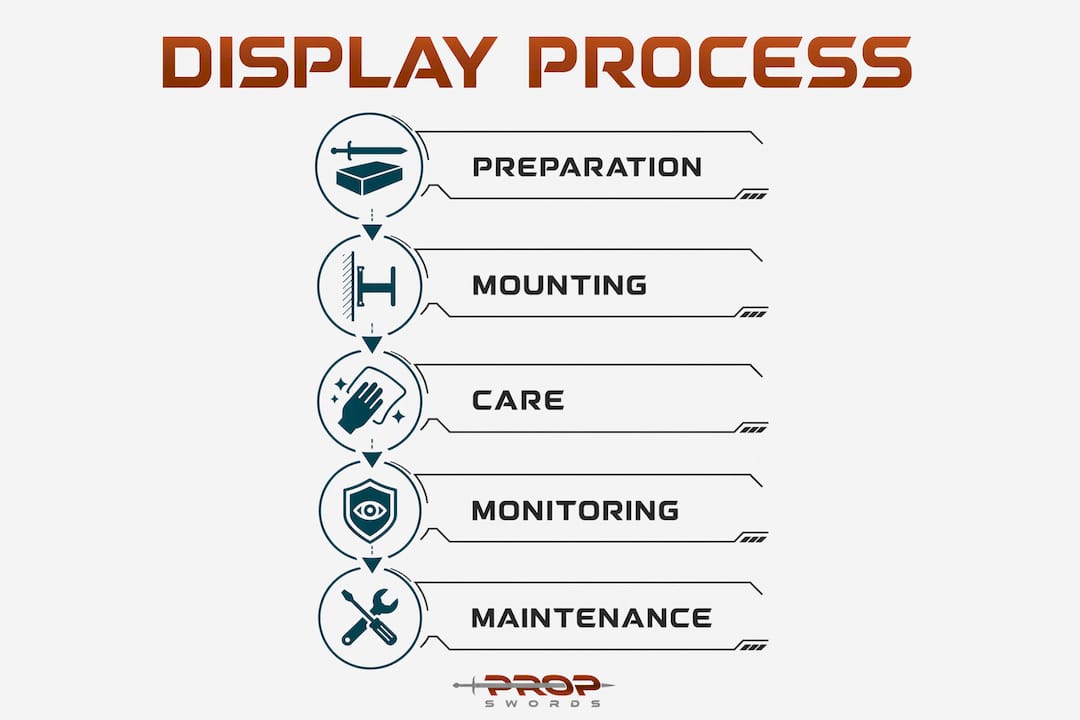
The movie prop sword display process covers three distinct phases: preparation, mounting, and ongoing care. Most collectors focus only on the middle phase and wonder why their swords deteriorate. Understanding all three is what separates a display that lasts a decade from one that degrades in two years.
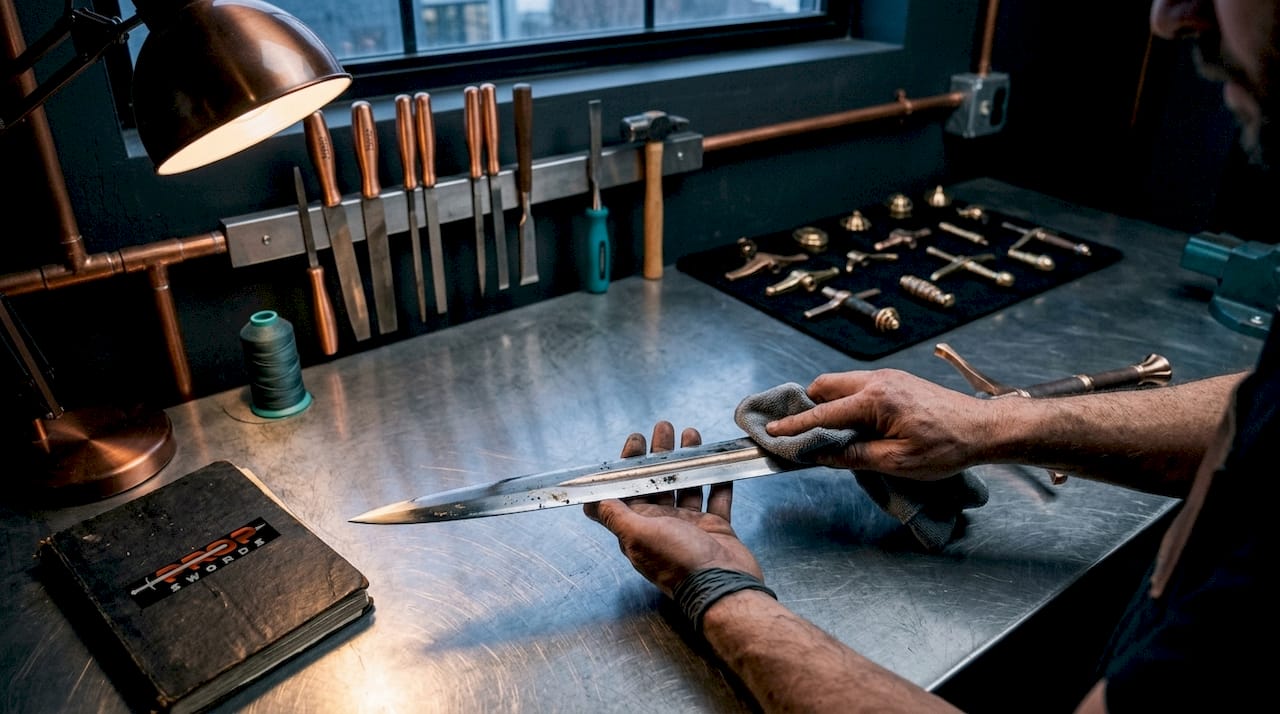
Movie prop swords often use lightweight foam cores with detailed external finishes, while hero props use heavier steel for close-up shots. This structural variation matters directly for mounting. A foam-core stunt sword weighs a fraction of a steel replica, so the hardware requirements differ significantly. Knowing what you own determines every decision that follows.
The industry term for the broader practice is prop preservation and display, a standard used by film archivists and museum conservators. The collector community uses both terms interchangeably, and both are valid. What matters is that the principles behind professional prop preservation apply directly to your home display, whether you own one sword or forty.
Essential tools and environment for displaying movie prop swords
Choosing the right display type
Three display formats dominate sword collection showcasing: wall mounts, freestanding stands, and enclosed display cases. Each serves a different purpose and suits a different space.
| Display type | Best for | Key advantage | Key limitation |
|---|---|---|---|
| Wall mount | Single statement pieces | Space-efficient, dramatic visual impact | Exposes sword to ambient air and dust |
| Freestanding stand | Multiple swords, flexible placement | Easy repositioning, no wall damage | Takes floor or shelf space |
| Enclosed display case | Long-term preservation, valuable pieces | Controls humidity, blocks dust and UV | Higher cost, less accessible |
Wall mounts work well for decorative replicas in stable, climate-controlled rooms. Enclosed cases are the correct choice for anything with significant monetary or sentimental value. Tru Vue Optium Museum Acrylic cases with 6mm panels minimize dust, humidity fluctuations, and UV damage, making them the gold standard for fragile collectibles.
Environmental controls that actually matter
The single most overlooked factor in sword display is humidity. Optimal relative humidity for sword display sits between 45 and 55% RH. Displays kept above 65% RH risk mold growth; high humidity also accelerates corrosion on metal components. This means a sword hung in a bathroom or basement without humidity control is actively being damaged.
Room-level humidity control is less effective than microclimate control. Hygrometers combined with silica gel trays inside display cases give you reliable, repeatable humidity management at the level that actually touches the sword. A digital hygrometer costs under $20 and removes all guesswork.
Temperature stability matters almost as much as humidity. Rapid temperature swings cause materials to expand and contract, which stresses joints, loosens fittings, and can crack painted or lacquered finishes over time. Keep displays away from exterior walls, heating vents, and windows.
Pro Tip: When selecting materials for your display case or mount backing, choose inert materials that do not off-gas. Certain plastics and adhesives emit chemicals that degrade sword finishes inside closed displays over months. Conservation-grade foam, acid-free fabric, and untreated hardwood are safe choices.
How to mount movie prop swords safely, step by step
Mounting is where most collectors make irreversible mistakes. The steps below apply to both wall mounts and freestanding stands, with notes on where the process diverges.
- Clean the sword before mounting. Use a soft, lint-free cloth to remove fingerprints and dust. Oils from skin accelerate corrosion on metal parts. Never use abrasive cleaners or excess moisture.
- Measure and mark your mount points. Hold the sword against the wall or stand in your intended position. Mark the blade support points with painter’s tape, not permanent marker. For wall mounts, locate studs with a stud finder before drilling.
- Select hardware rated for the sword’s weight. A steel replica can weigh 3 to 6 pounds. Use wall anchors or stud screws rated for at least twice the sword’s weight. Under-rated hardware is the leading cause of display failures.
- Install cushioned supports at contact points. Bare metal hooks scratch finishes and create stress points. Wrap hooks with soft leather, felt, or conservation-grade foam before placing the sword.
- Orient the sword correctly. Mounting swords blade-side up in horizontal displays preserves edge sharpness and prevents warping over time. Vertical displays should support the sword at the guard, not the blade tip.
- Check stability before walking away. Gently apply lateral pressure to the mounted sword. It should not shift or rock. Secure fit and cushioned supports extend the lifespan of both the sword and the mount hardware.
- Minimize future handling. Every time you pick up a displayed sword, you introduce oils, risk drops, and disturb the mount. If you want to show it to guests, do so deliberately and with clean hands.
Pro Tip: Balance aesthetics with preservation by positioning your most visually dramatic sword at eye level, then building the rest of the display around it. Eye-level placement reduces the temptation to handle the piece and gives visitors the best viewing angle without touching.
Creative sword display ideas that actually work
Themed and story-driven displays
The most memorable sword displays tell a story. A replica of Aragorn’s Andúril from The Lord of the Rings displayed alongside a printed map of Middle-earth and a small figurine creates a scene, not just a shelf. Collectors who build story-driven displays report significantly higher satisfaction with their collections than those who simply hang swords in rows.
Themed displays also solve the practical problem of mixed collections. If you own swords from different franchises, grouping them by theme, era, or material creates visual coherence. A Viking-themed corner with crossed axes, a shield, and two Norse-inspired swords reads as intentional. The same pieces scattered across a room read as clutter.
Lighting and background art
Lighting transforms a good display into a great one. LED strip lighting with UV filters placed behind or below a display case highlights blade geometry without causing finish damage. UV-filtered lighting balances visibility with conservation, which is exactly what gallery curators use for the same reason.
Background art amplifies the effect. A printed canvas of a battle scene, a custom-painted wall panel, or even a dark velvet backing inside a case creates contrast that makes the sword’s details pop. The background should complement, not compete. Dark neutrals (charcoal, navy, deep burgundy) work best for most blade finishes.
Here are additional display ideas worth considering for your sword collection showcasing:
- Custom tiered racks allow you to display six to twelve swords in a single wall section without crowding, using staggered heights for visual rhythm.
- Mixed-media shadow boxes combine a sword with a prop, a costume piece, or a signed photo for a complete movie memorabilia display.
- Rotating display stands let you feature one sword at a time in a prominent spot while storing others safely nearby.
- Acrylic pedestal mounts work well for shorter swords or daggers, giving them a museum-quality presentation on a shelf or desk.
How to maintain movie prop swords after display
Cleaning without causing damage
Proper cleaning routines avoid moisture damage and maintain finish integrity on replica swords. The rule is simple: clean gently, clean rarely, and never use abrasive materials. A soft microfiber cloth removes dust and fingerprints without scratching. For metal blades, a small amount of Renaissance Wax or a sword-specific oil applied sparingly every three to six months prevents oxidation.
Avoid household cleaners entirely. Products containing ammonia, bleach, or alcohol strip protective coatings and dull finishes permanently. For swords with decorative wrapping on the handle, use a dry brush to remove dust rather than any liquid.
Inspection and monitoring schedule
| Maintenance task | Frequency | Method |
|---|---|---|
| Dust removal | Monthly | Soft microfiber cloth, dry brush for handles |
| Humidity check | Weekly | Digital hygrometer reading inside case |
| Silica gel replacement | Every 3 to 6 months | Replace or recharge gel packs when saturated |
| Full cleaning and oiling | Every 6 months | Approved oil or wax on metal surfaces |
| Mount hardware inspection | Annually | Check for loosening screws, worn cushioning |
The conservation approach treats the display case as a microclimate system actively fighting deterioration, not just a physical barrier. Adopting this mindset means you check your display the way a museum curator checks an exhibit, not the way someone dusts a bookshelf.
Pro Tip: Keep a simple log of your maintenance dates and any observations about finish changes or hardware wear. A three-minute note after each inspection tells you whether a problem is new or has been developing for months. This is the single habit that separates collectors who catch problems early from those who discover damage too late.
For a deeper dive into long-term preservation, the replica sword maintenance guide from Propswords covers material-specific care in detail.
Key takeaways
The movie prop sword display process requires controlled environments, weight-rated hardware, and consistent maintenance to protect both the sword’s finish and its long-term value.
| Point | Details |
|---|---|
| Environment controls preservation | Keep humidity between 45 and 55% RH using silica gel trays and a digital hygrometer. |
| Hardware must match sword weight | Use anchors or screws rated for at least twice the sword’s weight to prevent mount failure. |
| Orientation affects condition | Mount horizontally blade-side up to prevent warping and preserve edge sharpness over time. |
| Lighting requires UV filtering | Use UV-filtered LEDs to illuminate displays without degrading finishes or fading decorative elements. |
| Maintenance is scheduled, not reactive | Clean, inspect, and replace silica gel on a fixed schedule rather than waiting for visible damage. |
Why most collectors get the display wrong before they even hang the sword
I’ve seen hundreds of sword displays, and the most common mistake has nothing to do with the mount. It’s the location. Collectors choose where to hang a sword based on where it looks best in the room, which is the right instinct, but they ignore what that location does to the sword over time. A sword hung above a fireplace looks incredible. It also sits in a zone of fluctuating heat, rising smoke particles, and dry air that will destroy the finish within a few years.
The second mistake is treating display and storage as opposites. Some collectors display their most valuable pieces and store the rest, which is fine. But the storage conditions are often worse than the display conditions, which defeats the purpose. A sword in a cardboard box in a humid garage is in worse shape than one on a wall in a climate-controlled room.
What I’ve found actually works is treating every sword in your collection as if it’s on loan from a museum. That mental shift changes how you select hardware, how you choose locations, and how often you check on things. It also makes the display more intentional. When you think like a curator, you stop hanging swords randomly and start building displays that have a point of view.
The movie sword checklist from Propswords is worth bookmarking for this reason. It forces you to answer the right questions before you drill a single hole.
— Muhammad
Upgrade your collection with Propswords

Propswords carries a curated selection of replica swords built for collectors who care about both display quality and long-term preservation. From anime-inspired blades to Viking and movie replicas, every piece is designed with the detail and finish that makes a display worth building. If you’re ready to add a centerpiece to your setup, the top replica swords for 2026 page is the right starting point. Free shipping within the USA is included, and the range covers everything from single statement pieces to full themed collections. Browse the selection and find the sword your display has been missing.
FAQ
What is the movie prop sword display process?
The movie prop sword display process is the practice of preparing, mounting, and maintaining replica or screen-used swords using proper hardware, environmental controls, and cleaning routines. The goal is to preserve the sword’s condition while maximizing its visual impact.
What humidity level is best for displaying swords?
The optimal range is 45 to 55% relative humidity. Levels above 65% RH risk mold and accelerate corrosion, so a digital hygrometer and silica gel trays inside the display case are the most reliable control method.
Should I mount my sword horizontally or vertically?
Horizontal mounting blade-side up is the preferred method for most swords. This orientation preserves edge sharpness and reduces the risk of warping compared to vertical or blade-down positions.
What materials should I avoid when building a display case?
Avoid materials that off-gas, including certain plastics, foam with plasticizers, and solvent-based adhesives. These chemicals degrade sword finishes inside closed displays over time. Use conservation-grade foam, acid-free fabric, and untreated hardwood instead.
How often should I clean a displayed sword?
Dust monthly with a dry microfiber cloth and apply a protective oil or wax to metal surfaces every six months. Avoid liquid cleaners entirely, and inspect mount hardware annually for wear or loosening.
Recommended