TL;DR:
- Movie sword terminology provides the precise vocabulary to describe sword parts, fighting techniques, and choreography seen on screen. Understanding terms like pommel, fuller, and koshirae enhances appreciation of prop accuracy and fight realism, especially through the parry-riposte cycle. Recognizing these elements transforms viewing from spectacle to engaging narrative grounded in authentic swordplay principles.
Movie sword terminology refers to the precise vocabulary describing sword parts, fighting techniques, and choreography seen on screen, and knowing these terms transforms a casual viewer into an informed one. When you watch Aragorn swing his longsword in The Lord of the Rings or see a samurai draw a katana in The Last Samurai, every movement, every blade shape, and every guard position has a name rooted in centuries of real swordcraft. A sword has three core parts: the hilt, the blade, and the point. Understanding this film sword glossary gives you the language to discuss props, choreography, and historical accuracy with real authority.
Movie sword terminology explained: the key parts of a sword
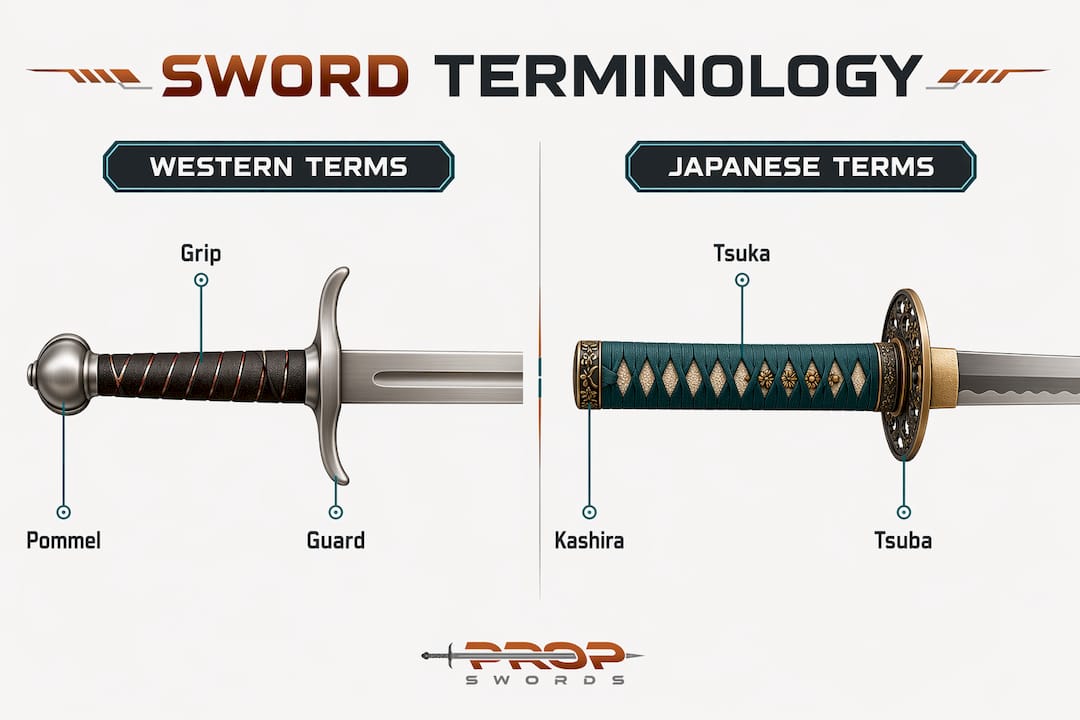
The hilt assembly includes three components: the guard, the grip, and the pommel. Each one serves a distinct mechanical purpose, not just an aesthetic one. The guard (also called the crossguard) stops an opponent’s blade from sliding down onto your hand. The grip is where the fighter holds the weapon, and its length determines whether a sword is one-handed or two-handed. The pommel, the weighted cap at the bottom of the grip, counterbalances the blade and keeps the sword from feeling nose-heavy during extended use.
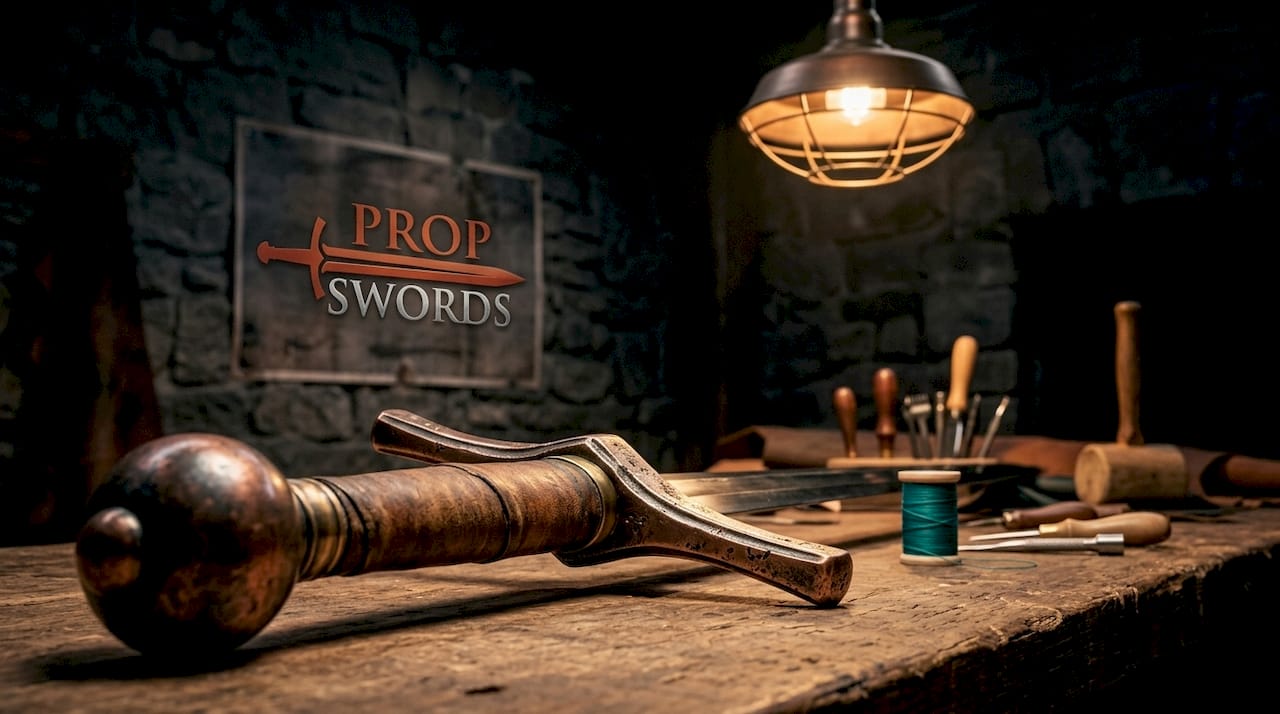
Blade anatomy carries its own set of terms that movie productions use when designing props. The edge is the sharpened side used for cutting, while the spine is the thick, unsharpened back of the blade that provides structural rigidity. The fuller, often called a “blood groove,” is a groove running along the blade that reduces weight without sacrificing strength. That name “blood groove” is a popular myth. The fuller is purely an engineering feature, and recognizing it in a film prop tells you the production team did their homework.
Japanese swords introduce a separate but equally precise vocabulary. Katana-specific terms include the tsuka (handle), tsuba (hand guard), kissaki (tip), and mune (spine). These are not interchangeable with Western terms even when the parts serve similar functions, because the geometry and craftsmanship philosophy differ significantly. The tsuba, for example, is often an ornate disc rather than a simple crossbar, reflecting Japanese aesthetic values alongside practical defense.
Pro Tip: When watching a sword-heavy film, pause on close-up prop shots and identify the pommel, guard, and fuller. If the prop has a realistic fuller and a balanced pommel, the production likely consulted a swordsmith or historical advisor.
Here is a quick reference for the core terms:
- Pommel: Weighted cap at the base of the grip; provides balance and can be used as a striking surface
- Grip: The handle section where the fighter’s hand contacts the sword
- Crossguard/Guard: The horizontal bar protecting the hand from opposing blades
- Fuller: The longitudinal groove in the blade that reduces weight while maintaining strength
- Edge: The sharpened cutting surface of the blade
- Spine: The thick, unsharpened back of the blade
- Tip/Point: The terminal end of the blade used for thrusting
How do sword types and cultural origins shape film sword vocabulary?
The broadest division in cinematic sword terminology is curved versus straight blades, and each category carries its own naming conventions. Straight swords like the longsword and the rapier dominate Western European film settings, from medieval epics to Renaissance dueling dramas. Curved blades like the katana and the scimitar appear in East Asian and Middle Eastern contexts. This is not just visual variety. The curve of a blade changes how it cuts, how it is carried, and what fighting style it demands, which in turn changes the terminology used to describe its use.
The Japanese sword tradition uses the term koshirae to describe the complete mounting set that dresses a blade for use and display. Koshirae includes every component from the tsuka to the saya (scabbard), and each piece represents both craftsmanship and cultural legacy. When a film like Rurouni Kenshin shows a character maintaining their sword, the attention to koshirae components signals authenticity to knowledgeable viewers. Western swords have no single equivalent term for this complete mounting concept, which itself reflects a philosophical difference in how each culture treated the sword as an object.
The table below compares key terminology across Western and Japanese sword traditions as they appear in film contexts.
| Feature | Western sword terms | Japanese sword terms |
|---|---|---|
| Handle | Grip | Tsuka |
| Hand guard | Crossguard or guard | Tsuba |
| Blade back | Spine | Mune |
| Blade tip | Point or tip | Kissaki |
| Complete mounting | No single equivalent | Koshirae |
| Scabbard | Scabbard or sheath | Saya |
Collectors note that sword balance depends heavily on hilt geometry, and prop swords look authentic only when this balance is respected. A katana with an oversized tsuba or a longsword with a pommel that is too light will look wrong to anyone who has held the real thing. Film productions that get this right earn credibility with enthusiast audiences, and knowing the terminology lets you spot the difference.
What sword fighting terms appear in movies and what do they mean?
The two most important sword fighting terms in cinematic swordplay are the parry and the riposte. A parry is a defensive action that deflects or blocks an incoming attack. A riposte is the offensive action delivered immediately after a successful parry, completing the defensive-offensive cycle in one fluid exchange. Together, they form the rhythmic backbone of almost every choreographed sword fight you have ever seen on screen, from the duels in The Princess Bride to the lightsaber battles in Star Wars, which borrow directly from fencing structure.
Movie sword realism depends more on accurately choreographed defense-offense flow than on any single impressive move. This is why fencing terms like riposte matter so much to fight choreographers. A fight that strings together random attacks looks chaotic and unconvincing. A fight built on parry-riposte cycles looks purposeful and grounded, even when the weapons are fictional. Actors and fight choreographers focus on this dynamic because it is both visually and tactically convincing to audiences.
HEMA (Historical European Martial Arts) contributes additional vocabulary that appears in more technically accurate productions. Absetzen is a HEMA term for parrying while simultaneously thrusting in one motion, representing overlapping defense and offense in a single beat. This is not a sequential block-then-attack. It is one continuous movement where the blade redirects the incoming strike while the point drives forward. When you see this executed cleanly in a film fight, the choreographer almost certainly studied historical sources.
Pro Tip: To spot realistic swordplay in a film, watch for the riposte. If every attack is followed by a counter-attack that flows directly from the defense, the choreography is grounded in real fencing logic. If fighters simply take turns swinging, the scene prioritizes spectacle over craft.
Key sword fighting terms to recognize on screen:
- Parry: A defensive action that deflects or redirects an incoming blade
- Riposte: The immediate offensive response following a successful parry; must be trained as a single continuous motion with the parry
- Absetzen: A HEMA technique combining parry and thrust in one simultaneous movement
- Bind: When two blades make contact and fighters apply pressure against each other
- Feint: A deceptive movement intended to draw a parry before the real attack lands
How does knowing sword terminology improve your film experience?
Understanding sword terms changes what you notice during fight scenes, and that shift makes films more rewarding to watch. Instead of seeing a blur of metal, you start tracking specific choices: why a character uses a thrust instead of a cut, why the guard design matters when blades lock, or why a prop katana with the wrong tsuba breaks the period illusion. This is the practical payoff of building a film sword glossary in your head.
Recognizing accurate versus inaccurate props is one of the most satisfying skills a film enthusiast can develop. Productions with serious historical advisors get the fuller right, balance the pommel correctly, and choose blade geometry that matches the setting. Productions cutting corners use generic fantasy shapes that no real swordsmith would recognize. The ultimate movie sword checklist from Propswords gives collectors and fans a structured way to evaluate these details in both films and replica purchases.
Terminology also unlocks better conversations in fan and collector communities. When you can describe a scene using terms like riposte, tsuba, or fuller, you signal that your analysis goes beyond surface impressions. This matters in cosplay communities too, where choosing a replica that accurately reflects a film character’s weapon requires knowing what the original prop actually was. A replica longsword with the wrong crossguard or a katana with an inaccurate koshirae misses the point entirely.
The connection between terminology and collecting runs deep. Knowing what makes a sword prop authentic, from blade geometry to hilt balance, helps you make smarter purchasing decisions. Propswords covers this in detail for anyone considering movie swords as collectibles or display pieces.
Key takeaways
Movie sword terminology is the foundation for understanding both prop design and fight choreography in film, and the parry-riposte cycle is the single most important concept for reading cinematic swordplay.
| Point | Details |
|---|---|
| Three core sword parts | Every sword has a hilt, blade, and point; sub-terms like pommel, fuller, and guard build from this base. |
| Fuller is functional | The fuller reduces blade weight without weakening it; it is not decorative, despite the “blood groove” nickname. |
| Eastern vs. Western vocabulary | Japanese terms like tsuka, tsuba, and koshirae have no direct Western equivalents and reflect distinct cultural traditions. |
| Parry-riposte is the core of choreography | Realistic film swordplay is built on the parry-riposte cycle, not individual impressive moves. |
| Terminology improves collecting | Knowing sword parts helps fans evaluate prop accuracy and choose better replicas for cosplay or display. |
Why I think most film fans are watching sword fights wrong
I have spent years watching sword-heavy films with enthusiasts who focus almost entirely on the spectacle: the sparks, the speed, the dramatic finishing blow. What they miss is the grammar underneath. The first time I watched The Princess Bride after learning fencing terminology, the Inigo versus Westley duel became a completely different scene. Every parry set up a riposte. Every feint had a logical purpose. The fight was not just exciting. It was a conversation in a language I could finally read.
The most common misunderstanding I encounter is that sword fights in movies are either “realistic” or “fake,” as if those are the only two options. The better question is whether the choreography respects the internal logic of swordplay, specifically the parry-riposte dynamic that makes exchanges feel earned rather than random. Films like The Duellists and Rob Roy get this right. Many big-budget productions do not, and the difference is visible once you know what to look for.
My honest recommendation is to start with the anatomy before the technique. Learn what a fuller is, understand why the pommel matters for balance, and recognize the difference between a crossguard and a tsuba. Once the parts make sense, the movements that use those parts become readable. Sword fights stop being noise and start being narrative. That shift is worth every minute of study.
— Muhammad
Find your next movie sword replica at Propswords

Propswords carries a curated selection of replica swords built with the anatomical accuracy that terminology-savvy collectors actually care about. Whether you are looking for a katana with a properly proportioned tsuba or a longsword with a balanced pommel and realistic fuller, the collection is designed for fans who know the difference between a display piece and a prop that respects the original. Explore the best replica swords of 2026 to find options that match the film accuracy standards covered in this article. For cosplay-focused buyers, the medieval sword comparison breaks down six top options by design accuracy and build quality. Free shipping within the USA is included on all orders.
FAQ
What does “hilt” mean in movie sword terminology?
The hilt is the complete handle assembly of a sword, including the grip, guard, and pommel. It is the part the fighter holds and the section most visible during close-up prop shots in films.
What is a riposte in sword fighting?
A riposte is the offensive action delivered immediately after a successful parry. It completes the defense-offense cycle and is the foundational rhythm of most choreographed movie sword fights.
What is the difference between a katana and a longsword in film terminology?
A katana is a curved Japanese sword with specific parts named in Japanese (tsuka, tsuba, kissaki), while a longsword is a straight Western sword described using terms like grip, crossguard, and pommel. The two traditions use entirely separate vocabularies reflecting distinct cultural origins.
What is a fuller on a sword blade?
The fuller is a groove running along the length of the blade that reduces weight without weakening the steel. It is commonly but incorrectly called a “blood groove.” Seeing a fuller on a film prop sword is a sign of design accuracy.
What is Absetzen in movie sword choreography?
Absetzen is a HEMA technique where the fighter parries and thrusts simultaneously in one motion, merging defense and offense into a single beat. It appears in more historically grounded film fight sequences and signals that the choreographer drew from real martial arts sources.
Recommended