TL;DR:
- Proper sword care involves cleaning after handling, applying protective oil, and controlling humidity to prevent rust. Using the right products, such as Gunex or mineral oil, and avoiding leather storage helps preserve blades effectively. Consistent maintenance and correct storage practices ensure a collection that appreciates over time instead of deteriorating visibly.
Most collectors discover the hard way that neglect ruins a blade faster than any battle would. Rust creeps in overnight, grips crack from the wrong oil, and a sword stored in its leather scabbard for six months can come out looking like it survived a shipwreck. Mastering sword care essentials is the difference between a collection that appreciates over decades and one that deteriorates in plain sight. This guide covers everything on your sword care essentials list, from the right oils and cloths to storage setups and the myths that trip up even experienced collectors.
Table of Contents
- Key takeaways
- 1. Sword care essentials every collector must have
- 2. Best oils and polishes for blade protection
- 3. Essential sword tools for your maintenance kit
- 4. Grip and hilt care: what most collectors get wrong
- 5. Storage solutions that actually protect your sword
- 6. Common sword care myths debunked
- 7. Comparing sword care kits: what suits your needs
- What years of handling swords actually taught me
- Find quality replica swords and care supplies at Propswords
- FAQ
Key takeaways
| Point | Details |
|---|---|
| Clean after every handling | Fingerprints leave acid residue that starts corrosion within hours on bare steel. |
| Oil blades, not grips | A light coating of oil protects blades but can weaken cord and leather grips. |
| Avoid leather scabbards for storage | Long-term storage in leather traps moisture and accelerates rust and deterioration. |
| Control your storage environment | Humidity is the primary driver of blade corrosion; a dry, stable space is non-negotiable. |
| Skip WD-40 as a primary protectant | WD-40 does not offer the long-term corrosion resistance blades actually need. |
1. Sword care essentials every collector must have
Before getting into specific products and techniques, you need to understand what a solid sword care essentials checklist actually looks like. The core categories are cleaning, oiling, polishing, grip care, and storage. Every other decision flows from these five areas.
Cleaning is the foundation. Fingerprints deposit acidic oils that begin corroding high-carbon steel within hours. After every handling session, wipe the blade down with a soft, lint-free cloth. Do not use paper towels. They scratch more than most people realize.
Oiling comes right after cleaning. The goal is a thin, even film across the entire blade surface. Not pooling, not dripping. Just enough to create a barrier between the steel and the air. Good oil options include Gunex, mineral oil, and specialized sword oils designed for carbon steel.
Polishing is periodic, not routine. Use it to remove surface oxidation before it becomes rust. Start with the mildest abrasive that gets the job done and work up from there only if needed.
- Keep a dedicated soft cotton cloth for dry wipes
- Keep a second cloth for oil application only
- Store your oil in a small dropper bottle for precise application
- Use a wooden or bamboo skewer to reach tight areas around the guard and crossguard
Pro Tip: Do a visual inspection every 30 days even if you have not handled the sword. Catching early surface oxidation takes two minutes to fix. Missing it for six months means serious work.
2. Best oils and polishes for blade protection
The oil you choose matters more than most newcomers expect. Not all oils are created equal when it comes to protecting a carbon steel blade.
Gunex is a popular choice among European collectors and HEMA practitioners. It applies thinly, resists evaporation longer than plain mineral oil, and does not gum up. Specialized sword maintenance kits from established suppliers often include Gunex or an equivalent formulation for good reason.
Mineral oil is the budget-friendly standard. It is food-safe, odorless, and widely available. The trade-off is that it evaporates faster, so blades stored with mineral oil need more frequent reapplication. For display pieces you handle often, that is a workable routine.
Petroleum jelly (Vaseline) is one of the best options for long-term blade storage. Apply a thin coat over the entire blade, wrap it in acid-free tissue, and store it in a cool, dry location. It stays put for months without reapplication.
- Gunex: best for actively used or frequently handled swords
- Mineral oil: best for regular-maintenance display swords
- Petroleum jelly: best for archival or long-term storage situations
- Camellia oil: favored by Japanese sword (katana) collectors for traditional maintenance
When it comes to the best sword polish, Renaissance Wax is worth knowing. It is a microcrystalline wax originally developed for museum conservation. It provides a protective barrier and a clean finish without altering the blade’s appearance.
Pro Tip: Never apply oil straight from the bottle onto the blade. Pour a few drops onto your cloth first, then wipe. This prevents pooling near the guard and keeps oil off the grip unintentionally.
3. Essential sword tools for your maintenance kit
A proper maintenance kit is not a luxury. It is what separates a collector from someone who just owns swords. Standard sword care kits typically include oil, polishing cloths, sanding pads, and sharpening stones, and that bundle covers most of what you need for regular upkeep.
Beyond the basics, a few additional tools make a real difference:
- Microfiber cloths: Better than cotton for initial dry wipes. They lift particulate instead of pushing it across the blade.
- Brass-bristle brushes: Safe for scrubbing tight areas around guards, crossguards, and pommels without scratching steel.
- Sanding pads in graded grits: Start at 800 grit and work up to 2000 grit for light surface rust removal. Never start with anything coarser unless the blade is seriously pitted.
- Sharpening stone (whetstone): For functional swords that see actual use. A 1000/3000 combination stone handles most edge maintenance.
- Rust eraser: A Japanese tool that looks like a pencil eraser and removes surface rust without chemicals. Extremely useful and underrated.
If you are following a dedicated sword care guide for replica swords specifically, note that many replicas use stainless steel or zinc alloy fittings, which require different care than high-carbon blades.
4. Grip and hilt care: what most collectors get wrong
Grip care is where even experienced collectors make mistakes, and the errors can be permanent. The most common one is treating the grip the same way you treat the blade.
Do not apply oil to a cord grip. Cord wraps, whether cotton, silk, or synthetic, absorb oil and weaken over time. The fibers break down, the wrap loosens, and the aesthetic is ruined along with the structural integrity. Wipe cord grips gently with a barely damp cloth to remove dust and nothing more.
Leather grips are different. They do need nourishment, but with the right product. Leather grip care calls for a dedicated leather oil or grease, applied sparingly. Be aware that most protective leather products will darken the leather over time. That is not damage; it is a natural result of conditioning. Test on a hidden area first if the color matters to you.
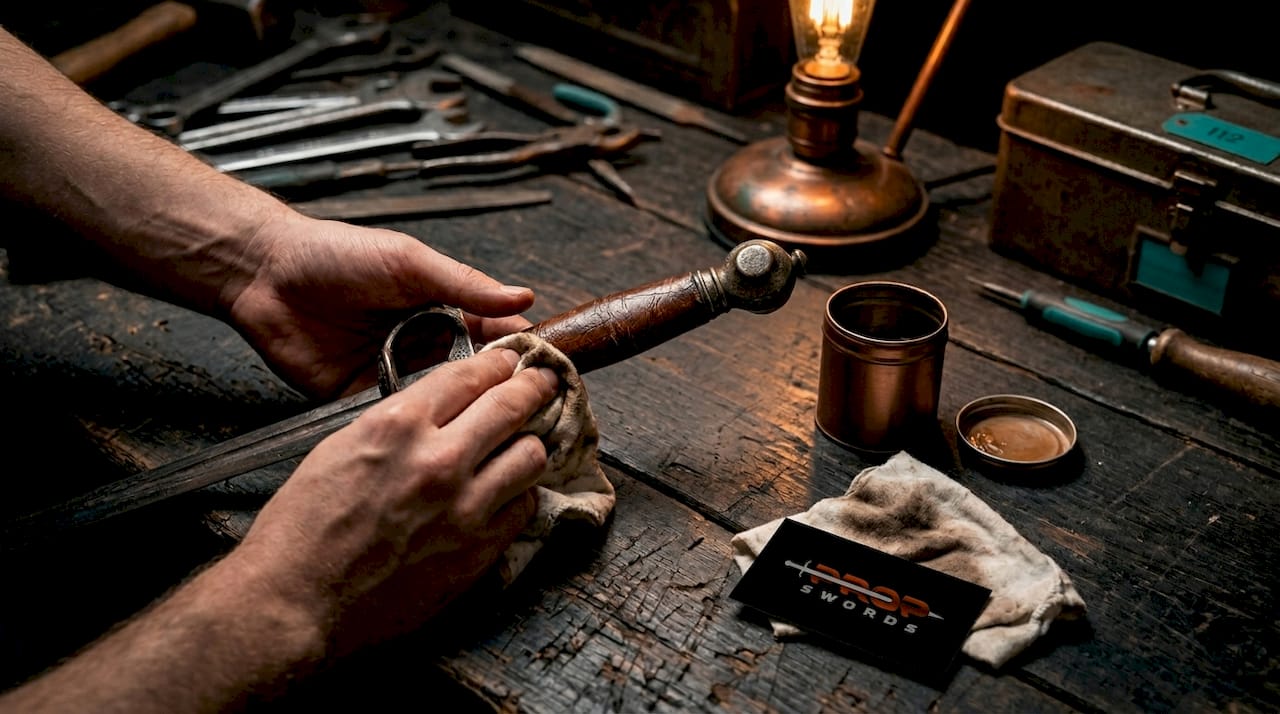
Metal hilts, including brass, steel, and nickel fittings, just need a dry polish with a soft cloth. For tarnished brass, a specialized metal polish applied lightly does the job. Avoid anything abrasive that will scratch the surface.
When should you call a professional? If the grip wrap is unraveling past simple re-tucking, if the pommel has cracked, or if the hilt fitting has worked loose in a way that affects safe handling. Amateur repairs on structural components create safety risks.
5. Storage solutions that actually protect your sword
Most sword storage mistakes come from aesthetics winning over preservation. The sword on the open wall-mount looks incredible. It is also collecting dust and being affected by humidity swings every time you run a hot shower down the hall.
The single biggest storage mistake: storing swords long-term in leather scabbards. Leather retains moisture and holds it directly against the blade. Within months, even in a seemingly dry home, that contact creates rust. Use the scabbard for display and transport. Use a wooden mount or a padded horizontal rack for storage.
Humidity control is the single most important environmental factor for long-term preservation. Target below 50% relative humidity in your storage space. A small dehumidifier or silica gel packets placed near the storage area does a lot of heavy lifting in humid climates.
- Wall-mount horizontal racks: great for display, acceptable for storage if the environment is controlled
- Wooden storage boxes with acid-free lining: best for archival storage
- Sword bags (cotton or velvet): good for transport; not suitable for long-term storage without ventilation
- Freestanding floor racks: practical for large collections, keep swords off the ground and away from baseboard moisture
For display-focused collectors, the guide to safer sword displays at Propswords covers mounting hardware, wall anchoring, and angle considerations that most generic guides skip entirely.
Pro Tip: If you display multiple swords, rotate which ones are out in the open every three months. This limits cumulative UV and humidity exposure on any single piece.
6. Common sword care myths debunked
Misinformation travels fast in collector communities. Here are the ones that cause the most damage.
Myth: WD-40 is a reliable sword oil. WD-40 is a water displacer and a light solvent, not a long-term protectant. It evaporates quickly and does not provide the corrosion resistance a bare steel blade needs. Fine for removing a stuck screw on the hilt. Not fine as your primary blade oil.
Myth: More oil means more protection. Excess oil attracts dust, seeps into the grip, and creates a gummy buildup that is harder to clean off than light surface oxidation. Less is more.
Mistake: Using harsh abrasives to remove rust. Aggressive abrasives damage the blade finish and can remove hardening treatments on functional blades. Start with a rust eraser. Move to 800-grit sanding pads only when the eraser does not fully do the job.
Myth: Sharpening and honing are the same thing. Sharpening removes material to create a new edge. Honing realigns an existing edge without removing material. For functional swords that see regular use, honing after each session and sharpening once or twice a year is the right rhythm.
Mistake: Treating all sword materials the same. Stainless steel replicas, high-carbon steel blades, and decorative chrome-plated swords all need different care approaches. What works on a battle-ready katana can ruin a decorative replica with a plated finish.
7. Comparing sword care kits: what suits your needs
Not every collector needs the same kit. Here is a practical comparison to help you decide.
| Kit type | Best for | Typical contents | Price range |
|---|---|---|---|
| Basic maintenance kit | Beginners, display collectors | Oil, polishing cloth, basic instructions | $15–$30 |
| Intermediate kit | Active collectors, occasional users | Oil, microfiber cloths, rust eraser, sanding pads | $30–$60 |
| Advanced kit | Practitioners, restoration collectors | Oil, full grit set, sharpening stone, wax, brass brush | $60–$120 |
| Museum-grade care kit | Serious preservationists | Renaissance Wax, conservation cloths, pH-neutral cleaner | $80–$150 |
For most collectors with a mix of display and functional pieces, an intermediate kit covers the daily sword care checklist without over-investment. Advanced kits make sense once you are working with high-carbon blades you actually use.
For a deeper breakdown of replica-specific maintenance, the replica sword maintenance guide at Propswords covers products and techniques matched to the materials most commonly used in anime-inspired and movie replica swords.
What years of handling swords actually taught me
I spent a long time overcomplicating sword care before I learned to trust simplicity. The first sword I neglected properly was a carbon steel longsword I left in its scabbard through a humid summer. When I pulled it out in September, the pitting along the ricasso looked like someone had taken a ballpeen hammer to it. That was an expensive lesson.
What I have come to understand is that consistency beats intensity every time. You do not need a three-hour maintenance session once a year. You need five minutes after every handling session and a 30-minute thorough clean every couple of months. That rhythm, done faithfully, keeps blades in display-ready condition indefinitely.
The other thing I got wrong for years was grip care. I was oiling everything because it felt thorough. The moment I read that cord grips should never be oiled, I looked at three swords I had been “caring for” and realized I had been slowly degrading the wraps. The fix was simple. Stopping was all it took.
My honest take: most of the sword care myths that circulate online come from people applying general metal care logic to swords specifically. Swords are not kitchen knives, they are not firearms, and they are not tools. They occupy a category that blends functional metallurgy with craftsmanship and history. Treating them that way, with some patience and appropriate specificity, is what actually preserves them.
— Muhammad
Find quality replica swords and care supplies at Propswords
If you are building your collection and want to start with pieces worth protecting, Propswords carries a carefully selected range of replica swords for enthusiasts across every interest, from anime classics to Viking and medieval-inspired designs.

Browse the best replica swords of 2026 to find your next display piece, cosplay sword, or collector’s addition. Propswords ships free within the USA and carries options suited to every budget, whether you are picking up your first replica or adding to a serious collection. Quality replicas deserve quality care, and knowing your sword care essentials from day one makes a real difference in how long your pieces last and how good they look doing it.
FAQ
What oils work best for blade protection?
Gunex, mineral oil, and camellia oil are the most widely recommended options for regular blade maintenance. For long-term storage, petroleum jelly applied in a thin coat provides lasting protection in a cool, dry environment.
How often should I oil my sword?
Wipe the blade with a lightly oiled cloth after every handling session and do a full cleaning and re-oiling every one to two months for display swords. Blades stored in humid environments may need attention more frequently.
Can I store my sword in its scabbard?
Short-term storage and transport in a scabbard is fine, but long-term scabbard storage traps moisture against the blade and causes rust. Use a padded rack or acid-free wooden case for extended storage.
Is WD-40 good for sword maintenance?
WD-40 works for loosening stuck fittings but should not be used as a primary blade oil. It does not provide reliable long-term corrosion protection and evaporates too quickly to be useful for ongoing blade preservation.
What should a basic sword care checklist include?
At minimum, your checklist should cover a dry wipe after every use, light oiling of the blade, periodic polishing, grip care appropriate to the material, and controlled storage away from humidity and direct light.
Recommended