TL;DR:
- Martial arts swords are culturally specific tools designed for precise combat techniques and philosophical principles. They develop mental discipline, physical coordination, and self-awareness through dedicated training practices. Today, sword arts thrive globally as a means of cultural preservation, personal growth, and competitive sport.
Few weapons carry as much cultural weight as the martial arts sword. Whether you’re drawn to the razor-precision of a Japanese katana, the flowing elegance of a Chinese jian, or the raw power of a European longsword, understanding what is a martial arts sword means understanding the people who forged these traditions across centuries. This article cuts through the Hollywood noise and goes deep: the history, the philosophy, the blade types, and the techniques that define sword-based martial arts across cultures and continents.
Table of Contents
- Key takeaways
- What is a martial arts sword, exactly?
- History and cultural roots of sword arts
- Types and characteristics of martial arts swords
- Philosophy and mindset of swordsmanship
- Core training techniques and practices
- Modern relevance of sword martial arts
- My take on why martial arts swords matter beyond fighting
- Explore quality swords for training and collecting
- FAQ
Key takeaways
| Point | Details |
|---|---|
| Swords span many traditions | Martial arts swords include Japanese, Chinese, and European weapons, each with distinct designs and systems. |
| Design shapes technique | Blade length, weight, and balance directly influence the fighting style and training approach of each tradition. |
| Philosophy drives practice | Concepts like mushin and yi (intention) are central to mastery and distinguish sword arts from raw combat. |
| Training starts safe | Beginners use bokken, foam, or blunted steel before advancing to live-blade techniques and sparring. |
| Modern practice is thriving | With over 6 million kendō practitioners worldwide, sword arts remain a globally growing discipline in 2026. |
What is a martial arts sword, exactly?
A martial arts sword is not simply any bladed weapon hanging on a wall. It is a culturally specific tool, designed for defined combat techniques, and deeply embedded in the martial philosophy of the tradition it comes from. The katana is not interchangeable with a rapier. A jian is not a dao. Each blade was engineered for a specific context of battle, a specific body mechanic, and a specific set of values about what a warrior should be.
The confusion often comes from media. Movies and video games reduce swords to props for flash and spectacle, but the history of sword martial arts tells a very different story. These weapons developed over centuries alongside the civilizations that used them. Each design choice, from the curve of a blade to the length of a grip, carries functional reasoning rooted in real combat experience.
What unifies all martial arts swords, regardless of culture, is their role as both tool and teacher. Training with a sword develops precision, timing, spatial awareness, and mental discipline in ways that unarmed practice simply cannot replicate.
History and cultural roots of sword arts
The sword’s place in martial arts spans virtually every advanced civilization in human history, from ancient Rome to feudal Japan to Renaissance Europe. Understanding these roots is the foundation for understanding what you’re training when you pick up any blade today.
Japanese traditions
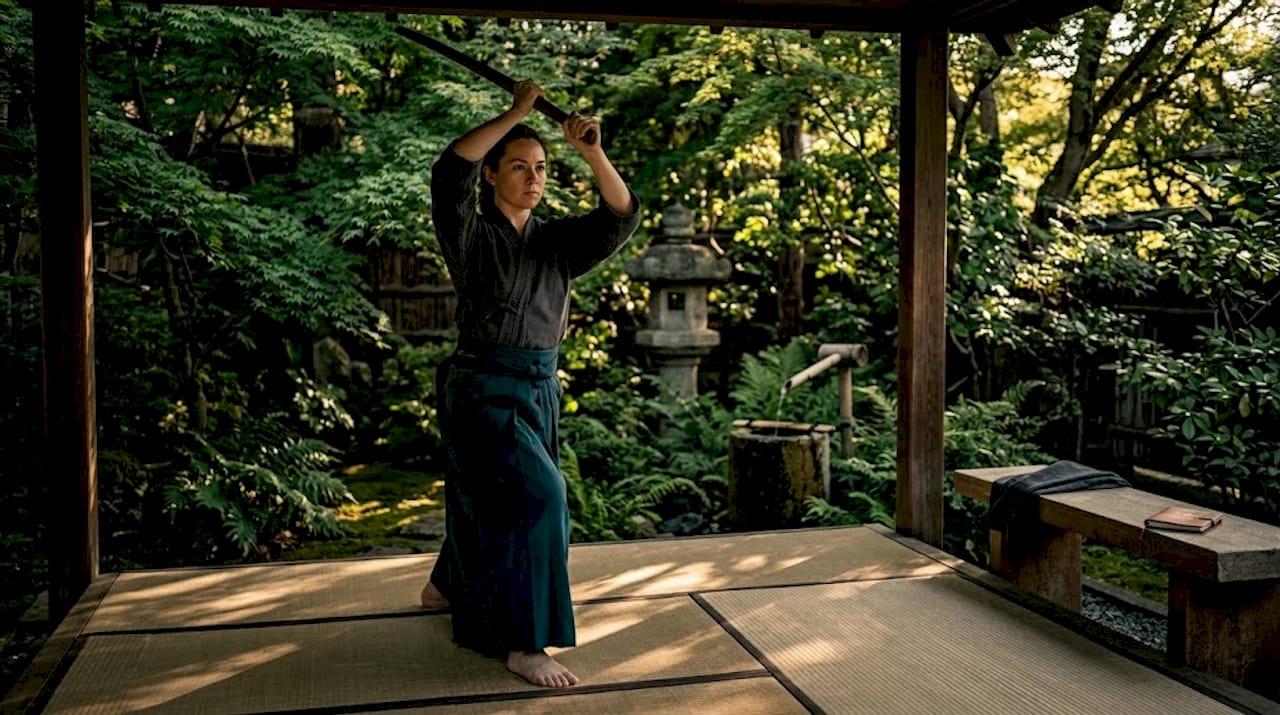
Japan produced some of the most formalized sword arts in history. Kenjutsu was the combat-oriented system used by samurai on the battlefield. As Japan moved away from open warfare, kenjutsu evolved into kendō, a sport-based discipline using bamboo swords called shinai, and iaidō, the art of drawing and cutting in a single motion. Zen Buddhism’s influence on samurai culture was profound, shaping not just fighting technique but the entire psychological framework behind sword mastery.
Chinese traditions
Chinese sword arts divide primarily between the jian (double-edged straight sword) and the dao (single-edged curved sword). The jian prioritizes finesse, footwork, and precise thrusting. The dao favors power and sweeping cuts. Both appear in traditional wushu forms and in systems like Tai Chi sword (Taijijian), where the weapon becomes an instrument of meditative movement and internal energy cultivation.
European traditions
European sword arts are experiencing a full-scale modern revival through Historical European Martial Arts (HEMA). The longsword tradition from German and Italian masters like Johannes Liechtenauer and Fiore dei Liberi documented detailed systems of cuts, thrusts, guards, and grappling techniques. The rapier defined Renaissance dueling culture, favoring point control and economy of movement. The military saber became the weapon of cavalry and later Olympic fencing.
Here is a quick reference for the main sword art traditions:
| Tradition | Primary Weapon | Core Focus |
|---|---|---|
| Japanese kenjutsu | Katana | Combat efficiency, mental clarity |
| Japanese kendō | Shinai (bamboo sword) | Sport, discipline, character development |
| Chinese Taijijian | Jian | Internal energy, meditative flow |
| Chinese wushu | Dao or jian | Forms, athleticism, versatility |
| European HEMA | Longsword, rapier | Historical technique, sparring |
| Olympic fencing | Foil, épée, saber | Sport, speed, point control |
Types and characteristics of martial arts swords
The physical design of each sword is inseparable from the martial arts blade fighting system it belongs to. Here is what defines the major types:
Katana. Japan’s iconic curved single-edged sword. The curvature accelerates cutting power along the arc of a draw stroke. Typically around 26 to 28 inches of blade with a two-hand grip, it is balanced for speed and precision together.
Jian. The Chinese straight sword is double-edged and typically lighter than comparable blades. It demands fine motor control and is associated with scholars and nobles as much as warriors. Thrusting attacks and rapid wrist changes are its hallmarks.
Dao. The Chinese saber is heavier, single-edged, and built for powerful chopping and sweeping cuts. Soldiers used it widely because it was easier to produce and faster to learn than the jian.
Longsword. The European knight’s weapon features a blade around 35 to 45 inches with a grip that accommodates two hands. The German and Italian longsword systems include cutting, thrusting, and even half-swording techniques where the practitioner grips the blade itself for close-range leverage.
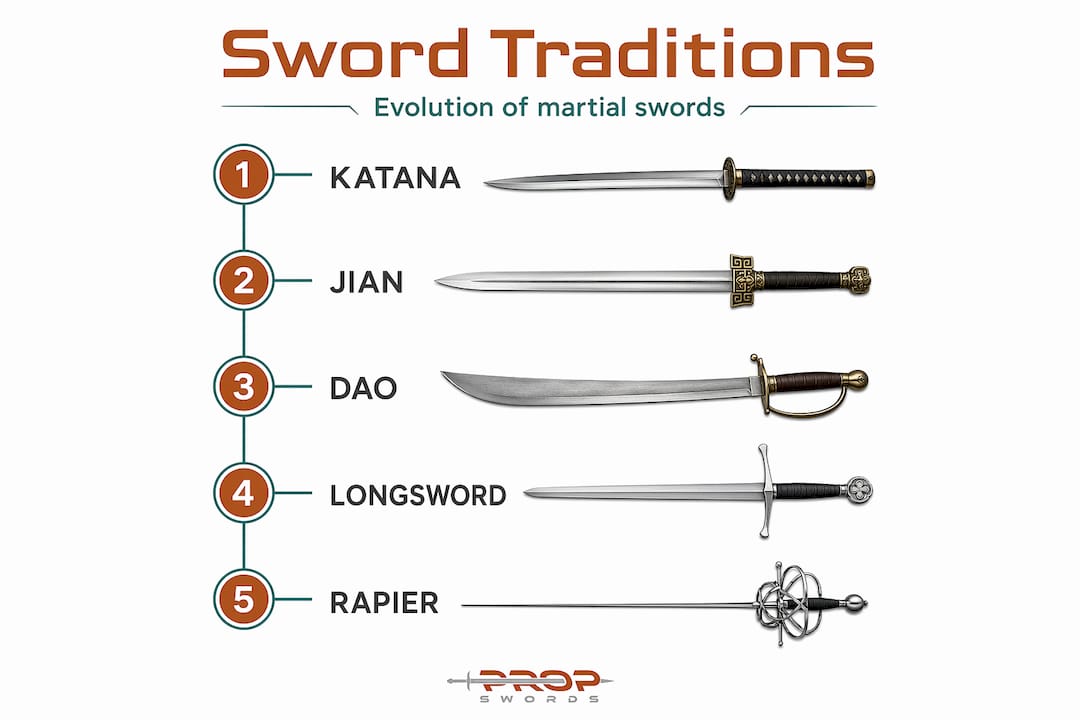
Rapier. A thinner, longer thrusting sword developed for civilian dueling in the 1500s and 1600s. Speed of the point and precision targeting define rapier technique.
Bokken and practice swords. The wooden bokken mirrors the katana’s weight and dimensions without the lethal edge. Blunted steel and foam training swords allow sparring at realistic intensity without injury risk.
Pro Tip: When choosing your first training sword, balance and length matter more than appearance. A well-balanced bokken builds correct mechanics faster than an ornate piece that handles poorly.
Philosophy and mindset of swordsmanship
This is where martial arts sword practices separate from simple weapon use. Every major tradition connects the physical technique to an inner discipline that shapes who you become through training.
Japanese sword arts center on mushin, literally “no mind.” The mushin concept means reacting without hesitation, without ego, without the internal chatter that slows movement in a real encounter. A practitioner who has internalized mushin does not think about the next cut. The cut simply happens, emerging from years of practiced response.
Chinese Tai Chi sword philosophy operates through the concept of yi, or intention. According to Taijijian principles:
“The sword is an extension of the practitioner’s intention. Defense is prioritized before offense, embodying an ethos of preservation and balance.” (Tai Chi Notebook)
This is a critical distinction. Sword arts philosophize defense-first, treating aggression as a failure of the system, not a goal of it. The sword always remains in front, maintaining a protective posture even while attacking.
European traditions carry their own philosophical weight. Concepts of honor, measured restraint in dueling culture, and the duty to protect rather than conquer all shaped how swords were taught and used. Modern HEMA practitioners often reference historical manuals not just for technique but for the ethical context their authors embedded in the teaching.
Pro Tip: If you train sword arts purely for the physical workout, you’ll plateau faster than someone who also studies the philosophical tradition behind the weapon. Understanding the “why” behind each movement transforms mechanical repetition into genuine mastery.
Core training techniques and practices
Knowing what are sword martial arts means nothing without understanding how they are actually practiced. The training structure varies by tradition, but several universal principles apply across all systems.
-
Stance and footwork first. Every sword system begins with learning how to stand and move. Weight distribution, hip alignment, and the ability to transition between offensive and defensive positions without telegraphing your intention are the foundation everything else builds on.
-
Solo forms. Called kata in Japanese systems and taolu in Chinese systems, solo forms encode the essential techniques of a style in a memorized sequence. Practicing forms develops muscle memory, spatial reasoning, and the correct body mechanics for each technique before you add a resisting partner.
-
Body-led movement. Fluid technique in Tai Chi sword comes from the core and waist generating energy, not the arms pulling the blade. Arm-driven technique looks rigid and disconnected, and it drains energy faster under pressure.
-
Partner drills. Two-person exercises teach timing, distance, and the difference between theory and a moving target. The partner introduces variables that solo forms cannot.
-
Safe sparring. Modern training swords like foam replicas, shinai, and blunted steel allow practitioners to spar at full or near-full speed safely. This is where the real education happens.
-
Standing meditation. Chen-style Tai Chi sword training uses Zhan Zhuang (standing meditation) before sword movement to build core stability. Fundamental stances are practiced three to five times for 30 to 60 seconds each to build the muscle memory required for fluid sword movement.
The benefits of sword martial arts accumulate gradually. Practitioners consistently report improved posture, better spatial awareness, sharper focus under pressure, and a significantly calmer response to stressful situations.
Modern relevance of sword martial arts
Does martial arts use swords today? Absolutely, and at a larger scale than most people realize. The International Kendo Federation counts over 6 million practitioners worldwide as of 2026, making kendō one of the most widely practiced weapon arts on the planet.
HEMA has grown from a niche academic interest to a globally competitive sport with clubs on every continent. A single HEMA academy in Singapore reports approximately 150 active students, reflecting a worldwide pattern of growth. Practitioners are drawn by the combination of historical depth, physical intensity, and genuine community.
Beyond sport, sword arts today serve several distinct purposes:
- Cultural preservation. Practitioners keep alive systems that would otherwise exist only in historical manuscripts.
- Personal development. The discipline required to master sword techniques builds mental resilience that transfers to professional and personal life.
- Collecting and display. Many enthusiasts engage with display sword distinctions as a way to connect with history through ownership.
- Competitive sport. Kendō, Olympic fencing, and HEMA tournaments provide structured competitive outlets.
Sword arts have never been more accessible. Online instruction, global communities, and better training equipment mean you can begin studying seriously from almost anywhere.
My take on why martial arts swords matter beyond fighting
What I’ve found after years of observing and studying sword traditions is that most people misunderstand what they are actually training when they pick up a blade. They think the goal is to get good at sword fighting. That’s the surface layer.
The real training is in confronting yourself. Every time you run a kata slowly and realize your footwork collapses when your mind wanders, you’ve learned something about your own discipline. Every time you spar and feel the urge to rush, you’ve encountered your ego. The sword is a mirror with an edge.
Popular media frames sword arts as cool, cinematic, and explosive. Real practice is often slow, repetitive, and humbling. But that contrast is exactly the point. The practitioners who last are the ones who find meaning in the repetition, not the spectacle.
I genuinely believe sword arts are one of the most underappreciated tools for psychological development available. The philosophy is not decorative. It’s functional. When mushin actually kicks in during sparring, you understand why samurai spent decades chasing that state.
If you’re approaching swordsmanship as a collector, a martial artist, or just a curious enthusiast, I encourage you to go deeper than the blade itself. Study the tradition it comes from. The weapon makes a lot more sense when you understand the person it was designed to produce.
— Muhammad
Explore quality swords for training and collecting
Whether you are starting your training journey or building a collection that honors these traditions, the right sword matters. Propswords carries a curated selection of replica swords and training weapons inspired by the greatest sword traditions in history.
From katana-style training swords to historically inspired replicas spanning Viking, anime, and movie designs, Propswords offers something for every level of enthusiast. The best replica swords of 2026 are available with free shipping across the USA, and the catalog covers everything from display pieces to sparring-ready practice swords. If you want a sword that matches your passion for the art, start there.
FAQ
What is a martial arts sword used for?
A martial arts sword is used for combat training, solo forms, partner drills, sparring, cultural practice, and mental discipline development. Different traditions use different blade types suited to their specific techniques and philosophical goals.
Does martial arts use real swords in training?
Most martial arts sword training begins with safe practice weapons like wooden bokken, foam replicas, or blunted steel. Live blades are introduced only at advanced stages and in controlled environments like cutting practice (tameshigiri).
What are the main types of sword martial arts?
The main sword martial arts include Japanese kendō, kenjutsu, and iaidō; Chinese Taijijian and wushu sword; European HEMA with longsword and rapier; and Olympic fencing. Each system has distinct techniques, weapons, and philosophical foundations.
What are the benefits of sword martial arts training?
Training with martial arts swords builds physical coordination, core strength, mental focus, and stress resilience. Practitioners also develop patience and situational awareness that transfer beyond the training floor.
What is the best martial arts sword for beginners?
A well-balanced wooden bokken or a polypropylene training sword is the best starting point. Balance and weight matter far more than aesthetics at the beginner stage, since proper mechanics depend entirely on how naturally the sword moves in your hand.
Recommended