TL;DR:
- Sword metallurgy is the science of selecting, alloying, forging, and heat treating metals to produce durable blades. It involves processes that balance hardness, toughness, and corrosion resistance, significantly influencing a sword’s performance and preservation. Historical and modern analyses reveal how metallurgical techniques connect ancient trade networks to contemporary craftsmanship.
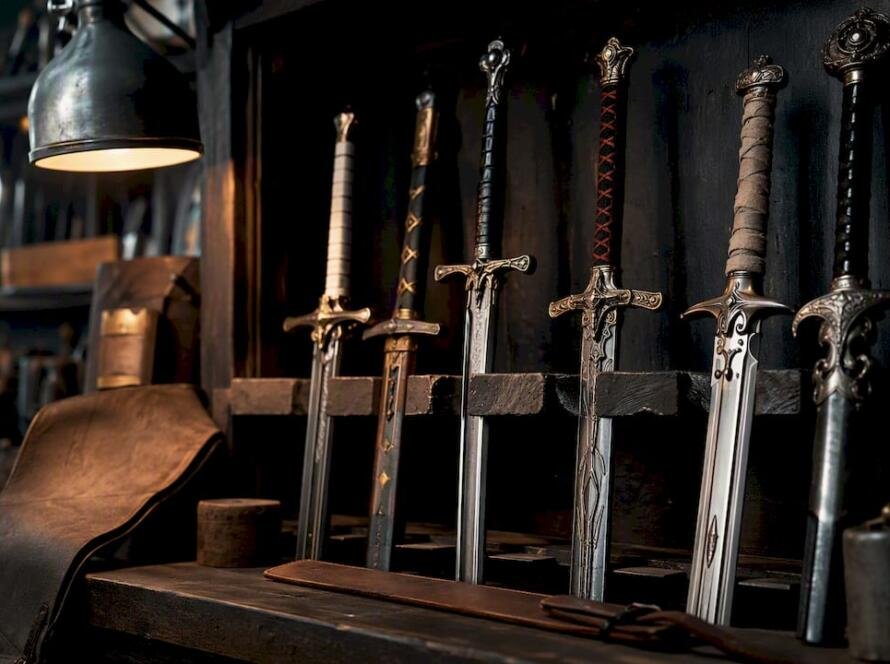
What is sword metallurgy? Most people assume a sword is just sharpened metal. It isn’t. Sword metallurgy is the precise science of selecting, alloying, forging, and heat treating metals so a blade can hold an edge, absorb impact, and survive combat without snapping. It sits at the intersection of chemistry, physics, and centuries of trial-and-error craftsmanship. For collectors, historians, and anyone fascinated by how great swords are actually made, understanding the metallurgy of swords reframes everything from museum exhibits to the replica hanging on your wall.
Table of Contents
- Key Takeaways
- Historical evolution of sword materials
- Core metallurgical processes in swordmaking
- Materials science behind sword metallurgy
- Archaeometallurgy and what ancient swords reveal
- Applying metallurgy knowledge to modern replicas
- My perspective: sword metallurgy is the hidden science that makes history physical
- Explore Propswords’ replica sword collection
- FAQ
Key Takeaways
| Point | Details |
|---|---|
| Metallurgy defines sword performance | The balance between hardness and toughness is controlled through forging and heat treatment, not just steel choice. |
| Carbon content is critical | Higher carbon increases hardness but can reduce toughness and even corrosion resistance, depending on microstructure. |
| Heat treatment is non-negotiable | Austenitizing, quenching, and tempering transform raw steel into a blade that flexes without breaking. |
| Archaeometallurgy reveals history | Modern SEM analysis of ancient swords has traced Viking trade routes and material sourcing across continents. |
| Collectors benefit from this knowledge | Understanding metallurgy helps you assess quality, care for your collection, and spot the difference between display and functional replicas. |
Historical evolution of sword materials
Sword metallurgy did not arrive fully formed. It evolved across thousands of years, driven by necessity and the limits of available materials.
Early swords were made from copper, then bronze. Copper is soft and bends under hard use, but it was far easier to work than stone and represented the first true metal weapons. Bronze, an alloy of copper and tin, was harder and held an edge better. Ancient civilizations built entire military strategies around bronze blades. The problem was always the same: bronze could not match the performance potential of what came next.
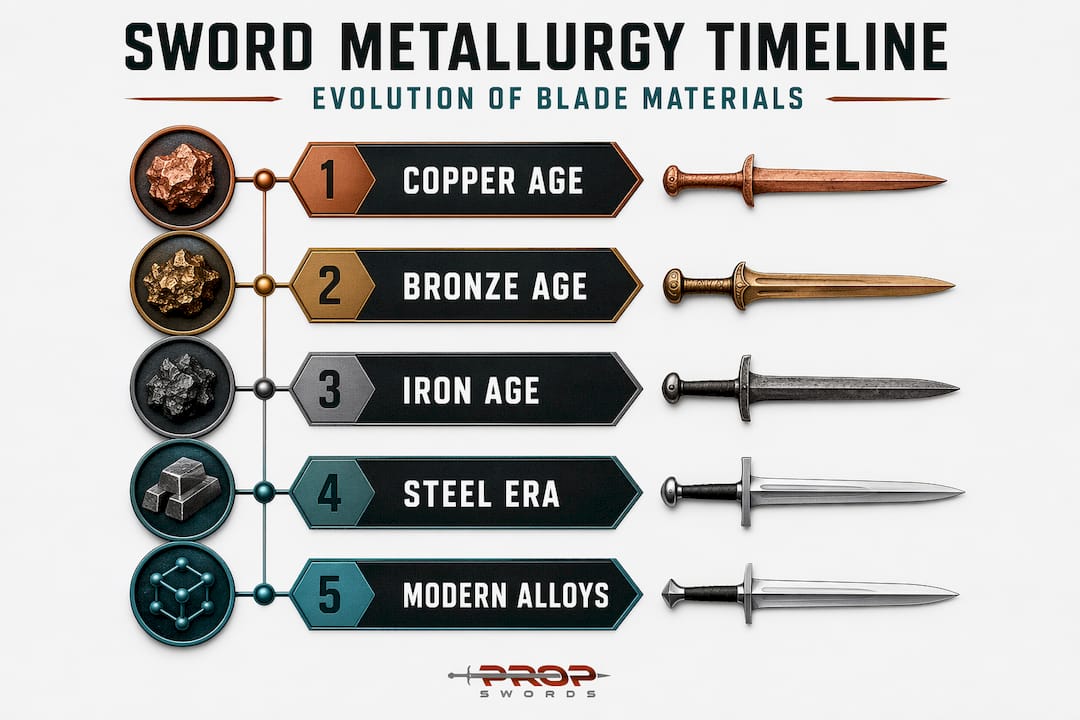
The shift to iron changed everything. Iron was harder than bronze and far more abundant, but raw iron presented its own challenges. It was brittle unless worked correctly. The real leap came when smiths discovered that introducing carbon into iron during smelting produced steel, a material with dramatically improved strength and edge retention. That discovery is the foundation of the sword making process as we know it.
Here is what that material evolution looked like across history:
- Copper swords (circa 3300 BCE): Malleable and easy to shape, but too soft for sustained combat use. Ceremonial as much as functional.
- Bronze swords (circa 3000 to 1200 BCE): Better strength and casting properties allowed longer blades and more reliable edges. Dominated the ancient world.
- Iron swords (circa 1200 BCE onward): Harder and more widely available once smelting techniques matured. Early iron swords were often inferior to bronze, but the potential was clear.
- Steel swords (circa 800 CE onward at scale): Carbon-controlled steel enabled swords that could be both hard and resilient. This is where blade metallurgy truly came into its own.
The historical sword craftsmanship behind each era reflects the available metallurgical knowledge. For example, Japanese tamahagane steel was created by heating iron sand with coal at extremely high temperatures for extended periods, then folded repeatedly to refine the grain structure and distribute carbon evenly. This was not tradition for tradition’s sake. It was an empirically discovered solution to uneven carbon distribution in the raw material.
Core metallurgical processes in swordmaking
The sword forging techniques that produce a great blade are not mysterious. They follow a specific sequence that modern metallurgists can explain precisely. Understanding that sequence is what separates a well-made sword from a decoration with an edge.
-
Billet preparation and forging. Steel is heated to a malleable state, typically glowing orange to yellow, and hammered into shape. This compresses grain structures, removes voids, and begins aligning the internal structure of the metal. Forging is not just shaping. It is mechanically improving the steel at the microstructural level.
-
Austenitizing. The blade is heated to a specific temperature range where the iron crystal structure transforms into austenite. This step is where the carbon dissolves uniformly into the steel matrix and prepares the material for the transformations that follow. Austenitizing prepares the structure for hardening, and temperature control here directly determines the outcome.
-
Quenching. The blade is plunged into a quench medium, typically water, oil, air, or a salt bath, to cool it rapidly. This traps carbon in a stressed crystal structure called martensite, which is extremely hard but also brittle. The choice of quench medium alters cooling rates and internal stress profiles, yielding meaningfully different mechanical outcomes even with identical steel composition.
-
Clay coating for gradient hardness. Japanese and Chinese smiths mastered a technique of applying thick clay to the spine of a blade before quenching, leaving the edge exposed. The edge cools fast and becomes martensitic and hard. The spine cools slowly under the clay and stays tougher. The result is a blade with a hard cutting edge and a resilient, shock-absorbing spine. Clay thickness affects martensite formation directly, and the distinctive visual curve of a Japanese katana is partly a mechanical result of this differential cooling.
-
Tempering. A hardened blade fresh from quenching is too brittle for use. Tempering reheats it to a lower temperature, allowing some of that extreme hardness to relax. Tempering converts brittle martensite into a balanced microstructure that can flex under stress without fracturing. This step is what makes the difference between a blade you can use and one that shatters on first impact.
-
Grinding and polishing. Beyond aesthetics, final grinding reveals the geometry that controls how the edge meets a target. Polishing on Japanese swords is a metallurgical art form in itself, revealing the hamon (the visible line between hard and soft zones) and surface crystalline patterns that reflect the blade’s internal history.
Pro Tip: When evaluating a sword’s quality, look for a visible hamon line on the blade. It signals that a differential hardening process was actually performed rather than simulated by acid etching, which is common in lower-quality production blades.
Materials science behind sword metallurgy
Carbon is the central variable in the metallurgy of swords. Add too little and you get soft, easily deformed steel. Add too much and the blade becomes glass-hard but liable to crack under lateral stress. The sweet spot for most historical and functional sword steels sits between 0.45% and 1.0% carbon by weight.
What happens inside the steel at these carbon levels is where things get genuinely fascinating. Three microstructural components determine blade behavior:
| Microstructure | How it forms | What it does |
|---|---|---|
| Martensite | Rapid quenching traps carbon in lattice | Very hard, wear-resistant edge retention |
| Pearlite | Slow cooling produces layered iron and cementite | Softer, tougher, shock-absorbent |
| Retained austenite | Incomplete transformation during quench | Can improve toughness but reduces stability |
The ratio of these components depends on carbon content and heat treatment. This is why two blades made from steel with identical chemistry can perform completely differently. The process, not just the material, determines the outcome.
Recent research makes this concrete. A study comparing sword blades found that a blade with 0.69% carbon showed better corrosion resistance than one with 0.98% carbon, despite the higher-carbon blade being harder. The microstructural differences created by the varied carbon levels changed how each blade reacted electrochemically to its environment. That finding has real implications for long-term sword preservation.
“Carbon content and heat treatment not only affect blade performance but also influence corrosion resistance, critical for long-term sword preservation.” — MDPI Crystals Research
Pattern welding, often called Damascus steel in modern contexts, takes this further by combining steels of different carbon contents in alternating layers. When folded and worked, these layers create both a visual pattern and a blade that theoretically combines the hardness of high-carbon zones with the toughness of lower-carbon ones. Understanding the materials used in replica swords helps collectors distinguish true pattern-welded pieces from decorative acid-etched imitations.
Archaeometallurgy and what ancient swords reveal
Modern metallurgical science has opened an unexpected window into the past. By applying laboratory analysis to ancient blades, researchers can determine where the steel came from, how it was processed, and what trade networks made it possible.
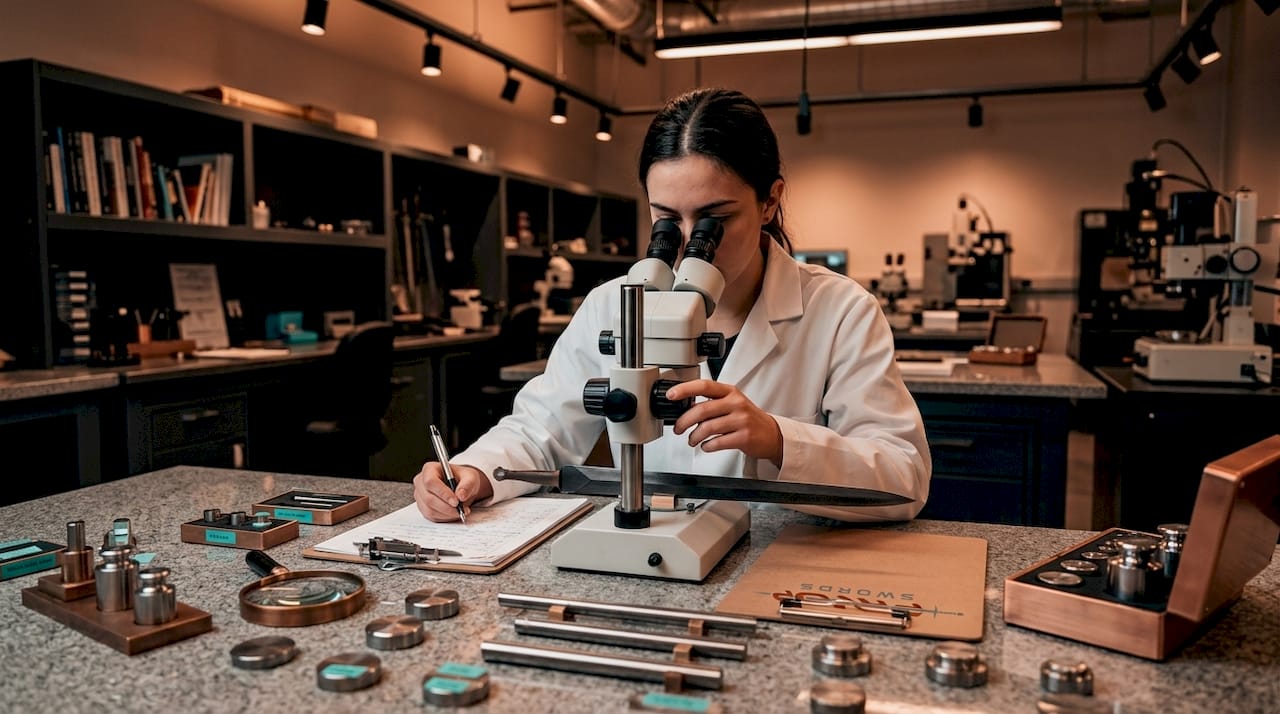
Scanning electron microscopy (SEM) is the key tool here. Researchers can analyze specimens as small as one millimeter from a sword blade and quantify carbon content with precision that traditional methods cannot match. Traditional metallography fails to classify carbon content accurately in ancient swords because historical steelmaking was inconsistent and the resulting microstructures do not match modern reference atlases.
The Viking sword case study is the best example of what this science can deliver. Analysis of Viking-era blades using SEM showed they contained imperfectly melted high-carbon steel mixtures traceable to crucible steel technologies practiced in Central Asia and Iran. That finding rewrote assumptions about Norse metallurgy. The Vikings were not just warriors. They were participants in a sophisticated international steel trade stretching thousands of miles.
Pro Tip: If you visit a museum with Viking sword exhibits, ask whether the blades have been subjected to elemental analysis. Many institutions have now partnered with university metallurgy departments to develop provenance data that completely changes how these objects are interpreted.
This kind of archaeometallurgical data from swords reveals technology transfer patterns and trade links that written records often never captured. A blade’s steel is essentially a chemical fingerprint of the civilization that produced it.
Applying metallurgy knowledge to modern replicas
Understanding what is blade metallurgy does more than satisfy intellectual curiosity. For collectors, it directly informs how to evaluate, maintain, and display a sword collection.
Here is what metallurgy knowledge translates to in practical terms:
- Assessing quality. High-carbon steel (typically labeled 1045 to 1095) in a replica indicates it went through real heat treatment. Stainless steel replicas look good but are generally too brittle or too soft for anything beyond display due to different carbon and chromium balances.
- Understanding corrosion risk. As the research above shows, carbon content and microstructure influence how steel reacts to moisture and oxygen. Carbon steel swords need regular oiling. Ignoring this is how collections deteriorate.
- Evaluating tempering for safe display. A properly tempered blade will not snap under light handling. Replicas that skip proper tempering can fracture unpredictably, which matters for display safety.
- Reading material specifications. Sword listings that specify heat treatment, HRC (Rockwell hardness) ratings, and steel grade are giving you metallurgical data. Those numbers tell you whether a replica reflects real sword forging techniques or is purely ornamental.
The replica sword maintenance guide from Propswords covers the practical upkeep steps that directly connect to these metallurgical realities, from wiping down carbon steel blades after handling to choosing the right storage environment.
My perspective: sword metallurgy is the hidden science that makes history physical
I’ve spent years looking at swords from both ends: the collector’s eye and the metallurgist’s lens. What strikes me most is how persistently people underestimate what went into these objects.
The popular image of the village blacksmith hammering out a sword by instinct is almost entirely wrong. The best historical smiths were, functionally, applied materials scientists. They understood, through generations of accumulated knowledge, that different cooling rates produced different hardness profiles. They knew that folding steel improved it. They figured out that clay on a spine and bare metal on an edge would create a blade that could do two contradictory things at once. They just did not have the vocabulary we use today.
What I find most surprising, every time I encounter it, is the archaeometallurgical evidence. The Viking sword data alone should get more attention than it does. The idea that Norse warriors were carrying blades forged from Iranian crucible steel, traded across the Silk Road and reworked in Frankish workshops, is not a footnote. That is a story about how interconnected the ancient world was, told through the chemistry of a weapon.
For collectors, this matters beyond trivia. Understanding the science behind your swords changes how you see them. A sword is not just a historical artifact or a fantasy replica. It is a record of the metallurgical knowledge available to the people who made it, and sometimes, the trading networks that supplied them.
— Muhammad
Explore Propswords’ replica sword collection
If sword metallurgy has deepened your appreciation for what goes into a great blade, that knowledge deserves to be paired with a collection that reflects it.

Propswords offers a carefully curated range of replica swords built on materials and processes that mirror real metallurgical principles. Whether you are looking for historically grounded pieces or fantasy icons rendered in quality steel, the best replica swords for 2026 selection covers collectors at every level. Each product listing includes material specifications so you can evaluate steel grade and treatment before purchasing. For deeper reading on what separates quality replicas from shelf decorations, the sword materials collector’s guide gives you the framework to shop with confidence.
FAQ
What is sword metallurgy?
Sword metallurgy is the science of producing, alloying, and heat treating metals to create blades that balance hardness for edge retention with toughness to resist breaking. It covers everything from steel composition to quenching and tempering processes.
How does carbon content affect a sword blade?
Carbon determines how hard a steel blade can become after heat treatment. Higher carbon increases hardness and edge retention, but research shows it can also reduce corrosion resistance depending on the microstructure produced during quenching.
What is the difference between quenching and tempering?
Quenching rapidly cools steel to create hard martensite, while tempering reheats the blade to reduce brittleness. Both steps together produce a blade that is hard enough to hold an edge but resilient enough to flex under stress.
How do scientists study ancient sword metallurgy?
Researchers use scanning electron microscopy to analyze sub-millimeter specimens from ancient blades, quantifying carbon content and identifying steel types. This technique has successfully traced Viking sword materials to Central Asian and Iranian crucible steel sources.
Does metallurgy affect how I should care for my sword?
Yes. Carbon steel swords require regular oiling to prevent oxidation because their microstructure is more electrochemically reactive than stainless alternatives. Understanding the steel type in your replica directly informs the right maintenance routine.
Recommended