TL;DR:
- Evaluating replica sword quality requires understanding materials, construction, and balance to ensure durability and authenticity.
- Prioritize full-tang construction, appropriate steel types, and proper heat treatment, especially for functional use.
- Ultimately, choose a replica that aligns with your purpose, balancing technical specs with personal satisfaction.
You finally pull the trigger on that replica sword you’ve been eyeing for months, and when the package arrives, something feels off. The blade wobbles. The finish looks cheap. The weight is wrong. This frustration is more common than you’d think among anime fans, cosplayers, and serious collectors, and it usually comes from buying without a real quality framework. This guide gives you concrete, evidence-backed steps to assess replica sword quality before you spend a single dollar, whether you’re shopping for a display piece, a cosplay prop, or a long-term collection addition.
Table of Contents
- Key factors to assess before you buy
- How to check balance, weight, and handling
- Assessing steel, hardness, and edge finish
- Purpose-driven evaluation: Display vs. functional swords
- The collector’s reality: Why perfect swords don’t exist
- Explore top-quality replica swords and collector resources
- Frequently asked questions
Key Takeaways
| Point | Details |
|---|---|
| Check construction basics | Assess steel, heat treatment, tang, and assembly before buying any replica sword. |
| Test balance and weight | Measuring the sword’s balance and handling reveals real-world quality and safety. |
| Match sword to purpose | Display, cosplay, and functional use require different quality criteria. |
| Look for authenticity | Documentation and credible finishing are proof of collector-grade swords. |
Key factors to assess before you buy
Every replica sword purchase lives or dies on a handful of core quality criteria. Steel type, heat treatment, tang construction, balance, and assembly tightness are the non-negotiables. Understanding each one gives you a structured lens to evaluate any sword, no matter which anime, movie, or historical era inspired it.
You can assess sword quality by working through these construction elements in a logical order. Start with materials, then move to construction, and finish with assembly. This sequence mirrors how sword makers think about quality, and it works just as well for buyers evaluating a finished product.
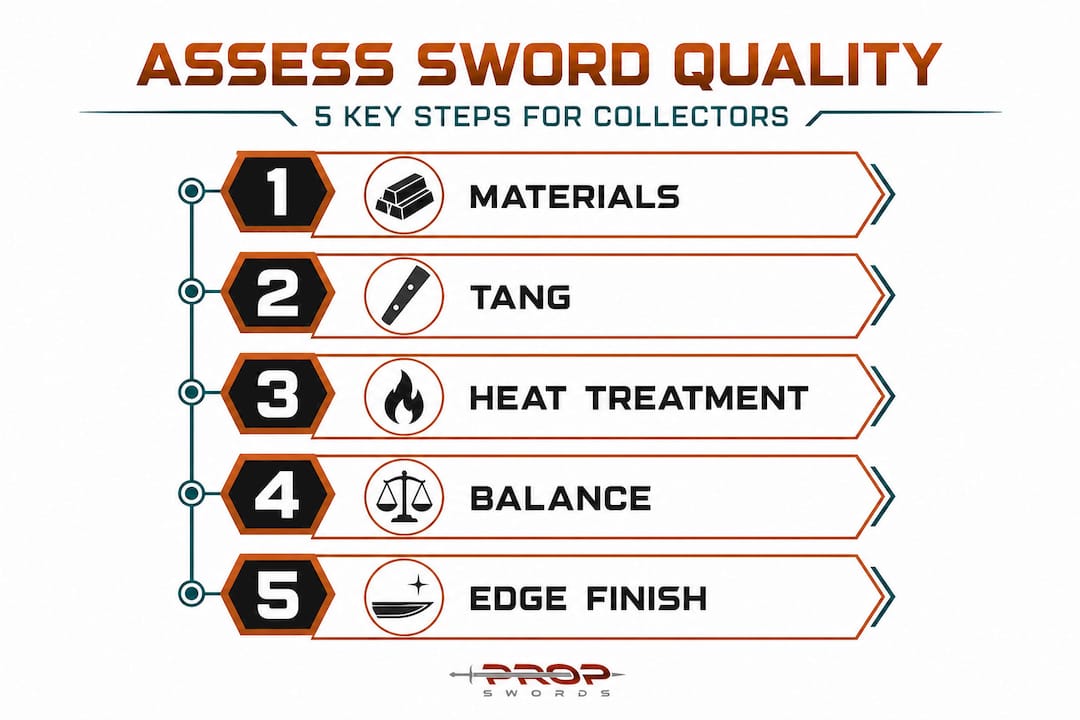
Here’s a quick breakdown of the main criteria:
| Quality factor | Why it matters | What to look for |
|---|---|---|
| Steel type | Determines durability and finish | 1045, 1060, 1095, or stainless |
| Heat treatment | Affects hardness and toughness | Manufacturer documentation or specs |
| Tang construction | Impacts structural safety | Full-tang preferred |
| Balance | Affects handling and display feel | Measured from guard to balance point |
| Assembly tightness | Prevents wobble and accidents | Zero play between handle and blade |
When it comes to replica sword materials, carbon steel grades like 1060 or 1095 high carbon are generally better choices than stainless steel for anything functional. Stainless looks great but tends to be brittle under stress. For display-only pieces, stainless is perfectly acceptable.
Tang construction deserves special attention. A full-tang sword has the blade metal running through the entire handle, making it significantly stronger than a partial or rat-tail tang. If a manufacturer avoids the word “full-tang” in their specs, ask directly. This matters especially for cosplay events where you’re handling the sword repeatedly.
Hardness rating (HRC) is a common spec you’ll see in product listings. The HRC sweet spot sits between 50 and 60 for most practical swords. Go too high, and the blade becomes brittle. Go too low, and it won’t hold an edge. But hardness alone doesn’t tell the whole story.
Pro Tip: Don’t let a high HRC number sell you. A sword with an HRC of 58 but poor heat treatment will underperform a well-treated blade rated at 52. Ask about the heat treatment process, not just the number.
Using a detailed sword materials guide alongside your shopping research gives you a much stronger foundation. Understanding the difference between spring steel, high-carbon steel, and stainless helps you cut through marketing language fast.
How to check balance, weight, and handling
Understanding materials is one thing, but actually holding and testing a sword tells you even more. Here’s how to do it safely and effectively, whether you’re at a convention vendor booth or testing a sword you just received in the mail.
Step-by-step balance test:
- Place the sword horizontally on a narrow support, like a finger or a thin rod.
- Slide the sword slowly until it balances level without tilting.
- Mark that point.
- Measure the distance from the crossguard (the hand guard between blade and handle) to that balance point.
- Compare that measurement to known standards for the sword style you’re buying.
Balance is measurable this way, and it gives you an objective number instead of a vague “feels right” impression. A typical European longsword balance point lands around 3 to 7 inches from the guard. Japanese katana replicas typically balance a bit closer to the guard. Knowing these ranges helps you spot an oddly weighted replica immediately.
Weight matters differently depending on your use case. Cosplayers carrying a sword for six hours at a convention need something manageable. Display collectors care more about visual accuracy than weight. Serious martial arts practitioners have entirely different requirements.
Here’s a practical weight reference for common replica styles:
| Sword style | Typical replica weight | Cosplay comfort |
|---|---|---|
| Katana | 2.0 to 2.6 lbs | Comfortable for most |
| Longsword | 2.5 to 3.5 lbs | Moderate effort |
| Claymore style | 4.5 to 6.0 lbs | Heavy for extended carry |
| Anime oversized prop | Varies widely | Often very light foam cores |
When examining a physical sword, look for these red flags in the finish and construction:
- Visible machine grinding marks along the blade face
- An overly glossy, almost plastic-looking shine that hides poor surface work
- Inconsistent grind lines that don’t follow the blade geometry cleanly
- Wobble or play between the handle and blade when you grip and twist
- Handle wrapping that’s already fraying or uneven at the edges
For Japanese-style replicas specifically, authentic quality checks include looking at how the sword is balanced in hand and watching for those telltale machine marks. Genuine craftsmanship shows in consistent hand-finishing and proper polish progression along the blade.
Always use caution when handling any sword, replica or functional. Even display pieces have edges that can cause injury. Keep the blade pointed away from others, never draw quickly in crowded spaces, and use a scabbard whenever possible during transport.
Understanding the practical display sword differences between wall hangers, prop pieces, and collector-grade replicas helps you set the right expectations before you even buy. And if you’re setting up a display, run through a sword display checklist to make sure your setup is both safe and visually impressive.
Assessing steel, hardness, and edge finish
Balance and physical inspection matter, but judging steel and edge quality separates real craftsmanship from clever marketing. This is where a lot of buyers get fooled by spec sheets that look impressive but don’t hold up under scrutiny.
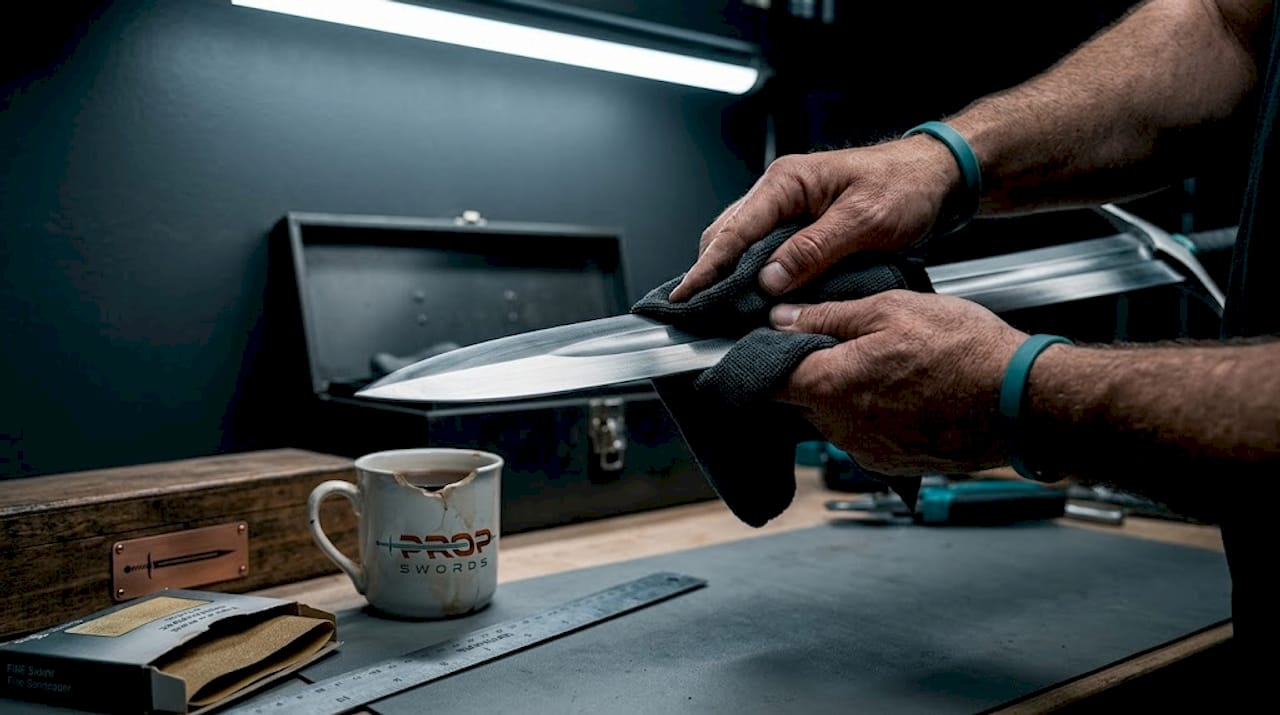
Start with the hardness conversation. As mentioned earlier, the practical HRC range for usable swords sits between 50 and 60. But how do you verify this without a lab? You mostly can’t, which is why manufacturer reputation and documentation matter so much. Look for brands that publish their heat treatment methods, not just final hardness numbers.
Here are the key things to evaluate on steel quality and edge finish:
- Edge geometry: The edge should taper consistently along the full length of the blade. Uneven grinding creates weak points.
- Grind type: Hollow grinds, flat grinds, and convex grinds each have different performance characteristics. Know which one your sword style should have.
- Polish progression: Quality blades show a gradual, consistent polish from spine to edge. Random scratches or swirl marks indicate poor finishing.
- Steel grain: If you can examine the surface closely, look for a consistent, fine grain. Coarse or inconsistent grain suggests lower-quality steel or poor heat treatment.
- Blade geometry: Distal taper (the blade getting thinner toward the tip) and profile taper (getting narrower) affect handling significantly. Replicas often skip this detail.
Stat callout: The best performing replica swords achieve a balance between hardness and toughness, not maximum hardness. Steel at HRC 58 to 60 with proper differential heat treatment holds an edge while resisting impact. This matters far more than marketing terms like “ultra-hardened” or “military grade.”
Pro Tip: For display swords, shift your focus entirely to surface finish, detail accuracy, and color consistency. For functional or test-cut swords, prioritize durability, edge geometry, and steel documentation. You’re essentially evaluating two different products with the same shape.
When you’re authenticating replica swords, look for evidence-backed claims rather than marketing language. Words like “legendary steel” or “ancient forging secrets” are creative writing. Words like “1095 high-carbon, normalized and quenched in oil, tempered to HRC 56” are actual specifications you can evaluate.
Purpose-driven evaluation: Display vs. functional swords
Not every sword needs to pass the same tests. Your purpose for buying defines what “quality” means, so here’s how to match your evaluation criteria to your actual goal.
Evaluating a display sword:
- Check visual accuracy against the source material, whether that’s a movie still, an anime episode, or a historical reference image.
- Examine the surface finish under different lighting conditions. A great display piece looks good from every angle.
- Verify that proportions match the original design closely, including handle length, blade curvature, and guard shape.
- Look at the fittings quality: tsuba, pommel, grip, and any decorative elements should be firmly attached and well finished.
- Confirm the mounting hardware (if wall-displayed) can support the sword’s weight safely.
Evaluating a functional or cosplay-use sword:
- Run the flex test: hold the handle firmly and apply gentle lateral pressure to the tip. The blade should flex slightly and return to true without taking a set (permanent bend).
- Check functional handling principles by measuring flex symmetry. A good blade flexes evenly from both sides, indicating consistent heat treatment and geometry.
- Confirm the full-tang construction by examining the handle end cap or pommel for exposed metal.
- Test grip comfort for extended carry, especially if you’re planning a full convention day.
- Check for any sharp edges on the handle fittings that could cause hand fatigue or injury.
Documentation matters more as you move up the collector scale. For Japanese-style pieces, authentication paperwork like NBTHK certificates or torokusho registration confirms the piece’s provenance and construction. This isn’t just about bragging rights: it’s evidence that someone with expertise examined and approved the sword.
The ultimate display sword guide breaks down why many collectors choose display-grade replicas as their primary focus, and the emotional value of display swords explains the deeper reasons why fans connect so strongly with specific pieces. Both resources are worth bookmarking before your next purchase.
The core takeaway here: define your purpose first, then build your checklist around it. A cosplayer and a martial artist buying the same sword model will be evaluating completely different things.
The collector’s reality: Why perfect swords don’t exist
Here’s the uncomfortable truth that nobody in the replica sword community talks about enough. After all the checklists and technical steps, many collectors end up paralyzed by the pursuit of perfection and miss the point entirely.
We’ve seen it consistently. Buyers obsess over HRC ratings for a sword they’ll hang on a wall and never touch. Others spend weeks debating steel types for a cosplay prop that will see two hours of use per year. This is where the checklist mentality can actually work against you.
The most satisfied collectors we know practice something different. They identify their single most important criterion, verify it rigorously, and accept reasonable trade-offs on everything else. A display collector who prioritizes visual accuracy over steel specs will be far happier than one chasing a technically perfect sword that looks slightly off from their favorite anime character’s weapon.
No replica sword is perfect. Even high-end production pieces have compromises built in. The goal isn’t to find a flawless sword; it’s to find the right sword for what you actually need it to do. That requires honesty about your own priorities before you start evaluating.
Experienced collectors often apply criteria from historical sword standards as a reference point, not a rigid requirement. Understanding what a historical piece was designed to do helps you evaluate whether a modern replica captures that intent accurately, even if it uses modern manufacturing methods.
Personal satisfaction in this hobby comes directly from matching sword quality to its use and meaning to you. A well-chosen replica that connects you to a character, story, or historical moment will bring more long-term joy than a technically superior sword that leaves you emotionally cold. That’s not a compromise. That’s collecting done right.
Explore top-quality replica swords and collector resources
If you’ve worked through this guide and feel ready to start applying these checks, the next step is finding replica swords worth evaluating in the first place. Great assessment skills only matter if you’re looking at quality options.
At Propswords, we’ve curated a selection of replicas built with the criteria in this guide in mind, including details on steel type, tang construction, and finish quality. Browse the best replica swords for 2026 for a vetted starting point that covers everything from anime-inspired pieces to historical recreations. If your interest runs toward iconic pop culture weapons, the fantasy sword collectibles section covers the most sought-after pieces in fandom collecting. Free shipping within the USA is available, and our catalog is built for fans who actually know what they’re looking for.
Frequently asked questions
How can you tell if a replica sword is full-tang?
Full-tang swords have blade metal running the full length of the handle; look for exposed metal at the handle’s end cap or pommel, or request manufacturer specs before buying.
What makes Japanese replica swords authentic?
Japanese-style replicas earn authenticity through proper weight distribution, clean hand-finished surfaces free from machine marks, and legal documentation like torokusho registration or NBTHK authentication.
Should I care about the hardness rating (HRC) for display swords?
For display swords, HRC matters very little; focus on finish quality and design accuracy instead. For functional swords, look for a balanced hardness range between 50 and 60 that prioritizes toughness alongside edge retention.
What’s the easiest way to test sword balance?
Rest your sword on a narrow support like one finger and slide it until it holds level without tilting, then measure that point from the crossguard for a reliable, objective balance measurement.
What are common signs of poor sword quality?
Sloppy assembly, loose fittings, and visible machine marks are the clearest red flags, along with an artificially glossy blade finish and manufacturer specs that rely on marketing language rather than actual technical documentation.
Recommended