TL;DR:
- Authentic replica swords are made from high-quality materials, feature full tang construction, and have detailed, organic hamon lines. Visual and physical inspections, combined with documentation review and expert consultation, are essential for verifying authenticity. A multi-factor approach ensures collectors can reliably distinguish genuine replicas from fakes before purchase.
You finally unbox a replica sword that looked flawless in the product photos, only to notice the blade wobbles, the hamon line looks like it was printed with a laser, and the handle feels hollow. That discovery stings, especially when you’ve spent real money chasing a piece that’s supposed to honor your favorite anime or movie. Worse, a poorly constructed sword isn’t just disappointing to display. It can be a genuine safety risk during cosplay. This guide gives you the expert-backed, step-by-step methods collectors use to separate high-quality, authentic replicas from mass-produced fakes before the purchase, not after.
Table of Contents
- Know your requirements: What makes an authentic replica?
- Inspecting the blade: Visual and construction tests
- The role of documentation and authentication papers
- Dealers, provenance, and the expert’s eye: Going deeper
- What most guides miss about replica sword authenticity
- Ready to find authentic-quality replicas?
- Frequently asked questions
Key Takeaways
| Point | Details |
|---|---|
| Multiple checks needed | Rely on several physical, documentation, and provenance factors to confirm authenticity. |
| Inspect the hamon | A genuine-looking temper line with depth and irregularity is hard to fake and signals craftsmanship. |
| Check tang construction | Full tang designs indicate durability and quality, but should not be the only factor. |
| Authenticate certification | Always verify documentation through reputable sources and never trust papers alone. |
| Use expert review | Seek expert or community help for high-value or difficult-to-verify replicas. |
Know your requirements: What makes an authentic replica?
Having set the stakes for collectors, let’s break down what authenticity means and the features that signal a worthy replica.
Not every replica sword needs to pass the same standard. A wall-mounted display piece has different requirements than a cosplay prop you’ll carry for hours at a convention. Before you can spot a fake, you need to define what “authentic quality” means for your intended use. That clarity saves you from overspending on features you don’t need and from buying something dangerously underbuilt for your actual purpose.
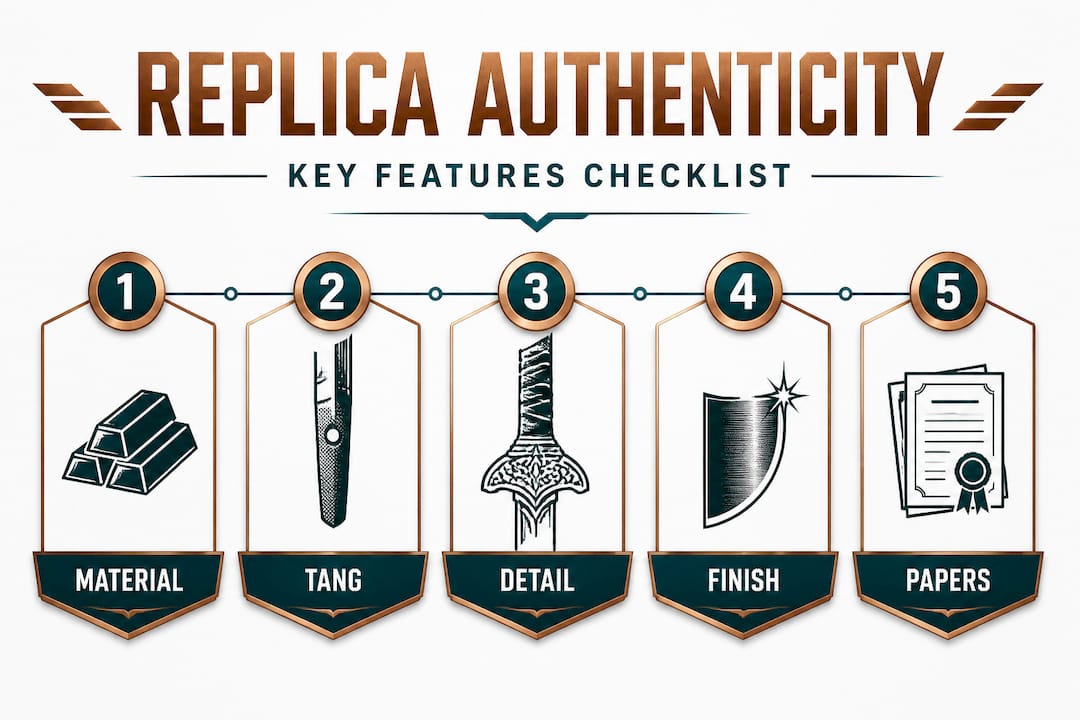
Material is the first deciding factor. Genuine quality replicas use high carbon steel, stainless steel, or specific alloy blends suited for their purpose. Display replicas for a display replica swords setup can use decorative finishes without demanding functional steel, but they should still show proper craftsmanship. Cosplay swords require lighter materials to reduce injury risk, while serious collector pieces demand museum-grade attention to detail.
Construction is where many cheap imitations fall apart, sometimes literally. Full tang construction means the blade steel runs the full length of the handle, making the sword structurally sound and durable. Rat-tail tang designs, by contrast, use a thin metal rod inserted into the handle, which is weaker and far more common in budget decorative pieces. For collectors who want quality they can trust, full tang is the baseline expectation.
Finish and detail accuracy round out the checklist. Does the blade geometry match the source material? Are the guard, handle wrapping, and fittings consistent with the design being replicated? These are the questions you should be asking before spending. Learning how to properly choose replica swords based on material and construction prevents the most common buying mistakes collectors make.
| Feature | Authentic quality replica | Budget decorative |
|---|---|---|
| Blade material | High carbon or alloy steel | Cheap stainless or zinc alloy |
| Tang type | Full tang | Rat-tail tang |
| Hamon line | Differential or detailed etching | Acid etched or painted |
| Handle fittings | Metal or quality resin | Plastic or hollow |
| Documentation | Certificate or maker’s mark | None or generic label |
| Finish accuracy | Screen/source accurate | Approximate or inconsistent |
Key features worth prioritizing:
- Steel grade: Look for specifications like 1045, 1060, or 1095 high carbon steel for functional replicas
- Weight distribution: Authentic replicas feel balanced, not nose-heavy or handle-heavy due to poor materials
- Fittings and tsuba: Metal guard pieces that are securely fastened, not loose or glued
- Blade geometry: Correct curvature, edge bevel, and tip shape per the original design
Inspecting the blade: Visual and construction tests
Once you know what features define authentic replicas, it’s time to examine the sword physically for subtle signs that most buyers overlook.
The hamon is the most discussed authenticity indicator for Japanese-style sword replicas. A hamon (temper line) is the visual boundary between the hardened edge and the softer spine of the blade. On an authentic or high-quality replica, the hamon results from differential hardening and shows natural crystalline activity with irregular, organic patterns, depth, and texture that catches light differently at various angles. Many mass-produced replicas fake this feature using acid-etching or laser engraving, resulting in a uniform, shallow line that lacks the depth variation of genuine differential hardening.
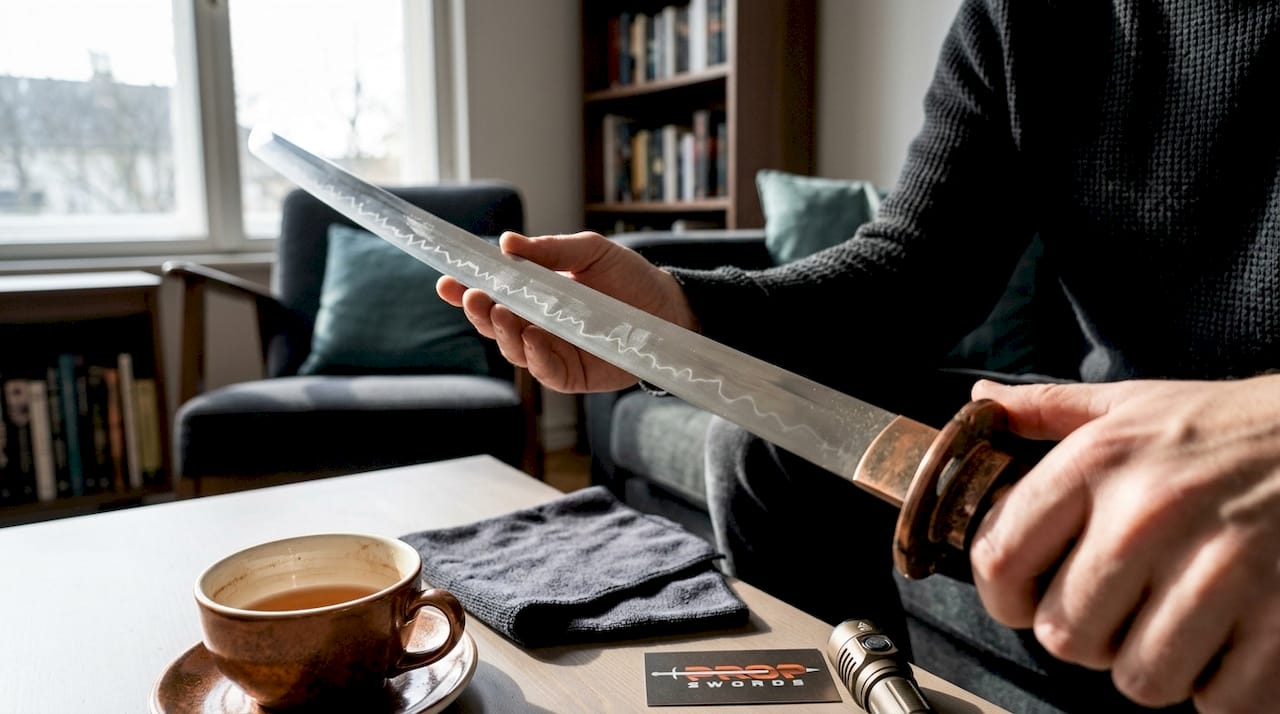
Run your eye along the blade edge in natural light. Tilt the blade slowly. A real hamon should almost seem to shift and breathe as light hits it differently. A faked one will look flat, consistent, and overly geometric, like a printed design rather than a metallurgical feature.
To fully authenticate replica swords, you should also check the blade’s surface finish up close. Authentic quality replicas show consistent polishing, with no grinding marks, pitting, or uneven color variation caused by rushed buffing. Hold the blade flat against a light source and look across the flat. Ripples, uneven reflection, or rough spots indicate poor construction.
Here’s a numbered inspection routine you can follow every time:
- Check the hamon line in natural light by tilting the blade at multiple angles. Look for depth and organic variation versus a flat, printed appearance.
- Inspect the blade surface for grinding marks, pitting, or uneven polish, especially near the tip and edge bevel.
- Examine the tang by checking how the blade attaches to the handle. Ask for a tang photo when buying online, or remove the handle if you have the piece in hand.
- Test the handle fitment by gripping the sword firmly and checking for movement between blade and handle. Any wobble is a red flag.
- Review blade geometry against reference images of the source character or historical design. Check curvature, tip shape, and edge bevel consistency.
- Assess the fittings including the tsuba (guard), habaki (blade collar), and handle wrappings for material quality and secure attachment.
Pro Tip: Use a strong flashlight held at a low angle to the blade surface. This technique, called raking light, exaggerates surface imperfections that look invisible under direct overhead lighting and is used by professional authenticators across many collectible categories.
“The difference between a quality replica and a cheap imitation is rarely obvious at a glance. It lives in the details most buyers skip: the hamon depth, the tang length, the weight in your hand. Train your eye before you open your wallet.”
Consulting an anime sword checklist before purchasing helps ensure you’re not missing design-specific features. Understanding the broader craftsmanship qualities that serious collectors prioritize gives you a stronger foundation for every inspection.
| Feature | Authentic quality indicator | Fake or budget indicator |
|---|---|---|
| Hamon | Organic, irregular, shows depth | Flat, uniform, laser or acid line |
| Blade surface | Consistent, smooth polish | Grinding marks, pitting, rough spots |
| Tang | Full tang, visible through handle | Rat-tail, loose or hidden |
| Handle stability | No movement when gripped firmly | Wobbles or creaks |
| Fittings | Securely fitted, metal components | Loose, glued, or plastic |
The role of documentation and authentication papers
Even with a convincing blade, authenticity isn’t guaranteed unless you evaluate what’s on paper.
For serious collectors, documentation is both proof and protection. Japanese sword replicas and high-end historical weapon replicas may come with certificates issued by recognized bodies. For genuine Japanese swords (nihonto), the NBTHK (Nihon Bijutsu Token Hozon Kyokai) is the most recognized authentication authority. Reputable replica swords for collectors may include certificates of authenticity from the maker, materials documentation, or design licensing papers. Understanding what proper documentation looks like helps you catch forgeries before they cost you.
Authentication papers can be forged, and this is one of the most overlooked risks in the collector community. A convincing looking certificate attached to a low-quality sword is a red flag combination, not a green light. The right approach is to verify the seller’s reputation independently, cross-reference documentation details, and never let paperwork alone drive a high-value purchase.
Here’s what to examine in any documentation provided:
- Issuing body legitimacy: Can you verify the organization online? Does the body have a known reputation in the collector community?
- Serial or registration numbers: Does the certificate include traceable numbers that can be independently verified?
- Maker’s mark on the blade: Quality replicas often have a signature or stamp on the tang that matches documented records.
- Paper and print quality: Cheap forgeries sometimes use low-resolution printing or obviously generic templates.
- Seller reputation: Cross-check reviews, forum discussions, and social media presence before trusting any documentation.
- Design licensing papers: For anime or movie replicas, look for official licensing agreements with the intellectual property holder. Licensed replicas demonstrate a legal and quality commitment.
Pro Tip: When purchasing online, ask the seller for a photo of the tang with the handle removed. The signature or stamp on the tang is much harder to fake than any attached paper certificate.
NBTHK certification specifically signals that a Japanese sword has been inspected and classified by recognized experts. For high-quality replica collectors, asking whether the piece carries any equivalent maker’s documentation is a reasonable and respected request that any serious seller should be comfortable answering.
Dealers, provenance, and the expert’s eye: Going deeper
If you’re serious about collecting or investing, best practices don’t stop at hands-on inspection or paperwork verification.
Provenance refers to the documented history of ownership and previous expert appraisals for a collectible item. In the sword world, provenance adds significant credibility, especially for high-value pieces. A replica sword with a known ownership trail and documented expert reviews is fundamentally more trustworthy than an identical piece with no history. This mirrors practices in other high-value collectible markets. Even comparing authentication in replica bags reveals the same core truth: multi-factor verification with professional input consistently outperforms any single inspection method.
Expert review is the gold standard for resolving doubt. A physical examination by a recognized sword specialist or a trusted experienced collector can identify nuances that even thorough self-inspection misses. Experts examine micro-level surface characteristics, steel grain structure under magnification, and construction details that require years of comparison experience to read accurately.
“Even if a replica visually matches the source material perfectly, it can still fail on authenticity markers such as hamon method, tang construction, or documentation. The most reliable method is multi-factor verification combined with expert review when the stakes are high.”
Here’s when and how to seek expert help:
- Before high-value purchases: Any purchase above your personal “sting threshold” warrants a second opinion. What that number is varies by collector, but having a clear threshold prevents impulse regret.
- When provenance gaps exist: If a seller cannot explain where the piece came from or provide any ownership history, expert verification becomes essential.
- When documentation feels off: If anything about the paperwork seems inconsistent, an expert can assess authenticity independent of the documents.
- When you’re building a serious collection: Experienced collectors actively build networks with dealers and other collectors. Forum communities, collector clubs, and reputable dealers are invaluable for identifying trusted sources.
- When buying at auction or estate sales: These contexts often involve incomplete records and mixed quality lots, making professional verification especially valuable.
Understanding the deep history behind sword craftsmanship legacy also sharpens your eye. Collectors who understand historical construction techniques recognize quality far more reliably than those who rely only on visual appeal.
What most guides miss about replica sword authenticity
Most step-by-step guides focus on a single checklist and treat identification as a linear process. Check the hamon, check the tang, check the papers, done. But experienced collectors know that’s not how this actually works.
The real challenge is that each verification method has blind spots. A visually perfect hamon can still be faked using sophisticated acid work. A full tang can still be combined with poor steel. Authentic-looking documentation can accompany a poorly constructed blade. No single factor closes the case.
What separates collectors who consistently find quality pieces from those who get burned repeatedly is a multi-factor mindset. They treat every purchase as a puzzle where multiple independent data points need to converge before they commit. If the blade looks right but the tang feels wrong, that contradiction is a warning sign, not a minor footnote.
There’s also a mentorship element that guides rarely discuss. Many of the most reliable collectors built their eye through years of conversations with more experienced collectors, not just through reading guides. Joining forums, attending collector events, and building relationships with trusted dealers accelerates your learning curve dramatically.
The passion that brings you to collecting replica anime and movie swords is real, and it should stay real. But pairing that passion with the sword materials guidance and technical discipline that serious collectors apply turns enthusiasm into expertise. The best collection you’ll build is one where every piece was purchased with both heart and informed judgment working together.
Ready to find authentic-quality replicas?
If you want to take the guesswork out of buying replica swords that actually hold up to scrutiny, the collection and resources at Propswords are built specifically for collectors who care about quality.
Browse our handpicked selection of best replica swords curated for collectors who care about construction, detail accuracy, and source fidelity. Whether you’re building a display collection or gearing up for your next cosplay event, our guides on safe and realistic cosplay swords walk you through exactly what to look for and how to prepare. Every piece we feature is chosen with the same multi-factor standards this guide describes, so you spend less time second-guessing and more time enjoying your collection.
Frequently asked questions
What is the fastest way to spot a fake Japanese sword replica?
Check the hamon line authenticity by tilting the blade in natural light. An artificial or uniform pattern signals a fake, while a genuine or quality-replicated hamon shows depth, irregularity, and texture that shifts as the angle changes.
Do full tang swords guarantee authenticity?
Full tang construction is a strong quality indicator, but it must be paired with blade finish evaluation, documentation review, and seller verification. Tang type alone is not a complete verdict.
Can collectors trust authentication papers for replicas?
Not unconditionally. Authentication papers can be forged, so always cross-reference with the seller’s reputation and seek independent expert review for high-value purchases.
How important is provenance when buying replicas?
Provenance adds reliability significantly, especially for high-value collectibles. A documented ownership history and prior expert appraisals reduce uncertainty and protect your investment over time.
Recommended