TL;DR:
- Sword balance is determined by the Point of Balance, which measures where a sword balances on a finger from the guard. It impacts handling, speed, cutting power, and fatigue, with close-to-guard PoBs favoring agility and near-tip PoBs providing more force. Proper balance testing and adjustment ensure the sword complements the user’s skill and style, preventing bad habits and enhancing performance.
Sword balance is defined as how weight is distributed along a sword’s length, measured by a specific point called the Point of Balance (PoB). The PoB is the exact spot where a sword balances on a single finger, measured from the guard toward the tip. For functional katanas, the PoB typically falls 4–6 inches from the guard. For one-handed swords, it sits closer at 2–4 inches. Where that point lands determines how the sword feels in your hand, how fast you can move it, and how quickly your arm gives out.
What is sword balance and why does it matter?
Sword balance is the single most important factor in how a sword handles. Two swords of identical weight can feel completely different based on where that weight sits. A sword balanced near the hilt feels quick and responsive. A sword balanced toward the tip feels sluggish but hits harder.
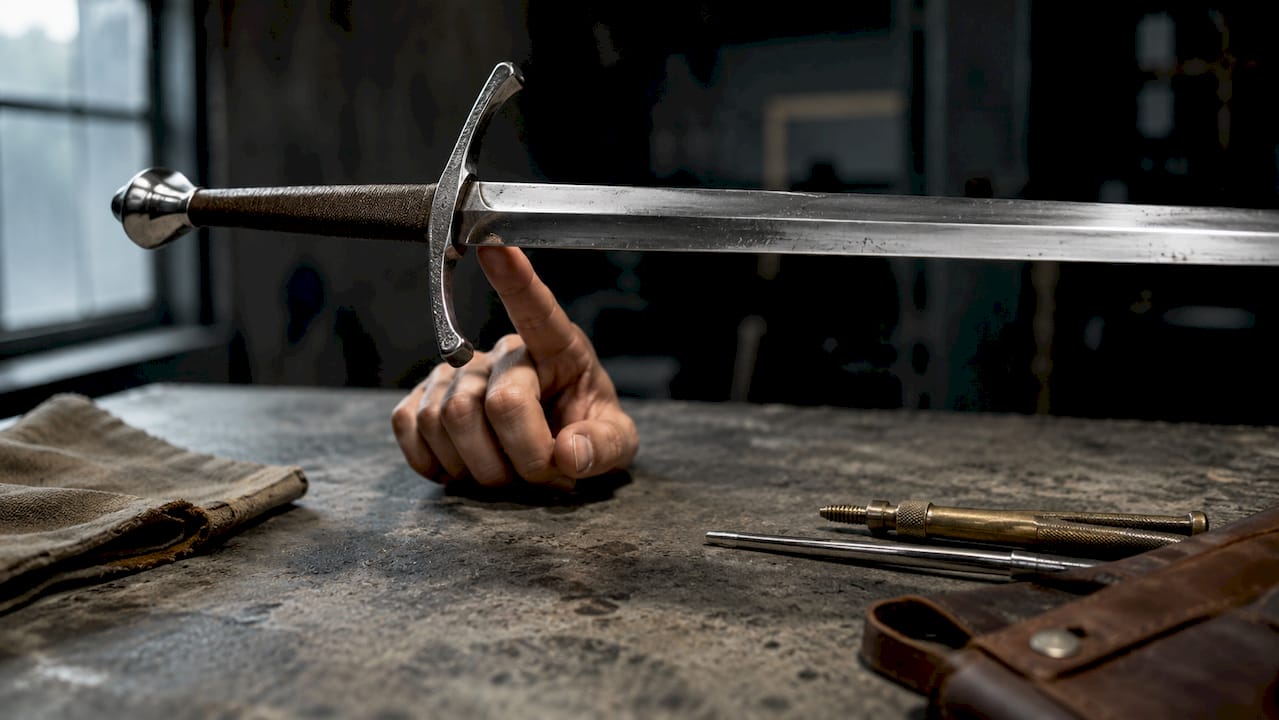
The PoB is the standard industry measurement for sword balance. Swordsmiths, martial arts instructors, and collectors all use it to describe and compare swords. When you see a sword listed with a PoB of 3 inches, that means the center of gravity sits 3 inches from the guard. That single number tells an experienced practitioner a great deal about how the sword will perform.
The importance of sword balance extends beyond comfort. Balance affects cutting efficiency, recovery speed after a strike, and the physical toll on your wrist and forearm over a long training session. Choosing the wrong balance for your skill level or discipline is one of the most common mistakes sword enthusiasts make.
How does sword balance affect handling, cutting power, and fatigue?
Balance location creates a direct trade-off between speed and power. A PoB closer to the guard produces a sword that is faster to swing, easier to redirect, and less tiring to hold extended. A PoB farther from the guard increases cutting momentum but causes faster fatigue because the arm works harder to control the extra tip weight.
The practical effects break down clearly:
- Speed and agility: A guard-balanced sword recovers quickly after each strike, making it ideal for sparring, forms practice, and defensive techniques.
- Cutting power: A forward-balanced sword delivers more force on contact. Tameshigiri practitioners, who cut through rolled tatami mats, often prefer this.
- Control and recovery: A handle-balanced sword is easier to stop mid-motion, which matters in controlled sparring formats.
- Fatigue: Forward balance increases the lever arm your muscles must fight. Over a 90-minute session, that difference becomes significant.
- Combat style: Thrusting-focused styles like European rapier fencing favor a guard-balanced sword. Cutting-focused styles like kenjutsu often accept more forward balance.
Pro Tip: Hold the sword at your side for 60 seconds without moving. If your forearm burns before the minute is up, the balance is too far forward for your current strength level.
A forward balanced sword feels heavier and delivers more force, while a sword balanced near the hilt feels quicker and easier to control. Neither is universally better. The right choice depends on what you are training to do.
What technical factors shape sword balance?
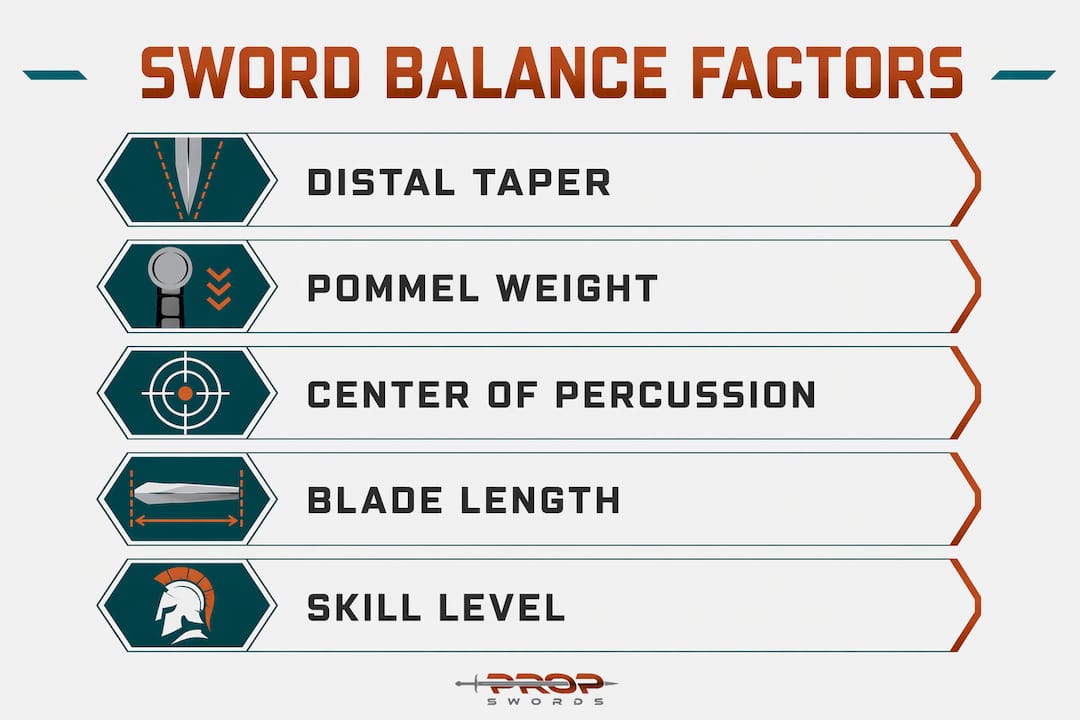
Three design elements determine where a sword’s PoB lands: distal taper, center of percussion, and pommel weight. Swordsmiths adjust all three during the forging and finishing process to hit a target balance point.
Distal taper
Distal taper is the gradual thinning of the blade spine from the guard to the tip. A blade with strong distal taper loses significant weight toward the tip, pulling the PoB back toward the hilt. This improves agility without sacrificing structural strength at the base of the blade, where impact forces are highest. A blade with little distal taper retains more tip mass, pushing the PoB forward.
Center of percussion
The center of percussion is the blade’s sweet spot, located roughly two-thirds down the blade from the guard. Striking with this zone maximizes force transfer to the target while minimizing vibration felt in the hand. A sword designed with a well-placed center of percussion reduces hand fatigue and improves cutting efficiency. Swordsmiths align the center of percussion with the intended striking zone for the sword’s style.
Pommel adjustments
The pommel is the counterweight at the base of the handle. Increasing pommel mass pulls the PoB back toward the guard. Reducing pommel mass lets the PoB shift forward. This makes the pommel the most practical post-forging tool for fine-tuning balance. Some production swords use threaded pommels specifically to allow user adjustment.
| Design element | Effect on PoB | Effect on handling |
|---|---|---|
| Strong distal taper | Moves PoB toward guard | Faster, more agile |
| Weak distal taper | Moves PoB toward tip | More cutting force |
| Heavier pommel | Moves PoB toward guard | Quicker, less fatiguing |
| Lighter pommel | Moves PoB toward tip | More momentum on cuts |
| Longer blade | Moves PoB forward | Requires more strength |
How do sword types and skill levels influence ideal balance?
Different sword types carry different standard PoB ranges based on their design purpose. Most one-handed swords balance 2–4 inches from the guard. Longer blades like sabers and Viking swords often have a PoB 5–7 inches out. Functional katanas typically land at 4–6 inches from the guard, reflecting their design for powerful two-handed cuts.
| Sword type | Typical PoB range | Best suited for |
|---|---|---|
| One-handed arming sword | 2–4 inches | Speed, thrusting, control |
| Katana | 4–6 inches | Two-handed cuts, kenjutsu |
| Viking sword | 5–7 inches | Powerful slashing cuts |
| Saber | 5–7 inches | Cavalry-style cutting |
| Training sword | 2–3 inches | Beginners, reduced fatigue |
Skill level changes what balance works best for you. Beginners benefit from handle-balanced swords because the reduced tip weight lowers fatigue and makes technique easier to develop. A new practitioner struggling with a forward-balanced sword will compensate with poor form, which builds bad habits. Experienced cutters can handle and often prefer forward balance because they have the strength and technique to use the extra momentum productively.
Training swords and sparring tools typically carry a guard-close PoB by design. This protects both practitioners and equipment during contact drills. Cutting swords used for tameshigiri or test cutting often carry a more forward PoB to maximize force on the target. Matching the sword’s balance to its intended use is not optional. It is the difference between a tool that works with you and one that fights you.
Pro Tip: If you train with a samurai-style training sword before moving to a live blade, choose a training sword whose PoB closely matches your target live blade. The muscle memory you build will transfer accurately.
What techniques help you assess and achieve proper sword balance?
Testing sword balance does not require specialized equipment. These methods work in any practice space.
-
The finger balance test. Place one finger under the blade just forward of the guard and let the sword rest horizontally. The point where it balances without tipping is the PoB. Measure from the guard to your finger with a ruler. Compare that number to the typical range for your sword type.
-
The wiggle test. Hold the sword in your normal grip. Make small, controlled side-to-side motions above the crossguard and watch the tip. The optimal grip position creates a rolling motion in the hand with the tip staying relatively still. If the tip swings wide, your grip is too far from the crossguard. The ideal grip point for most practitioners sits roughly 3.5 cm below the crossguard.
-
Grip position adjustment. Shifting your grip forward or back on the handle changes how the sword feels without changing its actual PoB. Moving your grip forward makes the sword feel more tip-heavy. Moving it back makes the sword feel lighter and faster. Test different grip positions before concluding a sword is wrong for you.
-
Pommel weight adjustment. If your sword has a removable or threaded pommel, adjusting pommel weight is the most direct way to shift the PoB. Add mass to pull balance toward the guard. Remove mass to push balance forward. Even small changes of a few grams produce a noticeable difference in how the sword handles.
-
Timed fatigue test. Perform 50 controlled cuts and note where fatigue appears first. Fatigue in the forearm and wrist suggests the PoB is too far forward for your current strength. Fatigue in the shoulder suggests the sword is too heavy overall, not necessarily unbalanced.
Checking historical sword replica specs before purchasing gives you a baseline PoB to compare against these tests. Knowing the number before you pick up the sword sets realistic expectations.
Key takeaways
Sword balance, measured by the Point of Balance, determines every aspect of how a sword handles, from speed and control to cutting power and fatigue.
| Point | Details |
|---|---|
| PoB defines sword balance | Measure from the guard to find where the sword balances on one finger. |
| Guard-close PoB favors speed | A PoB of 2–4 inches from the guard suits beginners and thrusting styles. |
| Forward PoB increases cutting force | A PoB of 5–7 inches suits experienced cutters and slashing disciplines. |
| Three design factors control PoB | Distal taper, center of percussion, and pommel weight all shift the balance point. |
| Test before committing | Use the wiggle test and timed fatigue test to confirm a sword suits your grip and strength. |
Why balance is the one thing most enthusiasts get wrong
Most sword enthusiasts focus on steel type, blade length, or visual finish when choosing a sword. Balance rarely enters the conversation until something feels off. That is a mistake I have seen repeated constantly, and it costs practitioners months of relearning.
I have handled swords across a wide PoB range, from a guard-hugging 2-inch balance on a short arming sword to a 6-inch forward balance on a heavy katana. The difference is not subtle. The forward-balanced katana demanded a completely different grip discipline. My wrist position, my follow-through angle, and my recovery timing all had to adjust. Practitioners who skip this step and just muscle through with poor technique build compensation patterns that are hard to undo.
The most common mistake I see is choosing a sword that looks right rather than one that feels right. A beautifully finished replica with a forward-heavy balance will punish a beginner every session. A plainer sword with a well-placed PoB will build better technique faster. The quality assessment process should always include handling the sword, not just inspecting it visually.
My advice: test balance before anything else. If you cannot hold the sword, use the finger balance test on any sword you are considering. Then match that number to your discipline and experience level. Adjust the pommel if the sword allows it. Do not accept a balance that fights your natural grip. The sword should work with your body, not against it.
— Muhammad
Replica swords worth handling at Propswords
Propswords carries a curated selection of replica swords built with attention to weight distribution and handling characteristics. Whether you are a collector looking for display accuracy or a practitioner who wants a training-ready replica, the balance specs matter as much as the finish. The best replica swords of 2026 at Propswords include options across the full PoB range, from guard-balanced training pieces to forward-weighted cutting replicas. Each listing includes weight and length data so you can calculate expected balance before buying. Free shipping within the USA makes it practical to order and test without added cost.
FAQ
What is the Point of Balance in a sword?
The Point of Balance is the sword’s center of gravity, measured in inches from the guard toward the tip. It is the single most useful number for predicting how a sword will handle.
How far from the guard should a katana’s PoB be?
A functional katana typically has a PoB of 4–6 inches from the guard. This range supports the two-handed cutting techniques central to kenjutsu and iaido.
What affects sword balance most?
Distal taper, pommel weight, and blade length are the three primary factors. Pommel weight is the easiest to adjust after the sword is forged.
How do I test sword balance at home?
Balance the sword horizontally on one finger just forward of the guard to find the PoB. Then perform the wiggle test to confirm the balance suits your grip position and technique.
Should beginners choose a guard-balanced or forward-balanced sword?
Beginners should choose a guard-balanced sword with a PoB of 2–4 inches. The reduced tip weight lowers fatigue and makes it easier to develop correct technique without compensating for poor balance.
Recommended