There is no single best sword metal. The right choice depends entirely on what you plan to do with the blade: hang it on a wall, wear it to a convention, or actually cut with it. Get that match wrong and you either overpay for performance you will never use, or you end up with a blade that looks great until it snaps.
Quick use-case guide:
- Display and collecting: Stainless steel (440C, 420) or low-carbon alloys work well. Corrosion resistance and finish quality matter more than edge retention.
- Cosplay and LARP: Low-to-mid carbon steel or stainless for props; spring steels like 5160 or 9260 for any contact sparring.
- Cutting and live blades: Carbon steels in the 1060–1095 range, or spring steels for heavy-impact work.
Two things matter more than the grade stamp: heat treatment and price. A 1095 blade with poor heat treatment performs worse than a well-treated 1060. And a sword claiming premium steel at a suspiciously low price almost always cuts corners in the forge.
Table of Contents
- What are the main types of sword metal?
- Why heat treatment matters more than the grade stamp
- Which metal fits your actual use?
- How to spot misleading steel claims before you buy
- Keeping your blade in good shape
- How Propswords fits these recommendations
- Your pre-purchase checklist
- Key Takeaways
- Why specs and provenance are the real story
- Propswords has the replica you are looking for
- Useful sources
- FAQ
What are the main types of sword metal?
The sword-making world runs on a handful of steel families, each with real trade-offs.
Carbon steels (10XX series)
Carbon steels are the backbone of functional swords. The SAE numbering tells you the carbon content: 1060 sits at 0.55–0.65% carbon, 1095 near 0.90–1.0%. Higher carbon means better edge retention and harder steel, but also more brittleness and more corrosion risk.
- 1060: Great balance of toughness and hardness. Popular for katanas and medieval swords. Forgiving to heat-treat.
- 1095: Holds a razor edge but needs perfect heat treatment and regular oiling. Best for cutters who know blade care.
- 1045: The entry-level minimum for a functional blade. Soft enough to bend rather than shatter, but edge retention is modest.
Spring steels (5160, 9260)
Spring steels are engineered for toughness and elastic recovery rather than maximum sharpness. 5160 contains about 0.7% chromium and handles repeated impacts without fatigue cracking. 9260 adds 2% silicon, letting the blade spring back even after bending close to 90 degrees. Both are common in HEMA training swords and heavy-use replicas.
Stainless steels (440C, 420, 304/316)
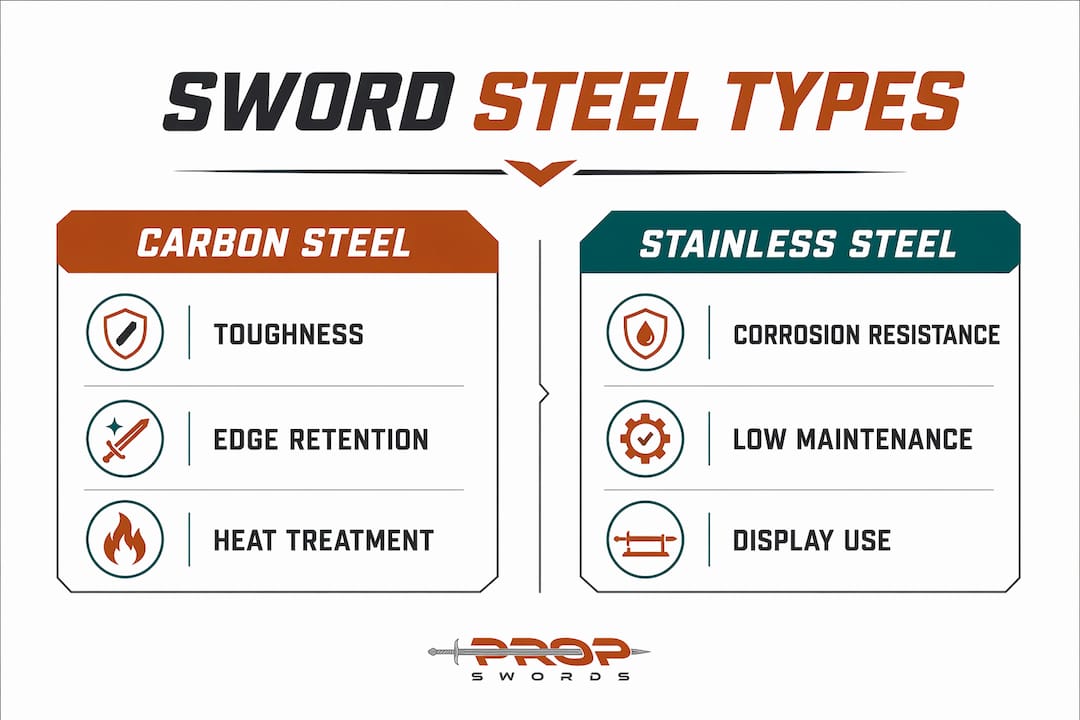
Stainless steel resists rust with minimal upkeep, which is why display pieces often use it. The catch: blades longer than roughly 12 inches in stainless become brittle at the grain boundaries. 440C is the best of the group for edge retention, but no stainless grade is suitable for a functional cutting sword at full length.
Damascus (pattern-welded)
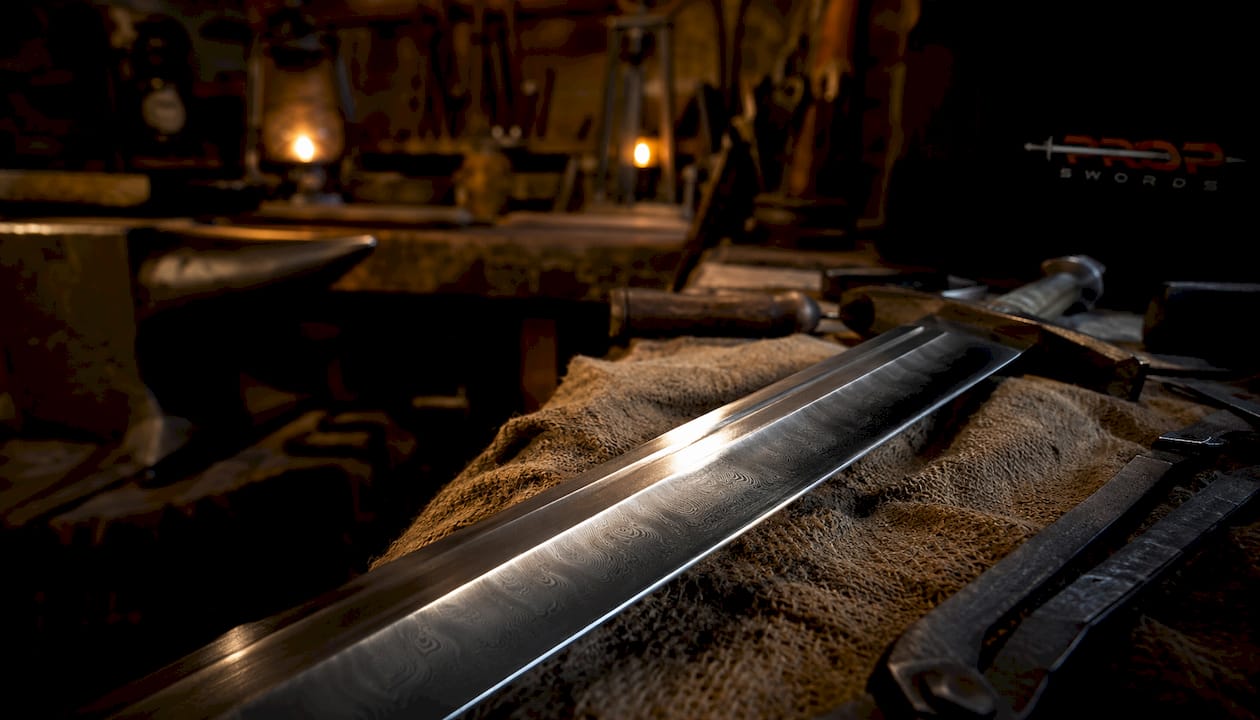
Modern Damascus is pattern-welded from two or more constituent steels, often 1095 and 15N20. The visual result is striking. Performance, though, depends entirely on the maker’s skill and the steels chosen. A well-made Damascus blade can perform like its best constituent steel. A poorly made one is just expensive and unreliable.
Tool steels and PM steels
L6 Bainite has a reputation as one of the toughest sword steels available when properly heat-treated. T-10 tool steel offers very high hardness and edge retention. Powder-metallurgy steels like CPM S35VN hold edges longer and resist corrosion better than most carbon steels, but they cost significantly more and require specialized heat treatment. For most collectors and cosplayers, these are overkill.
| Steel family | Toughness | Edge retention | Corrosion resistance | Best for |
|---|---|---|---|---|
| 1060 carbon | High | Moderate | Low (needs oiling) | Cutting, display |
| 1095 carbon | Moderate | Very high | Low (needs oiling) | Cutting, collecting |
| 5160 spring | Very high | Moderate | Low | HEMA, heavy use |
| 9260 spring | Very high | Moderate | Low | HEMA, sparring |
| 440C stainless | Low | Moderate | High | Display only |
| Damascus | Varies | Varies | Low | Collecting, display |
| L6 / T-10 tool | Very high | High | Low | High-end cutting |
Why heat treatment matters more than the grade stamp
A blade’s real-world performance is set in the forge, not on the spec sheet. Heat treatment, quench, and temper determine the final hardness, toughness, and whether the steel behaves the way its grade implies.
The grade tells you the steel’s potential. Heat treatment determines whether that potential was ever realized. Through-hardening makes the whole blade uniformly hard, which suits cutters. Differential hardening creates a hard edge and a softer, tougher spine, the method behind traditional Japanese hamon. Tempering after quench reduces brittleness. Skip or rush any step and even premium steel becomes a liability.
What to ask a seller before you buy:
- What is the stated HRC hardness range? (Functional swords typically fall between HRC 50–60.)
- Was the blade through-hardened or differentially hardened?
- What quench medium was used (water, oil, interrupted quench)?
- Was the blade tempered after quench, and at what temperature range?
- Can you provide a spec sheet or third-party test result?
Sellers who cannot answer questions 1 and 2 are a red flag. Good manufacturers publish this information on their product spec pages.
Which metal fits your actual use?
The best metal for swords shifts depending on the job. Here is a direct map.
Display and collecting: Stainless or low-carbon steel. You want corrosion resistance and a clean finish. Functional performance is irrelevant. Budget: entry-level display pieces start well under $100.
Cosplay props (no contact): Stainless or low-carbon steel again. Weight and finish authenticity matter. A partial tang is acceptable for a wall piece or costume prop that never takes impact.
Stage combat and LARP sparring: Spring steels (5160, 9260) with a full tang and controlled hardness. HEMA training blades use tuned heat treatment and thicker edges to handle repeated impact safely. Check convention and event rules before bringing any metal blade; many venues require blunted or foam alternatives.
Cutting practice and live blades: 1060 or 1095 carbon steel, properly heat-treated. 1060 for durability and forgiveness; 1095 for maximum edge retention if you are confident in your maintenance routine.
Serious collecting: Damascus or tool steels for visual and performance prestige. Expect to pay a premium and budget for maintenance.
| Intended use | Toughness needed | Edge retention | Corrosion resistance | Typical price |
|---|---|---|---|---|
| Display | Low | Low | High | Under $150 |
| Cosplay prop | Low | Low | Medium | $50–$150 |
| LARP / sparring | Very high | Low | Low | $200–$500 |
| Cutting practice | High | High | Low | $150–$300 |
| Serious collecting | Medium | Medium | Varies | $300 |
Pro Tip: Before any public event, check your state and local laws on carrying bladed weapons. Many states regulate blade length and transport method regardless of whether the sword is a replica.
How to spot misleading steel claims before you buy
Steel-name fraud is common in the replica market. Lower-cost steels like 1045 are sometimes labeled as 1060 or 1095 because most buyers cannot tell the difference visually. Surface finishes (mirror polish, decorative heat coloring) say nothing about core metallurgy. A beautiful etch pattern on Damascus does not confirm the constituent steels or the heat treatment quality.
Red flags to watch for:
- No stated HRC hardness range on the product page
- “High-carbon steel” with no grade number
- Vague heat-treatment language (“professionally tempered,” no specifics)
- Missing tang description (full, partial, rat-tail)
- Price far below market for the claimed grade (a genuine 1095 sword with proper heat treatment rarely sells under $150; a real L6 Bainite sword has never been credibly sold under $1,000)
- Stock photos with no actual blade close-ups
Use the buyer’s guide at Propswords to cross-check specs before purchasing anywhere.
Pro Tip: Compare prices across the DojoTrack price comparison tool to get a realistic market baseline for the steel grade you are considering.
Keeping your blade in good shape
Maintenance requirements differ sharply by metal type.
- After every handling session: Wipe the blade with a clean, dry cloth to remove fingerprint oils. Skin oils accelerate rust on carbon steel within hours.
- Oil carbon and spring steel blades: Apply a thin coat of camellia oil, mineral oil, or Renaissance Wax after wiping. Stainless steel needs this far less often but still benefits from occasional treatment.
- Control humidity: Store blades in a climate-controlled space. Humidity above 60% accelerates corrosion on high-carbon blades. Silica gel packs inside a display case or sheath help.
- Polishing: Use a soft cloth and metal polish designed for steel. Avoid abrasive compounds on mirror-polished stainless display pieces.
- Sharpening: Display pieces should keep their original factory edge. For functional blades, use a whetstone progression (220 to 1000 grit) or hire a professional sharpener familiar with sword geometry.
- Storage and display: Wall mounts should support the blade at two points to prevent stress. Sheaths should be dry and clean. Avoid leather sheaths for long-term storage of carbon steel; leather retains moisture.
For detailed display setup advice, the sword display guide at Propswords covers mounting options and humidity management.
How Propswords fits these recommendations
Propswords stocks replica swords that map directly to the metal-to-purpose framework above. Two catalog items worth knowing:
- Handmade Stainless Steel Leather Wrapped Wood Handle Leaf Spear: A display-grade piece in stainless steel. The finish and corrosion resistance make it a strong choice for collectors who want a wall piece that stays looking sharp with minimal upkeep. The leather-wrapped wood handle adds authenticity without the maintenance burden of a full-carbon blade.
- Sword of Dragons Fantasy Sword (1065 carbon steel): Built from 1065 carbon steel, which sits between the 1060 and 1095 grades in hardness and toughness. This is a functional-grade replica suitable for display and light cutting practice, with the carbon content to take and hold a real edge.
When browsing Propswords product pages, look for the stated steel grade, any heat-treatment notes, and the tang description. Items that list all three are the ones worth your money. Propswords also offers custom engraved options, Damascus steel pieces, and anime and movie-inspired replicas across the full price range.
Your pre-purchase checklist
Before committing to any sword purchase, run through this list:
- Confirmed steel grade (specific SAE number, not just “high-carbon steel”)
- Heat-treatment details (through-hardened or differential, tempering confirmed)
- Stated HRC hardness range (50–60 for functional blades)
- Tang construction (full tang for any functional use; partial tang acceptable for display only)
- Intended use confirmed (display, cosplay, cutting)
- Price consistent with claimed grade and construction
- Return or warranty policy in writing
- Shipping method and any legal restrictions for your state
Three quick seller questions and what good answers look like:
- “What is the HRC hardness?” Good answer: a specific range like 50–58 HRC. Bad answer: “very hard” or no answer.
- “Is this through-hardened or differentially hardened?” Good answer: either, with a brief explanation. Bad answer: “yes, it’s heat-treated.”
- “What is the tang construction?” Good answer: “full tang, peened pommel.” Bad answer: “strong handle.”
Key Takeaways
Heat treatment and intended use together determine which sword metal is right for you, not the grade name alone.
| Point | Details |
|---|---|
| Match metal to purpose | Stainless for display, carbon steel (1060–1095) for cutting, spring steel (5160/9260) for sparring. |
| Heat treatment is decisive | A well-treated 1060 blade outperforms a poorly treated 1095 in real-world use. |
| Price signals quality | Genuine high-carbon swords with proper heat treatment rarely sell at bargain prices; extreme discounts suggest compromised specs. |
| Maintenance varies by steel | High-carbon blades need oiling after every use; stainless display pieces need far less upkeep. |
| Propswords catalog | The Sword of Dragons (1065 carbon steel) and the Stainless Steel Leaf Spear cover functional and display needs respectively. |
Why specs and provenance are the real story
The sword community spends a lot of energy debating which steel grade is “the best,” and that debate mostly misses the point. A 1060 blade from a maker who controls their heat treatment process will outperform a 1095 blade from a factory that rushes the temper. The grade is a ceiling, not a guarantee.
What actually separates a trustworthy catalog from a questionable one is transparency. Sellers who publish HRC ranges, describe their heat-treatment process, and specify tang construction are telling you they stand behind the metallurgy. Sellers who hide behind vague language are telling you something too.
Collectors and cosplayers deserve honest specs. The replica sword market has enough beautiful pieces that there is no reason to settle for a blade whose provenance you cannot verify.
Propswords has the replica you are looking for
Propswords offers replica swords across the full spectrum: stainless display pieces, carbon steel functional replicas, Damascus options, and anime and movie-inspired designs, all with free shipping within the USA.
Whether you are building a display collection, suiting up for a convention, or looking for a functional blade to practice with, Propswords lists steel grade, heat-treatment notes, and tang construction on product pages so you can buy with confidence. Custom engraving is available, and the return policy covers orders that do not meet expectations. Browse the full catalog at propswords.com and filter by use case to find the right blade for your collection.
Useful sources
- List of blade materials — Wikipedia: Comprehensive reference for steel grades, compositions, and common sword applications.
- Sword — Wikipedia: Historical context on blade development from bronze through modern steel.
- Sword Steels 101 — Sword Buyers Guide: Practical breakdown of 1045, 1060, 1095, spring steels, and tool steels with price guidance.
- Sword Steels Complete Guide — Medieval Swords World: Detailed composition table and use-case recommendations for SAE-graded sword steels.
- Best Metal for Sword Making — Metal Supermarkets: Use-case-driven comparison of carbon, stainless, spring, and tool steels.
- Carbon Steel for Swords Guide — SwordsInfo: Deep dive into 10XX carbon steels and their performance trade-offs.
- Best Metal for Sword Making — SwordsInfo: Covers spring steels, Damascus, and modern alloy choices.
- Metallurgy and Blade Construction — Historical Sword Society: Expert-level treatment of heat treatment, alloy selection, and HEMA blade engineering.
- What Is the Best Sword Steel — Walker Metal Smith: Overview of tool steels and PM steels for premium sword applications.
- Western European Sword ca. 1400 — Metropolitan Museum of Art: Primary source on historical sword construction and materials.
FAQ
What is the best sword metal for display?
Stainless steel (440C or 420) is the top choice for display swords. It resists corrosion with minimal upkeep and holds a clean finish without regular oiling.
Is carbon steel or stainless steel better for cutting?
Carbon steel, specifically grades like 1060 or 1095, is better for cutting. Stainless steel blades over 12 inches become brittle at the grain boundaries and are not suited for functional use.
What does HRC mean on a sword spec sheet?
HRC stands for Hardness Rockwell C, a standard scale for measuring steel hardness. Functional sword blades typically fall in the 50–60 HRC range, balancing edge retention with enough toughness to resist shattering.
How do I know if a sword’s steel grade is genuine?
Ask the seller for the specific SAE grade number, the HRC hardness range, and heat-treatment details. Vague answers like “high-carbon steel” with no grade number are a warning sign of mislabeled product.
Does Propswords list steel specs on product pages?
Yes. Propswords product pages include steel grade, heat-treatment notes, and tang construction details, so buyers can verify the specs before purchasing.
Recommended