TL;DR:
- Sword anatomy encompasses the blade, hilt, and scabbard, with each part influencing a sword’s performance and handling. Understanding components like the fuller, tang, and pommel enables buyers to evaluate quality and suitability for combat or display. This knowledge is essential for making informed decisions, ensuring durability, and appreciating the engineering behind each weapon.
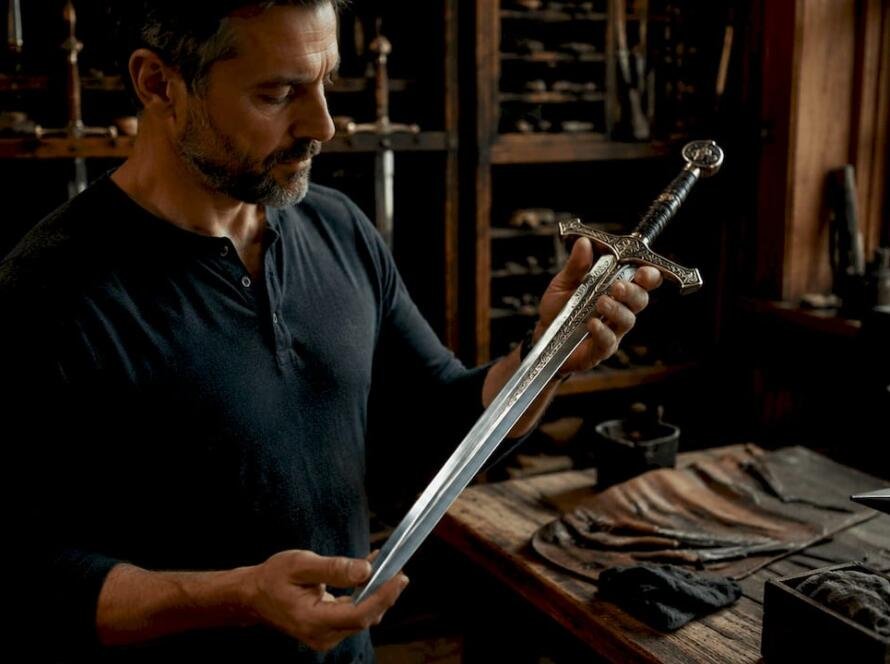
Sword anatomy is the study of a sword’s distinct parts, specifically the blade, hilt, and scabbard, and how each component shapes the weapon’s function, balance, and handling. Whether you’re a swordsmanship student, a history enthusiast, or a cosplayer building an accurate replica, understanding what is sword anatomy gives you a practical framework for evaluating any sword you encounter. A sword is categorized into three primary sections: the blade, which cuts or thrusts; the hilt, which the wielder controls; and the scabbard, which protects the blade when not in use. Each section contains sub-components that directly affect how a sword performs, feels, and lasts.
What is sword anatomy and why does it matter?
Sword anatomy is the formal term for the complete map of a sword’s structural components, from the tip of the blade to the base of the pommel. Historians, martial artists, and collectors all use this vocabulary to describe, compare, and evaluate weapons across cultures and centuries. The 5,000-year evolution of sword design reflects a constant balance between ergonomic control and material efficiency, meaning every named part exists for a reason. Knowing the terminology also protects you as a buyer. When a seller describes a sword’s tang construction or fuller geometry, you need the vocabulary to judge whether that description signals quality or a red flag.
The three primary divisions are blade, hilt, and scabbard. The blade does the cutting or piercing work. The hilt provides control, leverage, and hand protection. The scabbard stores and preserves the blade. Within each division, specific components carry out precise mechanical roles, and those roles interact. A heavier pommel shifts the balance point toward the hand, making the sword feel faster. A wider fuller reduces blade weight without sacrificing stiffness. These are not decorative choices. They are engineering decisions made in steel.
What are the key components of the sword blade?
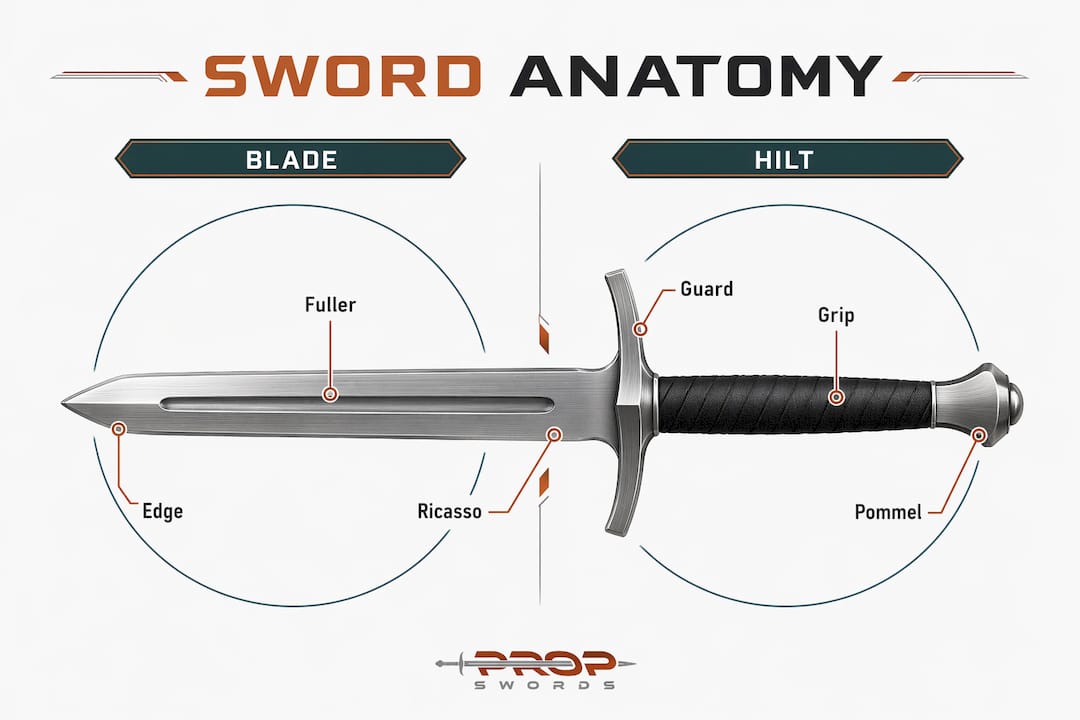
The blade is the core working element of any sword, and its primary components include the edge, spine, tip, fuller, ricasso, forte, and foible. Each part serves a distinct mechanical purpose, and understanding them helps you read a sword’s intended use at a glance.
- Edge: The sharpened side of the blade, ground to a fine angle for cutting. Single-edged blades, like the Japanese katana or the Norse seax, sharpen only one side. Double-edged blades, like the European arming sword or the Roman gladius, sharpen both. The edge geometry determines whether a sword excels at slicing, chopping, or drawing cuts.
- Spine: The thick, unsharpened back of the blade. The spine provides structural rigidity. Without it, the blade would flex or snap under lateral stress. On single-edged swords, the spine is often visibly thicker to compensate for the asymmetric grind.
- Tip: The point at the end of the blade. Tip shapes vary significantly. A sharp, narrow tip, as seen on the estoc or the rapier, prioritizes thrusting through gaps in armor. A rounded or clipped tip, as on some sabers, favors cutting over piercing.
- Fuller: A longitudinal groove running along the flat of the blade. The fuller acts like an I-beam in architecture, reducing blade weight while maintaining stiffness. The widespread myth that it is a “blood groove” designed to ease withdrawal from wounds has no historical basis.
- Ricasso: An unsharpened section at the base of the blade, just above the guard. The ricasso is a deliberate design for control, not a manufacturing flaw. On two-handed swords like the German Zweihänder, fighters would grip the ricasso directly for close-quarters leverage, a technique called “half-swording.”
- Forte and foible: The forte is the lower third of the blade, closest to the hilt. It is the strongest section, used for parrying. The foible is the upper third, closest to the tip. It is the most flexible and carries the most cutting energy at speed. Knowing which zone you are using in a technique is fundamental to classical fencing.
Pro Tip: When examining a replica sword, run your eye along the fuller. A clean, consistent groove that runs parallel to the spine indicates quality machining. An uneven or shallow fuller that fades before the tip often signals a decorative piece with no structural integrity.
How is the hilt constructed and what roles do its parts serve?
The hilt is everything above the blade, and the hilt consists of three core elements: the guard, the grip, and the pommel. A fourth critical element, the tang, is hidden inside the hilt but determines the entire structure’s strength.
- Guard (crossguard): The guard sits between the blade and the grip, protecting the hand from an opponent’s blade sliding down toward the fingers. On a classic European longsword, the guard is a straight crossbar. On a rapier, it expands into an elaborate cage of rings and bars called a complex hilt. The guard’s shape directly reflects the fighting style the sword was designed for.
- Grip: The grip is the section the wielder holds. Materials across history include wood wrapped in leather, ray skin (same), wire, cord, and modern synthetic materials. Grip length determines whether a sword is one-handed, hand-and-a-half (bastard sword), or two-handed. Ergonomic shaping, including slight swells or twists, helps the hand maintain orientation without looking at the blade.
- Pommel: The pommel caps the end of the grip. The pommel counterbalances the blade and can serve as a close-range striking tool. A heavier pommel pulls the balance point toward the hand, creating a more maneuverable feel. Pommel shapes include wheels, discs, Brazil nuts, and fishtails, each associated with specific periods and sword types.
- Tang: The tang is the extension of the blade that runs through the grip and is secured by the pommel. A full tang offers superior strength because the blade steel runs the full length of the handle. A partial tang extends only partway. A rat-tail tang is a thin threaded rod welded to the blade base, common in decorative swords and significantly weaker under stress.
Pro Tip: Before buying any replica, ask the seller specifically about tang construction. A full tang sword will almost always be described as such because it is a selling point. If the listing does not mention the tang type, assume it is a rat-tail and price your expectations accordingly.
The interaction between these four elements determines a sword’s balance point, which is the spot on the blade where the sword pivots naturally. Most historical swords balance somewhere between two and six inches from the guard. Moving that point forward makes cuts feel more powerful. Moving it back makes the sword feel faster and more responsive in the hand.
What is the purpose and anatomy of the scabbard?
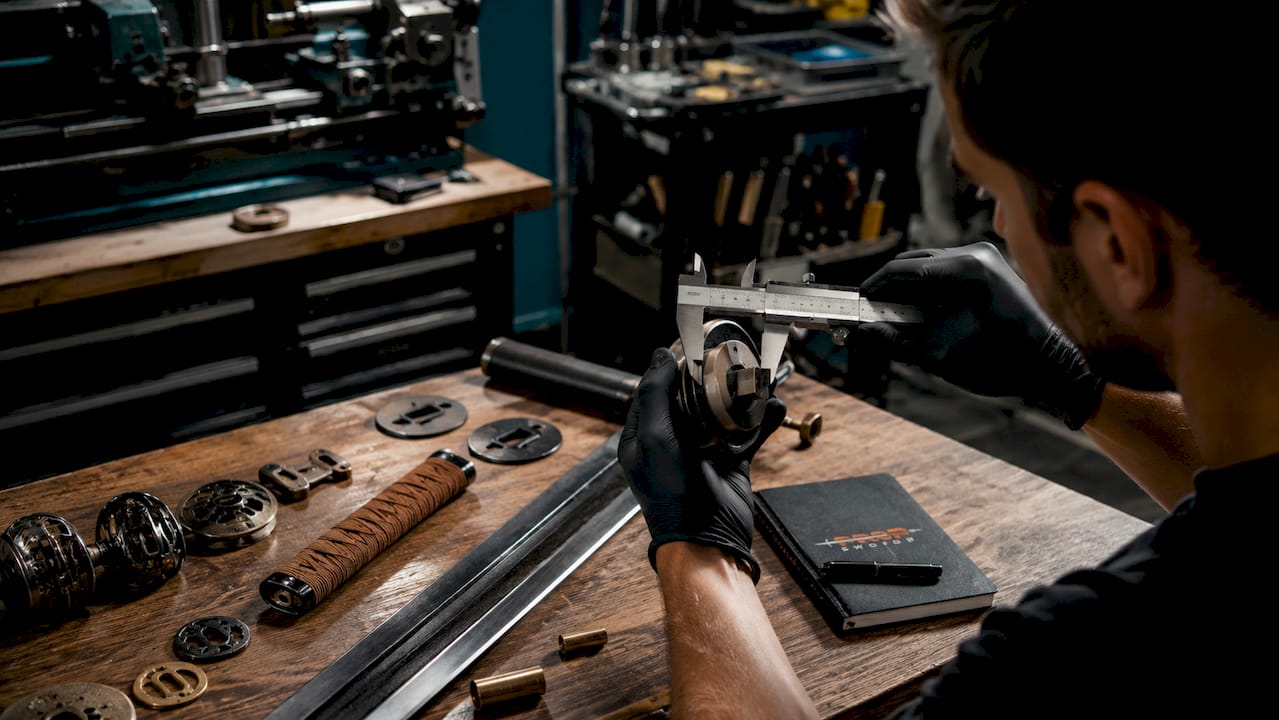
The scabbard is the protective sheath that houses the sword when it is not in use. Its primary function is to protect blades from rust and damage while allowing safe and easy transport. Without a scabbard, a sharp blade is a constant hazard to the carrier and anyone nearby.
Scabbards across history were made from wood cores covered in leather, fabric, or metal. Japanese saya (scabbards) used magnolia wood for its softness, which prevented edge damage during sheathing. Viking scabbards lined their interiors with wool, whose natural lanolin oils provided passive rust protection. Modern display scabbards often use synthetic materials or chrome-plated metal.
The main structural components of a scabbard are:
- Throat (locket): The opening at the top where the blade enters. The throat must fit the blade’s cross-section precisely. Too loose and the blade rattles and risks damage. Too tight and drawing the sword becomes difficult or impossible.
- Body: The main length of the scabbard that surrounds the blade. The fit along the body determines how securely the sword is retained during movement.
- Chape: The metal fitting at the tip of the scabbard. The chape protects the bottom of the scabbard from wear and prevents the blade tip from piercing through.
| Scabbard component | Material examples | Primary function |
|---|---|---|
| Throat (locket) | Brass, steel, leather | Guides blade entry, retains sword |
| Body | Wood, leather, synthetic | Surrounds and protects blade length |
| Chape | Steel, brass | Protects scabbard tip from blade puncture |
For cosplay and display purposes, scabbard quality is often overlooked. A poorly fitted scabbard that lets the blade rattle will scratch the finish over time, which matters significantly for collectors investing in detailed replicas.
How do variations in sword anatomy affect performance?
Anatomy variations directly affect how a sword handles, what fighting style it suits, and how durable it is under use. This is where anatomy knowledge becomes genuinely practical for anyone choosing a sword, whether for martial arts training, historical reenactment, or cosplay.
- Fuller width and depth: A wider, deeper fuller removes more material and reduces weight more aggressively. This makes the sword faster but slightly reduces lateral strength. Narrow fullers offer a middle ground. Swords without any fuller, like many Japanese katana, compensate through differential heat treatment and blade geometry.
- Blade curvature: Curved blades, as on the shamshir or the katana, generate more draw-cut force because the edge travels across the target rather than straight through it. Straight blades, as on the gladius or the estoc, deliver more direct thrusting power. Replica buyers should match blade shape to the character or historical period they are representing.
- Pommel weight: A heavier pommel shifts the balance point toward the hand, which reduces the effort required to change direction quickly. This is why fast, agile swords like the rapier tend to have compact, dense pommels. Slow, powerful cutting swords like the falchion often have larger, heavier pommels to manage the blade’s forward weight.
- Tang construction: For replica quality and durability, the tang is the single most important structural element. A full tang sword can withstand the stress of stage combat or active cosplay. A rat-tail tang will eventually fail at the weld point, which is a safety risk, not just a quality issue.
- Guard design: A simple crossguard suits broad cutting styles. A complex swept hilt or cup hilt, as on a rapier, protects the fingers during thrusting exchanges. For cosplay, guard complexity also signals the character’s fighting style and period, making it a detail worth getting right.
Pro Tip: For cosplay swords that will see active use at conventions or stage combat, prioritize safe replica construction over visual detail. A sword with a full tang and a well-fitted guard will survive a full convention weekend. A purely decorative piece with a rat-tail tang will not.
Key takeaways
Sword anatomy is the structured vocabulary that connects every physical component of a sword to its specific mechanical function, and knowing it separates informed buyers from uninformed ones.
| Point | Details |
|---|---|
| Three primary sections | Every sword divides into blade, hilt, and scabbard, each with distinct sub-components. |
| Fuller myth | The fuller is a structural weight-reduction groove, not a blood channel, functioning like an I-beam. |
| Tang determines durability | Full tangs provide superior strength; rat-tail tangs are common in decorative swords and fail under stress. |
| Pommel affects balance | Pommel weight shifts the balance point and directly changes how fast or powerful a sword feels. |
| Scabbard fit matters | A poorly fitted scabbard damages the blade finish over time, which is critical for display collectors. |
Why anatomy knowledge changed how I look at every sword
Most beginners focus on the blade and ignore everything else. I did the same thing when I first started studying historical swords. The grip felt like packaging. The pommel looked like decoration. The scabbard was just the thing you put the sword in when you were done. That perspective is wrong, and it costs people money.
The fuller myth is the most persistent misconception I see repeated in collector communities. Calling it a blood groove sounds dramatic, but it misrepresents the engineering entirely. The fuller is why a sword can be both light and stiff. Remove it, and you either add weight or sacrifice rigidity. That is not a minor detail. It is the difference between a sword that handles well and one that feels like a steel bar.
The tang issue is where I see the most real-world consequences. I have watched display swords fail at the hilt during light stage combat because the rat-tail tang gave way at the weld. That is not just a broken sword. It is a safety incident. When you understand tang construction, you stop buying swords based on how they look in photos and start asking the questions that actually matter.
For cosplayers specifically, anatomy knowledge also improves the realism of your presentation. Knowing that a character’s sword has a swept hilt and a ricasso tells you something about the world they inhabit and the fighting style they use. That context makes your costume more than a costume. It makes it a statement.
— Muhammad
Find the right replica sword at Propswords
Understanding sword anatomy gives you the tools to judge a replica before you buy it. At Propswords, every sword in the catalog is selected with collectors and cosplayers in mind, which means attention to tang construction, guard detail, and blade geometry. Whether you are building a historically accurate display piece or gearing up for your next convention, the best replica swords for 2026 cover anime, Viking, medieval, and movie-inspired designs with free shipping across the USA. If you are still deciding on the right style, the cosplay sword selection guide walks you through every anatomy-based consideration that matters for a safe, realistic choice.
FAQ
What are the three main parts of a sword?
A sword divides into three primary sections: the blade, the hilt, and the scabbard. The blade cuts or thrusts, the hilt provides control and hand protection, and the scabbard stores and protects the blade when not in use.
What is the fuller on a sword blade?
The fuller is a longitudinal groove cut into the flat of the blade. It functions like an I-beam in architecture, reducing blade weight while maintaining stiffness, and has no connection to the common “blood groove” myth.
Why does tang type matter for replica swords?
The tang is the blade extension that runs through the grip. A full tang provides structural integrity across the entire handle length, while a rat-tail tang is a weaker welded rod common in decorative pieces that can fail under active use.
What is the ricasso on a sword?
The ricasso is the unsharpened section of the blade just above the guard. It is a deliberate design feature that allows the wielder to grip the blade directly for added control, particularly on large two-handed swords like the Zweihänder.
How does pommel weight affect sword handling?
A heavier pommel shifts the sword’s balance point toward the hand, making the weapon feel faster and easier to redirect. A lighter pommel allows the balance point to sit further forward, adding power to cuts but reducing agility.
Recommended