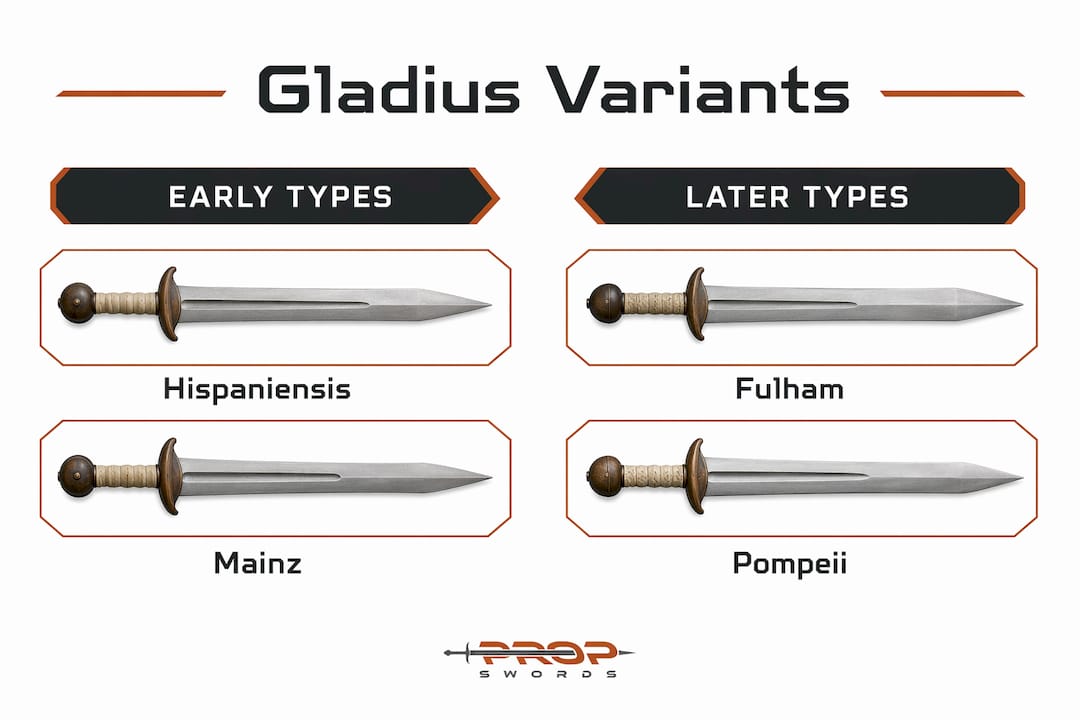
The gladius is the definitive Roman sword, a short double-edged blade that armed Rome’s legions from the 3rd century BC through the 3rd century AD. It came in four main variants: the gladius Hispaniensis, the Mainz gladius, the Fulham gladius, and the Pompeii gladius. Alongside it, Roman soldiers carried the spatha (a longer cavalry sword that eventually replaced the gladius) and the pugio (a utility dagger). Together, these ancient Roman weapons defined one of history’s most effective military systems.
Here is a quick reference for the primary Roman swords:
- Gladius Hispaniensis: Blade leaf-shaped, the earliest and heaviest variant among the types
- Mainz gladius: Blade with wasp-waisted curves and triangular point, moderately heavy
- Fulham gladius: Blade with straight edges and a long triangular tip, relatively light
- Pompeii gladius: Blade with parallel edges, the shortest of the variants, relatively light
- Spatha: Blade over 75 cm, used first by cavalry then adopted by infantry
- Pugio: A short dagger worn as a sidearm, not a battlefield sword
What makes the Roman sword so distinctive?
The gladius was purpose-built for one thing: killing at close range inside a tight formation. Its short blade, typically 45–68 cm, let a legionary thrust into an enemy’s torso without needing room to swing. That constraint was a feature, not a limitation. Roman legions fought shoulder to shoulder behind large scutum shields, and a long slashing sword would have been useless in that press. The gladius weighed roughly 700–800 grams, light enough to use all day, heavy enough to punch through light armor.
The Romans did not invent this design. They adopted it from Celtiberian warriors fighting for Carthage during the Punic Wars, particularly after the Battle of Cannae in 216 BC, when they saw firsthand how well those swords performed at both slashing and thrusting. Scipio Africanus is credited with formalizing the adoption after the Battle of Cartagena in 209 BC. Rome took the concept and refined it over four centuries into a weapon that terrified opponents from Gaul to Macedonia.
The four main gladius variants, explained
Gladius Hispaniensis (used roughly 216 BC to 20 BC)
This is the original, and it was bigger than most people expect. The blade ran 60–68 cm with a pronounced leaf-shape, and the full sword measured 75–85 cm. At 900 g to 1 kg, it was the heaviest gladius. The leaf-blade profile gave it a slight waist, widening toward the middle before tapering to a point. Polybius described it as having “an excellent point and a strong cutting edge on both sides.” Recent archaeological finds have actually shown that the gladius Hispaniensis was not short at all; its blade length matched the earliest known imperial spathae, which challenges the old assumption that Roman swords were always compact.
Mainz gladius (introduced around 20 BC)
The Mainz gladius kept the wasp-waisted curves of the Hispaniensis but shortened and widened the blade to 50–55 cm and 7 cm across, with a more pronounced triangular point. The full sword ran 65–70 cm and weighed 800 g. The most famous surviving example, the Sword of Tiberius, was found in the Rhine near Mainz and has been in the British Museum’s collection since 1866. Its gilded bronze scabbard depicts Tiberius presenting a victory statuette to Augustus, flanked by the gods Victory and Mars Ultor. The Mainz type was the frontier soldier’s sword, built for the hard campaigning on Rome’s northern borders.
Fulham gladius (used from 43 AD through the late 1st century)
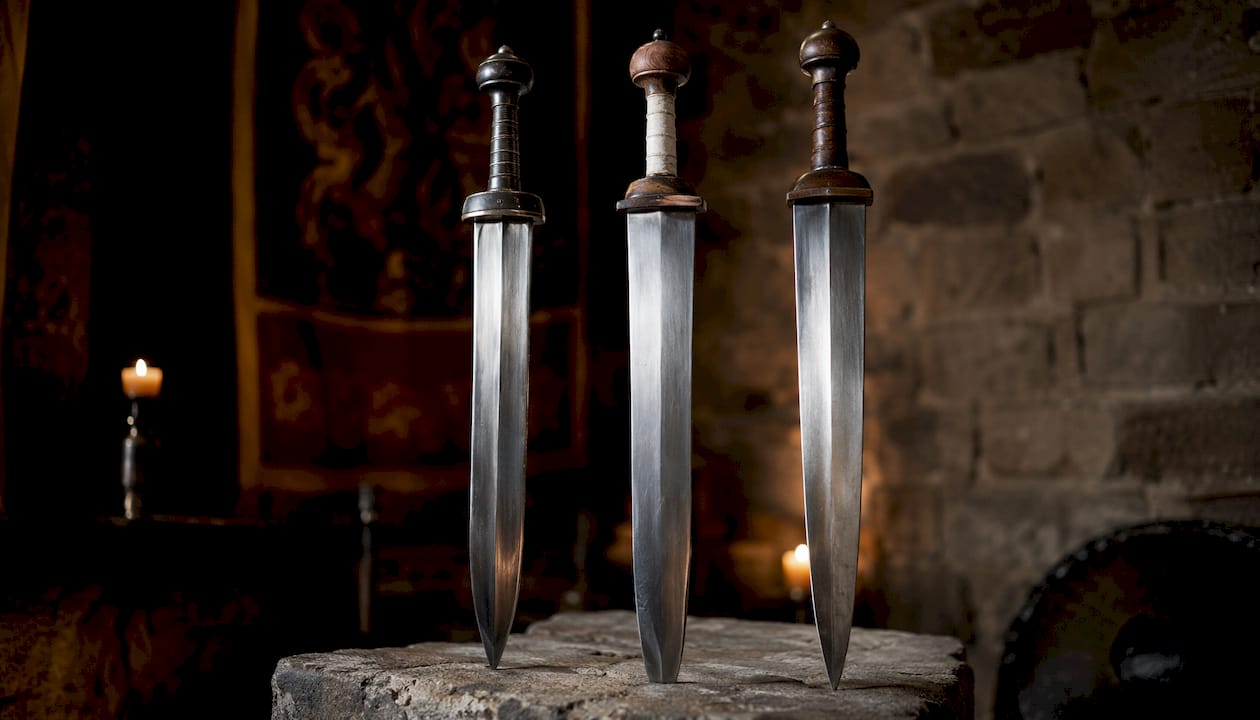
The Fulham is sometimes called the Mainz-Fulham because it bridges the two dominant types. It has straight edges rather than the Mainz’s curves, combined with a long triangular tip. Blade length is moderately sized, between other gladius variants, overall length 65–70 cm, and width 6 cm. At 700 g with a wooden hilt, it was the lightest of the longer variants. A full-size replica is on display at Fulham Palace in London. The Fulham appeared after Aulus Plautius’ invasion of Britain in 43 AD, suggesting it may have been developed or popularized during that campaign.
Pompeii gladius (most popular variant, 1st–3rd century AD)
The Pompeii gladius is the one most people picture when they think of a Roman sword. It has completely parallel cutting edges and a short triangular tip, with no waist at all. The blade is 45–50 cm, the full sword 60–65 cm, and it weighs 700 g. Four examples were found in the ruins of Pompeii, which is how modern historians named it. It is the shortest of the four variants, and over time later versions grew longer, eventually being called semi-spathae as the army transitioned toward the longer spatha. The Pompeii type was the dominant sword of the high empire.
| Variant | Blade length | Overall length | Weight | Distinctive feature |
|---|---|---|---|---|
| Hispaniensis | 60–65 cm | 75–85 cm | 900 g–1 kg | Leaf-shaped blade |
| Mainz | 50–55 cm | 65–70 cm | 800 g | Wasp-waisted, triangular point |
| Fulham | 50–55 cm | 65–70 cm | 700 g | Straight edges, long point |
| Pompeii | 45–50 cm | 60–65 cm | 700 g | Parallel edges, shortest blade |
Pro Tip: When evaluating replica Roman swords for a collection, the blade profile is the fastest way to identify the variant. Parallel edges with a short triangular tip means Pompeii; a visible waist with a long taper means Mainz.
The spatha and pugio: Rome’s other blades
The spatha started as a cavalry weapon in the 1st century AD. Its blade ran over 75 cm, giving mounted soldiers the reach they needed to strike downward from horseback. By the late 2nd or early 3rd century, Roman infantry had adopted it too, as battlefield tactics shifted away from the tight close-order formations that made the gladius so effective. The spatha’s longer reach let soldiers engage from a slightly safer distance and made it practical when formations became more fluid.
The pugio was a different tool entirely. It was a short dagger, not a sword, worn on the left hip as a sidearm. Roman soldiers used it for utility tasks and as a last-resort weapon when the gladius was unavailable or impractical. The pugio was a short dagger, small enough to serve as a convenient sidearm. It carried real symbolic weight too: the daggers used to assassinate Julius Caesar on the Ides of March in 44 BC were pugiones.
The transition from gladius to spatha was not a sudden swap. For decades, both weapons coexisted in Roman legions, with the gladius persisting among light infantry even after the spatha became dominant. The shift reflected a broader change in Roman warfare: less reliance on the tight manipular formation and more on flexible units that needed longer reach. Collectors and reenactors today often display both types together precisely because they represent two distinct eras of Roman military thinking.
How Roman swordsmiths built a blade that lasted centuries
Roman smiths used a layered construction method that balanced two competing needs: a hard edge that holds a sharp point, and a flexible core that absorbs impact without snapping. They placed harder, higher-carbon steel on the outer layers of the blade and softer steel at the center. This is the same principle behind Japanese tamahagane construction, though the Romans arrived at it independently and applied it to a very different blade geometry.
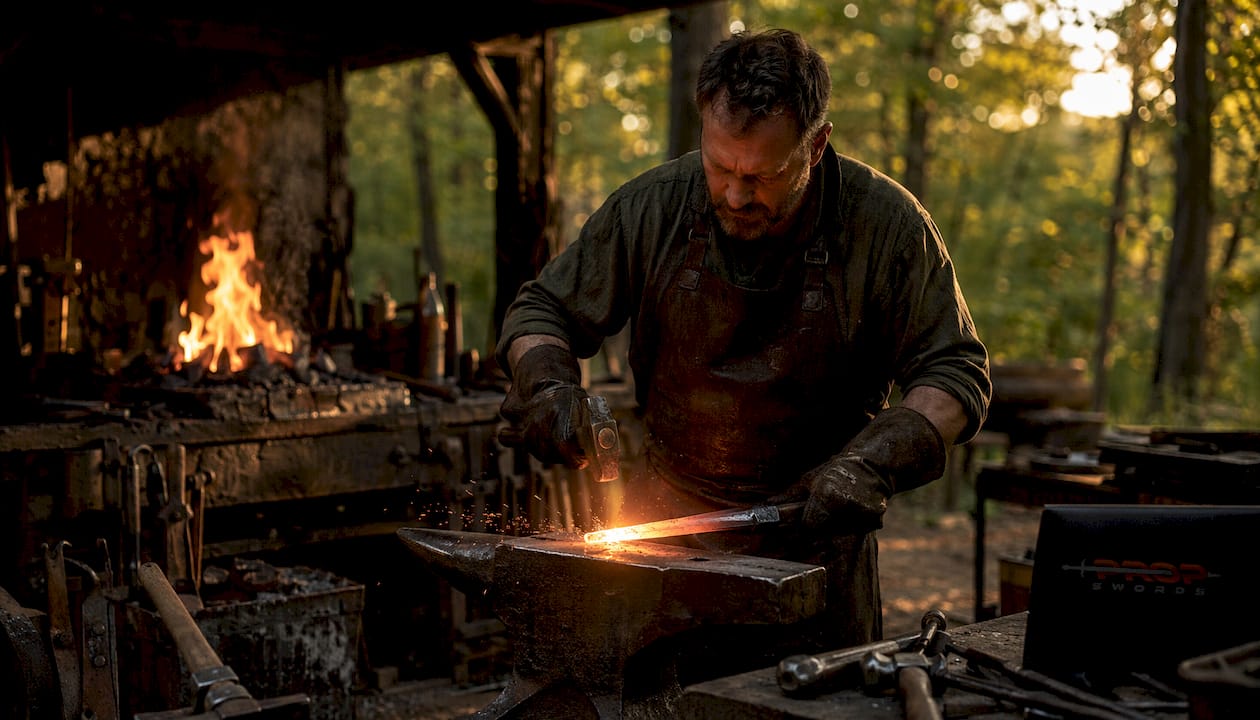
Blade strength was achieved in one of two ways: welding together strips of iron and steel, which produced a channel down the center of the blade, or fashioning a single piece of high-carbon steel in a rhomboidal cross-section. The rhomboidal profile is particularly clever because it adds rigidity without adding weight, distributing stress across the blade’s width rather than concentrating it at the center. Many surviving gladii show this cross-section clearly under examination. You can read more about how sword materials affect durability in the context of modern replicas.
Hilts were made from wood, bronze, or ivory, with a knobbed pommel that provided balance and a grip that sometimes featured ridges for the fingers. The scabbard was typically sheet metal or wood covered in leather, hung from a wide belt called the cingulum via four hoops. Legionaries wore the gladius on the right hip, which seems counterintuitive but made sense in a tight formation: drawing across the body would have been impossible, so a short sword on the right hip could be drawn straight out with the right hand.
How Roman soldiers actually used the gladius in battle
The gladius was not a dueling weapon. It was a component in a coordinated system, and that distinction explains almost everything about its design. A Roman legionary’s combat sequence began before the sword ever left its scabbard. First, the formation advanced behind large scutum shields, locking into a tight wall. At close range, each soldier hurled a pilum, a heavy javelin designed to bend on impact so it could not be thrown back. The pilum disrupted enemy formations and weighed down shields that caught it.
Then came the gladius. Legionaries were trained specifically to thrust rather than slash, driving the point into the enemy’s torso or throat. Slashing requires room to swing; thrusting requires almost none. In the press of a shield wall, a thrust was the only practical strike. Roman military doctrine, as described by ancient writers including Livy, emphasized that a thrust six inches deep was lethal, while a slash across the arm or chest might not stop a determined opponent. The scutum shield covered the legionary’s body from chin to shin, letting him absorb blows while delivering precise stabs.
Historians describe the Roman legionary as a coordinated human weapons system rather than an individual fighter. The gladius was deadly precisely because it was embedded in that system. An enemy facing a Roman formation could not swing a long sword without hitting his own men or the shields in front of him. The Romans, by contrast, had exactly the weapon they needed for exactly the space they were fighting in.
What archaeology and historians tell us about the gladius’s evolution
The clearest picture of how Roman swords developed comes from combining three sources: physical blades recovered from rivers, battlefields, and graves; Roman art including mosaics and tomb sculpture showing swords in use; and literary accounts from writers like Polybius and Livy. No single source is sufficient on its own. M.C. Bishop’s Gladius, published by Osprey Publishing, remains one of the most thorough syntheses of this evidence, tracing how blade shape evolution reflects changing fighting styles among both soldiers and gladiators.
The historian Simon James offered a striking corrective to the standard narrative about the gladius Hispaniensis:
That finding reshapes how we understand the transition from gladius to spatha. The gap between the two weapon types was smaller than previously assumed, which suggests the shift was driven more by tactical doctrine than by a dramatic change in blade length.
The Mainz Gladius at the British Museum, the four Pompeii-type swords found in the ruins of that city, and the Künzing hoard (a large 3rd-century find that included short swords with blades of 23–39 cm, likely made from broken spathae) all contribute to a picture of a weapon that was constantly adapted to local conditions and individual preferences. Roman soldiers were often responsible for acquiring their own weapons, so standardization was always partial. A collector examining historical sword criteria will find that authentic-looking variation between examples is actually historically accurate, not a sign of poor quality.
The gladius also carried real cultural weight beyond the battlefield. Roman gladiators took their name from the weapon. The word gladius became the general Latin term for any sword by the 1st century AD. Centurions wore their swords on the left hip rather than the right, a visible mark of rank. The sword appeared on coins, in sculpture, and in the iconography of Roman power from the Republic through the late Empire.
Key Takeaways
The gladius was a short, double-edged thrusting sword used by Roman legionaries from the 3rd century BC to the 3rd century AD, with four main variants that evolved in response to changing tactics and battlefield conditions.
| Point | Details |
|---|---|
| Four gladius variants | Hispaniensis, Mainz, Fulham, and Pompeii each differ in blade length, profile, and weight. |
| Blade length range | Gladius blades ran 45–65 cm; the spatha exceeded 75 cm as tactics evolved. |
| Weight consistency | Most gladii weighed 700–800 grams, balancing speed with enough mass for lethal thrusts. |
| Tactical system | The gladius worked with the scutum and pilum in tight formations, not as a standalone weapon. |
| Spatha transition | Infantry adopted the spatha in the late 2nd to 3rd century AD as close-order formations gave way to more fluid fighting. |
Find your own piece of Roman history

If you want to own a piece of this history, Propswords carries a curated selection of Roman gladius replicas built with attention to the design details that matter: blade profile, hilt construction, and period-accurate proportions. Whether you are after a Pompeii-type for display or a Mainz variant for reenactment, the best replica swords for 2026 are available with free shipping across the USA. Propswords also stocks top replica picks for collectors if you want guidance on which variant suits your collection.
For collectors who also appreciate Roman-themed display pieces, the Cycle Gladiator metal sign from Artfuzz makes a strong companion piece to a gladius replica.
FAQ
What is the Roman sword called?
The primary Roman sword is called the gladius, a short double-edged blade used by Roman infantry from the 3rd century BC to the 3rd century AD. The longer cavalry sword adopted later is called the spatha, and the dagger sidearm is the pugio.
Why were Roman swords so short?
Roman swords were short because legionaries fought in tight formations where there was no room to swing a long blade. A thrust six inches deep was lethal, and the short gladius delivered that thrust without requiring the soldier to break formation or expose his body.
Is the gladius a good sword?
The gladius was extraordinarily effective within its intended context: close-quarters thrusting inside a disciplined shield formation. Ancient historians like Livy recorded that Macedonian soldiers were horrified by what Roman swords could do after early skirmishes, and the weapon remained in service for roughly six centuries in various forms.
What sword did Julius Caesar use?
Caesar would have carried a gladius as his primary sword, consistent with Roman military practice of his era. A legendary sword attributed to Caesar in medieval tradition is called Crocea Mors, described as a bronze gladius variant, though this belongs more to myth than verified history.
Recommended