A Damascus steel sword typically ranges from a lower price for decorative, acid-etched pieces up to several thousand dollars for hand-forged, full-tang collector’s blades, with most functional replicas costing from mid-hundreds dollars upward. The gap comes down to two things: whether the “Damascus” pattern is genuinely forge-welded or just etched onto plain steel, and whether the sword is built to hang on a wall or to actually take a swing. The next section breaks down exactly what you get at each price tier.
TL;DR:
- Genuine forge-welded Damascus swords with proper heat treatment and full tang construction typically start at around $250 and can exceed $1,000 for custom or maker-signed pieces.
- Most decorative or lightly functional Damascus swords listed at lower prices often feature etched patterns on plain steel and lack authentic differential hardening or full-tang craftsmanship.
- The main cost drivers are steel type, forging method, and heat treatment, with hand-forged blades and carefully controlled hardening significantly increasing the price.
- Verifying the pattern’s depth, grain continuity, and requesting steel specifications or forging proof are essential to avoid overpaying for fake or poorly made Damascus swords.
- Prices for authentic swords vary by type, with practical katanas generally costing $200 to $400, while European longswords and custom pieces often go above $1,000, depending on craftsmanship and materials.
Table of Contents
- Damascus Sword Price Ranges: Budget, Midrange, and Premium
- What Actually Drives the Price of a Damascus Sword
- How Much Should You Pay for a Katana, Longsword, or Scimitar?
- How Can You Tell Real Damascus From an Etched Pattern?
- Where Should You Buy a Damascus Sword?
- How to Budget by Use: Display, Cosplay, or Functional Cutting
- Propswords Product Examples Across Price Bands
- Are Damascus Sword Prices Rising or Falling?
- Do Prices Vary by Region or Availability?
- What I’ve Learned About Judging Sword Price vs. Authenticity
- Shop Damascus Swords by Price Band at Propswords
- Sources
- FAQ
Damascus Sword Price Ranges: Budget, Midrange, and Premium
Prices split into three rough tiers. Knowing which one you’re shopping in saves you from comparing apples to katanas.
Budget ($80–$250): These are mostly decorative or lightly functional pieces. The blade steel is often stainless or a single carbon steel with an acid-etched or laser-printed Damascus pattern layered on top, not actual folded steel. Fittings tend to be cast metal or resin, and the tang is frequently a rat-tail design (a thin rod peened into the handle) rather than full tang.
Midrange ($250–$1,000): This is where genuine pattern-welded steel starts showing up. Functional replicas in this range commonly feature differential hardening or a convincing hamon, real full-tang construction, and better wood or leather-wrapped handles. Expect $150 to $500 for solid entry-level functional pieces, with better laminated or hand-differentially-hardened swords starting closer to $1,000.
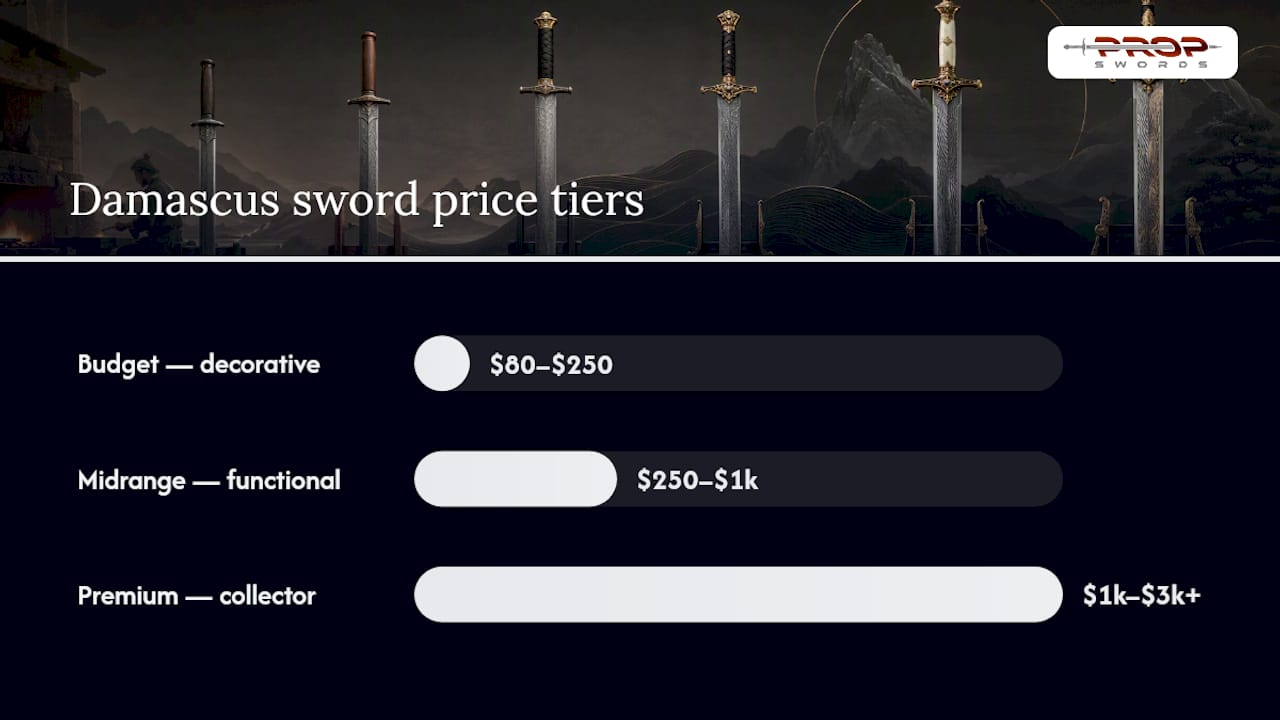
Premium/collector ($1,000–$3,000+): Hand-forged blades from named smiths, limited production runs, and maker-signed pieces live here. You’re paying for labor hours, not just material. A blade with a genuine hand-hammered pattern, precision heat treatment, and premium furniture (brass, horn, exotic wood) justifies the jump.
A few things to watch for at each level:
- Custom commissions from independent smiths often start where premium retail leaves off, sometimes $1,500 to $5,000+, because you’re paying for one-off labor.
- Antique or genuinely old Damascus/wootz pieces exist outside this pricing model entirely and are valued more like art objects than sporting goods.
- Small forges can undercut expectations. One example: a hand-forged Viking-style Damascus sword listed around $190, proof that maker overhead and regional labor costs matter as much as materials.
- Sale pricing on vendor sites can make a $400 sword look like a $200 deal. That’s a markdown, not evidence the sword is actually a budget-tier product.
What Actually Drives the Price of a Damascus Sword
Two swords can look nearly identical in photos and differ by $800 in price. The reasons are almost always buried in construction, not appearance.
Steel choice matters first. Common carbon steels like 1095 or 5160 are cheaper to source and heat treat than layered tool-steel combinations. True Damascus (or pattern-welded steel) is made by forge-welding two or more steel types together, then folding and hammering them repeatedly, which is far more labor-intensive than working a single billet.
Forging method is the biggest cost lever. A press-forged or machine-assisted blade takes a fraction of the time of a hand-forged one. Genuine hand-forging, where a smith folds and welds the billet by hand, drives price up because it’s slow and skill-dependent, not because the steel itself costs more.
Heat treatment separates display pieces from real tools. Differential hardening (and the resulting hamon line) requires a smith who controls clay application and quench timing precisely. This step is what makes a blade actually usable for cutting, and it’s expensive to get right consistently.
Construction details you should check:
- Full tang (the blade metal extends the full length of the handle) versus rat-tail tang
- Guard and pommel material (solid brass or steel versus cast alloy)
- Fit and finish: gap-free joints, even bevels, consistent polish
Pro Tip: Buy the best heat treatment and tang construction you can afford before worrying about how flashy the pattern looks. Pattern is cheap to fake; proper hardening and a solid tang are not, according to buyer guidance from Sword Buyers Guide.
How Much Should You Pay for a Katana, Longsword, or Scimitar?
Sword type changes the math, because different traditions carry different construction expectations.
Katanas command a premium when they include real differential hardening and traditional fittings (tsuba, habaki, properly wrapped tsuka-ito). Midrange practical katanas with a convincing hamon commonly land between $200 and $400, while hand-forged, maker-signed pieces climb well past $1,000.
European longswords tend to run midrange ($200 to $600) for solid functional pieces with proper distal taper and balance. Bespoke maker versions, built to historical specs from named smiths, regularly exceed $1,000.
Short swords and scimitars split cleanly: decorative versions sit under $200, while functional versions with real curved-blade geometry and proper edge geometry run $250 to $700.
Fantasy and licensed replicas don’t follow steel logic at all. Limited-edition runs tied to a film or game franchise can price well above what the construction alone would justify, purely on scarcity and licensing costs.
How Can You Tell Real Damascus From an Etched Pattern?
This is the single most useful skill for avoiding overpriced fakes.
- Check pattern depth and grain continuity. Genuine forge-welded Damascus shows the pattern continuing consistently along the blade’s contours, including into the edge bevel. Etched or printed patterns often look flat or stop abruptly near the edge.
- Look at the hamon closely. A real hamon from differential hardening has a soft, cloudy, slightly irregular line under raking light. An etched-on hamon looks painted, too uniform, and sits identically on every unit of the same model.
- Ask the seller for proof. Request photos of the actual billet before folding, the steel spec (grade numbers, not just “high carbon”), and confirmation of forging method.
Watch for the word “Damascus” used loosely, as marketing shorthand for any wavy pattern, a common practice flagged across the replica trade. If a listing can’t answer what steel it’s made from, treat the low price as a signal, not a bargain.
Pro Tip: Independent verification, a spec sheet or maker photo, protects you far better than trusting product descriptions, since retailers naturally emphasize visual pattern over construction detail.
Where Should You Buy a Damascus Sword?
Your channel choice shapes both price and risk.
- Retail replica shops offer the most predictable pricing and easiest returns, usually $80 to $600, with clear product photos and standardized specs.
- Custom smiths and small forges offer the widest quality ceiling but the least price consistency, anywhere from $190 to $3,000+, depending entirely on the maker’s reputation.
- Open marketplaces carry the highest fraud risk since anyone can list a sword with vague or copied descriptions.
Before buying anywhere, confirm: steel spec, tang construction, actual product photos (not stock renders), and existing customer reviews. Ask directly about return windows, warranty coverage, and whether shipping includes insurance, especially for higher-value pieces crossing state or international lines.
How to Budget by Use: Display, Cosplay, or Functional Cutting
Match your spend to what you’ll actually do with the sword.
- Display only: $80 to $200 covers you. Prioritize good fittings and finish over steel performance since it never leaves the mount.
- Cosplay: $150 to $350 gets a lightweight, durable piece. Prioritize a secure tang and rounded or peace-bonded edge over pattern authenticity.
- Functional cutting or training: $400 to $1,500+ is realistic. Prioritize proper heat treatment, full tang, and steel grade first; upgrade fittings last.
Pro Tip: Spend upgrade dollars in this order: tang construction, then heat treatment, then steel grade, then cosmetic fittings. Reversing that order gets you a pretty sword that fails under stress.
Propswords Product Examples Across Price Bands
Propswords carries pieces across all three tiers, so you can compare real listings instead of guessing. The Damascus Steel Medieval Barbarian Sword sits in the midrange band with hand-forged construction and a leather sheath included. The Authentic Japanese Katana in Damascus steel represents the katana category discussed above, while the Custom Handmade Damascus Battle Sword shows what upgraded, custom-tier features look like at retail. Dedicated product pages with detailed photos make comparing these options straightforward before you commit.
Are Damascus Sword Prices Rising or Falling?
Prices haven’t moved in one clean direction. The functional-replica market got noticeably cheaper at the entry level over the past decade as overseas manufacturing scaled up differential hardening techniques that used to be smith-exclusive. That’s part of why midrange practical katanas now commonly sell for $200 to $400 instead of the $600+ they might have run years ago.
At the same time, the premium and custom end has climbed, not fallen. Hand-forging remains slow, skilled labor, and as material and shipping costs rise, independent smiths have pushed maker-signed and limited pieces higher. The result is a widening gap: budget and midrange gear has gotten more accessible, while true collector-grade pieces have gotten pricier relative to mass-market goods.
Seasonal sales add short-term noise. Vendor markdowns during holiday periods can make a $400 sword look like a $250 deal temporarily, which is a pricing event, not evidence the sword’s actual construction tier changed. If you see a steep discount, check whether it’s a genuine sale on a quality piece or a permanently low price on thinner construction.
The other trend worth tracking: licensed and franchise-tied replicas now behave more like collectibles than tools. Limited runs tied to a film or game release can spike in resale value well above their original retail price if the run was small enough, something that almost never happens with generic historical replicas.
Do Prices Vary by Region or Availability?
Yes, and the reasons split between shipping economics and where the actual forging happens.
Smiths based in regions with lower labor costs (much of the hand-forged Damascus supply chain traces back to South Asia, particularly Pakistan) can offer genuinely hand-forged pieces at prices that would be impossible for a smith working in a high-labor-cost market. That’s part of why a hand-forged sword can list around $190 while carrying real differential hardening and hand-hammered pattern welding.
Within the United States, price differences are less about geography and more about shipping and import handling. Buying direct from an overseas forge often means longer shipping windows and potential customs handling, even when the sword itself is cheaper. Buying from a domestic retailer with U.S.-based inventory usually costs a bit more per unit but cuts shipping time to days instead of weeks and avoids customs uncertainty entirely.
Availability also shifts by category. Katana-style pieces with authentic fittings are widely stocked across price tiers because demand is consistent. Bespoke European longswords and scimitars see thinner availability at the midrange, since fewer makers specialize in those forms, which can push functional versions toward the higher end of their expected range simply due to limited supply.
What I’ve Learned About Judging Sword Price vs. Authenticity
After looking at enough listings side by side, the pattern gets obvious: sellers spend their marketing budget on the part that’s cheap to fake. A striking Damascus swirl costs almost nothing to etch onto plain steel, but a properly heat-treated, full-tang blade takes real skill to produce, and that’s the part low-price listings quietly skip.
My rule of thumb: if a listing can’t tell you the steel grade or forging method, price it as decorative no matter how good the photos look. A fair price for a genuinely functional sword rarely dips much below $150, because the labor floor is real. Run the checklist from the authenticity section before you trust any price tag.
— Muhammad
Shop Damascus Swords by Price Band at Propswords
Pieces are stocked across every tier discussed here, from display-ready decorative blades to hand-forged, full-tang collector pieces, so you can shop by budget instead of guessing which listing is legitimate. Every product page lists construction details and includes real photos.
If you’re weighing collector value against price, the Damascus swords collectors’ guide breaks down what actually makes a piece worth holding onto. Ready to compare real options side by side? Browse the top replica swords for 2026 to see current picks across budget, midrange, and premium bands, and check the specs listed on each page against the checklist before you check out.
Sources
- Japanese swords — Sword Buyers Guide
- Northmen Sword – A Hand-Forged Viking Damascus Steel Sword | Ansari Forge
FAQ
How much does a Damascus blade cost?
Prices typically range from $80 for decorative, etched pieces to $3,000 or more for hand-forged collector blades, with most functional swords falling between $150 and $600.
Are Damascus swords good quality?
Quality depends entirely on construction: genuinely pattern-welded steel with proper differential hardening performs well for cutting, while acid-etched decorative pieces are display-only regardless of how authentic the pattern looks.
Are Damascus knives worth anything?
A Damascus knife’s resale value comes from the maker’s reputation and confirmed hand-forging, not the pattern alone. Mass-produced etched pieces hold little resale value.
Can you buy real Damascus steel?
Yes. Genuine pattern-welded steel is widely available from both small forges and retailers like Propswords, but you need to confirm forging method and steel grade directly with the seller since many listings blur the line between true Damascus and etched imitations.
Recommended
- Damascus Steel Medieval Barbarian Sword, Hand Forged Damascus Steel Double Edge Blade with Leather Sheath
- Custom Handmade Damascus Steel Combat Hunting Sword. Long Sword, Double Edge Sword Viking Sword with Leather Sheath
- Damascus vs Stainless: Which Knife Should You Buy?
- Handmade Damascus Steel Double Edge Short Sword With Leather Sheath