The core routine for Damascus knife care is simple: hand-wash with mild soap, dry every surface thoroughly including the spine and ricasso, apply a thin coat of food-safe mineral oil or camellia oil, then store in a dry environment. Do that consistently and you’ll prevent the vast majority of rust problems before they start.
After every use, do this:
- Rinse the blade under warm water immediately after use.
- Wash gently with mild dish soap and a soft cloth or sponge.
- Dry completely with a lint-free towel, including the spine, handle junction, and any recesses.
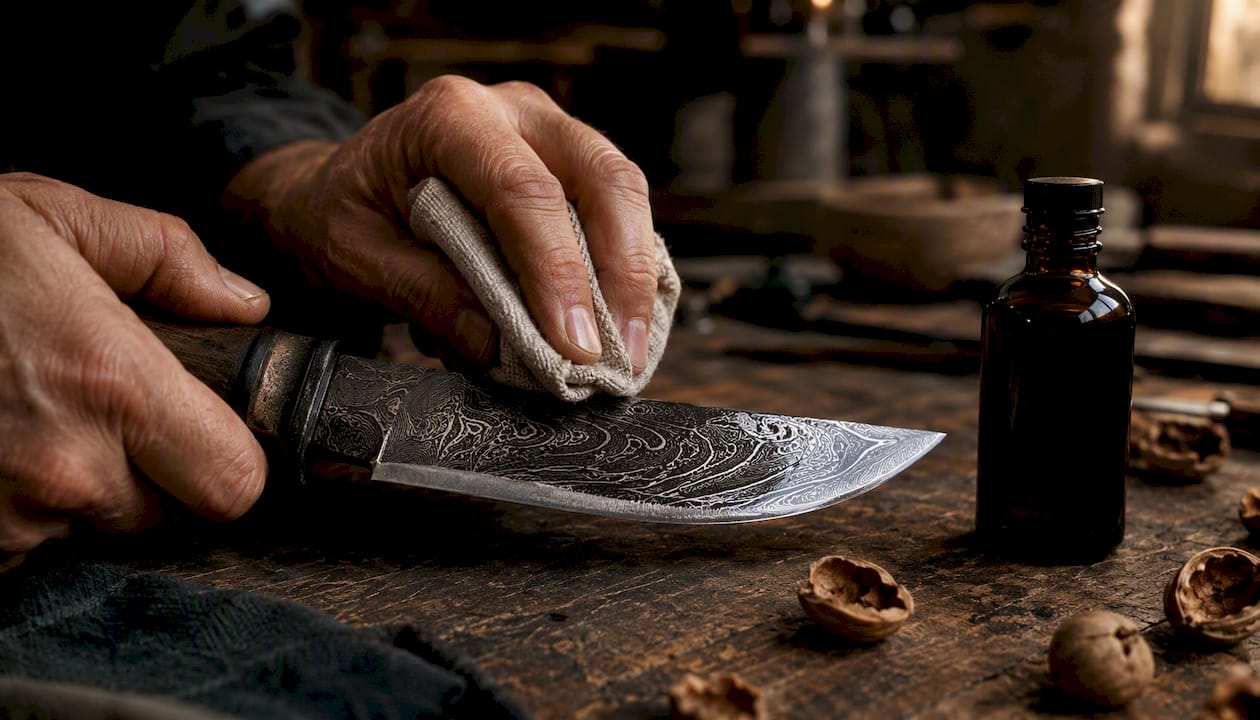
- Apply a very thin coat of food-safe mineral oil, camellia oil, or museum-grade wax for display pieces.
That oil layer is your primary defense. It seals the high-carbon steel surface from moisture and oxygen, the two things that turn a beautiful Damascus pattern into a rust problem. JW SteelCrafts confirms this routine as the standard maker recommendation.
Key Takeaways
Consistent daily care, specifically cleaning, drying, and oiling after every use, prevents the vast majority of Damascus blade rust and preserves the etched pattern long-term.
| Point | Details |
|---|---|
| Clean, dry, oil after every use | Hand-wash with mild soap, dry every surface including spine and ricasso, then apply a thin coat of mineral or camellia oil. |
| Use food-safe oils for kitchen blades | Mineral oil and camellia oil are stable and non-gumming; avoid olive oil and vegetable oils, which go rancid and leave sticky residue. |
| Treat rust early and gently | Start with oil soak and 0000 steel wool; escalate to baking-soda paste; stop and call a bladesmith if pitting is deep. |
| Store dry with humidity control | Use a breathable case with silica gel in humid climates; never store long-term in a leather sheath. |
| Propswords Damascus knives | Full-tang Damascus blades for kitchen use and display, with free US shipping, maintained using the routine in this guide. |
Table of Contents
- Why does Damascus steel need special care?
- How to clean your Damascus knife safely after each use
- Which oils and protective coatings actually work?
- How to remove surface rust without ruining the pattern
- How often should you hone, sharpen, and re-oil?
- Where and how should you store a Damascus knife?
- Common mistakes and how to fix them
- What experienced collectors actually prioritize
- Propswords: Damascus blades built for collectors who use them
- Sources
- FAQ
Why does Damascus steel need special care?
Damascus steel, more precisely called pattern-welded steel, is made by forge-welding alternating layers of high-carbon and lower-carbon steel, then etching the finished blade in acid to reveal the flowing pattern. That etching process is what makes the blade visually striking, and it’s also what makes it reactive.
The high-carbon layers oxidize faster than the lower-carbon ones. That contrast is what you see as the pattern, but it also means the blade has zones of differing reactivity sitting right next to each other. Moisture and chlorides (from salt, sweat, or acidic foods) concentrate at micro-crevices between those layers. Research from Michigan Technological University documents how this local surface chemistry drives localized corrosion and pitting on reactive steels, which explains why a Damascus blade can develop rust spots faster than a stainless kitchen knife even after brief exposure.
Two types of oxidation matter here:
- Stable patina (bluish-gray or dark brown): a controlled iron oxide layer that actually protects the steel underneath. You can cultivate it deliberately, and many owners do.
- Active rust (orange or red): hydrated ferric oxide that eats into the metal. Remove it immediately. Toolsmith Ltd draws this distinction clearly: patina is your ally, rust is not.
Acidic foods like citrus, tomatoes, and vinegar-based dressings accelerate oxidation significantly. So does salt. A blade used to slice a lemon and then left wet for an hour can develop visible rust spots by the next morning.
How to clean your Damascus knife safely after each use
The procedure is short, but the details matter. Rushing the drying step is where most rust problems begin.
- Rinse the blade under warm (not hot) running water right after use.
- Wash with a small amount of mild dish soap and a soft cloth or non-abrasive sponge. Work from the spine toward the edge, never drag your fingers across the cutting edge.
- Rinse again to remove all soap residue.
- Dry immediately with a clean, lint-free cotton or microfiber towel. Pay specific attention to the spine, the ricasso (the flat unsharpened section above the handle), and the handle junction where water hides.
- Air-dry briefly for a minute or two before oiling, so no trapped moisture gets sealed under the oil coat.
What to avoid:
- Never put a Damascus knife in the dishwasher. Made In Cookware is direct about this: the combination of harsh detergent, high heat, and prolonged moisture exposure ruins the finish and damages handles.
- No soaking in water or leaving wet in a sink.
- No abrasive scrubbing pads, steel wool, or powdered cleansers during routine cleaning.
- No harsh chemicals like bleach or oven cleaner, which strip the etched pattern.
Pro Tip: Use a microfiber towel for the initial wipe-down, then follow with a dry cotton cloth for the final pass. Microfiber pulls moisture out of tight spots; cotton confirms the surface is fully dry before you oil.
After cutting acidic foods (citrus, tomatoes, pickled vegetables), rinse and dry the blade within a few minutes rather than waiting until after the meal. The acid keeps working as long as it’s in contact with the steel.
Which oils and protective coatings actually work?
The right protectant depends on how you use the blade. A kitchen knife needs a food-safe option; a display piece can use heavier, longer-lasting coatings.
| Protectant | Food-Safe | Best For | Notes |
|---|---|---|---|
| Food-grade mineral oil | Yes | Kitchen knives, daily-use blades | Stable, non-gumming, widely available, inexpensive |
| Camellia oil | Yes | Kitchen knives, high-end blades | Traditional Japanese blade oil; thin, stable, no rancidity |
| Renaissance / museum wax | No (display only) | Collector and display blades | Micro-crystalline wax; long-lasting barrier, not for food contact |
| WD-40 | No | Emergency moisture displacement | Useful in a pinch but evaporates quickly; not a long-term protectant |
| Gun oil (e.g., CLP) | No | Non-food display or storage blades | Strong corrosion inhibitor for long-term storage |
Damascus Steel Buy recommends mineral oil and camellia oil for kitchen blades and Renaissance Wax for display pieces. HARAHU specifically warns against vegetable oils like olive oil or sunflower oil: they oxidize over time, go rancid, and leave a sticky film that’s difficult to remove without stripping the etch.
How to apply oil correctly: Put a few drops on a clean, soft cloth, not directly on the blade. Wipe in long strokes from spine to edge, following the grain of the steel. The coat should be barely visible, not pooling. Buff off any excess with a dry section of the cloth. A sticky or greasy blade means you used too much.
For display pieces, Renaissance Wax goes on the same way: a thin coat on a soft cloth, light circular motion, then buff to a low sheen. It lasts months between applications.
Pro Tip: WD-40 is fine for displacing moisture after an accidental soaking, but always follow it with a proper oil coat. WD-40 evaporates and leaves the steel unprotected.
How to remove surface rust without ruining the pattern
Catch rust early and you can remove it without touching the etched pattern. Wait too long and the pitting goes deep enough that only a bladesmith can restore it.
- Soak the spot in mineral oil for 10–15 minutes. Oil softens the rust and lubricates the surface before any abrasion.
- Use 0000 ultra-fine steel wool with oil. Work in the direction of the grain, not across it. Light pressure only. Toolsmith Ltd recommends this method specifically for light surface rust on Damascus.
- Try a baking-soda paste for stubborn spots: mix baking soda with a few drops of water to a thick paste, apply to the rust spot, let it sit for 5 minutes, then work gently with a soft cloth. Rinse and dry immediately.
- Cork and fine pumice for small pitted areas: wrap a wine cork in a cloth, dip in powdered pumice, and work the spot in small circles. This is more aggressive than the baking-soda method, so use it only when the first two steps haven’t cleared the rust. JW SteelCrafts lists this as a valid home method.
- Oil immediately after any rust removal. The freshly worked steel is more reactive than before.
The surface-chemistry research from Michigan Tech explains why acid-based commercial rust removers are risky for etched blades: the same chloride and moisture interactions that cause rust also make the etched surface vulnerable to further chemical attack. Phosphoric-acid removers can strip the etch contrast entirely.
When to stop and call a bladesmith: If rust has pitted below the surface, if the pattern has faded significantly in the affected area, or if rust covers more than a small spot, stop. A professional re-etch and polish will restore more than any home attempt.
Pro Tip: Never use naval jelly or CLR on a Damascus blade. They work on plain steel but will dissolve the etch contrast and leave the pattern looking flat and gray.
How often should you hone, sharpen, and re-oil?
| Task | Frequency | Tools |
|---|---|---|
| Clean and dry | After every use | Soft cloth, mild soap |
| Apply oil | After every use (or before storage) | Food-grade mineral oil or camellia oil |
| Visual rust check | Weekly in humid climates; monthly otherwise | Good light, clean cloth |
| Hone or strop | Every few uses or when edge feels dull | Leather strop, fine ceramic rod |
| Full sharpening | Every few months to once a year depending on use | Water stones with varying grits |
| Re-wax (display blades) | Every 3 months or so | Renaissance Wax, soft cloth |
For sharpening angles, 15°–20° per side suits most Damascus kitchen knives. Thinner angles (closer to 15°) give a sharper edge but require more frequent maintenance; 20° holds up better for harder use. For detailed sharpening technique, Propswords has a full knife sharpening guide covering grit progressions and angle-holding methods.
Avoid electric pull-through sharpeners and belt grinders for Damascus. They remove too much material too fast, can overheat the steel, and grind away the pattern layers near the edge. Water stones give you control. A fine ceramic or diamond rod works well for quick touch-ups between full sharpenings.
Blades with a stainless-clad exterior over a high-carbon core need less frequent oiling than full high-carbon Damascus, but the cleaning and drying steps are equally important. In coastal or high-humidity environments, increase oiling to after every use and add desiccants to your storage setup.
Where and how should you store a Damascus knife?
Short-term and long-term storage have different priorities. Short-term is about edge protection and accessibility; long-term is about humidity control and preventing contact corrosion.
Good storage options:
- Magnetic strip (spine-first): Keeps the edge off hard surfaces and allows airflow. Mount it away from sinks and dishwashers where steam is a factor.
- Knife block: Acceptable if the slots are clean and dry. Moisture trapped in a dirty block slot is a rust risk.
- Drawer insert or blade guard: Protects the edge during transport or in a drawer. Look for options with ventilation rather than sealed plastic.
- Breathable collector case with desiccant: Best for long-term storage of display pieces. Silica gel packets absorb ambient humidity and should be replaced or recharged every few months.
The leather sheath problem: Leather is fine for transporting a blade, but storing a Damascus knife in a leather sheath long-term is a mistake. Leather holds moisture and contains tanning acids that promote corrosion on bare steel. Use the sheath to carry the knife, then remove the blade and store it separately. For EDC carry options and sheath types, Blvista’s review of practical knife carry covers what to look for in a sheath for daily use.
Pro Tip: In humid climates (the Gulf Coast, Pacific Northwest, Florida), store your Damascus knives with a silica gel packet in the same drawer or case. Swap the packet every 3 months or when it changes color.
Quick don’ts:
- Never store wet or damp.
- Never wrap in plain paper (it holds moisture against the steel).
- Never leave in direct sunlight for extended periods; UV and heat cycles stress the handle material.
- Never store touching other metal objects that could scratch the etch.
Common mistakes and how to fix them
Dried-on food residue: Soak a cloth in warm water, lay it over the blade for 2–3 minutes to soften the residue, then wipe clean. Never scrape with a metal utensil.
Sticky, gummy oil buildup: You used too much oil or the wrong type (likely a vegetable oil). Wipe the blade down with a cloth lightly dampened with isopropyl alcohol to cut the residue, dry completely, then apply a thin, correct coat of mineral oil.
Accidental dishwasher exposure: Dry the blade immediately and thoroughly. Check for rust spots. Apply a generous (but not pooling) coat of mineral oil and let it sit for 30 minutes, then buff off the excess. If the handle has swelled, cracked, or separated, that’s a structural issue requiring professional assessment.
Salt or ocean-water splash: Rinse with fresh water immediately, dry, and re-oil within minutes. Salt left on the steel even briefly can start visible corrosion within hours.
Minor etch burnishing (pattern looks faded in a spot): Light contact with an abrasive surface can polish away the etch contrast. A bladesmith can re-etch the blade to restore the pattern. This is not a DIY fix.
Pro Tip: If you’re not sure whether a dark spot is patina or early rust, wipe it with a clean cloth. Patina stays; rust smears orange onto the cloth. Act accordingly.
What experienced collectors actually prioritize
The care guides are consistent, but most owners underestimate one thing: the drying step matters more than the oiling step. Oil applied over a blade that wasn’t dried completely seals moisture against the steel rather than protecting it. The rust that develops under a film of oil is often worse than rust that forms in open air, because you don’t see it until it’s already pitting.
The second thing worth saying plainly: patina is not a problem to solve. A Damascus blade that develops a stable dark patina over months of use is a blade that’s protecting itself. Polishing it back to bright steel every time you see discoloration removes that protection and forces the steel to re-oxidize. Let the patina develop, keep it stable with regular oiling, and only intervene when you see orange.
Propswords carries Damascus steel kitchen knives built for both use and display, and the care principles in this guide apply directly to every blade in that range. If you want a broader look at Damascus construction and what distinguishes different builds, the complete Damascus knife guide on the Propswords site covers it in detail.
Propswords: Damascus blades built for collectors who use them
Proper Damascus blade care starts with owning a blade worth caring for. Propswords offers a range of Damascus steel knives and collector-grade replica swords built with full-tang construction, genuine Damascus patterning, and materials that respond well to the maintenance routine in this guide. Every blade ships free within the USA.

Whether you’re adding a Damascus kitchen knife to your daily rotation or a display sword to your collection, Propswords has options at both ends of that spectrum. Browse the current Damascus lineup and find a blade that fits your use case, then apply everything in this guide from day one.
Sources
- How to Care for Damascus Steel Knives: Oiling, Sharpening & Storage Guide | JW SteelCrafts
- Damascus Steel Care Guide: Rust, Patina & Oiling in the UK – Toolsmith Ltd
- Surface chemistry reveals corrosive secrets | Michigan Technological University
- How to Care for a Damascus Knife – Practical Guide | HARAHU
FAQ
Does a Damascus knife need to be oiled?
Yes. A thin coat of food-safe mineral oil or camellia oil after every cleaning prevents rust by sealing the reactive high-carbon steel layers from moisture and oxygen.
What oil should you use on a Damascus knife?
Food-grade mineral oil or camellia oil for kitchen blades; Renaissance Wax or gun oil for display and storage pieces. Avoid olive oil and other vegetable oils, which go rancid and leave a sticky residue on the blade.
Can you use Vaseline on a Damascus knife?
Petroleum jelly works as a short-term moisture barrier in a pinch, but it’s thick, difficult to apply evenly, and not food-safe. Mineral oil does the same job with less mess and is safe for food-contact blades.
Is olive oil safe for Damascus steel?
No. Olive oil and other vegetable oils oxidize over time, turn rancid, and create a gummy film that’s hard to remove without stripping the etch. Stick to mineral oil or camellia oil.
How do you remove rust from a Damascus blade without ruining the pattern?
Soak the spot in mineral oil for 10–15 minutes, then work gently with 0000 ultra-fine steel wool in the direction of the grain. For stubborn spots, try a baking-soda paste. Oil the blade immediately after. If the rust has pitted below the surface, stop and consult a bladesmith.
Recommended