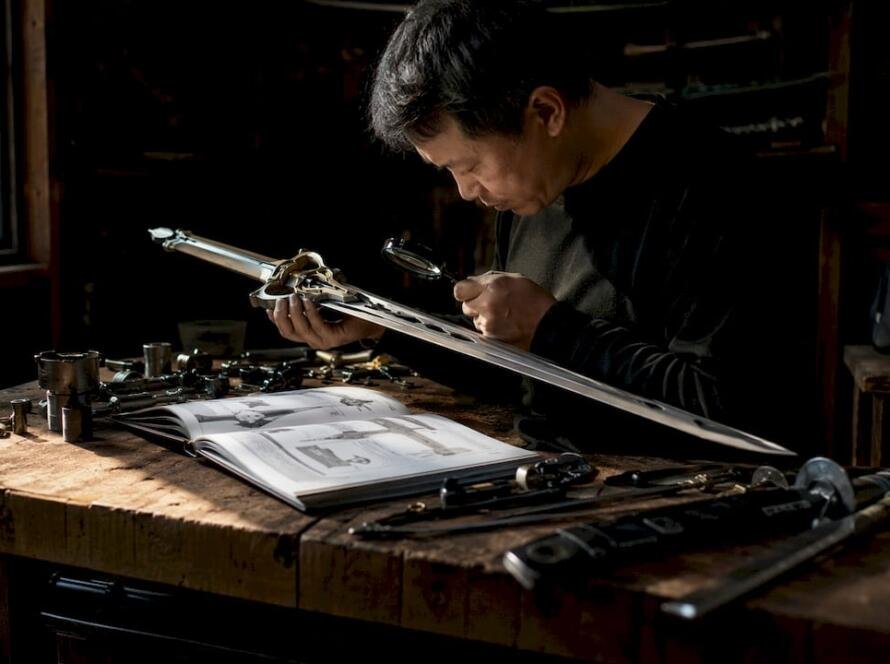
Most replica swords fall within a range of light to moderately heavy weights, depending on type, and a 3-pound blade is within the normal weight range commonly seen. Roughly 3 lb is typical for a katana-style or one-handed replica, while 5 lb is standard for a two-handed longsword or claymore reproduction. Total mass matters less than balance: a well-balanced 5-lb sword often feels lighter in hand than a poorly balanced 3-lb one.
TL;DR:
- Replica swords weighing around 3 pounds are typical for one-handed styles like arming swords and katanas, while two-handed swords usually weigh closer to 5 pounds or more.
- The feel of a sword depends more on its balance point than on total weight, with well-balanced heavier swords often feeling lighter and more maneuverable.
- Material choice and construction, such as steel grade and tang type, can cause weight variations of up to 30%, affecting durability and handling.
- Shipping weight often includes packaging and can be 1 to 5 pounds more than the actual sword weight, influenced by packaging type and carrier calculations.
- Buyers should verify specifications like blade length, thickness, handle length, and balance point, and request videos or photos to confirm handling and weight before purchase.
Table of Contents
- Replica Sword Weight Ranges By Type
- Why Weight Alone Doesn’t Tell You How A Sword Will Feel
- How Materials And Construction Change A Replica’s Weight
- What To Check On A Product Listing Before You Buy
- Packaging Weight And Why Shipping Numbers Look Higher Than Expected
- Why Propswords’ Listings And Author Background Matter Here
- Decorative Versus Combat-Ready: Where The Weight Actually Sits
- Weight’s Real Effect On Fatigue And Handling Speed
- Weight Tolerances And What “Authentic” Really Means
- Match The Weight To What You Actually Plan To Do With It
- Shop Weight-Transparent Replicas At Propswords
- Sources
- FAQ
Replica Sword Weight Ranges By Type
Weight ranges for swords fall into fairly predictable bands once you sort by category, and the numbers rarely match what movies or games suggest. A one-handed arming sword typically weighs around the low to mid range of a few pounds, according to the category breakdowns in WholesaleBlades’ sword weight guide. Hand-and-a-half swords, sometimes called “bastard swords” or longswords, usually weigh moderately heavier than one-handed swords. Two-handed swords, including many claymores and some zweihander reproductions, commonly weigh on the heavier side for ease of leverage, with a handful of ceremonial or oversized pieces going heavier still.
Pro Tip: If a listing doesn’t specify one-handed, hand-and-a-half, or two-handed grip style, check the handle length in the photos. Grip length tells you more about intended weight class than the product title does.
Here’s how the major categories typically break down:
- Fencing foil or épée: Around 0.9 to 1.1 pounds. These are the lightest blades most people ever handle, built for speed rather than mass.
- Rapier replicas: Roughly 2 to 2.75 pounds, with long, narrow blades that keep weight forward-light despite the length.
- Arming sword (one-handed): About 2.2 to 3.3 pounds, matching well-documented historical originals.
- Katana: Typically 2.2 to 3.3 pounds for the blade and mounted fittings, occasionally reaching 3.5 pounds with a heavier tsuba (guard).
- Hand-and-a-half longsword: Around 3.3 to 4.8 pounds, the range where “hybrid grip” swords tend to cluster.
- Claymore or zweihander: Roughly 4.4 to 7.7 pounds, with some display-grade reproductions of the largest historical zweihanders exceeding that on the high end.
Museum-measured data backs up the lighter end of these ranges more than most buyers expect. The Metropolitan Museum of Art’s Arms and Armor collection documents specimen weights that consistently undercut popular imagination. Most surviving medieval swords weigh under 4 to 4.5 pounds, not the 10 or 15 pounds Hollywood and some fantasy franchises imply.
That numbers gap matters for answering the two questions almost everyone searching for sword weight actually wants answered: is 3 lb heavy, and is 5 lb heavy?
Neither is. According to the ARMA weights essay, many historical longswords intended for actual use weighed between about 2 lb 3 oz and 3 lb 3 oz. A 3-pound replica isn’t just acceptable, it’s historically accurate for a huge swath of European blade types. Five pounds corresponds to the higher end of typical weights for two-handed swords and large claymores, matching expectations for big blades. Anything dramatically lighter than these ranges for a stated “full-size” or “functional” sword should raise questions, not confidence.
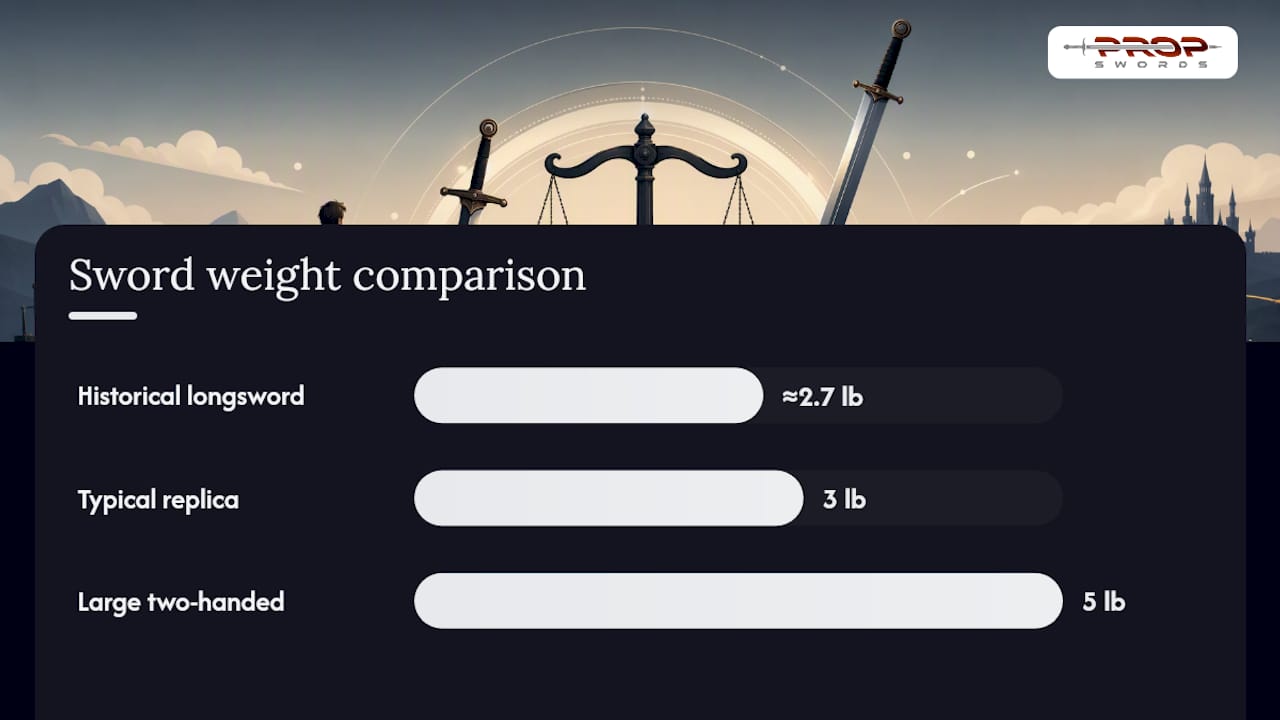
Blade length changes the math too. Longer blades weigh more even when the cross-section stays similar, a relationship documented in general sword classification references covering European and Asian typologies. A 40-inch katana blade and a 28-inch short sword built from the same steel stock won’t land in the same weight class, so comparing two swords by weight alone without checking blade length is a common buyer mistake.
Packaged shipping weight adds another 1 to 5 pounds on top of the blade itself, according to ParcelPath’s shipping weight guide, which matters if you’re trying to reverse-engineer a listing’s true sword weight from a shipping confirmation email. More on that later.
Why Weight Alone Doesn’t Tell You How A Sword Will Feel
A sword’s point of balance, or POB, usually matters more than its total weight for how it feels in the hand. POB is the spot along the blade where the sword balances horizontally on a single point, typically measured in inches from the guard. Most one-handed swords balance somewhere between 3 and 6 inches out from the guard; two-handed swords often balance farther out, sometimes 6 to 10 inches, because the extra hand on the grip compensates for a POB set deeper into the blade.
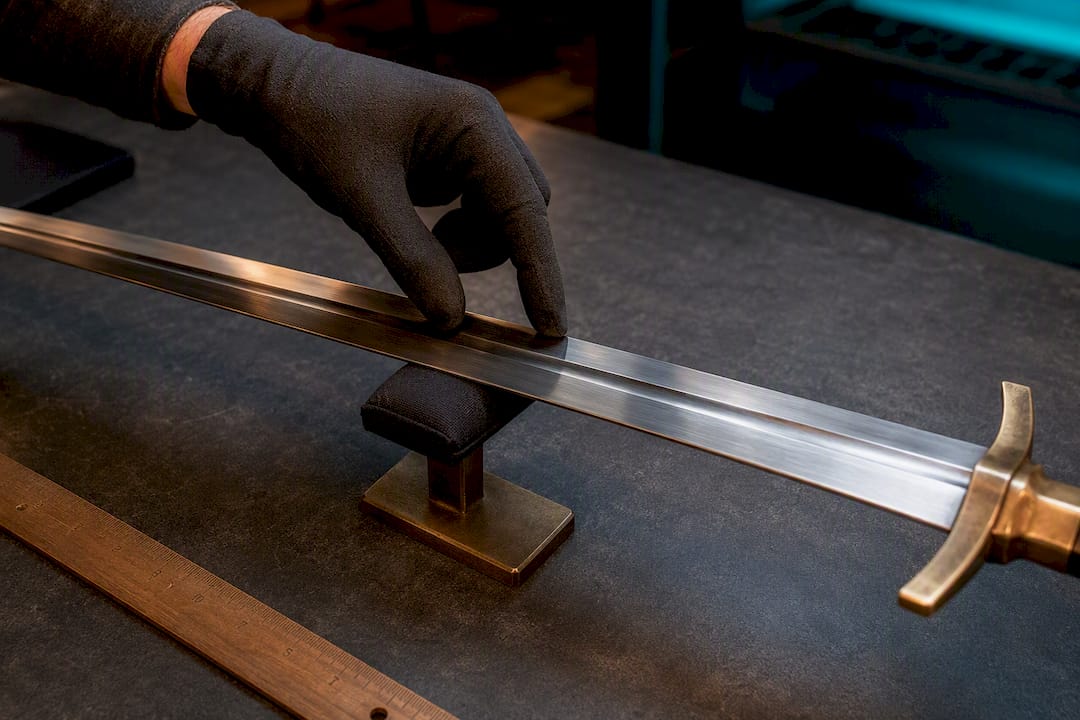
Practitioners who handle historical and reproduction swords regularly report something counterintuitive: a heavier sword with the right balance often feels lighter and quicker than a lighter sword with poor balance, according to ARMA’s analysis of sword handling. That’s not a minor footnote. It’s the single biggest reason two swords with identical weight specs can feel completely different in a cut or a thrust.
Three mechanical factors create that balance point:
- Distal taper — the blade gets thinner from guard to tip, shifting mass toward the hilt and making the sword pivot faster near the point.
- Blade profile — a wider, flatter blade near the guard carries more mass close to the hand; a narrow blade shifts weight further down the edge.
- Pommel counterweight — the metal ball or cap at the end of the grip pulls the balance point back toward the hand, sometimes dramatically, even with no change to the blade itself.
You can test balance without a lab scale. First, hold the sword loosely by the grip and let it settle. Second, place one finger under the blade and slide it until the sword balances flat. Third, do a slow figure-eight pivot from the wrist and notice how much resistance you feel at the tip versus the hilt. A sword that resists the pivot heavily usually has its balance point set too far forward for comfortable handling, regardless of what the total weight says.
Pro Tip: When a listing gives you total weight and blade length but nothing else, the missing variable is almost always pommel mass. Two swords can list the exact same weight and have wildly different balance points because one maker used a heavier steel pommel and a lighter blade, and the other did the reverse.
How Materials And Construction Change A Replica’s Weight
Material choice is the single biggest lever a maker has over final weight, and it’s also the detail most sellers explain the least. Stainless steel decorative replicas and high-carbon functional replicas of similar dimensions can differ in weight by 10 to 30%, depending on blade thickness and tang construction, according to SwordsInfo’s guide to sword-making metals.
Tang construction adds another layer. A full tang, where the blade’s steel extends the entire length of the handle as a single continuous piece, adds noticeably more weight and durability than a partial or “rat-tail” tang, which is a thin steel rod welded or peened into a separate handle assembly. Decorative wallhangers frequently use partial tangs because they only need to survive being displayed, not swung. Functional replicas built for cutting practice or stage combat almost always use full tangs because the stress of contact would snap a thinner rat-tail design.
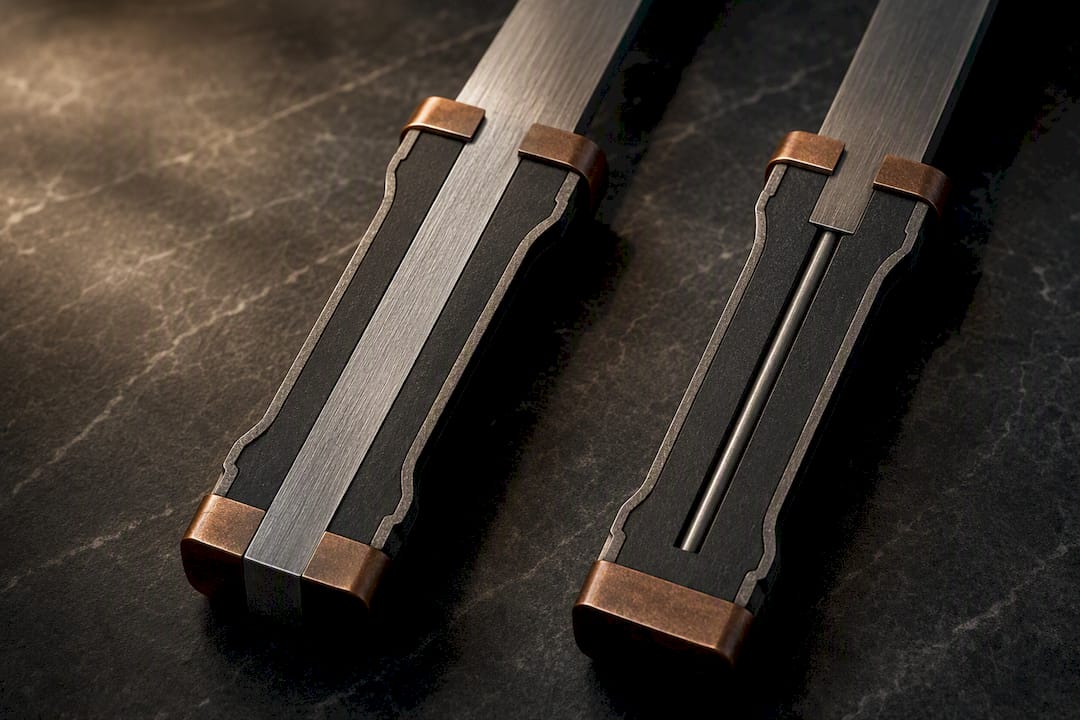
That construction gap explains a pattern buyers notice constantly: decorative “wallhanger” swords often weigh 30 to 50% less than a functional sword of the same visual dimensions, per ParcelPath’s comparison of decorative and functional blade weights. Thinner steel, hollow or partial tangs, and cheaper cast-metal fittings all shave weight off a display piece without necessarily hurting how it looks on a shelf or in photos.
Steel grade is the other clue worth learning to read. Common numbers you’ll see on functional and mid-tier replica listings:
- 1045 carbon steel — a lower-carbon steel, more affordable, slightly more flexible, common on entry-level functional pieces.
- 1060 carbon steel — a mid-range choice balancing edge retention and flexibility, popular for cutting-practice swords.
- 1095 carbon steel — higher carbon content, harder edge, less flexible, often used where cutting performance matters more than shock absorption.
- Stainless steel (400 series and similar) — common on decorative and cosplay pieces, generally lighter per unit volume than high-carbon steel and prone to chipping under real impact.
None of these numbers directly tells you the finished weight, since blade geometry changes that independently. But they tell you what the maker prioritized. A listing that names a specific carbon steel grade alongside a full-tang construction is signaling a functional-use build. A listing that just says “stainless steel” with no grade number is almost always describing a display piece, and the weight will usually reflect that lighter build. Guard and pommel material adds up too: cast zinc alloy fittings, common on budget decorative swords, weigh noticeably less than the brass or steel fittings typically found on higher-end functional reproductions, and that difference alone can shift total weight by several ounces.
What To Check On A Product Listing Before You Buy
A useful spec sheet gives you six numbers, and most listings only give you two or three. Total weight and blade length are the easy ones every seller lists. What separates a trustworthy listing from a vague one is whether it also includes blade thickness (measured at the spine near the guard), tang type, steel grade, and a listed balance point.
Ask these three questions before you buy anything described as “functional” or “battle-ready,” in order of usefulness:
- Can you send a short handling video? A ten-second clip of someone holding the sword and doing a basic pivot tells you more about real balance than any spec number.
- What’s the measured point of balance? If the seller can’t answer this, they likely haven’t measured it, which is itself useful information about how carefully the piece was built and QA’d.
- Can you get a scale photo with a length reference? A sword resting on a kitchen scale next to a tape measure or ruler confirms both weight and length in one image, and sellers who already have this on hand tend to be more transparent generally.
Watch for a specific pattern of red flags. A listing that claims “battle-ready” or “functional” but lists a weight noticeably below the historical range for that sword type (say, a two-handed claymore listed under 3 pounds) is very likely thinner and weaker than advertised. Vague material language like “high-quality steel” with no grade number is a soft warning sign, not a dealbreaker, but it should lower your expectations for edge retention and flex. Photos that show a different guard or pommel style than the written spec sheet describes suggest a listing that’s been recycled from an older product version.
- Missing balance point on a “functional” listing: ask before buying, don’t assume.
- Weight suspiciously low for the stated blade length and type: cross-check against the ranges for that category.
- No steel grade named at all: treat it as a decorative-grade build until proven otherwise.
- Photos and spec sheet don’t match on guard, pommel, or handle wrap: request current photos.
Set your expectations by intended use. A stainless decorative piece meant for a shelf or a cosplay photo shoot doesn’t need to match the balance profile of a carbon-steel functional sword, and comparing the two on weight alone misses the point of what each is built for. Propswords’ own guide to assessing sword quality walks through this same checklist in more depth if you want a second pass before checkout.
Packaging Weight And Why Shipping Numbers Look Higher Than Expected
The number on your shipping confirmation is never the sword’s actual weight, and the gap is bigger than most buyers guess. A basic cardboard shipping tube typically adds 1 to 2 pounds on its own. Foam padding and internal protective wrapping add a few more ounces on top of that. Wooden crates, generally reserved for higher-value or limited-edition pieces, add another 3 to 5 pounds beyond the sword’s actual mass, according to ParcelPath’s packaged-weight breakdown.
Dimensional weight pricing complicates things further for long items specifically. Carriers calculate shipping cost using the larger of actual weight or dimensional weight, a formula based on the package’s length, width, and height. A 40-inch sword tube might weigh only 4 pounds total but get billed at a higher dimensional rate purely because of its length, not its mass.
- Tube packaging: adds roughly 1 to 2 lb, standard for most single-sword shipments.
- Foam or protective wrap: adds a few ounces, common on higher-end or fragile pieces.
- Wooden crate: adds 3 to 5 lb, typically reserved for limited-edition or high-value swords.
If shipping cost matters more to you than presentation, ask whether lighter tube packaging is available instead of a crate. If the sword is a collector-grade purchase you plan to keep long-term, the extra weight and cost of a crate usually buys real protection against warping or dents in transit, and that trade-off is worth making deliberately rather than by default.
Why Propswords’ Listings And Author Background Matter Here
This guide comes from Muhammad, whose work covers the replica sword market from the seller side, where weight specs get written, measured, and sometimes overstated.
Propswords lists weight, blade length, and material details directly on product pages because vague specs are the single most common complaint collectors and cosplayers raise about this category. The site’s comparison of historical sword replica types breaks down weight and length side by side across four major historical categories, the same approach used throughout this guide.
Hands-on inspection before listing matters because a spec sheet is only as good as the person who measured it. A sword that gets weighed on an actual scale, with balance point checked by hand rather than estimated from the blade alone, produces listings buyers can actually trust when comparing options. That’s the standard this guide holds every weight range and buying tip to.
Decorative Versus Combat-Ready: Where The Weight Actually Sits
Decorative and combat-ready replicas don’t just differ in total weight, they distribute that weight in opposite directions. A decorative piece tends to carry its mass in ornamental fittings, cast pommels, and etched or plated blade surfaces, while the blade steel itself stays thin. That puts more relative weight toward the hilt and less toward the cutting edge, which makes a decorative sword feel front-light and back-heavy the moment you try to swing it.
Combat-ready and stage-combat replicas invert that pattern. Weight gets built into a functional distal taper and a properly proportioned pommel counterweight, spreading mass along the blade in a way that supports an actual swing rather than just a static display pose. The result is a sword that can weigh the same or even less than a heavily ornamented decorative piece but handle far better in motion.
This is also why two swords with identical listed weights can feel like completely different objects. One prioritizes how it looks standing still on a mount; the other prioritizes how it moves through a cut. Neither approach is wrong, but buying the wrong one for your actual use case is the single most common regret collectors report after their first replica purchase.
Weight’s Real Effect On Fatigue And Handling Speed
Total weight affects fatigue on a fairly straightforward curve: heavier swords tire your arm and shoulder faster during extended handling, cosplay events, or practice sessions, and that effect compounds with poor balance rather than existing independently of it. A 5-pound sword with the balance point set close to the guard will fatigue you slower than a 4-pound sword with a blade-heavy POB, because your muscles work harder fighting leverage than fighting raw mass.
Maneuverability follows a similar pattern. A blade-heavy sword resists quick direction changes even at a modest total weight, which shows up in stage combat and cosplay demonstrations as sluggish, effortful movement rather than clean motion. Swords built with proper distal taper and pommel counterweight let you execute the same cuts and pivots with noticeably less shoulder strain over an hour of handling, even when they weigh more on paper.
For all-day event wear or repeated demonstration use, prioritize a well-balanced sword in the 2.5 to 3.5 pound range over a heavier piece, even a well-balanced one. For short-duration display or photo work, total weight barely matters since you’re not sustaining a swing or a guard position for long stretches.
Weight Tolerances And What “Authentic” Really Means
Replica sword weight isn’t manufactured to a strict tolerance the way, say, a machined engine part is. That’s normal and not a sign of a defective piece.
“Authentic” in this market usually means matching the weight and balance characteristics of historical originals for a given sword type, not hitting an exact number to the ounce. A katana replica landing anywhere in the 2.2 to 3.3 pound band is authentic to historical katana weights even if it doesn’t match another retailer’s listing for the “same” sword exactly. The variation between two legitimately well-built swords of the same type is often larger than the tolerance range within a single maker’s production run.
Where tolerance claims should raise concern is when a listing promises an extremely specific weight (like “exactly 2.87 lb”) with no acknowledgment that hand-finished pieces vary. That level of false precision is more often a copywriting choice than a manufacturing reality.
Match The Weight To What You Actually Plan To Do With It
Display collectors should lean toward the lighter end of a category’s range and prioritize how the sword photographs and mounts, since total weight barely affects a piece that never leaves its stand. Cosplayers need something closer to the middle of the range, light enough to carry through a full convention day but built solidly enough not to feel like a toy in photos or on stage. Anyone doing actual handling, choreography, or cutting practice should prioritize balance and full-tang construction over chasing the lightest number on the page, even if that means accepting a heavier sword overall.
Balance decides how a sword feels far more often than the number on the listing does. I’d rather hand a customer a well-balanced 4-pound longsword than a poorly balanced 3-pound one, because the heavier sword will tire their arm less and control better through a full swing. That’s a pattern worth remembering before you filter search results by weight alone: filtering by category and construction quality first, then checking weight as a sanity check, gets better results than sorting by pounds and hoping the rest works out. If you’re choosing between two similar swords and one lists a measured balance point while the other doesn’t, that alone should usually decide it.
— Muhammad
Shop Weight-Transparent Replicas At Propswords
Propswords built its product pages around the exact gaps this guide just walked through: total weight, blade length, material, and construction notes listed together instead of buried or omitted. That’s the practical edge over browsing generic marketplace listings where half the specs are guesswork.

The top-rated replica sword picks for 2026 group well-reviewed swords across weight classes, so you can compare a lighter katana-style build against a heavier claymore-style piece without digging through dozens of individual listings. Collectors focused on display pieces will find lighter, ornamental-forward options on the display-worthy movie sword roundup, while cosplayers balancing convention-day comfort against screen accuracy can start with the medieval cosplay sword comparison. If you’re weighing a knife-style or smaller blade alongside a full sword purchase, Signature Laser Designs’ custom knife piece is worth a look for personalized options in that size range.
Start by picking your use case, check the listed weight and balance details on a couple of options, and reach out to Propswords’ support line if a spec sheet leaves you with a question before checkout.
Sources
- What Did Historical Swords Weigh? (ARMA)
- The Metropolitan Museum of Art — Arms and Armor collection
- How Much Does A Sword Weigh? A clear guide by type (ParcelPath)
- How heavy are swords? The ultimate weight guide (WholesaleBlades)
- Best metal for sword making (SwordsInfo)
FAQ
Is 3 Pounds Heavy For A Sword?
No. Roughly 3 pounds is typical for one-handed arming swords and katana-style replicas, and it falls within the 2 lb 3 oz to 3 lb 3 oz range ARMA documents for many historical longswords built for actual use.
Is 5 Pounds Heavy For A Sword?
Five pounds is normal for two-handed swords and larger claymore-style replicas, which commonly run 4.4 to 7.7 pounds according to category breakdowns from WholesaleBlades. It would be heavy for a one-handed arming sword, but expected for a big two-handed blade.
How Much Does A Typical Sword Weigh?
Most swords weigh between 1 and 5 pounds depending on type, with lighter fencing blades near 1 pound and two-handed swords reaching 5 to 7 pounds, per ParcelPath’s weight guide.
Is A Replica Sword Legal To Own?
Replica sword legality depends on blade type, edge sharpness, and your local jurisdiction’s specific knife and weapon laws, so check your state and local rules before ordering, especially for functional sharpened pieces. Decorative and display-only replicas from retailers like Propswords generally face fewer restrictions than sharpened functional blades, but rules vary enough by location that you should verify locally rather than assume.
Why Do Two Swords With The Same Weight Feel Different?
The likely difference is balance point, driven by pommel mass, distal taper, and blade profile rather than total weight. A sword balanced closer to the guard generally feels quicker and less tiring to handle than one with the same weight balanced farther down the blade.
Recommended