What does full tang mean in a knife?
A full tang knife is one where the metal of the blade extends the entire length and width of the handle, forming a single continuous piece of steel from tip to butt. The tang itself) is the unsharpened portion of the blade that runs into the handle, acting as the structural backbone of the whole knife. Without it, the blade and handle are just two separate pieces held together by hope and adhesive.
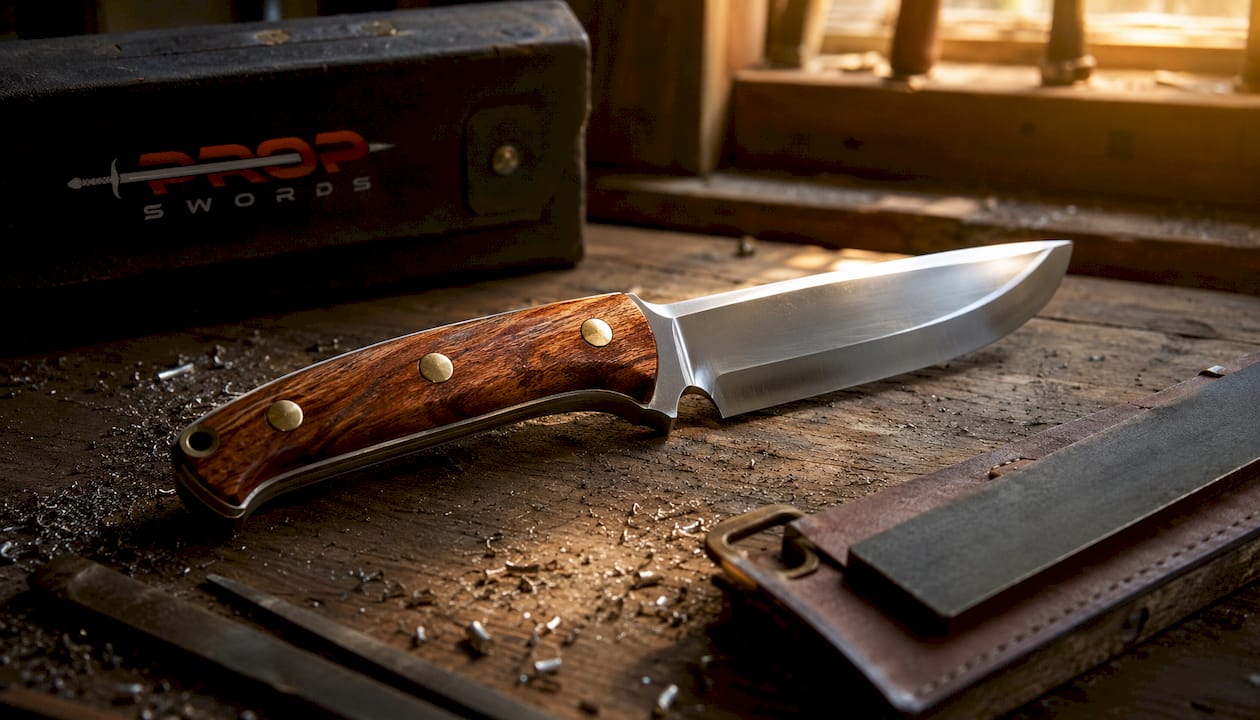
What makes a full tang distinct is that the steel doesn’t taper, narrow, or stop short. It fills the handle completely, and you can usually see it. Look at the spine and belly of the handle on a full tang knife and you’ll spot a thin strip of exposed steel running along both edges. Flip it over and you’ll see rivet heads where the handle scales, typically wood, G-10, or Micarta, are pinned to each side of the tang.
- The steel runs the full length of the handle, not just partway
- Handle scales are attached on both sides, not wrapped around a narrow rod
- Rivets, pins, or bolts are visible on the handle face
- A strip of steel is exposed along the top and bottom edges of the handle
- The blade and handle feel like one solid unit, not two pieces joined together
This construction distributes stress evenly across the entire steel surface rather than concentrating it at a single narrow point, which is exactly why full tang knives hold up under serious lateral force.
Full tang vs partial tang: what actually changes?
A partial tang is any design where the steel does not run the full length of the handle, or where it narrows significantly before it does. The most common version is the rat-tail tang, a thin rod of steel that threads into a hollow handle and is often secured with a nut at the butt end. It’s lighter, cheaper to produce, and perfectly fine for light kitchen work or decorative pieces.
The structural difference shows up fast under stress. A rat-tail tang concentrates stress at the narrow point where the steel meets the handle, creating a predictable failure zone under lateral loads. A full tang spreads that same force across a wide steel surface, so there’s no single weak point to exploit.
- Full tang: steel fills the handle completely; stress spreads evenly across the whole surface
- Partial tang: steel narrows or stops short; stress concentrates at the transition point
- Balance: full tang knives tend to be rear-heavy, improving agility and control; partial tangs are often forward-heavy, which can aid chopping
- Repairability: partial tang handles are usually easier to replace; full tang scales are riveted and harder to remove without damage
- Weight: partial tang knives are lighter, which matters for long carry or precision tasks
How do you tell them apart? Visible rivet heads and exposed steel along the handle edges are the clearest signs of a full tang. A smooth, seamless handle with no visible fasteners usually signals a hidden or partial tang underneath.
Why full tang construction is worth it for heavy use
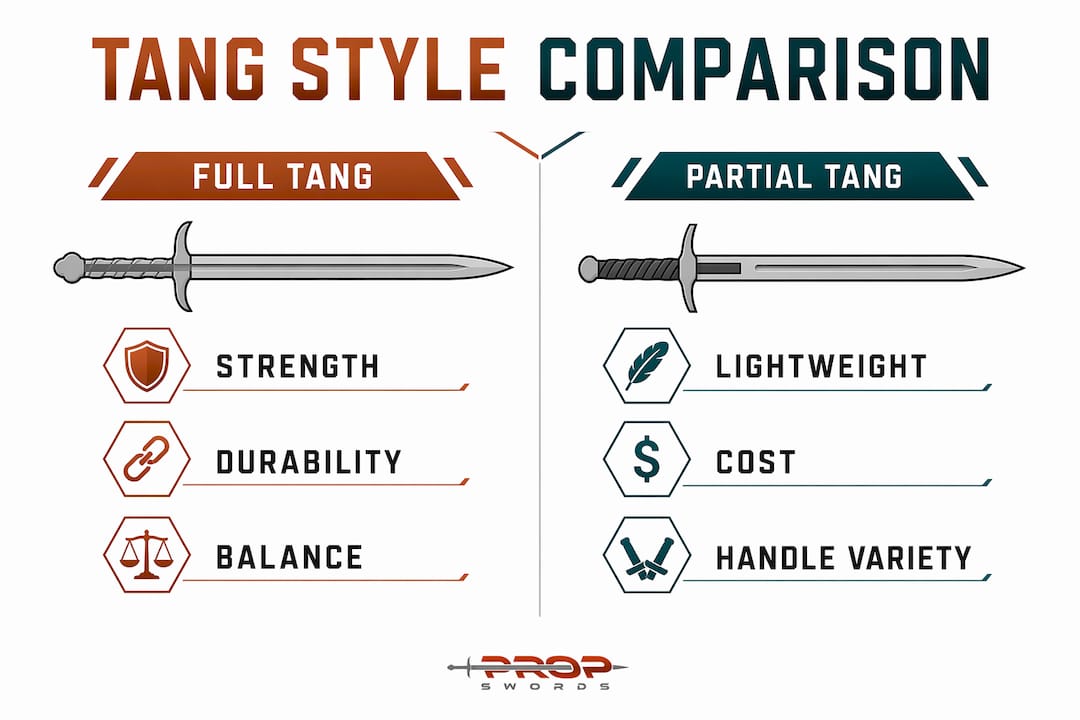
Full tang knives incorporate the maximum amount of steel in the handle, which is why they’re the standard in survival, bushcraft, and hunting knives. When you’re batoning wood, prying open a crate, or digging in hard ground, the lateral forces involved would snap a rat-tail tang at its narrowest point. A full tang just absorbs it.
The handle attachment is also more secure. Riveted or pinned scales grip the tang mechanically, not just chemically. Epoxy alone can fail with heat, moisture, or repeated impact. Pins and rivets don’t.
- Superior resistance to lateral stress, prying, and batoning
- Handle scales are mechanically fastened, not just glued
- More steel in the handle shifts the balance point rearward, improving control during rocking cuts and fine work
- Major Western knife manufacturers use full tang as standard for professional kitchen knives built to survive industrial use
- Added weight can be a drawback for long carry or tasks requiring a light, nimble blade
Pro Tip: Match the tang to the task. A full tang tracker knife is the right call for survival and outdoor use. For a precision Japanese-style slicer, a hidden tang may actually serve you better.
Common tang styles you’ll encounter in knives and swords
Tang design isn’t binary. There are at least five distinct styles in regular use, each built for a different purpose.
Full tang runs the complete length and width of the handle. The steel is visible along the handle edges, and scales are pinned on both sides. This is the go-to for survival knives, hunting blades, and heavy-duty kitchen knives.
Partial tang covers several sub-types where the steel either stops short of the handle’s full length or narrows considerably. Common in budget kitchen knives and decorative pieces where structural demands are low.
Rat-tail tang is the thinnest version of a partial tang. A narrow rod of steel threads into a hollow handle, often secured with a pommel nut. It keeps weight down and works fine for light cutting, but it’s not built for force.
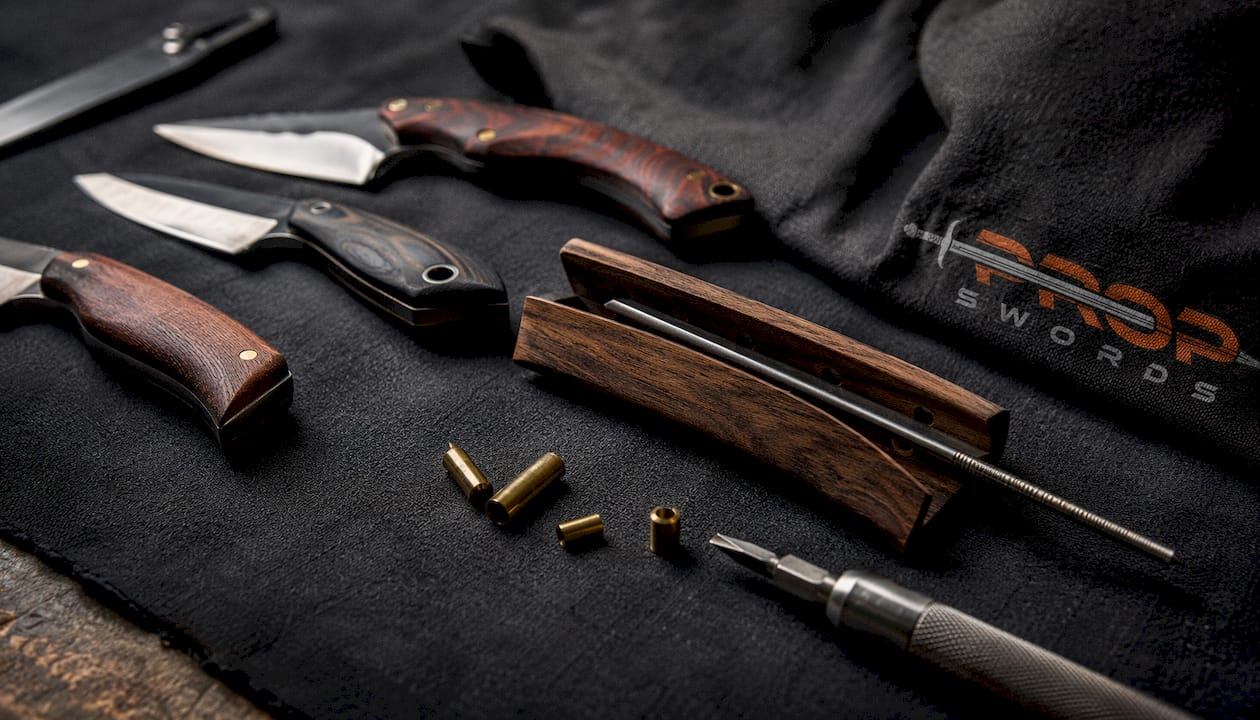
Hidden tang (also called a stick tang) runs the full length of the handle but is narrower than the handle itself, so it’s completely enclosed and invisible. Traditional Japanese knives like the yanagiba use this design. The forward balance it creates suits precision slicing far better than a rear-heavy full tang would.
Tapered or skeletonized tang is a full tang with material removed or the width reduced toward the butt end. This cuts weight while preserving most of the structural strength, and it’s common in tactical and survival knives where every gram matters.
| Tang Style | Steel Visibility | Best Use Case |
|---|---|---|
| Full tang | Exposed along handle edges | Survival, hunting, heavy kitchen use |
| Partial tang | Hidden, handle is seamless | Budget kitchen, decorative |
| Rat-tail tang | Hidden, pommel nut visible | Light cutting, decorative |
| Hidden tang | Fully enclosed | Traditional Japanese culinary knives |
| Tapered/skeletonized | Partially exposed or enclosed | Tactical, lightweight survival |
The engineering behind tang choice: balance, strength, and trade-offs
Full tang construction shifts the rotational balance point) toward the handle, which makes the knife feel more agile and easier to maneuver in the hand. That’s genuinely useful for rocking cuts, fine prep work, and tasks where you’re changing direction frequently. The trade-off is raw chopping power. A forward-balanced blade, like one with a hidden or partial tang, puts more mass ahead of the hand and lets gravity do more of the work on a downward chop.
Neither design is objectively better. The question is always what the knife needs to do.
Repair is where full tang construction shows its only real weakness. The rivets securing handle scales are difficult to remove without damaging the tang steel, so a worn or cracked handle often means the knife is effectively retired. Hidden tang knives, by contrast, allow handle replacement with basic tools. For a working knife you plan to maintain for decades, that’s worth factoring in.
- Full tang: best for lateral stress, prying, batoning, and survival tasks
- Hidden tang: best for precision slicing and traditional culinary work
- Rat-tail tang: acceptable for light kitchen use and display pieces
- At lower price points, steel quality and heat treatment affect performance more than tang style alone
- Skeletonized full tangs reduce weight while keeping most structural integrity intact
The Propswords full tang DIY chef’s knife is a good example of how full tang construction translates directly into a kitchen context, where handle security and balance both matter for daily use.
Explore full tang blades at Propswords

Propswords carries a curated range of full tang knives and replica swords built for collectors, cosplayers, and enthusiasts who care about construction quality. From survival blades to historically inspired swords, every piece is selected with tang integrity and build quality in mind. Browse the best replica swords for 2026 to find full tang options across styles, with free shipping throughout the USA.
Key Takeaways
A full tang knife is the strongest construction available because the steel runs the entire length and width of the handle, eliminating the stress concentration points that cause partial tang knives to fail under heavy lateral force.
| Point | Details |
|---|---|
| Full tang definition | Steel extends the full length and width of the handle as one continuous piece. |
| Visual identification | Look for exposed steel along handle edges and visible rivet or pin heads. |
| Strength advantage | Stress distributes evenly across the full steel surface, preventing failure under lateral loads. |
| Balance trade-off | Full tang shifts the balance point rearward, improving agility but reducing raw chopping power. |
| Not always the best choice | Hidden tang designs suit precision Japanese culinary knives better than full tang construction does. |
FAQ
What is a full tang?
A full tang is a knife construction where the blade’s metal extends the complete length and width of the handle, forming one unbroken piece of steel. It’s the strongest tang design available and the standard for survival, hunting, and heavy-duty kitchen knives.
Are full tang swords good?
Yes, for display and functional use alike. Full tang swords are structurally sound enough to handle real stress, and the construction ensures the blade won’t separate from the handle under force. Collectors also value them because the build quality is visibly superior to decorative-only pieces.
What are the disadvantages of full tang?
The main drawbacks are added weight and difficult repairability. Because the riveted handle scales are hard to remove without damaging the steel, a worn handle often can’t be replaced cleanly, making the knife effectively permanent in its original configuration.
What is the difference between a thru tang and a full tang?
A thru tang (also called a through tang or stick tang) runs the full length of the handle but is narrower than the handle itself, staying hidden inside. A full tang fills the entire handle width and is visible along the edges. Both run the full handle length, but only the full tang fills it completely.
Recommended