TL;DR:
- Swords in fantasy symbolize power, destiny, heroism, and identity rather than practical weapons.
- Fans collect or create replicas to connect emotionally with stories and characters they admire.
- Recreations are used for cosplay, display, LARP, and personal gifting within fan communities.
Historically, the sword was a sidearm. Soldiers on ancient battlefields relied on spears, bows, and shields far more than the blade at their hip. Yet in fantasy fandom, the sword is everything. It names heroes, seals destinies, and carries the emotional weight of entire story arcs. That gap between historical reality and fictional glory is exactly what makes swords in fantasy so fascinating. As role of swords in fantasy culture shows, these blades serve primarily as symbols of power, destiny, heroism, and identity rather than practical weapons. This guide unpacks that symbolism, spotlights the most iconic blades, and gives collectors and cosplayers the clarity they need.
Table of Contents
- Why swords matter in fantasy fandom
- Unpacking iconic swords: Anime and movie examples
- Collector culture: Why fans choose sword replicas
- Using swords in fandom: Cosplay, display, and beyond
- A deeper look: What most fans miss about swords in fantasy fandom
- Bring fantasy swords into your world
- Frequently asked questions
Key Takeaways
| Point | Details |
|---|---|
| Symbolic importance | Fantasy swords represent power, identity, and story-driven destiny for fans. |
| Collector priorities | Most collectors value emotional connection to characters over historical realism. |
| Practical uses | Fans use swords for safe cosplay, stunning display, and vibrant community gifting. |
| Fandom transformation | The meaning of a sword is reshaped by creative fan interpretation and ownership. |
Why swords matter in fantasy fandom
Swords have been tied to myth and legend for thousands of years. Excalibur proved Arthur’s right to rule. Gram slew the dragon Fafnir in Norse legend. Long before anime or blockbuster films existed, cultures around the world used the sword as a shorthand for heroism, sacrifice, and transformation. Fantasy storytellers inherited that tradition and amplified it.
In real history, swords were expensive, yes, but they were tools of last resort on the battlefield. A Roman legionary trusted his pilum javelin first. A medieval knight relied on his lance on horseback. The sword only came out when things got desperate. Fantasy flips this completely. The sword is the first thing a hero reaches for, and often the last thing standing between the world and destruction.
“Swords in fantasy tap into primal myths of courage and sacrifice—fantasy designs often ignore practical physics for maximum symbolic impact.”
This is why fandom obsession with swords runs so deep. Fans are not drawn to these blades because they want to understand medieval metallurgy. They are drawn because the sword represents something larger than itself. It is the character. It is the story. Collecting or displaying a replica is a way of holding onto that meaning in the real world. Anime sword collecting taps into this same emotional current, connecting fans to characters they have grown up with.
The fantasy sword tropes that appear again and again across genres are not lazy writing. They are cultural shorthand that audiences instantly recognize and emotionally respond to.
Here are the core symbolic roles swords play in fantasy:
- Power: The blade marks who holds authority, whether earned or stolen.
- Destiny: Chosen swords signal that the hero was always meant for greatness.
- Heroism: Drawing the sword signals the moment a character commits to the fight.
- Transformation: Swords change hands, break, and are reforged to mirror character growth.
- Identity: A named blade becomes inseparable from the character who wields it.
Now that we see swords take center stage in fantasy stories, let’s explore the most iconic blades and their unique meanings.
Unpacking iconic swords: Anime and movie examples
Not every famous sword is created equal. Some blades are terrifying in scale, some glow with supernatural energy, and some are cursed to destroy the very person who holds them. That variety is part of what makes fantasy sword culture so rich.
Iconic swords like Guts’ Dragon Slayer and Ichigo’s Zangetsu represent personal growth, supernatural power, and deep fan attachment. Dragon Slayer is literally too large to be a practical weapon, a slab of iron the size of a man, yet it perfectly captures Guts’ refusal to accept the limits placed on him. Zangetsu shifts form as Ichigo’s understanding of his own power evolves. The sword is not just a weapon. It is a mirror.
| Sword | Source | Symbolic trait |
|---|---|---|
| Dragon Slayer | Berserk | Defiance, raw survival |
| Zangetsu | Bleach | Identity, inner power |
| Tessaiga | Inuyasha | Protection, humanity |
| Zoro’s Wado Ichimonji | One Piece | Honor, promise, loyalty |
| Needle | Game of Thrones | Independence, personal will |
| Stormbringer | Elric Saga | Cursed power, tragic destiny |
Cursed or morally complex swords like Stormbringer add a layer that pure heroic blades cannot. They force the wielder to confront the cost of power. That complexity is exactly why fans gravitate toward them for cosplay and collection. A sword with a dark story feels more human.
Pro Tip: When shopping for anime sword buying tips, check whether the design is story-driven or historically inspired. Story-driven swords often feature exaggerated curves, supernatural engravings, or impossible proportions. Historical replicas prioritize period-accurate materials and balance. Knowing the difference helps you buy with purpose.
For collectors looking to compare options across the market, resources covering best anime sword replicas can help narrow down quality picks across price ranges.
With these iconic swords in mind, it’s critical to understand why collectors and cosplayers choose replicas and what truly matters to them.
Collector culture: Why fans choose sword replicas
The numbers tell a clear story. 70% of sword collectors prioritize emotional connection to fantasy stories over historical accuracy, choosing replicas for display, cosplay, or gifting. That statistic reframes the entire collector market. Most buyers are not trying to own a historically accurate weapon. They are trying to own a piece of a story that matters to them.
Emotional resonance drives nearly every purchase decision in this space. A fan who grew up watching One Piece does not want a generic katana. They want Zoro’s blade, complete with the specific wrapping, guard shape, and color that signal loyalty to that character. The physical object becomes a touchstone for memory and identity.
Here is how story-driven replicas compare to historical replicas across key criteria:
| Criteria | Story-driven replicas | Historical replicas |
|---|---|---|
| Design priority | Character accuracy | Period accuracy |
| Primary use | Display, cosplay, gifting | Display, martial study |
| Materials | Varies widely | Steel, wood, leather |
| Cost range | $30 to $500+ | $100 to $2,000+ |
| Emotional appeal | Very high | Moderate |
If you are buying your first fantasy sword, use this checklist to stay focused:
- Define your purpose. Display piece, cosplay prop, or gift? Each use case has different requirements.
- Check materials. Foam and resin work for cosplay. Steel is better for display longevity.
- Verify authenticity. Licensed replicas from recognized manufacturers hold value better.
- Confirm safety standards. Especially important for convention use or homes with children.
- Set a realistic budget. Quality replicas exist at every price point if you know where to look.
A good display sword guide will walk you through wall mounting, lighting, and preservation so your piece stays sharp for years. And if you are still deciding between styles, comparing fantasy vs historical swords side by side clarifies which direction fits your collection goals. For broader inspiration, movie sword collecting covers franchise-specific options beyond anime.
Knowing what drives fans to collect swords, let’s turn to how they’re used in practice within fandom life.
Using swords in fandom: Cosplay, display, and beyond
Fantasy swords do not just sit in glass cases. They travel to conventions, appear in photoshoots, anchor living room displays, and get passed down as meaningful gifts. The range of ways fans use these replicas is broader than most people outside the hobby realize.
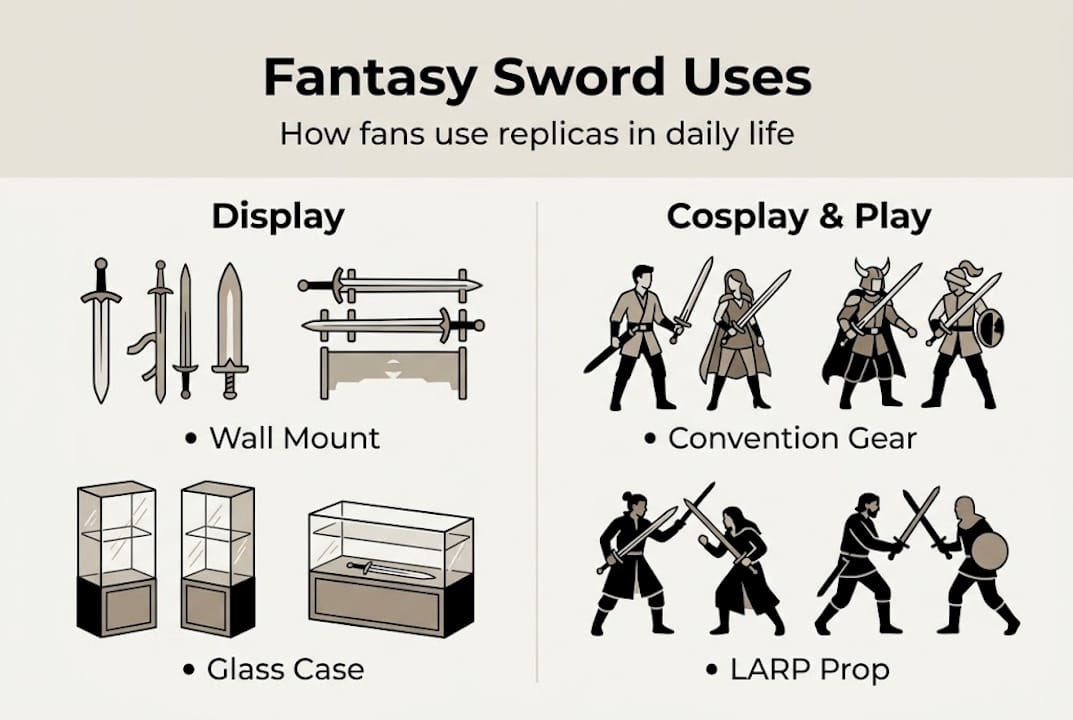
Here are the most common fandom uses for fantasy sword replicas:
- Cosplay: Carrying a character’s blade completes the look and signals deep fandom knowledge to fellow attendees.
- Home display: Wall-mounted or stand-displayed swords become conversation pieces and personal shrines to favorite stories.
- LARP (Live Action Role Play): Foam replicas allow participants to physically embody fantasy battles safely.
- Photography and content creation: Swords add dramatic visual weight to costume shoots and fan films.
- Gifting: A well-chosen replica makes a deeply personal gift for a fan who connects with a specific character.
Practical uses in fandom include cosplay with safe foam replicas, home display, LARP, and gifting, with fantasy swords focusing on aesthetics over combat function. That aesthetic focus is not a weakness. It is the point.
Pro Tip: Before bringing any replica sword to a convention, photograph it next to a ruler and review the event’s prop weapon policy. Most conventions require peace-bonding (securing the blade so it cannot be drawn), and some ban metal blades entirely. Knowing the rules in advance saves you from having your prop confiscated at the door.
At home, safe sword display practices matter more than most new collectors expect. Secure wall mounts, UV-filtering cases, and climate-controlled spaces protect your investment and keep the piece looking its best.
For a broader look at how the hobby intersects with craftsmanship, cosplay sword collecting explores how fans treat their replicas as genuine art objects rather than simple props.
As we’ve seen, fantasy swords are far more than static props. They move from myth to market and transform fan spaces.
A deeper look: What most fans miss about swords in fantasy fandom
Most conversations about fantasy swords focus on which blade is most powerful or which replica is most accurate. We think that misses the more interesting question: why do fans keep reinterpreting these swords long after the story ends?
Fandom does not just consume fantasy swords. It actively reshapes them. Fans create alternate-universe versions of famous blades, customize replicas with personal engravings, and build entire community identities around specific weapons. The sword stops being the creator’s property and becomes something shared and evolving.
“Chosen or soul-bound swords evolve with the user. Edge cases like cursed or reforged swords represent fandom’s embrace of imperfection, transformation, and shared story.”
There is also something powerful about broken or imperfect swords in fan culture. A cracked blade or a weapon reforged from pieces carries more emotional weight than a pristine one. It has history. Fans who customize their replicas to show battle damage or add personal symbols are not degrading the object. They are making it more meaningful.
The value of anime swords is not just in the steel or the license. It is in the story the owner brings to it. That is what separates a serious collector from someone who just bought a wall decoration.
Bring fantasy swords into your world
If this guide has shown you anything, it is that fantasy swords are not just objects. They are extensions of the stories and characters that shaped you as a fan. Whether you are building a display collection, preparing a cosplay, or searching for the perfect gift, the right replica connects you to something bigger than the blade itself.
At Propswords, we carry fantasy sword replicas inspired by the anime, movies, and fantasy worlds that matter most to collectors and cosplayers. From iconic anime blades to cinematic masterpieces, every piece is chosen for quality and detail. Check out our anime sword buying tips to find the right blade for your collection, with free shipping across the USA.
Frequently asked questions
What makes a sword iconic in fantasy fandom?
An iconic fantasy sword is deeply tied to its character’s journey, features a unique design, and symbolizes elements like power, destiny, or sacrifice. Guts’ Dragon Slayer and Ichigo’s Zangetsu are prime examples of blades that mirror personal growth and supernatural power.
Are fantasy sword replicas safe for cosplay events?
Yes, most cosplay swords are made of foam or lightweight materials specifically for safety, but always check convention rules before attending. Fantasy swords for cosplay focus on aesthetics and safety rather than combat function.
Why do collectors favor fantasy swords over historical types?
Most collectors value emotional connections to stories and characters from anime and movies more than historical accuracy. 70% of collectors prioritize that emotional bond when choosing a replica.
How much does a quality fantasy sword replica cost?
Prices range widely depending on materials and licensing. Replica sword prices run from around $30 for foam props to over $2,000 for licensed steel replicas with premium craftsmanship.
Recommended
- Understanding the role of swords in fantasy culture – propswords
- Fantasy Swords vs Historical Swords: What Collectors Need to Know – propswords
- Swords in Entertainment: Cultural Symbolism & Fandom – propswords
- Why swords are collectible: culture, craft, and fandom – propswords
- Fantasyland – 2000-reisen – Ihre Spezialisten für Urlaub mit Disney-Magie