Most anime-style katana replicas run a 70 to 73 cm blade with a roughly 103 cm overall length, wakizashi replicas land between 30 and 60 cm, and tantō stay under 30 cm. Oversized “anime” swords like buster blades or zanbato-style weapons ignore these norms entirely, sometimes scaling to the wielder’s own height. Pick your category first, then match the exact dimensions to how you plan to use the piece.
TL;DR:
- Most anime-style katana replicas feature a blade length around 70 to 73 cm, which balances well with an average adult’s height and arm length.
- The critical measurement for categorizing Japanese swords is nagasa, the straight-line blade length from tip to base, not the blade’s curve or overall length.
- Replica weights vary from about 1.0 to 1.4 kilograms for stainless steel models, while foam or resin versions are significantly lighter, affecting handling and display options.
- When scaling an anime sword, using character height and pixel measurements helps estimate realistic or exaggerated sizes, with a 5:1 blade-to-handle ratio maintaining proper proportions.
- Proper specs to ask for include nagasa, tsuka length, overall length, and balance point, as these determine how the sword feels, looks, and fits your use or display space.
Table of Contents
- What Are the Standard Japanese Sword Length Categories?
- What Are Common Replica Katana Dimensions and Weights?
- How Do You Scale an Anime Sword to a Real Replica Size?
- How Do You Choose the Right Sword Size for Your Needs?
- How Propswords Sizes and Specs Its Anime Sword Replicas
- The Size Obsession Misses What Actually Matters
- Sources
- FAQ
What Are the Standard Japanese Sword Length Categories?
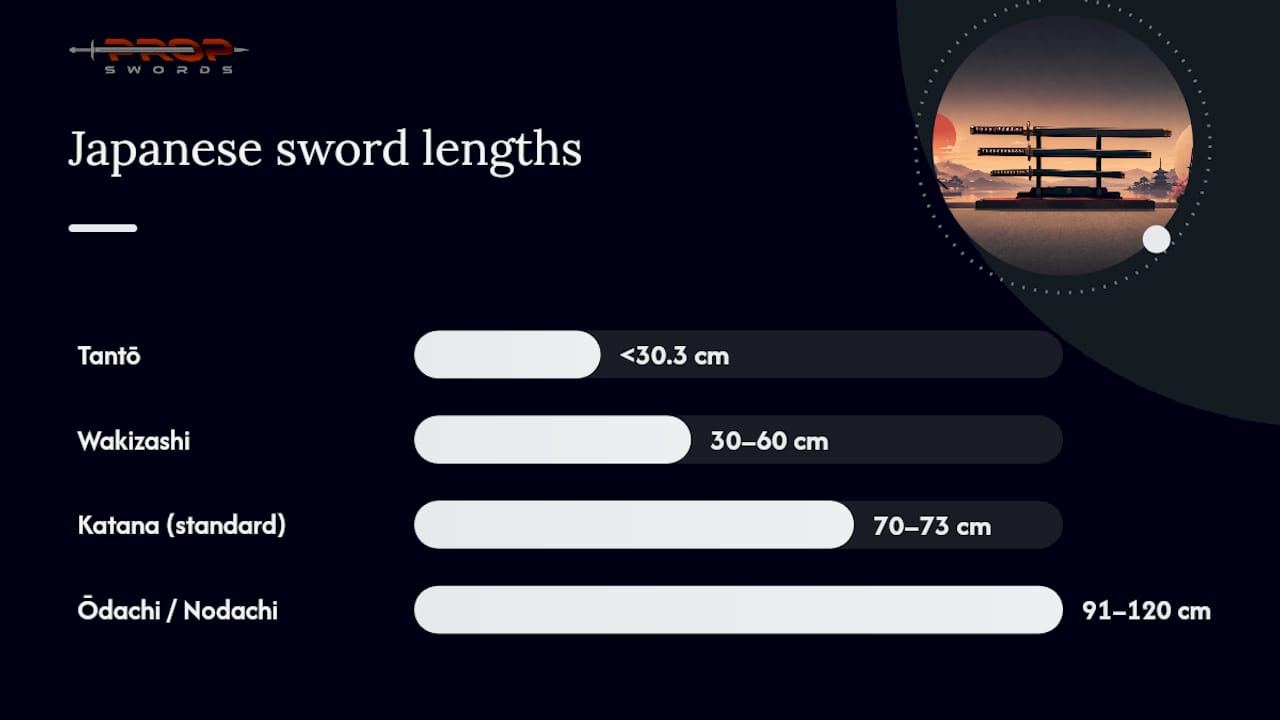
Japanese sword classification runs on a unit most Western collectors have never heard of: the shaku. One shaku equals roughly 30.3 cm, and it is the backbone of every traditional length category still used by makers and reference guides today, according to Japan Accents. Once you know the shaku, every category boundary snaps into place.
The measurement that actually matters is nagasa, the blade length measured in a straight line from the tip (kissaki) to the notch at the base (habaki), not the curve of the blade itself. Sellers and forums throw around “sword length” loosely, but nagasa is the number that determines which category a blade falls into, and it is the number you should ask about before buying a replica.
Here is how the categories break down, using the shaku conversions Japan Accents and the TOUKENZA nagasa classification guide both confirm:
- Tantō: under 1 shaku, or under about 30.3 cm (under 12 inches). These are dagger-length blades, common as a character’s backup weapon or a concealed blade in period-set anime.
- Wakizashi: 1 to 2 shaku, or roughly 30 to 60 cm (12 to 24 inches). Traditionally paired with a katana as a companion sword, and a popular choice for characters who fight in tight indoor spaces.
- Katana (uchigatana): 2 shaku or more, meaning 60 cm and up. In practice, almost every katana you will encounter, real or replica, sits in a tighter band than that minimum suggests.
- Ōdachi / nodachi: over 3 shaku, or beyond roughly 91 cm. These are the historical field swords that inspired most of anime’s oversized blade designs.
The “standard” katana blade length that shows up again and again in both antique swords and modern replicas is 70 to 73 cm, a range both Japan Accents and TOUKENZA point to as the practical center of the katana category. That is not a coincidence. A blade in that range balances well against an average adult’s height and arm length, which is exactly why swordsmiths converged on it centuries before anyone was designing a sword for a screen.
Historical katana lengths varied more than modern replicas suggest, though. Battlefield conditions, the wearer’s height, mounted versus foot combat, and even the era’s fashion all pushed nagasa up or down. A 16th-century katana made for a cavalry officer might run noticeably longer than a companion piece made for close indoor use. Anime borrows loosely from this variation, then exaggerates it for visual effect, which is why the on-screen katana in one series can look nothing like the one in another even though both are technically “katana.”
Nodachi and ōdachi occupy a strange middle ground in anime. These are real historical categories, not made-up designs, but their real-world lengths (typically 91 to 120 cm, occasionally longer) already sit close to what a lot of fans assume is “anime exaggeration.” When you see a nodachi-style weapon in a series that looks abnormally long, it might just be an accurate nodachi rather than a fictional stretch.
What Are Common Replica Katana Dimensions and Weights?
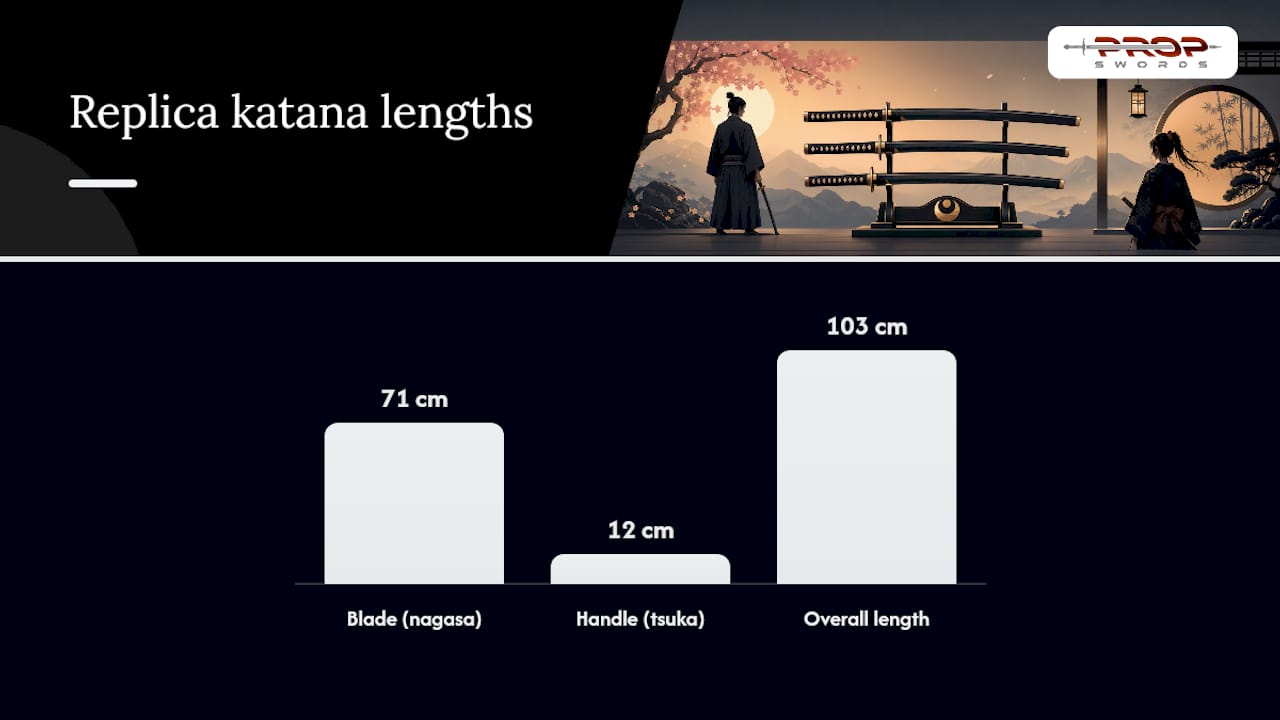
If you are shopping for a display or cosplay katana rather than researching history, here is the specification set that shows up across the replica market: a 71 cm blade, a 12 cm handle (tsuka), and an overall length near 103 cm, according to collector guides. Converted to inches, that is about a 28-inch blade, a 4.7 inch handle, and a 40.5 inch overall sword.
Pro Tip: Always ask for nagasa, tsuka length, and overall length as three separate numbers. A listing that only gives “overall length” can hide a stubby blade paired with an oversized handle, which throws off both the look and the balance.
Weight tells you almost as much as length does, and it swings hard depending on material:
- Stainless steel display blades: typically 1.0 to 1.4 kg (2.2 to 3.1 lbs) for a standard-proportioned katana replica, per the same collector data cited above.
- Carbon steel or functional-grade blades: often heavier and better balanced for actual movement, since they are built to handle real swing dynamics rather than just hang on a wall.
- Wood (bokken) or resin/foam versions: dramatically lighter, sometimes under 500 grams, and the go-to choice for cosplay events with weapon-check policies.
A standard display katana at 71 cm blade, 12 cm handle, and 103 cm overall typically weighs 1.0 to 1.4 kg, roughly the weight of a bag of sugar, distributed along a meter of steel or resin.
Material choice is a suitability decision, not just a durability one. Stainless steel holds an edge appearance well and photographs beautifully for display shelves, but it is heavier and less forgiving if you are wearing a costume for eight hours at a convention. Carbon steel is the pick for anyone doing actual practice cuts, but most retail replicas sold as “carbon steel” are decorative-grade and not tempered for real cutting. Resin and PU foam swords sacrifice the metallic look for weight you will not feel after three hours on your feet; for cosplay enthusiasts looking for unique accessories, the DIY creative sword hair stick offers a stylish, miniature sword-inspired touch for costumes (DIY creative sword hair stick — GothMarket).
Before you commit to a purchase, get four numbers from the seller, not one vague “length” figure. Blade length (nagasa), handle length (tsuka), overall length, and the balance point (the distance from the guard where the sword feels weight-neutral in the hand) together tell you whether a replica will look right, feel right, and photograph right. Propswords’ own buying tips for collectors and cosplayers walks through exactly which specs to request before you check out.
How Do You Scale an Anime Sword to a Real Replica Size?
Anime artists do not draw swords to a ruler. They draw them to the frame, the character’s silhouette, and whatever emotional weight the scene needs, which means “how big is that sword actually” is a question you answer with math, not a wiki lookup. Here is the method that gets you a workable estimate.
- Pick a stable reference in the same shot. Character height is the easiest anchor if the show has ever stated it (many character profiles do), but a doorframe, a torso width, or even a head-to-body ratio works if height is unknown.
- Measure both the reference and the sword in pixels on a still frame, using any image editor’s ruler tool or even a screenshot and a basic photo app’s crop dimensions.
- Build a ratio. Divide the sword’s pixel length by the reference’s pixel length, then multiply that ratio by the reference’s real-world size. If a character is 175 cm tall and the sword measures 1.4 times their height in the frame, you are looking at a 245 cm blade concept, before you factor in perspective distortion.
- Sanity-check against the 5:1 blade-to-handle ratio. Most replica makers and collectors treat roughly five parts blade to one part handle as the proportion that keeps a katana-style sword looking and handling correctly, a rule both the TOUKENZA guide and general collector practice back up. If your on-screen sword measures wildly outside that ratio, you are almost certainly looking at a BFS-style “Big Friendly Sword” design rather than a realistic katana, and your replica plan needs to account for that.
- Adjust the handle for usability, not just accuracy. An anime blade that scales to 150 cm cannot keep a 20 cm handle and remain wieldable. Realistic replica makers lengthen the tsuka and shift the balance point closer to the guard to keep an oversized piece from feeling like a crowbar in your hand.
Two examples make this concrete.
A realistically scaled katana: say a character stands 170 cm tall and their sword measures 0.43 times their height on screen. That gives you a 73 cm blade, which lands squarely in the standard katana range and needs no design compromise at all. Order it with a 12 to 15 cm handle and you have a proportionate, comfortable replica.
An oversized “anime” sword: think of the genre’s famous buster-blade designs, like Dragon Slayer or Tessaiga, where the blade can rival or exceed the wielder’s height. If your scaling math produces a 180 cm blade, a strict 5:1 ratio would call for a 36 cm handle, which is unusually long but not unreasonable for a two-handed grip. What changes is the balance point: makers typically move it closer to the guard and add weight-relief channels in the blade core so the piece is liftable for a photo pose rather than a genuine two-handed swing. Treat any blade over about 120 cm as a display-first commission unless the listing specifically states it is built and balanced for handling.
How Do You Choose the Right Sword Size for Your Needs?
Length is the number everyone asks about first, but it is the wrong number to optimize for on its own. Purpose should drive the decision before size does, because a sword that is technically “the right length” can still be the wrong sword if it does not match how you intend to use it.
Start with four questions:
- What is the primary use? Cosplay worn for hours needs different weight and balance than a piece that will sit on a wall mount forever.
- What is your height and reach? A 103 cm katana looks proportionate on someone 175 cm tall; the same sword can look and feel oversized on someone considerably shorter.
- Will you need to transport it? Convention weapon policies, airline checked-baggage rules, and venue restrictions often cap blade length or require peace-bonding, so check event rules before ordering anything over 90 cm.
- How much wall or shelf space do you actually have? A 103 cm overall sword needs roughly 110 cm of clear mounting length once you account for the stand or bracket hardware.
Proportion and balance matter more than raw length once you are past the “does it fit the room” question. A sword with correct 5:1 blade-to-handle proportions and a balance point close to the guard feels lighter in the hand than a longer sword with sloppy proportions, even at a shorter overall length. This is the detail most first-time buyers skip, and it is the one that determines whether a cosplay sword becomes a photo-only prop you set down after ten minutes or something you can actually carry through a convention hall.
For display, mount clearance is the detail people forget until the sword is already on the wall. A horizontal two-point mount needs the full overall length plus a few centimeters of bracket clearance on each end, while a vertical stand needs enough depth that the sword’s curve does not press against the wall. Eye-level or slightly above tends to show off the blade’s geometry better than a low mount, which foreshortens the view. Propswords’ collector’s guide to showcasing anime swords covers stand types and mounting height in more detail if you are setting up a permanent display.
How Propswords Sizes and Specs Its Anime Sword Replicas
Some reputed replica makers build their anime and movie-inspired replicas around the same measurement logic collectors already trust: nagasa, tsuka length, overall length, and balance point, specified up front rather than buried in a generic “length” field. That is the information a serious buyer needs before checkout, and it is the information worth asking for on any listing, from any seller.
Before you buy an anime-style sword, whether from Propswords or elsewhere, confirm these specs directly:
- Nagasa (blade length) in centimeters or inches, not a rounded “about” figure.
- Tsuka (handle) length, especially important if you plan to grip the sword two-handed for cosplay.
- Overall length, which determines both display footprint and transport logistics.
- Balance point distance from the guard, the single best predictor of how a sword will feel in an actual hand rather than just on a spec sheet.
- Material (stainless steel, carbon steel, or display-grade alloy), since this drives both weight and whether the piece is decorative-only or built to handle light practice use.
| Spec to confirm | Why it matters |
|---|---|
| Nagasa (blade length) | Determines sword category and on-screen accuracy |
| Tsuka (handle length) | Affects grip comfort and two-handed usability |
| Overall length | Drives both display footprint and venue/transport rules |
| Balance point | Predicts how heavy the sword feels in hand, regardless of total weight |
| Material | Sets weight range and whether it is display-only or practice-capable |
Propswords’ own checklist of what to consider before you buy walks through each of these in order, and the care basics guide covers how material choice affects long-term maintenance once the sword is on your wall or in your cosplay kit.
The Size Obsession Misses What Actually Matters
Everyone fixates on the blade-length number, and it is the least interesting measurement on the spec sheet. Two swords can share an identical 73 cm nagasa and feel like completely different objects in your hand, because one respects the 5:1 proportion and one does not. The conventional advice, “just check the length,” gets buyers a sword that looks right in a product photo and wrong the moment they pick it up.
What deserves more attention is balance point. It is the number sellers rarely volunteer and buyers rarely ask for, yet it predicts wearability better than weight or length combined. A heavier sword with the balance point near the guard can feel lighter than a lighter sword with mass concentrated toward the tip.
The oversized “anime-sized” swords get treated as a novelty category, but they deserve the most careful spec conversations of all. Scaling math from screen references only gets you a starting number. Whether that number becomes a wearable cosplay piece or a wall-only display piece depends entirely on how the maker handles the handle length and weight distribution, not on how faithfully the blade length matches the cartoon.
— Muhammad
Sources
- Japanese sword lengths — Japan Accents
- TOUKENZA: Nagasa length classification guide
- BFS — TVTropes
- The most iconic anime swords — GameRant
FAQ
What Are the Largest Swords in Anime?
Oversized “Big Friendly Sword” designs like Dragon Slayer and Tessaiga can scale to near or beyond the wielder’s own height, far exceeding the roughly 91 cm upper end of even the historical ōdachi category, as TVTropes’ BFS entry and GameRant’s roundup of iconic anime swords both illustrate.
What Are the Sizes of Japanese Swords?
Tantō run under 30.3 cm, wakizashi run 30 to 60 cm, and katana run 60 cm and up, with most katana blades centering around 70 to 73 cm; nodachi and ōdachi exceed roughly 91 cm, according to Japan Accents.
Which Is Longer, Kodachi or Wakizashi?
They overlap almost completely. A kodachi is essentially a short-bladed variant that falls within the same 30 to 60 cm wakizashi range, so neither is reliably longer than the other without checking the specific blade’s nagasa.
What Is the Standard Size of a Sword?
For katana specifically, the standard blade length most makers and antique examples converge on is 70 to 73 cm, with a 12 cm handle producing an overall length near 103 cm, a spec confirmed across both historical references and modern replica listings.
Ready to match a specific character’s blade to a replica you can actually display or wear? Browse Propswords’ top replica swords for pieces sized and specced using the same measurement standards covered here.
Recommended