Owning a sword is legal in all 50 states. The moment you carry one in public, though, you step into a patchwork of federal rules, state statutes, and city ordinances that can turn a lawful collector into a criminal defendant before the end of the block. No federal ban on sword ownership exists, but carrying and transporting swords are regulated at three distinct levels: federal constraints (TSA, federal buildings, customs), state statutes that typically govern swords under knife or dangerous-weapon language, and local ordinances that can be stricter than anything the state requires.
Three things to do right now:
- Keep any sword sheathed and secured whenever it leaves your home.
- Look up your state’s knife or dangerous-weapon statute and your destination city’s municipal code before carrying.
- When genuinely unsure, call your local police non-emergency line. It takes two minutes and can save you a felony charge.
Key Takeaways
Owning a sword is legal across all 50 states, but carrying one in public is governed by state statutes, local ordinances, and federal rules that vary sharply by location.
| Point | Details |
|---|---|
| Ownership is universally legal | No federal ban exists; complications arise the moment a sword leaves your home. |
| State laws vary dramatically | Texas permits carry with location restrictions (5.5-inch threshold); Illinois ties legality to intent and location under 720 ILCS 5/24-1. |
| TSA rules are clear | Swords are banned from carry-on bags; checked baggage requires a sheath and secure packaging. |
| Location upgrades charges | Carrying in schools, courthouses, or transit can convert a misdemeanor into a felony in states like Illinois. |
| Propswords replica option | Display-grade replicas from Propswords ship free in the USA and avoid the sharpened-blade scrutiny that functional swords attract. |
Table of Contents
- ## How U.S. sword laws work at the federal level
- How state statutes and city codes treat swords
- Where you cannot carry a sword, regardless of state law
- How to transport a sword safely and legally
- Using a sword for self-defense — the legal risks are serious
- Why statutes and courts treat swords inconsistently
- A compliance checklist before you carry or transport a sword
- What responsible collecting actually looks like
- Propswords has the replica swords collectors actually want
- Sources
- FAQ
## How U.S. sword laws work at the federal level
Federal law touches swords in three narrow but critical areas: air travel, customs and import, and federal property.
Air travel (TSA). Swords are prohibited in carry-on bags and permitted in checked baggage only when sheathed or securely wrapped. TSA officers retain discretion to prohibit any item they judge a security risk, even in checked bags. Check your airline’s own policy as well — some carriers add restrictions beyond TSA minimums.
Customs and import. Bringing a sword into the United States from abroad requires a customs declaration. CBP guidance covers edged items, and certain blades may be subject to import controls depending on country of origin or blade type. Declare the item; failing to do so risks confiscation and fines.
Federal property. Federal buildings, courthouses, military installations, and national park visitor centers often prohibit weapons regardless of what state law permits. Federal criminal statutes can apply independently of any state charge.
How state statutes and city codes treat swords
States almost never write a statute that says “swords.” Instead, they fold swords into broader knife or dangerous-weapon language, which is exactly why there is no bright-line legal distinction between a sword and a knife under most U.S. statutes. The American Knife & Tool Institute (AKTI) maintains state-by-state summaries that are the most practical starting point for owners, though AKTI itself notes these are a starting point, not legal advice.
Three dominant statutory patterns:
- Blade-length thresholds. Many states set a carry limit, commonly 3–5.5 inches, above which a blade requires a permit or is outright prohibited in public.
- Dangerous/deadly weapon classification. Some states skip length entirely and ask whether the item is designed or intended to cause harm. A sword almost always qualifies.
- Location-based prohibitions. Even permissive states restrict carry in schools, government buildings, bars, and transit systems.
Preemption matters more than most owners realize. In preemption states, state law overrides local ordinances, so a single state rule governs everywhere. In non-preemption states, a city can write rules far stricter than the state’s. You can be fully legal under state law and criminally exposed the moment you cross a city line.
Texas: the permissive model. Texas House Bill 1935, effective September 1, 2017, removed most blade-length restrictions. Blades over 5.5 inches are now “location-restricted knives” rather than automatically illegal. You can carry a sword in most public spaces in Texas; you just cannot bring it into schools, polling places, courts, bars, amusement parks, or places of worship without permission.

Illinois: the intent-focused model. Illinois law under 720 ILCS 5/24-1 allows ownership but treats swords as potential dangerous or deadly weapons. Carrying with unlawful intent, or carrying in a prohibited location, can elevate the offense from a Class A misdemeanor to a Class 4 felony. Chicago’s municipal code adds a further layer, restricting blades beyond what state law requires.
Seattle: the municipal-code model. Seattle Ordinance 12A.14.080, analyzed in the Zaitzeff v. Seattle case via AKTI’s coverage, defines dangerous knives as any fixed-blade or blade over 3.5 inches. A sword carried openly in Seattle can trigger a weapons charge even if Washington state law would otherwise permit it.
| State/Jurisdiction | Statutory approach | Blade threshold | Preemption |
|---|---|---|---|
| Texas | Location-restricted knife framework (HB 1935) | 5.5 inches for restricted locations | State preempts local |
| Illinois | Intent-based dangerous weapon (720 ILCS 5/24-1) | No fixed length; intent governs | No full preemption; Chicago adds restrictions |
| Seattle, WA | Municipal fixed-blade ordinance | 3.5 inches | City rule stricter than state |
Where you cannot carry a sword, regardless of state law
Some locations are off-limits under state statute, local ordinance, or federal law in virtually every jurisdiction. Carrying in these places typically upgrades the offense level.
- Schools and school zones. Most states treat weapon possession near schools as an automatic felony enhancement. Illinois, for example, converts a standard weapons charge into a Class 4 felony when the offense occurs within 1,000 feet of a school.
- Government buildings and courthouses. Federal and state law both apply here. A sword that is legal to carry on the street becomes a federal offense inside a courthouse.
- Bars and establishments that serve alcohol. Texas explicitly lists these as restricted locations under HB 1935. Illinois and many other states follow the same logic.
- Public transit systems. Subway systems, buses, and train stations in major cities frequently ban bladed weapons by ordinance.
- Airports (beyond security). TSA rules govern the checkpoint; local airport authority rules often extend restrictions to the entire terminal.
- Sporting arenas and large public events. Venue policy and local ordinance typically converge to prohibit blades of any length.
- Places of worship. Several states, including Texas, list these as location-restricted zones.
Under Illinois law (720 ILCS 5/24-1), carrying a sword in a prohibited location — a school, courthouse, or public transit system — can convert what would otherwise be a Class A misdemeanor (up to one year in jail and a $2,500 fine) into a Class 4 felony (one to three years in prison). Location is not a minor detail; it is the variable that determines whether you face a fine or a prison sentence.
How to transport a sword safely and legally
Getting a sword from your home to a convention, a range, or another state requires deliberate planning. Improvised transport is where most legal problems start.
Car travel:
- Sheathe or wrap the blade completely before placing it in the vehicle.
- Secure it in the trunk or a locked case, out of arm’s reach from the driver’s seat.
- Travel directly to your destination. Stopping at unrelated locations with a sword in the car can complicate a “lawful transport” defense.
- Keep any documentation (purchase receipt, event registration) in the glove compartment.
Event and convention travel:
- Contact the event organizer before you arrive. Most conventions require “peace-tying” (securing the sword so it cannot be drawn) and prohibit functional blades entirely.
- Carry your event ticket or registration confirmation. It establishes why you have the sword and where you are going.
- Follow the venue’s specific rules even if local law would otherwise permit carry.
Air travel checklist:
- Use a hard-sided, lockable case inside your checked bag.
- Wrap the blade in foam or a padded sheath.
- Declare the item at check-in if the airline requires it.
- Screenshot the TSA checked-baggage guidance and keep it accessible.
- Check the airline’s own policy — some carriers impose stricter rules than TSA.
Shipping: Major carriers have their own policies for bladed weapons. Check the carrier’s terms before shipping, pack blades in rigid, clearly labeled containers, and use a service that requires adult signature on delivery.
Pro Tip: For cross-state travel by car, research the knife and dangerous-weapon statutes for every state you will drive through, not just your origin and destination. A sword legal in Texas may trigger a charge in a state you pass through on the way.
Using a sword for self-defense — the legal risks are serious
Carrying a sword specifically for self-defense is one of the riskiest legal positions you can take. Legal analysts note that defensive use is rarely a protected category; the moment you frame a sword as a defensive weapon, prosecutors shift the analysis toward unlawful intent and brandishing, even in states with permissive carry rules.
Why intent changes everything:
- Mere possession of a sheathed sword in a lawful location is generally not a crime.
- Displaying or drawing a sword in a threatening manner, even without contact, typically constitutes brandishing or menacing under state law.
- Claiming self-defense after brandishing does not erase the brandishing charge. Courts treat the act and the claimed justification separately.
Typical prosecutorial outcomes when a sword is used defensively:
- Brandishing or menacing charge (misdemeanor in most states, felony if in a prohibited location).
- Unlawful use of a weapon charge under statutes like Illinois’s 720 ILCS 5/24-1.
- Aggravated assault if the sword is pointed at or swung toward another person.
- Enhanced penalties if the incident occurs near a school, in a bar, or on public transit.
A sword is a deadly weapon under virtually every state’s legal definition. Using one in a confrontation — even defensibly — will be treated by law enforcement and prosecutors as a deadly-force incident, with all the legal scrutiny that follows. The proportionality standard that applies to firearms applies here too, and courts are not lenient about large blades.
Scenario example: You carry a katana openly in a Texas park (legal under HB 1935 in that location). A verbal argument escalates and you place your hand on the hilt. That gesture alone can constitute threatening display, converting your lawful possession into a criminal act. Context and behavior, not just the sword’s presence, determine the charge.
Why statutes and courts treat swords inconsistently
The core problem is definitional. Regulators apply knife and dangerous-weapon statutes to swords, and those statutes were written with pocket knives and switchblades in mind, not katanas or longswords. The result is genuine legal ambiguity.
Where the gaps appear:
- Statutes that define “knife” by blade length may technically cover a sword but were never drafted with one in mind.
- “Dangerous weapon” definitions are broad enough to sweep in almost anything, giving prosecutors wide discretion.
- Sword canes (a blade concealed in a walking stick) are singled out by name in several state statutes as prohibited concealed weapons, even in states that otherwise permit open carry of swords.
- Courts have interpreted the same ordinance language differently across jurisdictions, as the Zaitzeff v. Seattle litigation illustrates.
Preemption compounds the confusion. In states without preemption, a municipal ordinance can define “dangerous knife” more broadly than the state statute, and the city rule governs within city limits. This is why an owner can be legal in one neighborhood and criminally exposed across the street.
Pro Tip: Always read the actual statutory text, not a blog summary. Look up the definitions section of your state’s knife or weapons statute and your city’s municipal code. The definition of “knife,” “dangerous weapon,” or “deadly weapon” in that text determines whether your sword falls under the law — not the sword’s common name.
A compliance checklist before you carry or transport a sword
Follow these steps in order before taking a sword outside your home.
- Identify your state’s preemption status. Check AKTI’s state knife law summaries to see whether state law overrides local ordinances or whether your city can impose stricter rules.
- Read the municipal code for your destination city. Search “[city name] municipal code weapons” and look for definitions of “dangerous weapon,” “knife,” or “bladed weapon.” Seattle’s 3.5-inch rule is a good example of what you might find.
- Sheathe and secure the sword before it leaves your home. A blade in a locked case in the trunk is far easier to defend legally than one on the back seat.
- Check venue and event rules. Email or call the organizer. Get confirmation in writing if possible.
- For air travel, follow TSA checked-baggage rules. Hard-sided case, sheathed blade, airline policy confirmed.
- For cross-state travel, check every state you pass through. Use AKTI summaries as a starting point, then verify against the state statute.
- Keep documentation with you. Purchase receipt, event ticket, or registration confirmation establishes context and purpose.
Quick reference resources:
- AKTI state knife law summaries for state-by-state starting points.
- TSA checked-baggage guidance for air travel rules.
- CBP import guidance for swords purchased abroad.
- LegalClarity’s federal and state overview for a plain-language legal summary.
Pro Tip: Store digital copies of your event waivers, tickets, and purchase receipts in a phone folder labeled “sword travel docs.” If you are stopped, you can show context immediately without fumbling through a bag.
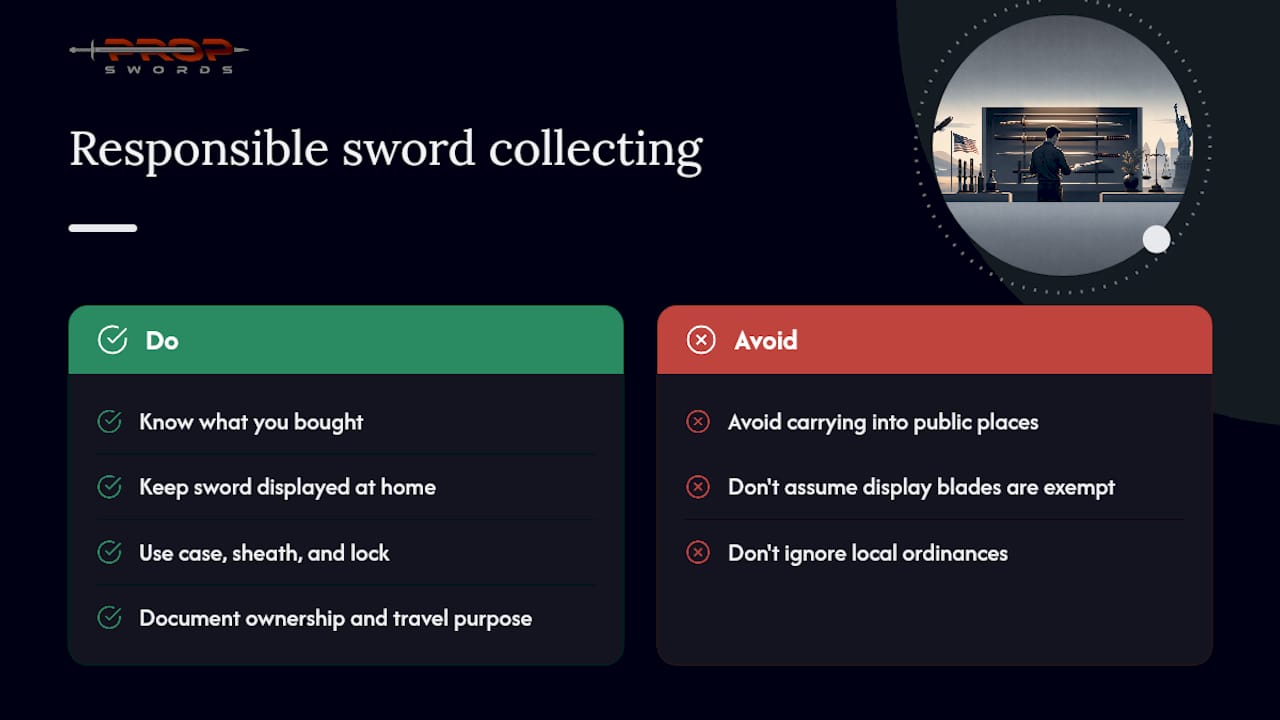
What responsible collecting actually looks like
There is a gap between what the law technically permits and what responsible ownership looks like in practice. Most collectors I talk to understand this intuitively: a sword on a wall mount in a well-lit display case is a conversation piece. The same sword carried to a grocery store, even sheathed, is a police call waiting to happen.
The advice worth giving at the point of sale is simple: know what you bought, know where it can go, and treat transport as a deliberate act rather than an afterthought. A prop sword versus a functional blade is a meaningful legal distinction in some jurisdictions, but blunt or display-only swords are not automatically exempt from weapon classifications. Seattle’s ordinance does not care whether your blade is sharp. Neither does a nervous bystander who calls 911.
The collectors who never have legal problems are the ones who pack their swords like they pack firearms: case, sheath, locked, documented, and transported with a clear purpose. That standard is not excessive caution. It is the practical floor for anyone who takes the hobby seriously.
Propswords has the replica swords collectors actually want
Collectors who want display-quality replicas without the legal exposure of functional blades have a cleaner path than most realize. Propswords carries replica swords built for display, cosplay, and collection — anime, movie, Viking, and historical designs that deliver the visual impact of the real thing without the sharpened-edge complications that attract the most scrutiny under local ordinances.

Every order ships free within the USA, and the product range covers everything from stainless steel display pieces to Damascus-finish collector items. If you are buying a sword to hang on a wall, bring to a convention, or give as a gift, a well-made replica is the practical choice: it looks right, ships cleanly, and keeps you on the right side of the blade-length rules that trip up functional-sword owners. Browse the 2026 replica sword collection and check the buyer’s guide for display and transport recommendations. This article is general information, not legal advice. Verify current rules with your state statute, local municipal code, or a qualified attorney before carrying any sword in public.
Sources
These are the primary references used in this article. Each covers a distinct part of the legal picture.
- Are Swords Illegal in the US? Federal and State Laws – LegalClarity
- Swords and Sensibilities | American Knife and Tool Institute
- Tsa
- Can you legally carry a sword in Texas? Knife laws explained
- CBP customer service import help
This article is general information, not a substitute for advice from a qualified lawyer. Consult a qualified legal professional about your own circumstances before acting on anything here.
FAQ
Can you legally carry a sword in public in the USA?
It depends entirely on your state and city. Ownership is legal everywhere, but public carry is regulated by state knife or dangerous-weapon statutes and local ordinances. Texas permits it in most locations under HB 1935; Illinois restricts it based on intent and location under 720 ILCS 5/24-1.
What states allow you to carry a sword openly?
Texas is the clearest permissive example after HB 1935 (2017), which allows open carry of blades over 5.5 inches in most public spaces with specific location exceptions. Other states vary widely; check AKTI’s state knife law summaries for your state’s current rules.
Can you legally defend yourself with a sword in the USA?
Legally, it is extremely risky. Displaying or drawing a sword in a confrontation typically triggers brandishing or menacing charges, and prosecutors treat it as a deadly-force incident regardless of your intent. Even in permissive states, the self-defense framing shifts the legal analysis toward unlawful use.
Is it illegal to carry a blunt or replica sword?
A blunt or display sword is not automatically exempt. Some ordinances, including Seattle’s fixed-blade rule, classify any fixed blade over 3.5 inches as a dangerous weapon regardless of sharpness. Check your local municipal code before carrying any sword, functional or not.
Do TSA rules apply to replica swords?
Yes. The TSA treats replica swords the same as functional ones: prohibited in carry-on bags, permitted in checked baggage when sheathed or securely wrapped. Always verify the airline’s own policy as well, since carriers can impose stricter rules than TSA minimums.
Recommended